
Starting a business in Europe while living in the United States might seem like a major obstacle. Many assume that opportunities disappear the moment they are based outside the European Union. However, that assumption is far from accurate. Non-EU residents can successfully register and operate businesses within the EU.
Even more encouraging, it is possible to set up a business in as little as three working days. The costs are also surprisingly low, often under 100 euros (around 110 US dollars). The European Union has simplified its processes, making company formation faster and more affordable than most expect.
Now is a great time to explore how this can be done step by step.
Can a Non-EU Resident Register a Company in the EU?
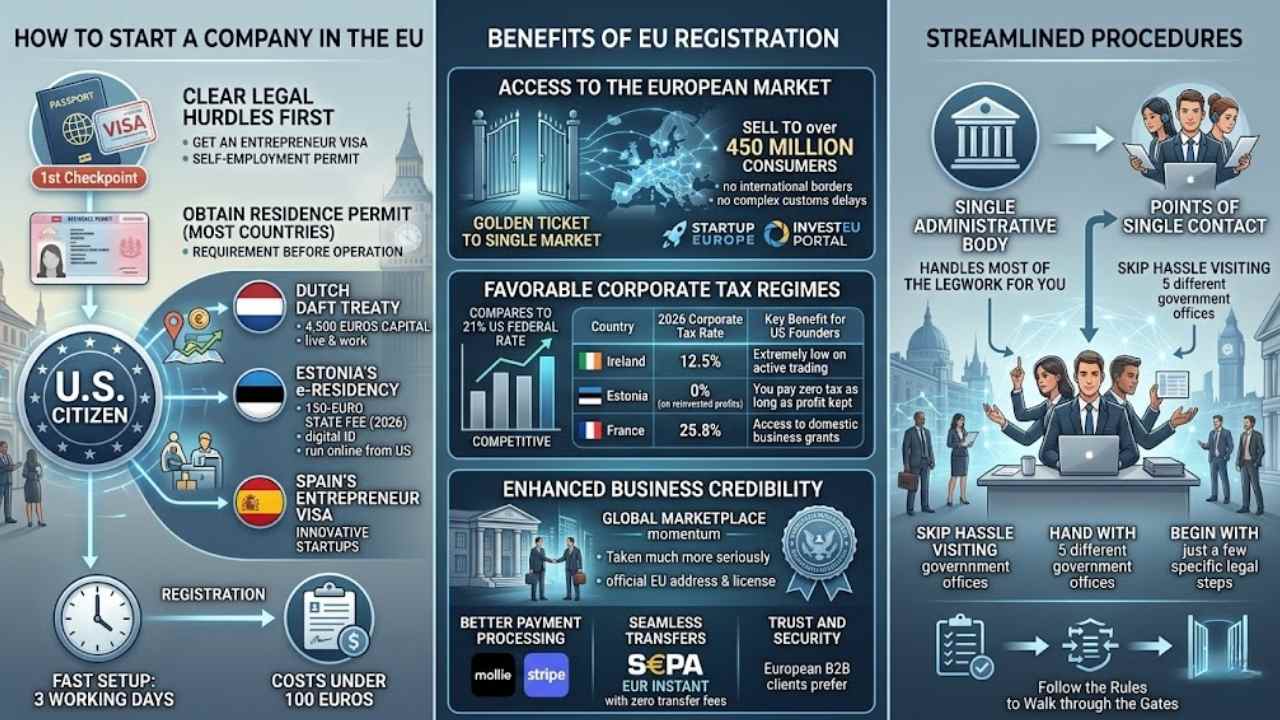
Non-EU nationals can absolutely register a company in the EU. You just need to clear a few specific legal hurdles first. Getting an entrepreneur visa or a self-employment permit stands as your very first checkpoint.
Most countries require non-EU citizens to obtain a residence permit before they can legally operate a business in Europe. If you are a US citizen, you actually have some incredible fast-track options available to you.
- The Dutch DAFT Treaty: The Dutch American Friendship Treaty allows US entrepreneurs to live and work in the Netherlands by depositing just 4,500 euros in business capital.
- Estonia’s e-Residency: For a 150-euro state fee in 2026, you can get a government-issued digital ID to run an Estonian company entirely online from the US.
- Spain’s Entrepreneur Visa: This program offers a straightforward path for innovative startups that bring economic value to Spain.
Once you secure your right to operate, the actual setup is incredibly fast. You can set up a business in the EU in no more than 3 working days through streamlined procedures. Registration costs stay under 100 euros for non-residents in many jurisdictions.
The European single market opens doors for entrepreneurs worldwide, but non-EU residents must follow the rules to walk through them.
All your paperwork flows through a single administrative body. Points of single contact in each country handle most of the legwork for you. This means you skip the hassle of visiting five different government offices just to get started.
Benefits of Registering a Company in the EU as a Non-Resident
Registering your company in the EU gives your business serious momentum. You tap into one of the largest consumer markets on the planet. You also gain access to favorable corporate tax systems, double tax treaties, and strong legal frameworks.
Access to the European market
Opening your company in the EU gives you a golden ticket to the European single market. You instantly gain the ability to sell to over 450 million consumers across multiple countries. You reach this massive customer base without crossing international borders or dealing with complex customs delays.
The EU single market removes trade barriers between member states. Your products and services move freely from Germany to France, or from Spain to Italy. No tariffs block your path, and no quotas limit your growth.
Small and medium enterprises, or SMEs, thrive in this open environment. The Startup Europe initiative actively supports new businesses entering this market. You can even find funding options and resources through programs like the InvestEU portal.
Favorable corporate tax regimes
The EU offers some of the most competitive corporate income tax rates globally. This makes it a highly profitable move for US founders looking to expand. Many EU countries provide favorable taxation systems that easily beat the standard US federal corporate rate of 21 percent.
| Country | 2026 Corporate Tax Rate | Key Benefit for US Founders |
|---|---|---|
| Ireland | 12.5% | Extremely low rate on active trading income. |
| Estonia | 0% (on reinvested profits) | You pay zero tax as long as you keep the money in the business. |
| France | 25.8% | Grants access to massive domestic business grants and tech subsidies. |
Your business banking and accounting become simpler because you report to one authority. Corporate tax obligations remain highly manageable when you work with legal and financial experts who understand these specific taxation systems.
Enhanced business credibility
A company registered in the EU carries real weight in the global marketplace. Clients, partners, and investors take you much more seriously when your business has an official EU legal address and a proper business licence.
- Better Payment Processing: EU registration allows you to open merchant accounts with top-tier providers like Stripe and Mollie without high cross-border fees.
- Seamless Transfers: You gain access to the SEPA network, allowing you to send and receive euros instantly with zero transfer fees.
- Trust and Security: European B2B clients strongly prefer working with locally registered entities to simplify their own compliance.
Non-residents who complete the registration process demonstrate a serious commitment to their business. You prove that you followed proper legal compliance procedures and met all local standards. Your brand transforms from a foreign side project into a legitimate, trusted enterprise.
Key Legal Requirements Before Registering
You must understand the specific residency rules and visa laws before you file any paperwork. Proper preparation here saves you months of delays.
Residency and visa considerations
Getting a residence permit is your first big step. Non-EU citizens must obtain this approval before they can legally start a business in Europe. An entrepreneur visa opens doors for non-residents who want to build companies across the EU.
- Submit a detailed business plan: Most countries require this document to prove your business is viable.
- Show proof of funds: You must prove you can support yourself financially during the startup phase.
- Meet stay requirements: You must demonstrate you will live in the country for more than a specified period to maintain your visa.
For US citizens, the Dutch American Friendship Treaty is a standout option. It requires a very low capital investment of just 4,500 euros, and the approval process currently takes only 4 to 6 weeks. Your local government contact person can guide you through the specific paperwork required for these treaties.
Compliance with EU regulations
EU regulations create a strict framework that applies to all companies operating within Europe. This applies equally to you, regardless of where you currently live. You must follow these rules to operate legally and avoid severe penalties.
The European Union sets high standards for data protection, labor laws, and financial reporting. The General Data Protection Regulation (GDPR) is the most critical rule you will face. If your business collects any data from EU citizens, you must comply with strict privacy laws. Fines for ignoring GDPR can reach up to 4 percent of your global revenue.
Professional legal guidance helps non-residents handle EU rules safely. These experts review your incorporation documents and ensure your data practices meet all requirements before you launch. Working with professionals cuts through the confusion and keeps your startup safe.
Business Structures Available to Non-EU Residents
You can pick from several distinct business setups. Each one has its own perks and drawbacks that shape how you run your company and manage your risk.
Limited Liability Company (LLC)
A Limited Liability Company, or LLC, gives non-residents the smartest way to manage company formations in the EU. This structure protects your personal money if the business faces a lawsuit or debt. Your personal US assets stay completely safe and separate from what the European company owes.
- Germany (GmbH): Highly respected, but requires a 25,000 euro minimum share capital.
- France (SARL): Very accessible for startups, requiring only 1 euro in minimum share capital.
- Estonia (OÜ): Perfect for digital nomads, requiring a low minimum capital of just 0.01 euros per shareholder.
Setting up an LLC in the EU takes no more than three working days through streamlined procedures. Registration costs stay under 100 euros for most non-residents in many countries. A single administrative body handles all your paperwork, which cuts through red tape fast.
Branch or subsidiary
You can set up either a branch or a subsidiary if you already run a successful US company. A branch operates as a direct extension of your parent company. It does not have its own legal identity. Because of this, your US parent company remains fully liable for all branch activities and debts in Europe.
Subsidiaries function very differently. They operate as separate legal entities with their own liability protection. This structure effectively shields your US parent company from any financial risks taken by the European office. Both options work well for non-EU residents, but they carry completely different tax reporting rules.
Branches typically report their earnings straight through the parent company’s tax system. Subsidiaries file separate tax returns locally and maintain completely independent financial records. You will want to choose a subsidiary if you want maximum legal protection for your home business.
Sole proprietorship
A sole proprietorship is the absolute simplest business structure you can pick as a non-EU resident. You own and run the business entirely by yourself. You have no partners or shareholders to consult. This structure works great if you want to start very small and keep your admin tasks light.
The paperwork is minimal, and costs stay incredibly low. You make every single business decision. Most non-residents can set up a sole proprietorship in just a few working days through streamlined procedures. Registration costs typically stay under 100 euros, making this a very budget-friendly launch option.
However, operating as a sole proprietor means you carry unlimited personal liability. If the business incurs debt, creditors can come after your personal bank accounts. It is also historically much harder to open a business bank account as a non-resident sole proprietor compared to an LLC owner.
Steps to Register a Company in the EU as a Non-Resident
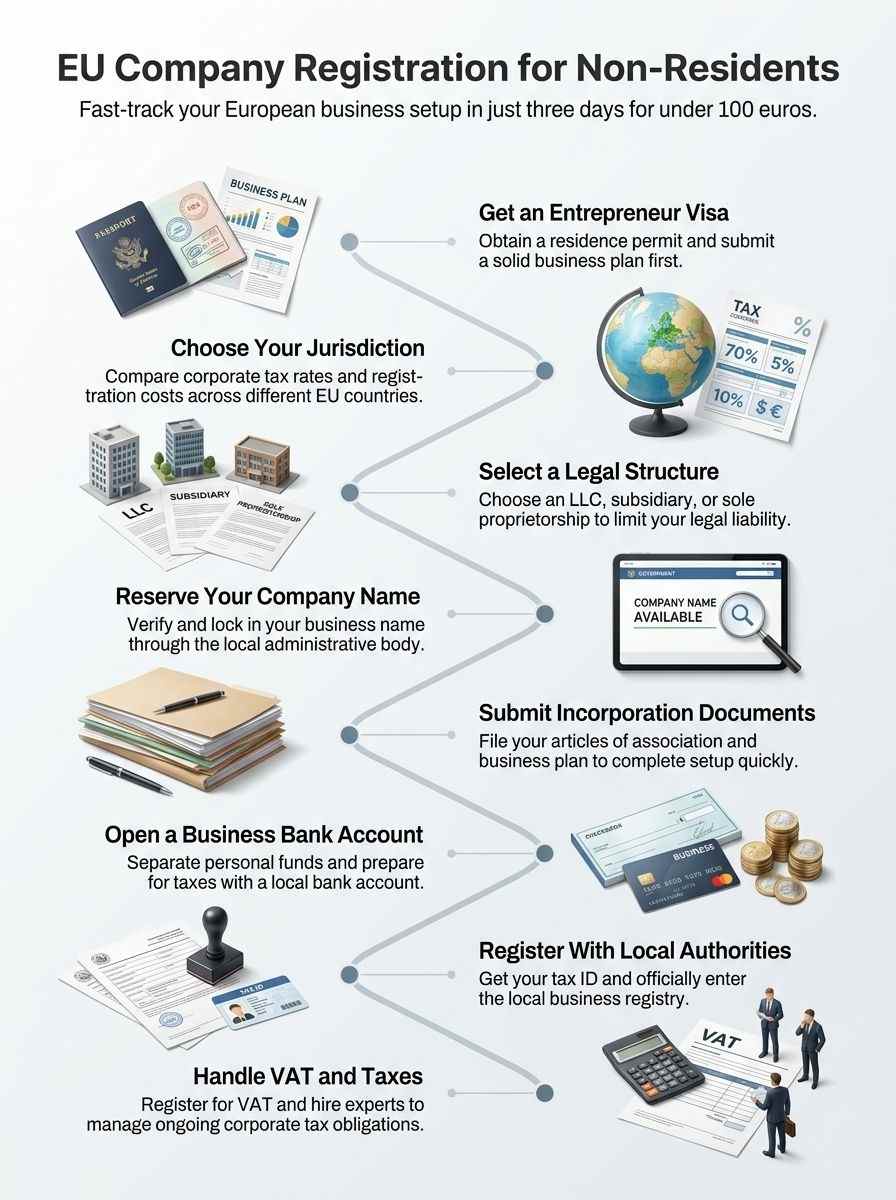
Getting your company set up in the EU takes focus, but you can easily break it down into simple steps. You will pick your country, choose your business type, and file the right papers.
Choose a jurisdiction
Your choice of location makes or breaks your EU business setup. Each country offers entirely different tax rates, registration costs, and cultural business rules.
- Ireland: The top choice for US tech startups due to its English-speaking workforce and 12.5 percent tax rate.
- The Netherlands: The best option for US sole proprietors utilizing the DAFT visa.
- Estonia: The absolute winner for digital nomads who want to manage everything remotely via e-Residency.
Research what each jurisdiction demands from non-residents before you commit your capital. Some countries require an entrepreneur visa with a full business plan. Professional legal guidance helps you match your specific business goals with the perfect location.
Select a legal structure
Picking the right business structure shapes your entire future in Europe. Non-EU residents can choose from several options, but an LLC is usually the safest bet. It shields your personal assets from business debts and gives you instant credibility with local clients.
Your choice dictates how you pay taxes and what legal responsibilities you carry. Think about your current business size, your five-year growth plans, and your risk comfort level before deciding. If you go with an LLC, you will file incorporation documents and register with local authorities very quickly.
Reserve your company name
You make your first impression with your company name. You must pick a name that works well in your chosen EU country and does not infringe on local trademarks. Most nations let you check name availability through a single administrative body.
Search the local e-business register to see if your desired name is taken. For example, in France, you will search the INPI database. Reserving your name locks it in place. You typically get between 30 and 90 days of protection to complete your full registration.
Prepare and submit incorporation documents
You need to gather several key papers before you submit anything to the European authorities. These documents include your articles of association, proof of identity, proof of address, and your business plan.
A pro-tip I always share with US founders is to prepare for the Apostille process. European governments will not accept standard US state documents without this specific international authentication.
- Step 1: Obtain a certified copy of your documents from your US state (like Articles of Organization).
- Step 2: Submit those documents to your state’s Secretary of State office.
- Step 3: Pay the fee to receive a Hague Convention Apostille stamp, which legally validates the document for EU use.
Submit your completed and apostilled documents to the appropriate government office in your chosen country. Setting up a business in the EU takes no more than three working days through streamlined procedures once your paperwork is perfect.
Open a business bank account
A business bank account strictly separates your personal money from your company funds. This separation protects your corporate veil and makes tax season much simpler. For non-residents, digital neo-banks have completely revolutionized this step in 2026.
| Neo-Bank | Best Feature for Non-Residents | Pricing Note |
|---|---|---|
| Wise Business | Provides local account details in over 8 currencies, including US Dollars and Euros. | No monthly subscription fee for the basic account. |
| Revolut Business | Excellent for teams needing multiple corporate expense cards and strict spending limits. | Tiered monthly pricing based on your feature needs. |
| Qonto | Built specifically for EU-registered companies with fantastic accounting integrations. | Requires a monthly subscription but simplifies EU tax reporting. |
Banks across the EU understand that non-residents face extra hurdles. Having a digital account ready before you start operations keeps your cash flow clean and organized from day one.
You must formally register your company with the local municipal authorities in your chosen EU country. This critical step comes right after you open your business bank account and finalize your incorporation documents. You will visit the municipal office or use their online portal to file your final registration paperwork.
Local authorities will then assign your company a local tax identification number. They will officially record you in the business registry. The cost stays low, typically under one hundred euros, which keeps your startup expenses perfectly manageable.
Financial and Tax Considerations for Non-Residents
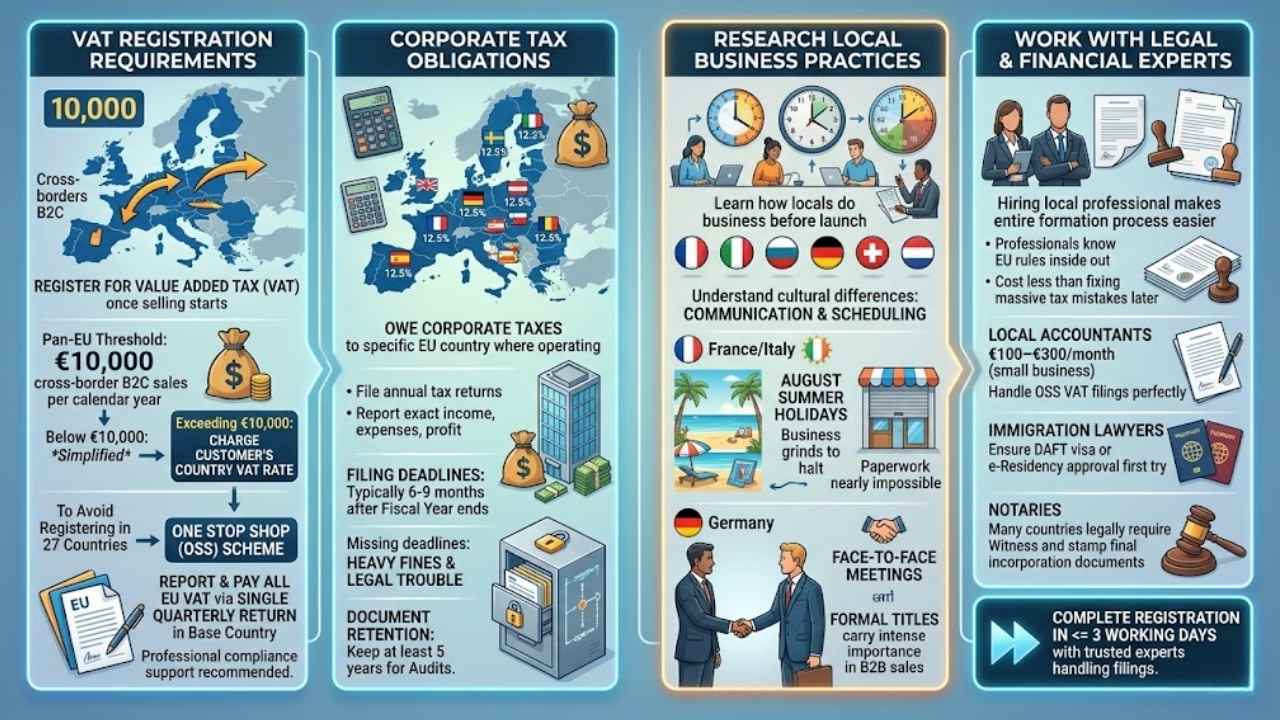
Money matters require strict attention when you run a company from outside the EU. Tax rules, VAT registration, and corporate obligations demand your focus from day one.
VAT registration requirements
You need to register for Value Added Tax (VAT) once your company starts selling in the EU. Your VAT obligations change based on where your customers live and what exactly you sell. The EU simplified this significantly for cross-border sellers.
The 10,000 euro pan-EU threshold is the magic number. Once your cross-border B2C sales exceed 10,000 euros in a calendar year, you must charge the VAT rate of your customer’s specific country.
To avoid registering for VAT in 27 different countries, you can use the One Stop Shop (OSS) scheme. The OSS allows you to report and pay all your EU VAT through a single quarterly return in your base country. Professional compliance support services help you set up OSS reporting correctly.
Corporate tax obligations
Your company owes corporate taxes to the specific EU country where it operates. Most EU nations tax corporate profits at rates between 12.5 percent and 30 percent. You must file annual tax returns with local tax authorities to report your exact income, expenses, and profit.
Missing tax deadlines brings heavy financial fines and legal trouble. Most European countries require you to file your annual return within six to nine months after your fiscal year ends. You must keep your financial documents backed up and secure for at least five years to satisfy audit requirements.
Tips for a Smooth Registration Process
Getting expert help cuts through the red tape and saves you months of intense frustration. You want knowledgeable people in your corner who speak the local language.
Research local business practices
Every country in the EU plays by its own distinct rules. You must learn how locals do business before you launch your product. Spend time understanding the cultural differences in communication and scheduling.
For instance, if you incorporate in France or Italy, you must know that business grinds to a halt during the August summer holidays. Getting government paperwork approved during that month is nearly impossible. In Germany, face-to-face meetings and formal titles carry intense importance during B2B sales.
Work with legal and financial experts
Hiring a local professional makes the entire formation process much easier. These professionals know the EU rules inside and out. Getting help from professionals costs far less than fixing massive tax mistakes later.
- Local Accountants: A good EU accountant usually costs between 100 and 300 euros a month for a small business. They handle your OSS VAT filings perfectly.
- Immigration Lawyers: They ensure your DAFT visa or e-Residency application gets approved on the very first try.
- Notaries: Many EU countries legally require a registered notary to witness and stamp your final incorporation documents.
You complete your registration in no more than 3 working days when trusted experts handle the filings for you.
Final Thoughts
You now know that non-EU residents can successfully complete a company registration in the EU within three working days. You can keep your initial filing costs under 100 euros. The entire procedure often flows through a single administrative body. This setup makes the process incredibly efficient for US founders.
Getting a residence permit or entrepreneur visa is your first major action step. After that, you will choose your business structure, pick the right country, and prepare your incorporation documents.
Opening a digital business bank account and registering with local authorities will officially put you on the map. Professional legal experts and financial advisors stand ready to guide you through your tax obligations.
Take action today by researching the specific rules in your target EU country. Connect with experienced local advisors to protect your investment. Thousands of non-residents have already built thriving enterprises across Europe. Your success story could easily be next.