You’ve probably pictured it a dozen times. You’re sipping coffee on a terrace in San Miguel de Allende or watching the waves in Puerto Vallarta, and you think, “I could actually live here.” But then the practical questions hit you. How do you legally stay longer than a standard six-month vacation? Getting a Mexico Temporary Resident Visa might seem complicated, but it’s actually one of the most accessible residency programs in the world.
This visa is the bridge between being a tourist and becoming a local. It grants you legal status for up to four years, opening doors to banking, healthcare, and even a local job.
I’m going to walk you through the exact steps, costs, and requirements for 2026 so you can stop dreaming and start packing.
What is a Temporary Resident Visa?
Think of the Temporary Resident Visa (Residente Temporal) as a provisional status for foreigners who want to stay in Mexico longer than 180 days but aren’t quite ready for, or eligible for, permanent residency. This permit is designed for people who have financial independence outside of Mexico. It is the go-to choice for digital nomads, retirees not yet ready for “Permanent” status, and remote workers.
Unlike a tourist permit that restricts you to travel, this visa grants you a unique legal status. You get a CURP (a government ID number similar to a Social Security number), which allows you to function like a resident.
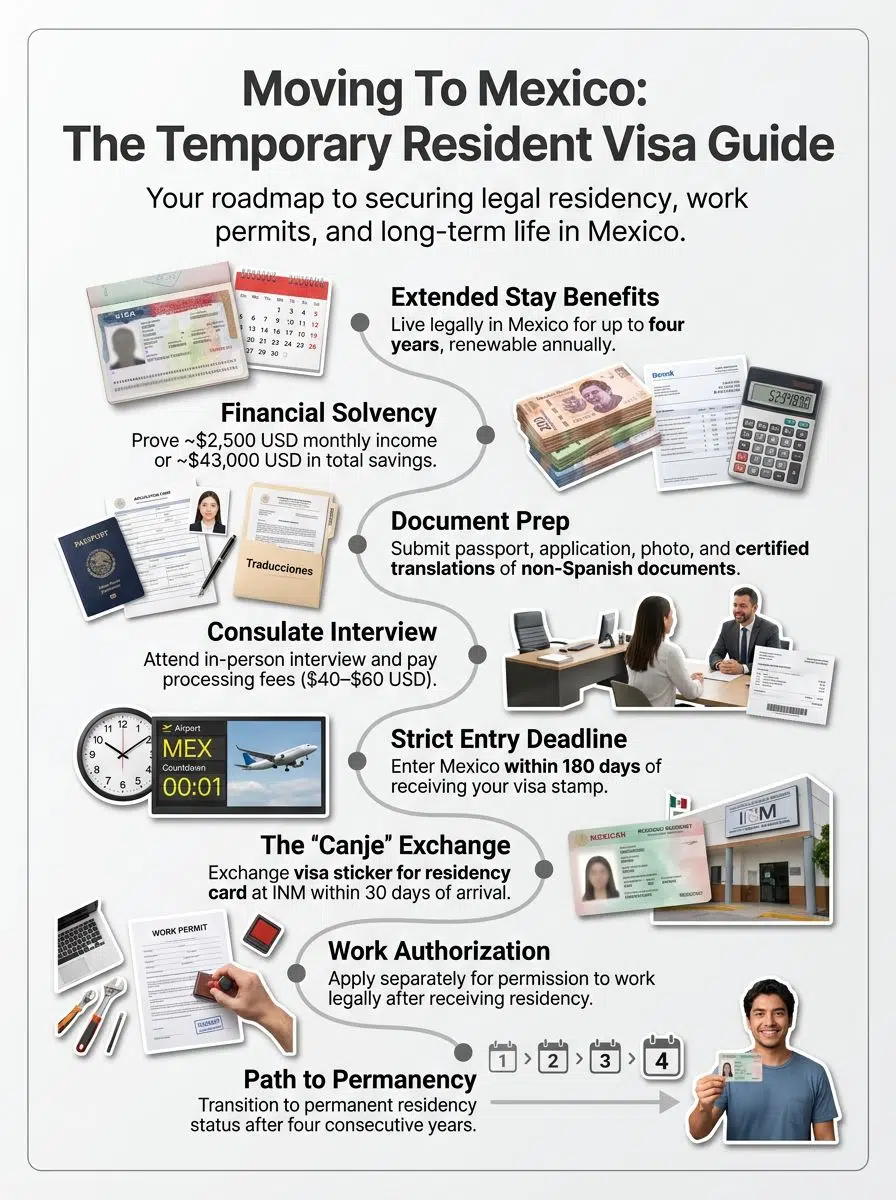
It acts like a probationary period. You start with a one-year card. If you enjoy your new life, you can renew it for three more years. After four consecutive years, you can transition to permanent residency without needing to prove your financials again.
Key Benefits of a Temporary Resident Visa
Getting this visa does more than just keep you legal; it makes daily life significantly easier and cheaper.
Live in Mexico for up to 4 years
Tourists live on a countdown clock, always watching for that 180-day limit. As a temporary resident, you can stay for one full year initially.
After that first year, you can renew for up to three additional years. You don’t have to leave the country to renew, either; you handle it all at your local immigration office (INM) right in Mexico. This stability lets you sign long-term leases, which are often 30-50% cheaper than vacation rentals.
A common misconception is that this visa automatically lets you work for a Mexican company. It doesn’t, but it does make getting permission much easier.
If you find a Mexican employer who wants to hire you, they simply give you an offer letter. You then apply for a work permit at the INM. This is different from working remotely for a US or Canadian company, which you can do freely without special permission since your income comes from abroad.
Access to public healthcare and services
Once you have your residency card, you can enroll in the IMSS (Instituto Mexicano del Seguro Social). This is Mexico’s public healthcare system.
For an annual fee, typically between $400 and $800 USD, depending on your age group, you get full medical coverage. This includes surgeries, medications, and hospital stays. While many expats prefer private insurance for faster service, having IMSS as a safety net is a massive financial relief.
You can also legally import your foreign-plated car for the entire duration of your residency, unlike tourists who strictly face the 180-day limit.
Pathway to permanent residency

This is the long game. If you maintain your temporary residency for four consecutive years, you become eligible for permanent residency.
This switch is often automatic if you apply on time. You won’t need to meet the high monthly income requirements again; you simply convert your status based on “time served.” It’s the easiest path to staying in Mexico forever.
Requirements for a Temporary Resident Visa
The requirements for 2026 have shifted slightly due to inflation and changes in the UMA (Unit of Measure and Update), which is the financial baseline Mexico uses for these calculations.
Valid passport and completed application form
You need a passport valid for at least six months, but I recommend having at least one year left on it. If your passport expires while you are a resident, it creates extra paperwork.
You will fill out a visa application form, which is standard across all consulates. Print it double-sided. Most consulates require you to fill it out by hand in blue or black ink.
Proof of financial solvency
This is where most people get stuck. You must prove you can support yourself without working in Mexico. Consulates use two main metrics: Monthly Income or Savings. You only need to meet one of these, not both.
| Requirement Type | Approximate Amount (2026 Estimate) | Timeframe Required |
|---|---|---|
| Monthly Income | $4,300 – $4,500 USD / month | Last 6 months (stamped pay stubs/statements) |
| Savings / Investments | $73,000 – $75,000 USD total balance | Last 12 months (average monthly balance) |
A Critical Note on “Consulate Shopping”: These numbers fluctuate because they are based on the exchange rate and the UMA. Some consulates, like those in Houston or Los Angeles, may require higher amounts than smaller consulates like McAllen or Las Vegas. Always check the specific PDF or website of the consulate where you plan to apply.
Passport-sized photograph
Do not bring a standard US passport photo. Mexico requires a specific “infantile” size (2.5 cm x 3 cm) or sometimes a standard passport size, but with strict rules: no glasses, no earrings, no smiling, and your forehead must be uncovered.
Go to a professional studio and ask specifically for “Mexican Visa” specifications. Drugstore photo counters often get this wrong.
Official translations of non-Spanish documents
If your bank statements or marriage certificates are in English, you might get lucky, but don’t count on it. Many consulates now demand certified translations.
For example, if you are applying with a spouse to lower your financial requirement (using the “Economic Dependents” route), your marriage certificate typically needs an Apostille and a translation. Check your specific consulate’s “Requirements” page before your appointment.
Application Process
The process is a two-step journey: Step one happens in your home country (the visa), and step two happens in Mexico (the residency card).
Step 1: Complete the application form
Download the form from the specific consulate’s website. It asks for basic data: your parents’ names, your marital status, and your current address.
Keep your answers consistent. If you say you are “Single” on the form but show a joint bank account with a partner, the officer will ask questions.
Step 2: Submit supporting documents to a Mexican consulate
You cannot just walk in. You must book an appointment through “MiConsulado,” the Mexican government’s online booking system.
Appointments open in blocks, often on the first day of the month, and vanish within hours. If you can’t find a slot, try checking specifically on Thursday afternoons or look for consulates in less populated cities.
Step 3: Attend an interview and pay the visa fees
The interview is usually short, about 10 to 15 minutes. The officer will ask simple questions: “Why do you want to live in Mexico?” and “How do you earn your money?” Answer honestly. “I work remotely” or “I am retired and love the culture” are perfectly acceptable answers.
You will pay the visa fee, which is roughly $53 USD (subject to change in 2026). Most consulates accept cash or credit cards, but having exact cash is always safer.
Step 4: Enter Mexico and exchange the visa for a residency card
Once approved, they will paste a visa sticker into your passport. This sticker is valid for one single entry and expires in 180 days.
You must travel to Mexico before that sticker expires. When you land, you are not done. You have merely started the clock for the most important step: The “Canje.”
Post-Approval Steps in Mexico
This is the part where many people make costly mistakes. That sticker in your passport is not your residency; it is just permission to come and get it.
Enter Mexico within 180 days of visa approval
When you arrive at a Mexican airport or border crossing, do not use the automated e-gates. You must see an immigration officer. Show them your visa sticker and clearly say, “Canje” (Exchange). They need to mark your digital entry form (FMMD) as “Canje” or “Resident” for 30 days, not as a tourist for 180 days.
If they mark you as a tourist by mistake, you cannot process your residency, and you will have to leave the country and start over.
Exchange visa for a residency card at an INM office within 30 days
Once you are in Mexico, the clock is tight. You have exactly 30 calendar days to start the process at the INM (National Migration Institute).
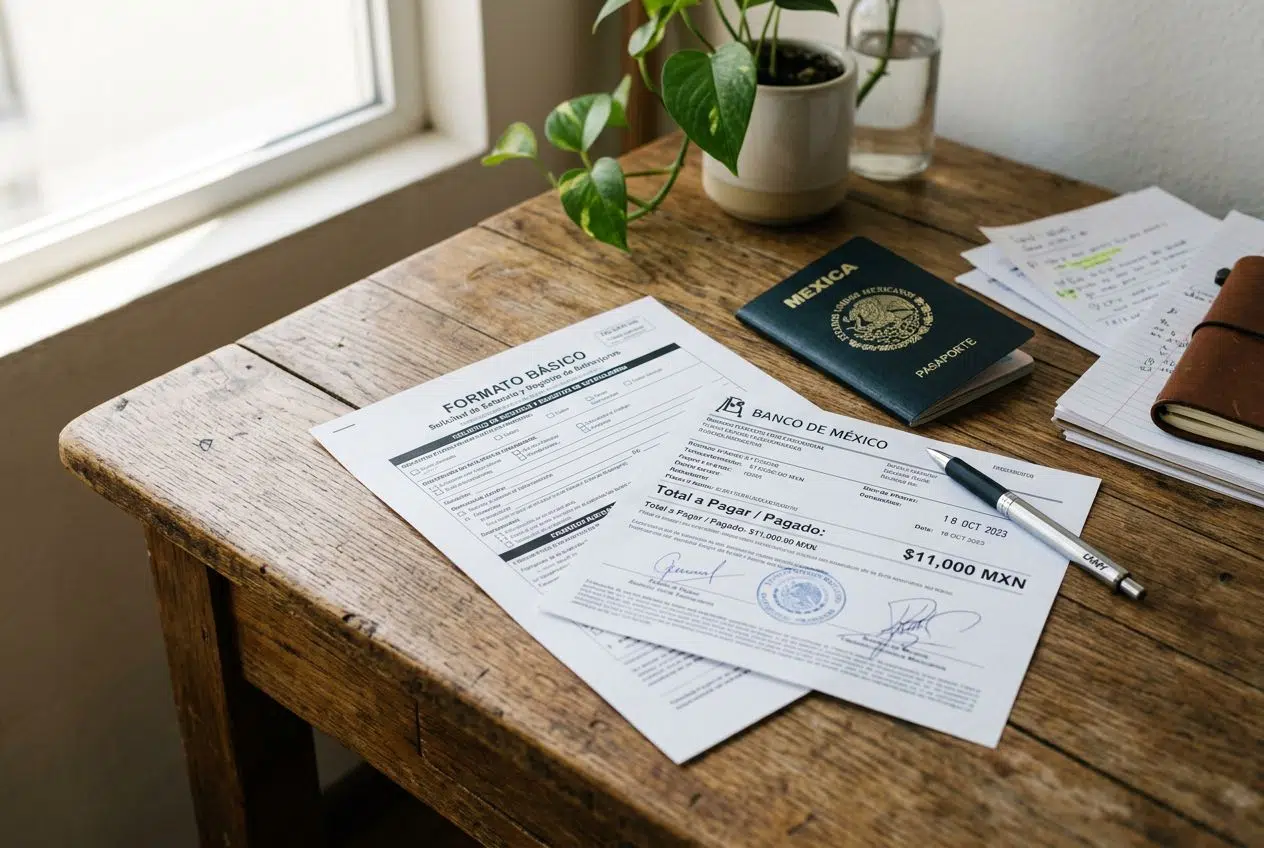
- The Form: You will fill out a “Formato Básico” online, print it, and bring it to the office.
- The Fees: You will pay roughly $11,000 MXN (about $550-$600 USD) for the one-year card. You cannot pay this at the immigration office; you must pay it at a bank and bring the receipt.
- The Appointment: Go early. INM offices in cities like Playa del Carmen or Mexico City often have lines starting at 6:00 AM.
Tips for a Successful Application
Success often comes down to preparation rather than luck. Here are the insider details that prevent rejection.
Practical Suggestions for Visa Applicants
Treat your consulate appointment like a job interview. Dress neatly, business casual is best. Officers have total discretion to deny you if they feel you aren’t serious or respectful.
Also, print 12 months of bank statements, even if they only ask for six. If one month looks unclear, having the extra history can save your application.
Prepare original and stamped financial documents
Online printouts are often rejected. Ask your bank to stamp and sign your statements. If your bank refuses (many US banks do), ask for a formal “Bank Letter” on letterhead that summarizes your monthly deposits and current balance.
Ensure official translations for non-Spanish documents
If you have a document that is crucial to your case, like a pension letter or a legal settlement proving income, get it translated by a certified translator. Simple Google Translations are not accepted for legal documents.
Begin the application process at least one month in advance
Do not book your flight to Mexico until you have the visa sticker in your hand. Consulates can delay, systems can go down, and background checks can take time. Give yourself a buffer.
Duration and Renewal of the Visa
Once you have that plastic card, you are a legal resident. But you need to watch the calendar.
Initial 1-year validity
Your first card will almost always be valid for one year only. It doesn’t matter if you have a million dollars in the bank; you start with one year.
Renewable for up to 3 additional years
30 days before your card expires, you can apply for renewal. You can choose to renew for one, two, or three years at once. Most people choose the three-year renewal to lock in the fees and avoid the paperwork hassle for a while. After completing four years total, you become a permanent resident.
Common Challenges and How to Overcome Them
We’ve listed some of the most common challenges and how to overcome them below.
Financial documentation issues
The most common rejection reason is “inconsistent income.” If you are a freelancer and your income varies wildly, $8,000 one month, $1,000 the next, consulates may deny you.
The Fix: Use the “Savings” route if your monthly income is unstable. Showing a solid block of savings (approx $74,000 USD) is often safer than volatile monthly earnings.
Language barriers and translations
INM agents in Mexico rarely speak English. The forms are in Spanish.
The Fix: Bring a Spanish-speaking friend or hire a “Facilitator” (Gestor). These locals charge a fee to wait in line for you, check your paperwork, and translate during the appointment. For many, it is worth every penny to avoid the stress.
Mexican bureaucracy moves at its own pace. The system often goes offline. Rules can change depending on which agent you get.
The Fix: Patience is your best tool. Bring a book, water, and a portable charger to your appointments. If you get a “No” from one agent for a minor issue, try to fix it and come back the next day; you might get a different agent who says “Yes.”
Final Words
Moving to Mexico is a big step, but the Temporary Resident Visa is the tool that makes it possible. By securing this status, you aren’t just a visitor anymore; you are building a life with rights, protections, and a clear path to the future. It allows you to slow down, stop counting days, and truly immerse yourself in the culture.
So, gather those bank statements, book that appointment, and get ready. Your new life south of the border is waiting for you.