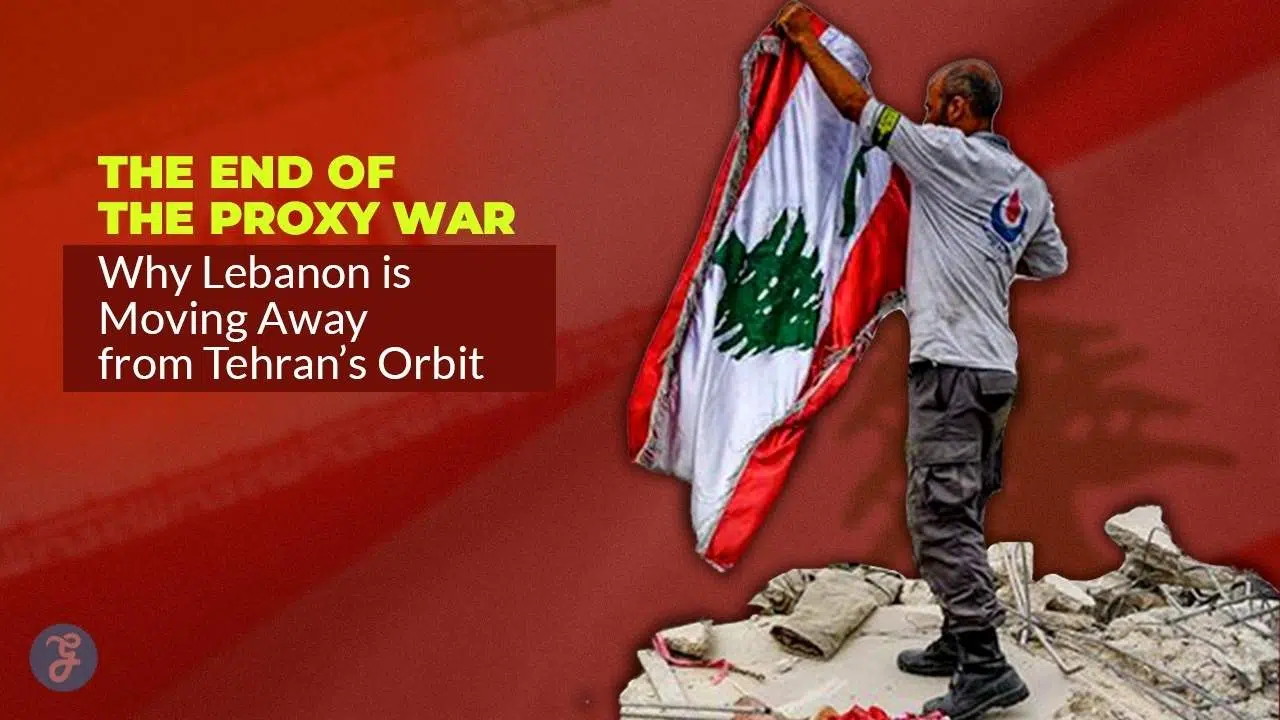
The end of Iranian influence in Lebanon didn’t begin with a summit or a ceasefire; it began when the money stopped showing up. For decades, the unspoken contract in Beirut’s southern suburbs was simple: loyalty in exchange for stability. But walk through Dahiyeh today, and the air is thick with a different kind of tension. There are no Iranian construction crews repairing the bomb sites. The local fighter, once the neighborhood kingpin, is holding an IOU instead of a paycheck.
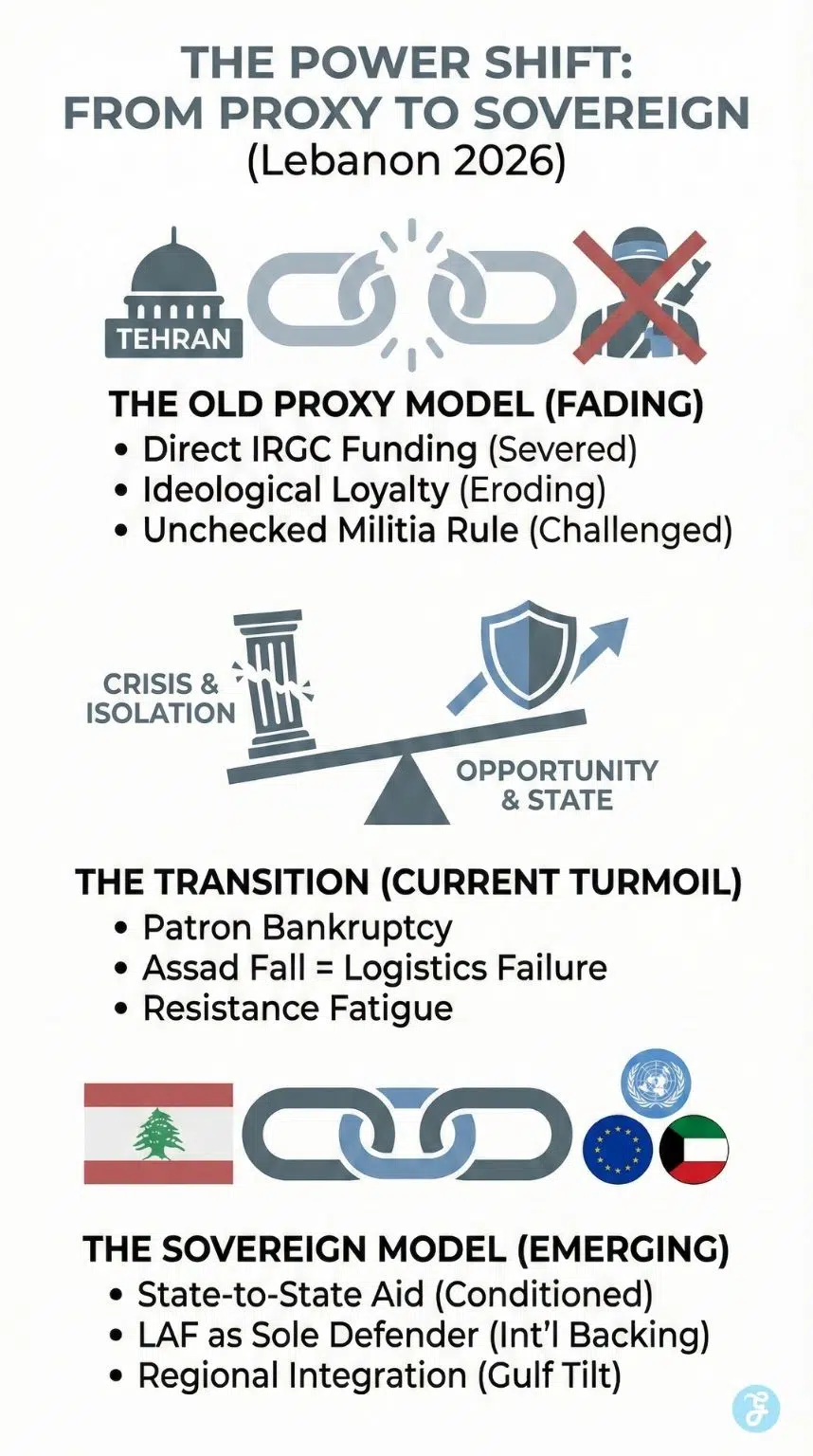
The “Axis of Resistance” is collapsing not just because of missiles, but because the checkbook that sustained it is finally empty. We are witnessing the death rattles of the proxy era. The “Land Bridge” that once stretched from Tehran to the Mediterranean has been shattered. The “Checkbook Diplomacy” that bought influence is over. Lebanon is drifting away from Tehran’s orbit not because its politicians have suddenly found their courage, but because the gravity of the Iranian sun has simply ceased to exist.
This op-ed will provide an in-depth, comprehensive analysis of this seismic shift, examining the military, economic, and geopolitical factors that are forcing Lebanon to finally break free.
The Geopolitical Earthquake: The Fall of the Land Bridge
To understand why 2026 is different from 2006 or even 2024, one must look east, across the Anti-Lebanon Mountains. The single most decisive factor in Hezbollah’s decline is not Israeli airstrikes, but the fall of the Bashar al-Assad regime on December 8, 2024.
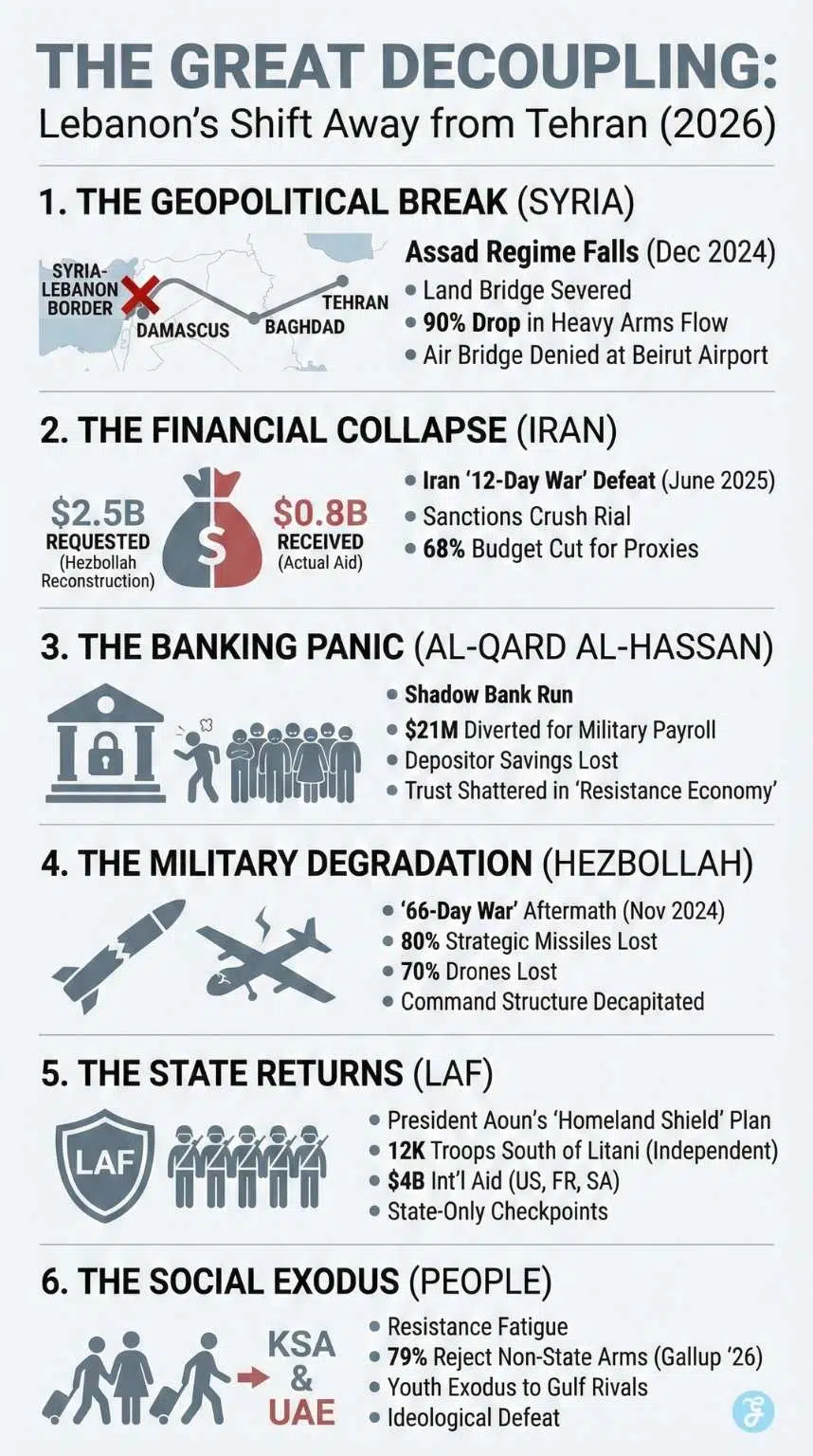
For thirty years, Syria was the strategic depth of the “Resistance.” It was the logistical superhighway that allowed the Islamic Revolutionary Guard Corps (IRGC) to truck ballistic missiles, heavy artillery, and anti-aircraft systems directly from Baghdad to the Beqaa Valley. As long as Assad sat in Damascus, Hezbollah was never truly besieged. It could always retreat, resupply, and regroup across an open border.
That era ended abruptly. The new transitional government in Damascus, led by Ahmed al-Sharaa, has fundamentally realigned Syria’s foreign policy. Motivated by a desperate need for international reconstruction funds and a deep-seated hostility toward the Iranian militias that once occupied their cities, the new Syrian leadership has closed the “Land Bridge.”
The Logistics of Strangulation
The impact of this closure cannot be overstated. Intelligence reports from January 2026 indicate that the flow of heavy weaponry to Hezbollah has dropped by over 90%.
- The Border Blockade: The Masnaa Border Crossing, once a sieve for IRGC logistics, is now monitored by a joint task force of the reformed Syrian Army and international observers.
- The Air Bridge Failure: Attempting to bypass the land route, Iran tried to establish an air bridge directly to Beirut Rafic Hariri International Airport in early 2025. This was immediately thwarted when the Lebanese Armed Forces (LAF), backed by threats of Israeli interception, refused landing rights to Mahan Air cargo flights.
Hezbollah is now an island. It is fighting with a finite stockpile of weapons that it cannot replenish. Every rocket fired is a rocket lost forever. This logistical strangulation has forced a change in military doctrine: from an aggressive posture of “deterrence” to a desperate defensive crouch. The organization knows that a prolonged conflict would leave it literally disarmed, not by treaty, but by attrition.
The Economics of Abandonment: When the Patron Goes Broke
Ideology may inspire men to fight, but logistics and salaries keep armies in the field. For decades, Hezbollah operated as a state-within-a-state, providing social services, schools, hospitals, and monthly stipends in fresh US dollars, insulating its base from the Lebanese economic collapse. This “Social Safety Net” was entirely funded by Tehran.
But in 2026, the patron is broke. The “12-Day War” between Israel and Iran in June 2025 was a catastrophe for the Iranian economy. The destruction of key oil export terminals on Kharg Island, combined with the “Maximum Pressure 2.0” sanctions regime re-imposed by the West, has sent the Iranian Rial into freefall.
The “Billion Dollar” Shortfall
Leaked internal communiques from the Hezbollah Shura Council, cited by regional intelligence sources, paint a grim picture of the organization’s finances:
- The Request: Following the devastation of the “Support War” (2023-2024), Hezbollah leadership requested an emergency injection of $2.5 billion for 2025-2026 to fund reconstruction and compensation for families of the slain.
- The Reality: Tehran provided less than $800 million.
The consequences are visible on the ground. For the first time, Hezbollah fighters are seeing their salaries cut or paid in worthless local currency. The “Martyrs Foundation,” which guarantees lifetime support for the families of fallen fighters, has begun issuing IOUs. In the Shiite villages of the South, where loyalty was often cemented by financial stability, the mood has turned from defiance to bitterness.
The narrative has shifted: “We gave our sons for the Supreme Leader, and he cannot even spare the funds to fix our roofs.”
This economic abandonment is the wedge that is driving the Shiite community away from Iran. They are realizing that in the eyes of Tehran, they are not partners, but disposable assets, cheap fodder for a war Iran is no longer willing to pay for.
The Run on the Shadow Bank: The Fall of Al-Qard Al-Hassan
If the cut in Iranian funding was a macro-economic blow, the collapse of Al-Qard Al-Hassan (AQAH) was the micro-economic earthquake that shattered the trust of the average household. For decades, AQAH served as the “Bank of the Resistance,” a sanctioned, interest-free financial fortress where the Shiite community deposited its life savings, in gold and cash, to avoid the paralysis of the formal Lebanese banking sector. It operated on a simple premise: The Party is more solvent than the State.
That premise collapsed in late 2025. Following the US Treasury’s aggressive targeting of AQAH’s “shadow accounts” and the destruction of thirty branches during the war, a panic set in. But the breaking point wasn’t the bombs; it was the betrayal.
In May 2025, diplomatic sources revealed that a US embassy tracking unit suspected AQAH had diverted $21 million in depositor funds directly to Hezbollah’s military wing to cover emergency payrolls for fighters. When depositors went to retrieve their savings in the Dahiyeh branches, they were turned away or offered “deferred payment” vouchers. The subsequent attempt to rebrand the institution as “Joud”, a supposedly commercial entity for gold-based lending, failed to stop the bleeding.
The psychological impact of this “bank run” cannot be overstated. For the shopkeeper in Nabatieh or the widow in Baalbek, this wasn’t just a financial loss; it was a violation of a sacred trust. The organization that claimed to protect their dignity had looted their savings to save itself.
The “Hollow Army”: A Post-Mortem of the 66-Day War
The military myth of Hezbollah, the idea that it was the “Defender of Lebanon”, was shattered during the “Support War” (or “66-Day War”) that ended in November 2024. While the organization claims a “divine victory” simply by surviving, the reality is a devastating degradation of its capabilities.
Decapitation of Command
The systematic elimination of Hezbollah’s leadership tier has left the organization lobotomized. The death of Hassan Nasrallah in late 2024 was a symbolic blow, but the subsequent elimination of his successors, including Hashem Safieddine and military chief Ali Tabatabai (Nov 2025), has created a paralysis in decision-making. The current leadership, composed of third-tier commanders, lacks the charisma to rally the base and the strategic experience to navigate the current crisis.
Loss of Strategic Assets
Estimates from the Institute for the Study of War (ISW) and other defense think tanks suggest that Hezbollah has lost:
- 80% of its strategic precision-guided missile inventory.
- 70% of its drone fleet.
- 45% of its seasoned combat manpower (killed or permanently disabled).
The organization that remains is a “zombie militia”, still dangerous, capable of localized terror, but no longer a strategic threat that can hold the region hostage. This weakness has emboldened its domestic rivals. In 2023, no Lebanese politician dared criticize Hezbollah for fear of assassination. In 2026, politicians are openly calling for disarmament on prime-time television, secure in the knowledge that Hezbollah is too weak to enforce its red lines.
The Rise of the State: President Aoun and the “Homeland Shield”
Nature abhors a vacuum, and as Iranian influence recedes, the Lebanese State is finally stepping in. The election of President Joseph Aoun in January 2025 marked the beginning of this transition. Unlike his predecessors, who were often consensus candidates approved by Hezbollah, Aoun came to power with a mandate for sovereignty.
The “Homeland Shield” Strategy
Working in tandem with Prime Minister Nawaf Salam, President Aoun has launched the “Homeland Shield” security plan. This is not merely a slogan; it is the first serious attempt to implement UN Resolution 1701 since 2006.
- Phase 1 (South of Litani): As of January 2026, the LAF has deployed 12,000 troops to the border region. For the first time, these troops are not coordinating with Hezbollah liaisons. They are dismantling unauthorized checkpoints and seizing weapons caches.
- International Backing: The international community has recognized this window of opportunity. At the Paris Conference for Lebanon (Feb 2026), the US, France, and Saudi Arabia pledged a combined $4 billion in direct aid to the LAF over five years. This aid is strictly conditioned on “verifiable progress in disarmament.”
The LAF is no longer a bystander. It is the only institution in Lebanon that enjoys cross-sectarian trust. By paying its soldiers in fresh dollars (funded by the US and Qatar), the Army has maintained cohesion while Hezbollah’s ranks fracture.
The Societal Shift: Resistance Fatigue
Perhaps the most damaging development for Tehran is the loss of “hearts and minds” within the Shiite community itself. The “Resistance Society” was built on a compact: Hezbollah provides security and dignity, and the community provides fighters and votes. That compact is broken.
The Gallup 2026 Shock
A groundbreaking poll released by Gallup in January 2026 reveals the extent of this shift.
- 79% of all Lebanese believe “Only the Army should possess weapons.”
- Among the Shiite community, support for Hezbollah’s armed status has dropped to 31%, a historic low.
- Trust in Iranian foreign policy has plummeted to single digits across all sects.
The Shiite community is suffering from “Resistance Fatigue.” After years of economic misery, the port explosion, and a devastating war that brought nothing but ruin, the promise of “Liberation” rings hollow. There is a growing movement within the community, led by independent Shiite figures and clerics, calling for “Lebanization”, the integration of the Shiite community back into the state fold, away from the Iranian axis.
The Silent Exodus: Voting with Their Feet
While politicians debate disarmament in Beirut, a more permanent referendum is taking place at the departure gates of Rafic Hariri International Airport. Lebanon is witnessing a “Silent Exodus,” and for the first time, it is disproportionately affecting the Shiite youth, Hezbollah’s future recruitment pool.
Data from the International Organization for Migration (IOM) and local think tanks indicate a surge in “elite labor mobility” throughout 2025. But the destination tells the story. Unlike previous generations that looked to West Africa or Latin America, today’s educated Shiite youth are flocking to Saudi Arabia and the UAE.
This migration is an ideological defeat for Tehran. Young engineers and doctors from South Lebanon are choosing the economic stability of the “Gulf rivals” over the revolutionary austerity of the “Axis.” They are integrating into societies that Hezbollah has spent years demonizing.
Domestically, the numbers are just as damning. A startling report by Information International in April 2025 showed that 50.7% of the Shiite community now views Iran’s influence negatively, a statistic that would have been unthinkable three years ago. The “Demographic Dividend” that Hezbollah relied on is expiring. The generation that was supposed to carry the banner of the resistance is instead packing its bags, driven away by a realization that the party offers martyrdom, but not a future.
The Danger Zone: Managing the Collapse
While the trend is positive, the situation remains perilous. A cornered Hezbollah is a dangerous Hezbollah. Stripped of its regional role and financial resources, the group faces an existential crisis. There are two primary risks in the coming months:
The “Samson Option” [Civil War]
There is a fear that Hezbollah, realizing it cannot fight Israel or the West, will turn its remaining guns inward to preserve its dominance over the Shiite community and the Lebanese state. However, this is less likely than in 2008. Hezbollah knows that a civil war today would not be a cakewalk. The Christian and Sunni factions are better organized, and the LAF would likely side against the militia. Moreover, a civil war would completely sever the last trickles of international aid, leading to total famine in Hezbollah’s own areas.
Asymmetrical Chaos
A more likely scenario is a return to the tactics of the 1980s: assassinations, kidnappings, and bombings aimed at destabilizing the Aoun presidency. The resignation of Wafic Safa (Hezbollah’s security chief) and the internal purges suggest the group is turning into a paranoid, underground intelligence apparatus rather than a political party.
The Role of the International Community
To prevent these scenarios, the international community must remain steadfast. The strategy must be:
- Support the LAF: The Army is the firewall against civil war. It must be funded, equipped, and politically backed to stand up to Hezbollah’s bullying.
- Economic Triage: Aid must bypass Hezbollah-controlled ministries and go directly to the people, reinforcing the idea that the State, not the Party, is the provider.
- No Normalization with the Militia: There can be no return to the “national unity governments” of the past, where Hezbollah held a veto. The Aoun-Salam government must be supported in its refusal to grant Hezbollah legitimacy.
Geopolitical Pivot Points: Lebanon’s Transition
| Date | Event | Impact on Iranian Influence |
| Dec 8, 2024 | Fall of the Assad Regime | The “Land Bridge” is severed. Syrian border closes to Iranian arms. |
| Jan 2025 | Inauguration of Pres Joseph Aoun | First pro-sovereignty president in decades; vows to implement UNSC 1701. |
| June 2025 | The “12-Day War” (Iran vs Israel) | Iran suffers a humiliating defeat; economic collapse follows sanctions. |
| Nov 2025 | Hezbollah Funding Cut | Tehran cuts Hezbollah budget by 60%; fighters’ salaries slashed. |
| Jan 2026 | Gallup Poll Release | 79% of Lebanese (and the majority of Shia) reject non-state weapons. |
| Feb 2026 | Paris Conference | $4B pledged to LAF, conditioned on disarming militias. |
Final Words: A Sovereign Horizon
The “Proxy War” in Lebanon is ending because the proxy model itself has failed. It was a model built on endless conflict, fueled by foreign money, and sustained by the illusion of victory. In 2026, the money is gone, the victory is exposed as a lie, and the conflict has brought only ruin.
Lebanon is moving away from Tehran’s orbit because it has no other choice. The gravity of the Iranian revolution has been exhausted. The “Land Bridge” is broken, and the “Axis of Resistance” has been revealed as an “Axis of Insolvency.”
This is a moment of immense danger, but also of unparalleled hope. For the first time in forty years, the destiny of Lebanon is being written in Beirut, not in Tehran or Damascus. The road ahead is paved with the rubble of the past, but it leads, finally, toward a sovereign horizon. The world must not look away now. Lebanon is trying to stand up; it is our moral obligation to ensure it does not fall back down.