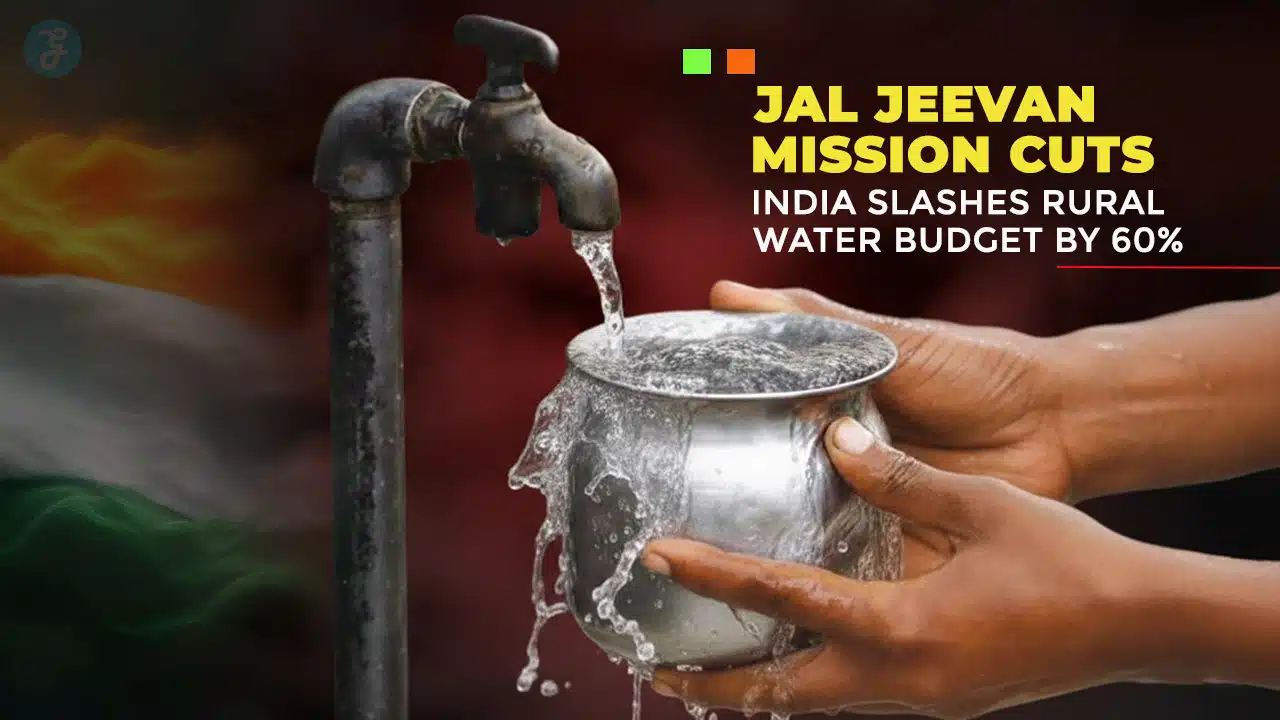
Why is this significant right now? In a stunning move on January 13, 2026, the Centre signaled a massive 60% reduction in the Jal Jeevan Mission’s (JJM) outlay for the current fiscal year—slashing it from a budgeted ₹67,000 crore to just ₹17,000 crore in Revised Estimates.
This drastic correction comes just as the mission enters its most critical “last mile” phase to reach the final 19% of unconnected rural households. The cut exposes deep fissures between central allocations, state-level execution capacity, and a bureaucratic deadlock over the scheme’s formal extension to 2028.
Key Takeaways
- The Figure: The Ministry of Finance has revised the FY 2025-26 allocation down by ~₹50,000 crore (a 60% drop) because the funds cannot be spent in the remaining three months.
- The Cause: A procedural limbo. While the Finance Minister announced an extension to 2028 in the last budget, the Union Cabinet has not formally approved the extension, legally freezing the release of fresh massive tranches.
- The Impact: States with difficult terrain (Rajasthan, Jharkhand, West Bengal) face an immediate cash crunch, potentially stalling ongoing pipe-laying works.
- The Shift: The government is pivoting from “speed of coverage” to “quality and audit,” following a crackdown on irregularities and corruption in 2025.
The Bureaucratic Choke: How We Got Here
To understand this drastic cut, one must look beyond the headline number. The Jal Jeevan Mission, launched in 2019 with the slogan “Har Ghar Jal” (Water to Every Home), had an initial deadline of 2024.4 By early 2024, it became clear that while progress was historic (jumping from 16% to 75% coverage), the 100% target was missed.
In the February 2025 Budget, Finance Minister Nirmala Sitharaman announced an extension to 2028 with an enhanced outlay.5 However, in India’s governance framework, a budget speech announcement is a statement of intent; the actual release of funds for a “sunset scheme” (one that has passed its original deadline) requires a specific Cabinet nod.
As of January 2026, that nod is pending. Without it, the Ministry of Jal Shakti cannot legally disburse the remaining ₹50,000 crore before the financial year ends in March. The “cut,” therefore, is less about austerity and more about a failure of administrative synchronization.
The Anatomy of the Stall
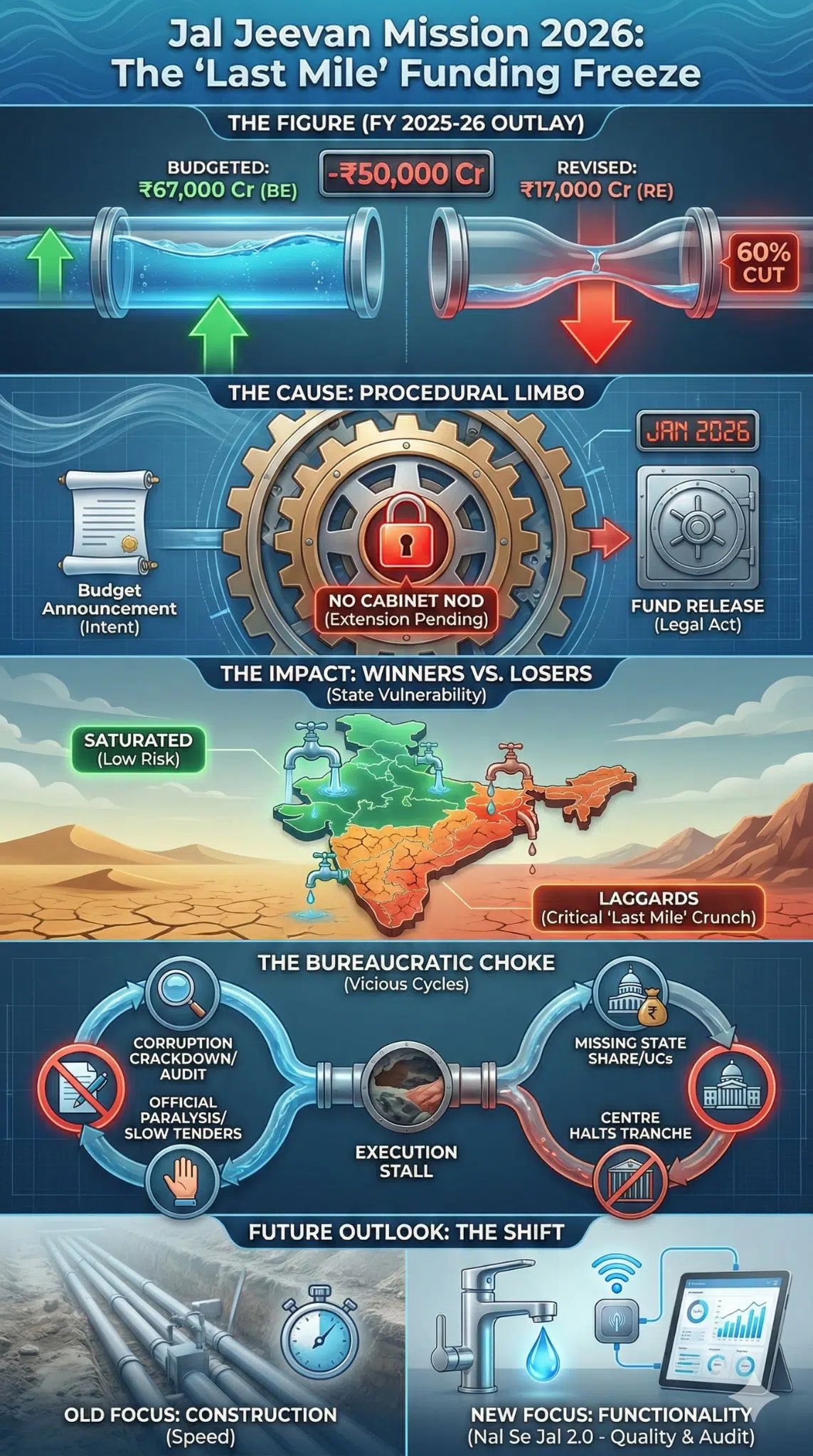
This development is not merely an accounting adjustment; it signals deeper structural challenges in India’s largest welfare project.
1. The “Last Mile” Penalty
The first 50% of connections were the “low-hanging fruit”—villages near existing water sources in accessible plains. The remaining 19% (roughly 3.6 crore households) are in the hardest geographies: the desert districts of Rajasthan, the arsenic-affected belts of West Bengal, and the hilly terrain of the North East.
Cost per connection in these areas is exponentially higher. A budget slash here strikes disproportionately at the most vulnerable populations who were left for last precisely because they were difficult to reach.
2. The Utilization Certificate (UC) Crisis
The Centre has tightened the purse strings on states that fail to provide Utilization Certificates (UCs) for previous funds. Several states, struggling with their own fiscal deficits, have delayed releasing their matching share (usually 50% or 10% depending on the state category).
When states don’t release their share, the Centre halts its next tranche. This creates a vicious cycle: work stops, UCs aren’t generated, and the budget remains unspent—leading to the Finance Ministry “saving” the money by slashing the Revised Estimates.
3. Corruption Crackdown and Quality Control
Throughout 2025, the Jal Shakti Ministry launched a massive audit following reports of “dry taps”—taps installed without water supply to inflate statistics. Over 700 officials and contractors were booked for irregularities.6
This necessary cleanup has had a side effect: paralysis. Officials are now terrified of signing off on new tenders or payments, slowing the pace of execution significantly. The 60% cut reflects this slowdown; the system is simply not moving fast enough to absorb ₹67,000 crore a year anymore.
4. The Capex vs. Opex Trap
The JJM is largely a Capital Expenditure (Capex) mission—building pipes and tanks.7 However, as 81% of India is now “covered,” the challenge shifts to Operating Expenditure (Opex)—maintenance, electricity for pumps, and chlorination.
The central budget is designed for Capex. It does not adequately cover Opex, which falls on Gram Panchayats and States. The stalling of funds suggests a lack of clarity on who pays for the sustenance of the infrastructure already built.
Data & Visualization: The Gap Between Promise and Reality
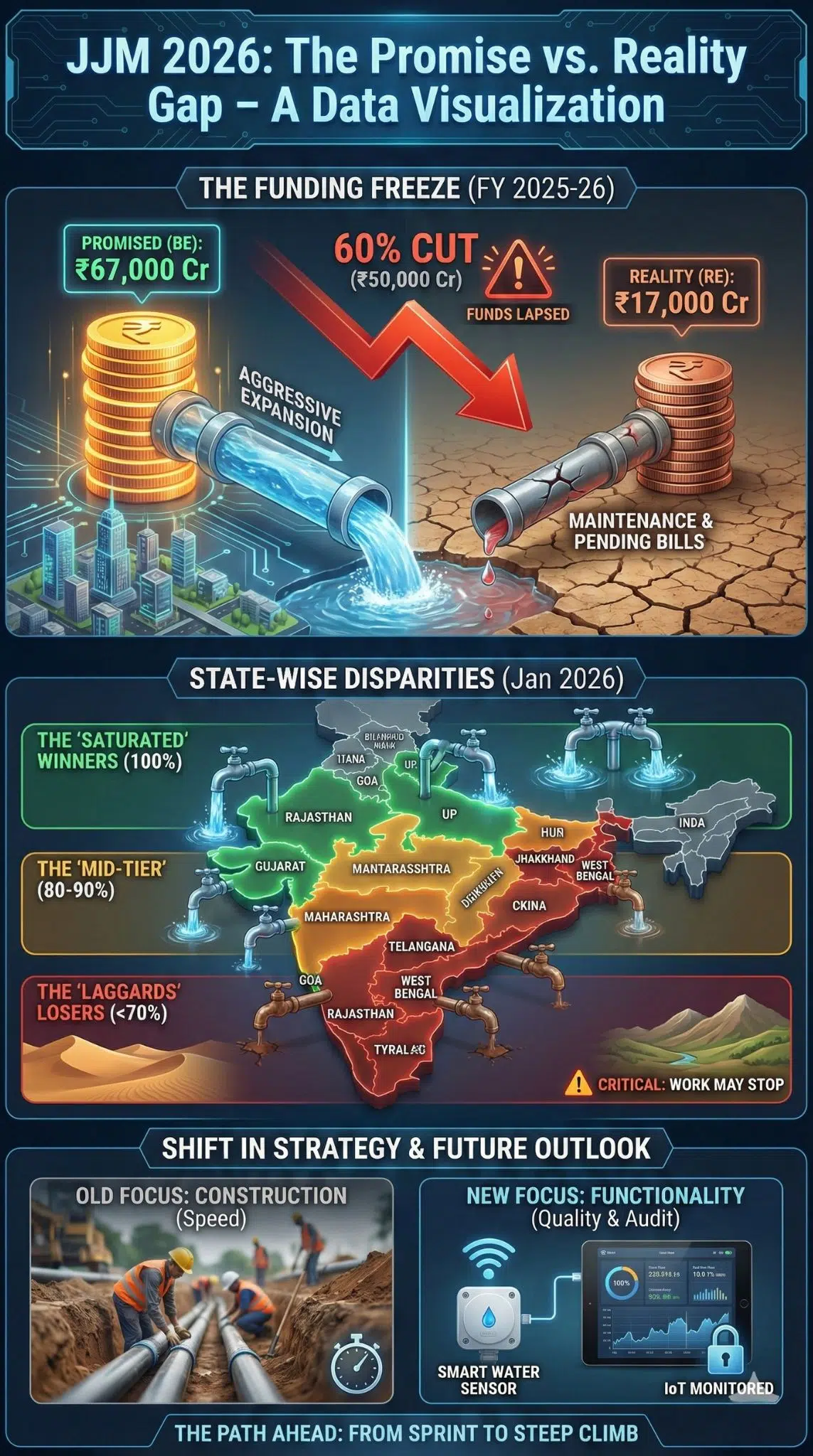
The following tables highlight the stark contrast in funding and regional progress.
The Funding Freeze (FY 2025-26) A comparison of what was promised vs. what is being released.
| Component | Budget Estimates (BE) | Revised Estimates (RE) | % Change |
| Total Outlay | ₹67,000 Cr | ₹17,000 Cr | – 74.6% |
| Focus | Aggressive Expansion | Maintenance & Pending Bills | Shift in Strategy |
| Status | Approved by Parliament | Capped by Finance Ministry | Funds Lapsed |
State-wise Disparities (Status as of Jan 2026) Who loses the most from the budget cut?
| Category | States | Coverage Status | Vulnerability to Cuts |
| The “Saturated” (Winners) | Goa, Telangana, Haryana, Punjab, Gujarat | 100% | Low (Need O&M funds only) |
| The “Mid-Tier” | Uttar Pradesh, Maharashtra, Madhya Pradesh | 80-90% | Medium (Can slow down but safe) |
| The “Laggards” (Losers) | West Bengal, Rajasthan, Jharkhand | < 70% | Critical (Work may stop entirely) |
Expert Perspectives
To maintain neutrality, we analyze differing viewpoints on this development.
The Fiscal Conservative View (Pro-Cut): Economists argue that “parking” funds in ministries that cannot spend them is bad economics. If the Jal Shakti Ministry hasn’t utilized the first ₹20,000 crore by Q3, releasing another ₹47,000 crore in Q4 leads to “March Rush”—wasteful spending just to exhaust the budget. The cut is a prudent fiscal correction to keep the fiscal deficit near the targeted 4.4%.
The Development/Welfare View (Anti-Cut): Water policy experts argue that this stop-start funding destroys contractor confidence. Small contractors who laid pipes on credit will go bankrupt if payments are delayed by 6 months due to “bureaucratic delays.” Furthermore, stopping funds now, when the mission is tackling difficult terrain, ensures that the most marginalized communities (tribals, desert dwellers) are the ones who get left behind.
“You cannot starve a project in the final mile. The cost of restarting stalled infrastructure is always higher than finishing it. This delay will likely push the 100% target beyond 2028.” — Dr. S. K. Rao, Lead Analyst, Water Policy Group.
Future Outlook: What Happens Next?
As we look toward the remainder of 2026, three scenarios are likely to emerge.
1. The “Cabinet Correction” (High Probability): The Union Cabinet will likely approve the JJM extension post-haste (likely late January or early February 2026) to prevent a political fallout. However, the funds for FY 2025-26 are gone. The focus will shift to the Budget 2026-27, where a fresh, perhaps slightly reduced, allocation will be made.
2. The Rise of “Nal Se Jal 2.0”: The narrative will shift from “Construction” to “Functionality.” Expect the next phase of funding to be tied strictly to water actually flowing, monitored by IoT sensors, rather than just pipes being laid.9 This will slow down expenditure but improve genuine access.
3. State-Led Crises: States like Rajasthan and West Bengal, which are heavily dependent on central funds for their water projects, may see a summer of discontent. If the central tap turns off, local water supply schemes could stall right before the summer heat hits in April/May 2026.
Final Words
The 60% cut to the Jal Jeevan Mission is a wake-up call. It reveals that the biggest hurdle to India’s development isn’t always a lack of money—often, it is the inability of the administrative machinery to spend that money efficiently, transparently, and on time. While the “Har Ghar Jal” dream remains alive, the deadline has moved, and the path ahead is no longer a sprint, but a steep, unpaved climb.