Hello again, I am Sukanta Parthib, founder and CEO of Imaginelab.art and Editorialge Media LLC. After publishing my initial thoughts on the current state of artificial intelligence, many of you asked for a much more detailed look into exactly how I use these tools in my daily professional life. The visual AI industry has fundamentally shifted its focus from simple art generation to strict user control. As a creator managing multiple client accounts, I no longer accept extra fingers, misspelled words, or random background objects in my deliverables.
Today, three major models have solved these problems, completely changing how creators and businesses work. But choosing between OpenAI, Google, and ByteDance requires understanding the nuanced differences in their visual engines, because they do not serve the exact same purpose. By looking closely at these three options, you can stop wasting time and money on the wrong subscription. Here is my fully expanded, first-hand account of working with GPT Image-2, Nano Banana 2, and Seedgram 4.5.
Which model is actually useful for creators, marketers, publishers, e-commerce owners, and SaaS founders?
I work around digital publishing, content strategy, branding, SEO, and AI product planning. So my needs are not only artistic. I often need images for blog articles, social media posts, e-commerce campaigns, infographics, editorial features, and product ideas.
In this kind of work, four things matter most:
- The model must understand the prompt clearly.
- The image must look professional.
- The text inside the image must be readable.
- The output must be fast and affordable enough for regular use.
After reviewing these three models, I found that each one has a clear strength.
- GPT Image-2 is best when accuracy, layout, and text matter.
- Nano Banana 2 is best when speed and realism matter.
- Seedgram 4.5 is best when character consistency, product consistency, and editing control matter.
So, I would not say one model is best for everyone. I would choose the model based on the job.
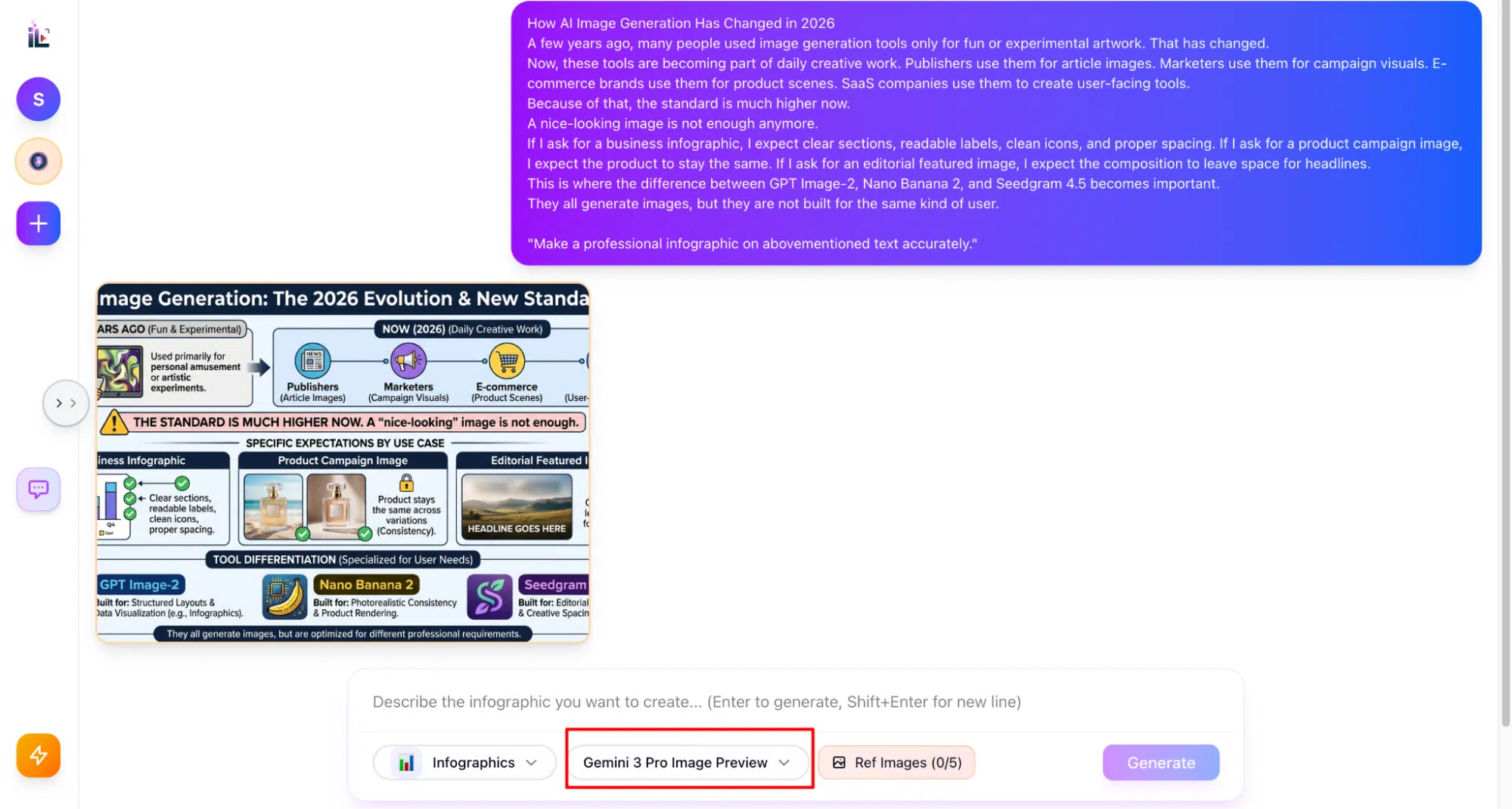
How AI Image Generation Has Changed in 2026
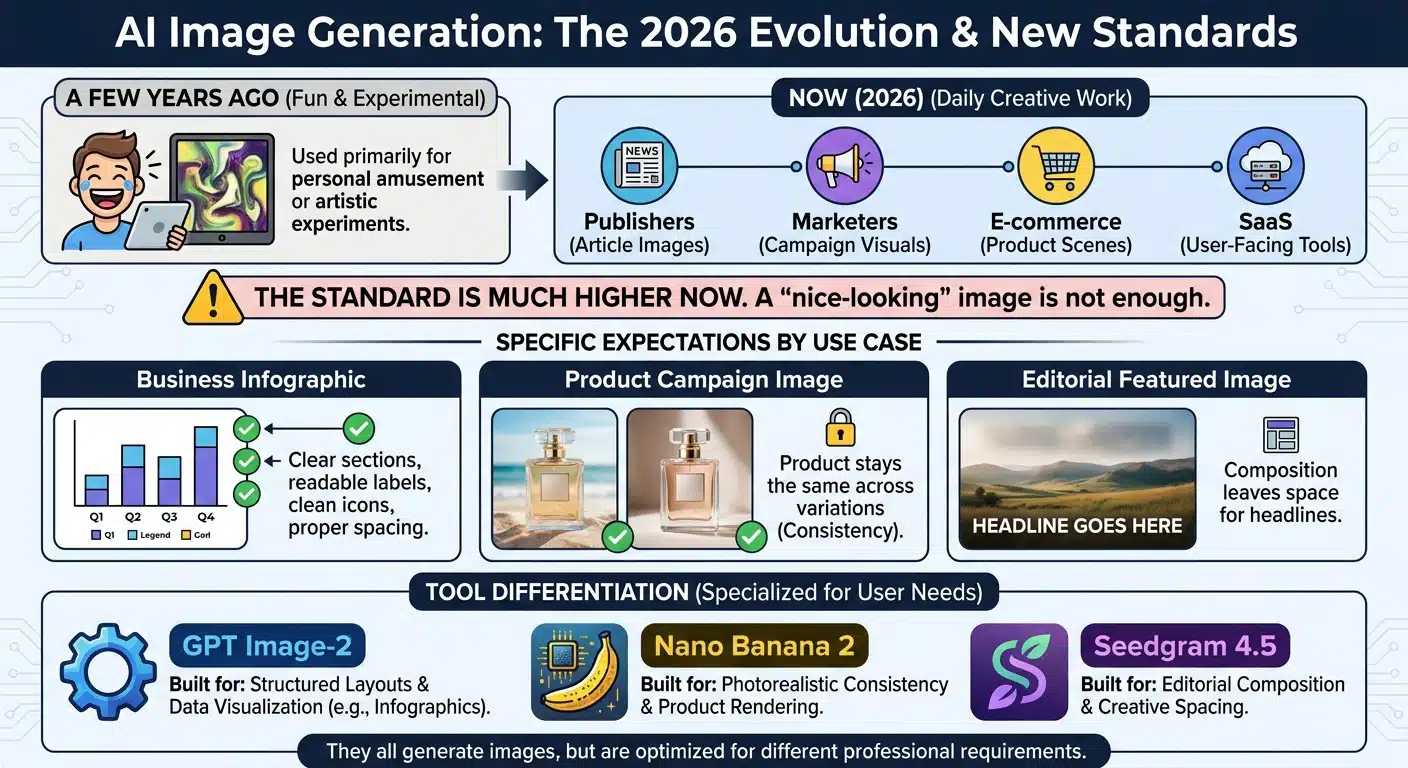
A few years ago, many people used image generation tools only for fun or experimental artwork. That has changed.
Now, these tools are becoming part of daily creative work. Publishers use them for article images. Marketers use them for campaign visuals. E-commerce brands use them for product scenes. SaaS companies use them to create user-facing tools.
Because of that, the standard is much higher now.
A nice-looking image is not enough anymore.
If I ask for a business infographic, I expect clear sections, readable labels, clean icons, and proper spacing. If I ask for a product campaign image, I expect the product to stay the same. If I ask for an editorial featured image, I expect the composition to leave space for headlines.
This is where the difference between GPT Image-2, Nano Banana 2, and Seedgram 4.5 becomes important.
They all generate images, but they are not built for the same kind of user.
Why Control Matters More Than Random Creativity
In professional work, random creativity can become a problem.
If I give a detailed prompt, I do not want the model to ignore half of it. I do not want extra objects in the background. I do not want broken text. I do not want a product to change shape. I do not want a person’s face to look different in every new image.
For casual use, those issues may be acceptable. For business use, they are not.
- A publisher cannot use an image with misspelled words.
- An e-commerce owner cannot use a product image if the product looks inaccurate.
- A brand cannot use a mascot if the face keeps changing.
- A SaaS founder cannot offer an image tool if users get random results.
That is why I care about control.
The best image model for me is not always the one that creates the most dramatic picture. It is the one that understands what I asked for and gives me something I can use.
Text Inside Images Is Now a Serious Requirement
Text rendering is one of the most important parts of modern image generation.
For many projects, the image itself is not enough. We need headlines, labels, buttons, captions, menu items, product names, chart titles, and call-to-action text.
Earlier image models often failed badly in this area. They created fake letters, broken spelling, strange symbols, and unreadable words.
That is a serious issue for publishing and marketing.
If I create an infographic for Editorialge or a featured image for a business article, I cannot publish it if the text is wrong. Even one misspelled word can damage trust.
This is why GPT Image-2 stands out in this comparison. Based on the attached comparison, GPT Image-2 is positioned as the strongest option for text accuracy, prompt following, and structured layouts. Nano Banana 2 is stronger for speed and realism, while Seedgram 4.5 is stronger for consistent characters, products, and editing control.
My Experience With GPT Image-2
GPT Image-2 feels like the model I would use when I need a careful and structured result.
It is not the fastest option, but it is the one I would trust more for detailed prompts, clean layout, and readable text.
For example, if I need a professional infographic with a title, three sections, icons, data labels, and a clean conclusion area, I would choose GPT Image-2 first.
The reason is simple: layout matters.
In publishing and design, a good image is not only about beauty. It must also communicate clearly. GPT Image-2 is useful because it handles structure better than many faster models.
Where GPT Image-2 Performs Best
I would use GPT Image-2 for the following:
- Infographics
- Blog featured images
- Business visuals
- UI mockups
- App screen concepts
- Educational graphics
- Presentation images
- Charts and diagram-style visuals
- Text-heavy social media posts
- Bengali and English visual content
If I need an image that contains readable words, organized sections, and a professional structure, GPT Image-2 is my first choice.
Why I Trust GPT Image-2 for Structured Work
From my own professional point of view, the biggest proof is usability.
If an image looks beautiful but needs too much correction, it does not save time. It creates more work.
For example, if I ask for a SaaS dashboard concept, I need the sections to make sense. If I ask for a comparison graphic, the labels must be readable. If I ask for a Bengali visual, the text must not look broken.
GPT Image-2 is valuable because it reduces these problems.
It may take longer than Nano Banana 2, but I would rather wait a little longer for an image that is closer to publishable.
The Weak Side of GPT Image-2
GPT Image-2 is not always the best choice for speed.
If I need many quick drafts for social media, it may feel slower. If I need highly natural lifestyle photography, the Nano Banana 2 may give a more realistic result.
So I would not use GPT Image-2 for every task. I would use it when accuracy matters more than speed.
My Experience With Nano Banana 2
Nano Banana 2 feels like the model for fast production.
If I need to create many image ideas quickly, this is the kind of model I would consider first.
In daily media and marketing work, speed matters a lot. Sometimes I need to test ten ideas before choosing one. Sometimes I need a quick image for a trend-based article. Sometimes I need a realistic visual that looks natural without spending too much time.
This is where Nano Banana 2 is strong.
According to the attached comparison, Nano Banana 2 is described as the fastest model among the three, with strong photorealism and useful grounding features.
Where Nano Banana 2 Performs Best
I would use Nano Banana 2 for:
- Social media images
- Fast creative drafts
- Lifestyle photography
- Realistic human scenes
- News-style visuals
- Trend-based content
- Bulk image generation
- Mobile-first creative workflows
- Fast idea testing
If I need a realistic image quickly, Nano Banana 2 makes sense.
Why Nano Banana 2 Is Useful for Content Teams
Content teams often work under time pressure.
A social media manager may need several versions of a post. A news publisher may need an image quickly. A marketing team may want different creative angles before choosing the final one.
Nano Banana 2 helps in those situations because it gives results fast.
For brainstorming, speed is very important. The first image does not always need to be perfect. Sometimes the goal is to see different directions quickly.
That is where Nano Banana 2 has real value.
The Weak Side of Nano Banana 2
Nano Banana 2 may not be my first choice for complex text-heavy images.
If the prompt has many small instructions, it may miss some details. If the design needs perfect labels or a detailed infographic layout, I would check the result carefully before using it.
- For simple realistic visuals, it is strong.
- For detailed structured graphics, GPT-Image-2 is safer.
My Experience With Seedgram 4.5
Seedgram 4.5 feels like the model for brand consistency and controlled editing.
This is very important for business users.
In marketing, the same person, product, or character may need to appear in many different images. If the face changes in every image, the campaign loses trust. If the product shape changes, customers may get confused.
That is why consistency matters.
Seedgram 4.5 is useful because it focuses on keeping faces, characters, products, and visual identity stable across different images.
Where Seedgram 4.5 Performs Best
I would use Seedgram 4.5 for the following:
- E-commerce product visuals
- Brand mascot campaigns
- Influencer-style images
- Character-based stories
- Product background changes
- Fashion campaign visuals
- Reference-image-based generation
- Consistent ad creatives
- Commercial product scenes
For e-commerce and brand marketing, Seedgram 4.5 has a strong practical use case.
Why Seedgram 4.5 Matters for Brands
In brand work, consistency is not optional.
If a company uses the same mascot in different campaigns, that mascot must look the same. If a fashion brand uses the same model across a campaign, the face and body structure must remain stable. If an e-commerce store shows the same product in different settings, the product must not change.
Seedgram 4.5 is useful because it helps solve this problem.
The attached comparison also highlights Seedgram 4.5’s strength in reference images, character consistency, and natural language editing.
Natural Language Editing Is a Big Advantage
One of the most practical things about Seedgram 4.5 is editing through plain instructions.
Instead of starting over, I can ask for a specific change.
For example:
- Change the blue bag to a red backpack.
- Replace the office background with a studio background.
- Keep the person the same, but change the outfit.
- Keep the product unchanged, but place it on a wooden table.
This kind of editing is very useful because it saves time.
In real work, the first image is not always perfect. Sometimes only one part needs to be changed. A model that can edit one part without damaging the rest of the image is very valuable.
The Weak Side of Seedgram 4.5
Seedgram 4.5 may not always be the best option for complex text-heavy layouts.
It is strong for consistency and editing, but if I needed a detailed infographic, GPT Image-2 would still be my first choice.
Seedgram 4.5 is best when the subject must stay consistent across multiple visuals.
GPT Image-2 vs. Nano Banana 2 vs. Seedgram 4.5: My Practical Comparison
Here is how I would compare the three models from my own working perspective.
| Area | Best Choice | My Reason |
| Text inside images | GPT Image-2 | Better for readable text and clean structure |
| Infographics | GPT Image-2 | Stronger layout and prompt following |
| Fast image generation | Nano Banana 2 | Better for quick drafts and bulk work |
| Photorealistic images | Nano Banana 2 | Stronger natural texture and realism |
| Character consistency | Seedgram 4.5 | Better for keeping the same person or character |
| Product consistency | Seedgram 4.5 | Better for e-commerce and brand campaigns |
| Social media visuals | Nano Banana 2 | Faster for daily content needs |
| UI/UX mockups | GPT Image-2 | Better for grids, sections, and labels |
| Brand campaigns | Seedgram 4.5 | Better for repeated visual identity |
| Editorial graphics | GPT Image-2 | Better for structured publishing visuals |
Which Model Is Best for Marketers?
For marketers, I would not choose only one model.
Marketing has different needs.
- A social media post may need speed.
- A product ad may need consistency.
- An infographic may need clear text.
- A campaign image may need a repeated character or mascot.
So my recommendation is simple:
- Use Nano Banana 2 for fast social media ideas.
- Use Seedgram 4.5 for brand and product consistency.
- Use GPT Image-2 for ads, infographics, and designs with text.
If I were running a campaign, I might use all three at different stages.
- Nano Banana 2 would help me create quick concepts.
- Seedgram 4.5 would help me keep the product or character consistent.
- GPT Image-2 would help me create the final text-heavy visual.
Which Model Is Best for Publishers?
For publishers, I would mainly use GPT Image-2 and NanoBanana 2.
Publishing needs both speed and quality.
For daily news-style visuals or simple article images, Nano Banana 2 is useful because it is fast and realistic.
For explainers, business graphics, AI guides, and infographics, GPT Image-2 is better because it handles structure and text more carefully.
As a publisher, I cannot use an image if the headline is wrong or the labels are unreadable. That is why GPT Image-2 is more useful for serious editorial graphics.
Which Model Is Best for E-commerce?
For e-commerce, Seedgram 4.5 is the strongest choice.
E-commerce images need product accuracy. If the product changes shape, color, size, or design, the image becomes risky to use.
Seedgram 4.5 is useful because it can help keep the same product consistent across different scenes.
For example, an e-commerce owner may want the same product in:
- A home setting
- A studio background
- A lifestyle scene
- A holiday campaign
- A social media ad
- A product comparison image
If the model can keep the product stable across these versions, it saves time and money.
That is why I would choose Seedgram 4.5 for product-focused campaigns.
Which Model Is Best for UI/UX and SaaS Design?
For UI/UX and SaaS design, I would choose GPT Image-2.
UI and SaaS visuals need clear structure. A dashboard mockup, app screen, or landing page concept must have proper spacing, readable text, buttons, cards, and logical sections.
A beautiful but messy UI image is not useful.
GPT Image-2 is better for this type of work because it follows layout instructions more carefully.
For a SaaS product like ImagineLab.art, this matters a lot. If users want to generate infographics, UI concepts, comparison graphics, or structured designs, the model must understand layout.
That is why GPT Image-2 should be placed as a premium option for structured visual generation.
Which Model Is Best for Infographics?
For infographics, GPT Image-2 is the safest choice.
Infographics require:
- A clear headline
- Well-organized sections
- Readable text
- Simple icons
- Good spacing
- Correct labels
- Logical flow
- Clean visual hierarchy
If any of these parts fail, the infographic becomes weak.
Nano Banana 2 may create a good-looking image quickly, but I would not trust it first for detailed infographic text. Seedgram 4.5 may keep characters and products consistent, but it is not my first choice for dense layout work.
So for infographic generation, my choice is GPT Image-2.
Pricing and API Thinking From a Founder’s View
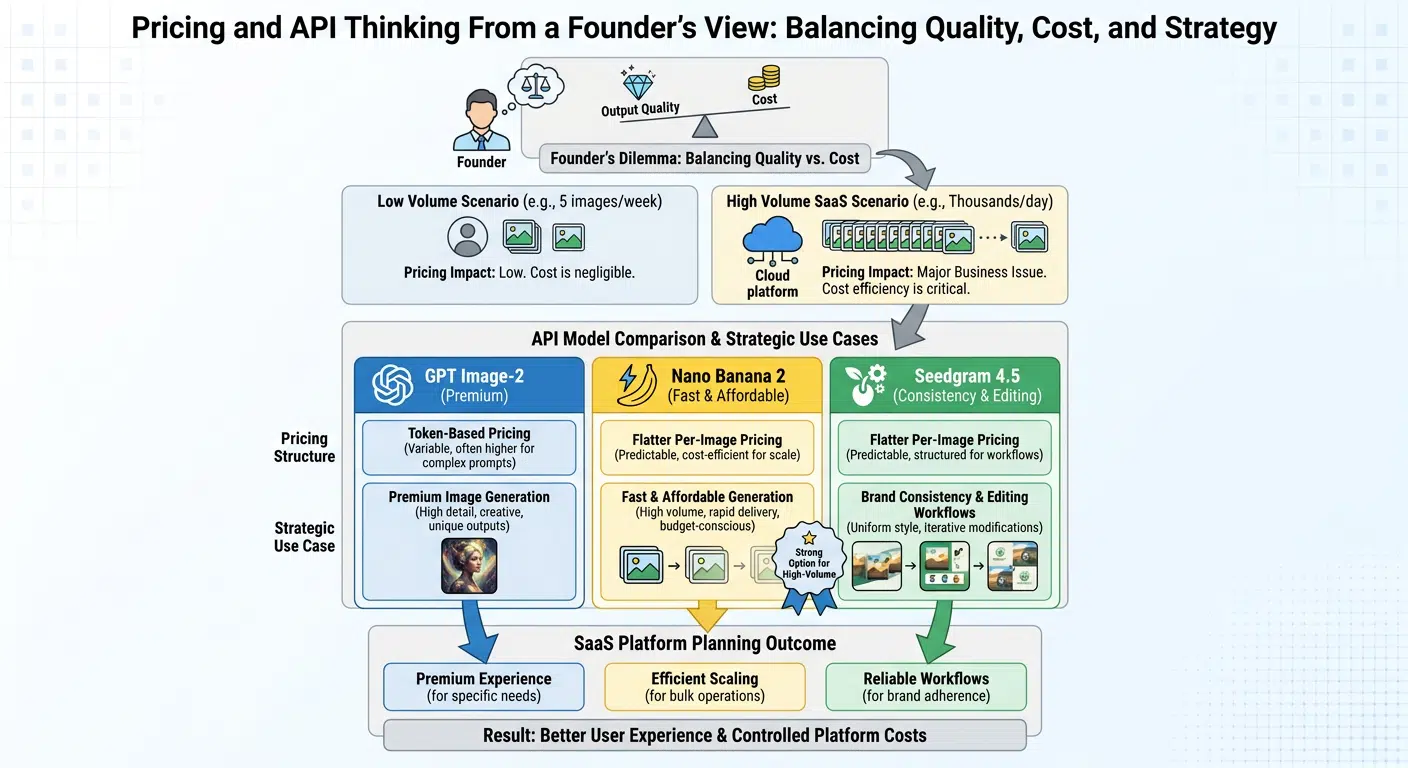
As a founder, I cannot look only at output quality. I also have to think about cost.
If someone generates five images per week, pricing may not matter much. But if a SaaS platform generates thousands of images per day, pricing becomes a major business issue.
The attached comparison says GPT Image-2 follows a token-based pricing structure, while Nano Banana 2 and Seedgram 4.5 are described with flatter per-image pricing models. It also presents Nano Banana 2 as a strong option for high-volume users because of speed and cost efficiency.
For SaaS planning, I would separate these models by use case.
- GPT Image-2 should be used for premium image generation.
- Nano Banana 2 should be used for fast and affordable generation.
- Seedgram 4.5 should be used for brand consistency and editing workflows.
This gives users a better experience and helps control platform costs.
How I Would Position These Models in a SaaS Product
If I were adding these models to an AI image SaaS platform, I would not show them only as technical model names. Most users do not care about technical details first. They care about results.
So I would position them like this:
| Model | User-Friendly Positioning | Best Use |
| GPT Image-2 | Best for accurate text and structured designs | Infographics, UI mockups, editorial graphics |
| Nano Banana 2 | Best for fast and realistic images | Social media, lifestyle visuals, quick drafts |
| Seedgram 4.5 | Best for consistent characters and products | E-commerce, branding, campaign visuals |
This makes the choice easier for users.
A beginner may not know which model to select. But they can understand simple labels like
- Best for infographics
- Best for realistic photos
- Best for product consistency
- Best for social media
- Best for editing
That is how I would design the user experience.
My Recommended Workflow
If I were using these three models in one professional workflow, I would use them like this:
First, I would use Nano Banana 2 for quick ideas.
Then, I would use GPT Image-2 for the structured final version if the image needs text or layout.
If the image needs the same product, person, or character again, I would use Seedgram 4.5.
This workflow makes sense because each model solves a different problem.
- Nano Banana 2 gives speed.
- GPT Image-2 gives structure.
- Seedgram 4.5 gives consistency.
Together, they can support a strong creative workflow.
My Final Verdict
After reviewing GPT Image-2 vs. Nano Banana 2 vs. Seedgram 4.5, my conclusion is straightforward.
GPT Image-2 is the best choice for structured visual work.
I would use it for infographics, UI mockups, business visuals, educational graphics, and any image that needs readable text.
Nano Banana 2 is the best choice for speed and realism.
I would use it for social media visuals, lifestyle images, quick drafts, and high-volume content production.
Seedgram 4.5 is the best choice for consistency and editing control.
I would use it for e-commerce products, brand mascots, influencer-style content, and campaign visuals where the subject must stay the same.
So, the right answer depends on the task.
- For text and layout, choose GPT Image-2.
- For speed and realism, choose Nano Banana 2.
- For product and character consistency, choose Seedgram 4.5.
As Sukanta Parthib, founder and CEO of Imaginelab.art and Editorialge Media LLC my practical view is this: the best creative workflow in 2026 should not depend on only one image model. A serious creator, publisher, marketer, or SaaS founder should use the right model for the right job.
That is the smartest way to save time, reduce mistakes, and create better visuals.
Frequently Asked Questions (FAQs) on GPT Image-2 vs. Nano Banana 2 vs. Seedgram 4.5
Which model is best for infographics?
GPT Image-2 is the best choice for infographics because it handles text, layout, and structured prompts better than the other two.
Which model is best for fast image generation?
Nano Banana 2 is the best choice for fast image generation. It is useful when you need many ideas quickly.
Which model is best for e-commerce product images?
Seedgram 4.5 is the best choice for e-commerce product images because it is stronger at keeping products consistent across different scenes.
Nano Banana 2 is a strong choice for social media because it is fast and creates realistic images quickly.
Which model is best for UI/UX mockups?
GPT Image-2 is the best choice for UI/UX mockups because it follows layout instructions more carefully.
Which model is best for brand campaigns?
Seedgram 4.5 is best for brand campaigns that need the same person, product, mascot, or character across many visuals.
Which model should a SaaS founder choose?
A SaaS founder should not depend on only one model. GPT Image-2 can be used for premium structured outputs, Nano Banana 2 for fast generation, and Seedgram 4.5 for reference-based editing and brand consistency.