
Ever wonder why the same few titles keep showing up whenever people argue about the most influential video games ever made? That usually happens because these games did more than sell well. They changed game design, shifted player habits, and pushed the gaming industry in a new direction.
In BAFTA’s 2025 public poll, Shenmue finished first, with Doom second and Super Mario Bros. third. That is a good reminder that influence is not just about nostalgia, it is about what later creators borrowed, refined, and built on. So if you want a clear, reader-friendly tour through video game history, you are in the right place.
What Makes Video Games Influential?
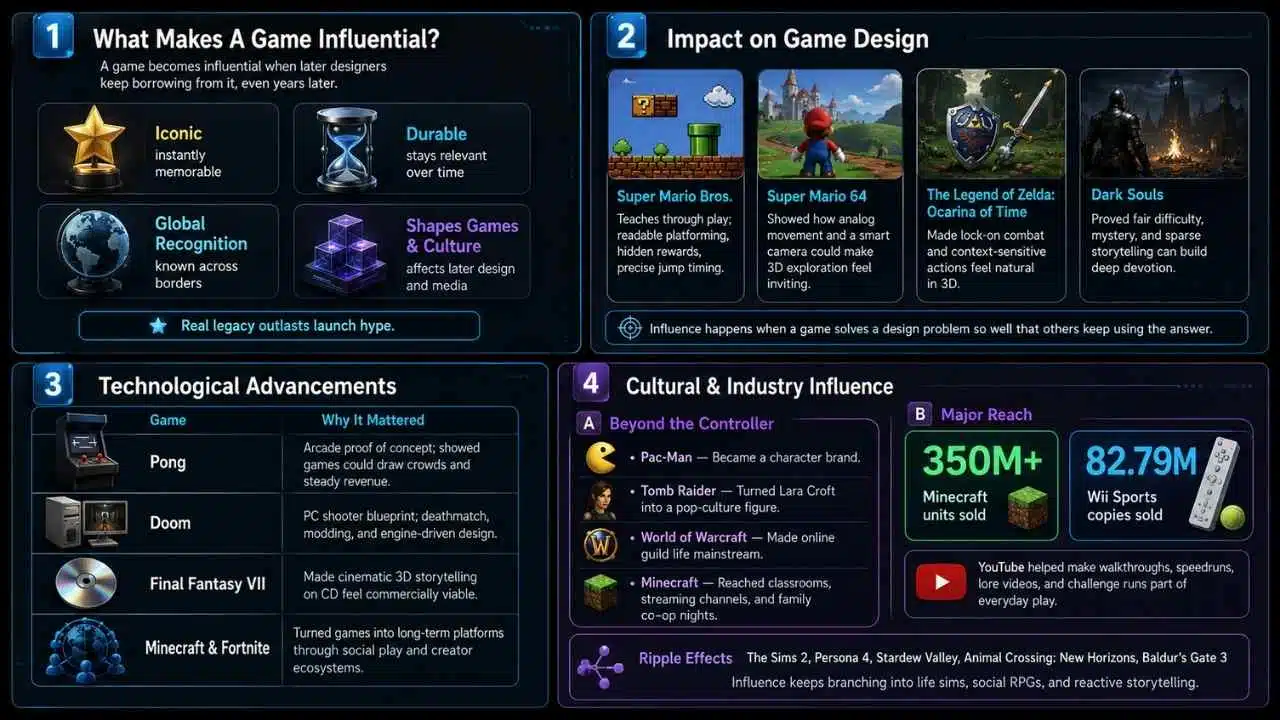
A game becomes influential when later designers keep borrowing from it, even years later. The Strong National Museum of Play uses four simple tests for lasting influence: a game should be iconic, durable, widely recognized across borders, and important to later games or culture.
That is a useful filter because it helps separate hype from real gaming legacy. A flashy launch can fade fast. A truly influential game keeps showing up in mechanics, level flow, controls, business models, community habits, and even the way people talk about play.
Impact on Game Design
Super Mario Bros. changed how designers teach players. World 1-1 still gets studied because it introduces running, jumping, hazards, power-ups, and secrets in a clean order that feels natural instead of bossy.
That sounds simple, but it is the foundation of good onboarding. If you make a player learn by doing, rather than by reading a giant tutorial box, your design feels smoother from the first minute.
- Super Mario Bros: standardized readable platforming, hidden rewards, and precise jump timing.
- Super Mario 64: showed how analog movement and a smart camera could make 3D exploration feel inviting.
- The Legend of Zelda: Ocarina of Time: made lock-on combat and context-sensitive actions feel natural in 3D.
- Dark Souls: proved that difficulty, mystery, and sparse storytelling could build devotion instead of frustration, when the rules stayed fair.
Influence is what happens when one game solves a design problem so well that everyone else starts using the answer.
Technological Advancements
Some games matter because they gave developers new tools. Pong showed that a simple game could become a business. Doom helped turn the PC into a major gaming platform, popularized deathmatch, and pushed an engine-based approach that made modding easier.
Final Fantasy VII then proved what CD-based hardware could do for scope. Square’s landmark RPG brought the series into 3D and used cinematic CG sequences to make story presentation feel bigger, which pushed console RPG expectations upward.
| Game | Breakthrough | Why it mattered |
|---|---|---|
| Pong | Arcade proof of concept | Showed that video games could draw crowds and steady revenue. |
| Doom | Fast 3D-style action, deathmatch, moddable structure | Gave shooters a blueprint and encouraged communities to build their own levels and variants. |
| Final Fantasy VII | 3D graphics and full-motion storytelling on CD | Made cinematic RPG ambition feel commercially viable. |
| Minecraft and Fortnite | Cross-platform social reach and creator ecosystems | Turned games into long-term platforms, not just one-time boxed releases. |
Cultural and Industry Influence
Influence also shows up outside the controller. Pac-Man became a character brand. Tomb Raider turned Lara Croft into a pop-culture figure. World of Warcraft made online guild life mainstream. Minecraft reached classrooms, streaming channels, and family co-op nights.
That kind of reach changes business decisions. Studios stop asking, “Will people buy this game?” and start asking, “Can this become a community, a creator scene, or a cultural symbol?”
- Minecraft became the best-selling video game ever, and Guinness updated its record in 2025 after Mojang reported more than 350 million units sold.
- Wii Sports sold 82.79 million copies according to Nintendo’s long-running Wii sales data, and The Strong later praised it for redefining who counts as a gamer.
- YouTube amplified gaming culture by making walkthroughs, speedruns, lore videos, and challenge runs part of everyday play.
- Games like The Sims 2, Persona 4, Stardew Valley, Animal Crossing: New Horizons, and Baldur’s Gate 3 show how influence can keep branching into life sims, social RPGs, and reactive storytelling.
Early Innovators in Gaming
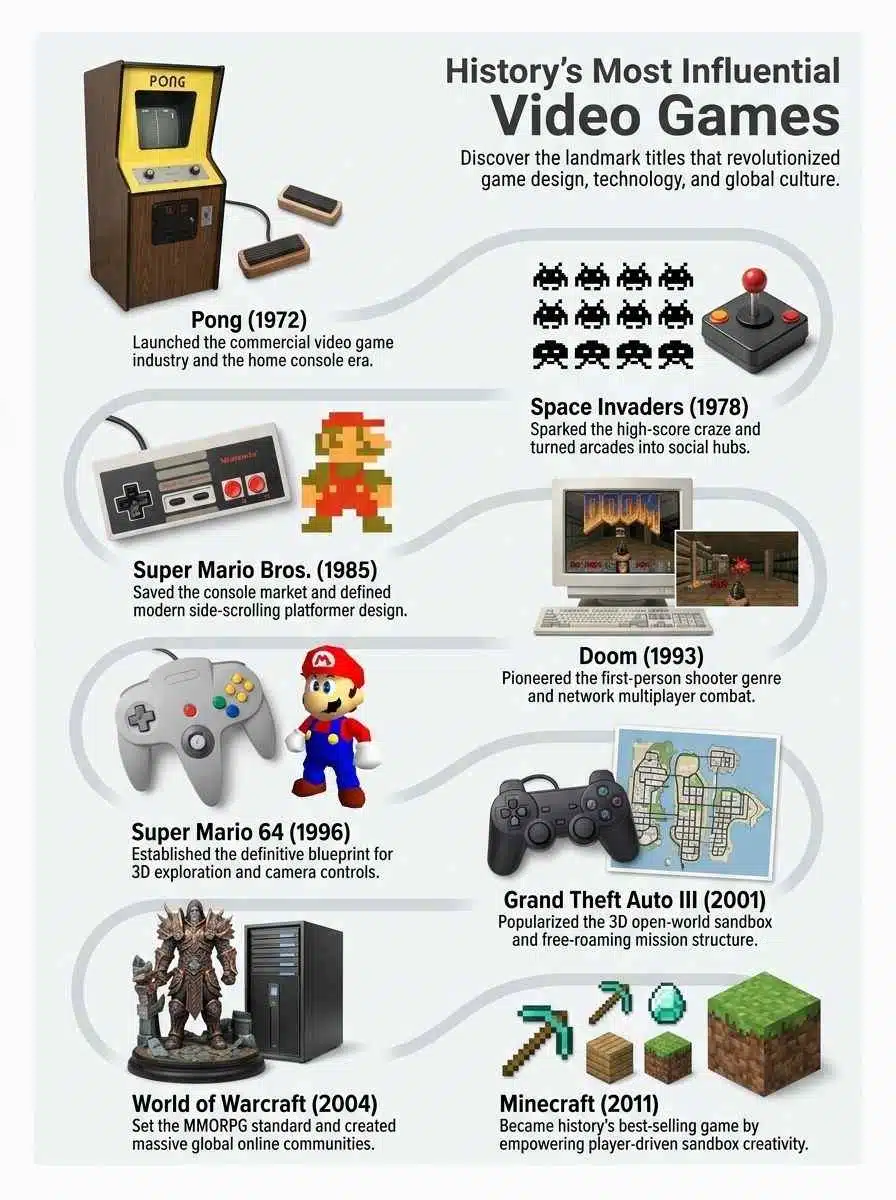
The earliest influential games look basic now, but their ideas still power modern releases. If you like score chasing, readable controls, or instantly understandable rules, you are already enjoying lessons first nailed by the arcade era.
Pong (1972)
Allan Alcorn built Pong at Atari, Inc. under Nolan Bushnell’s direction, and the result was simple enough for anyone to understand in seconds. That mattered because it lowered the barrier to entry at a time when the medium still had to prove itself.
The Strong points out that Pong was not the first video game, but it was the first to capture wide public attention. When Atari released a home version through the 1975 Sears Christmas Wish Book, the television stopped being just a passive screen and started becoming a play space.
If you study game feel, Pong still teaches a useful lesson: one sharp mechanic is enough if feedback is immediate and the objective is crystal clear.
Space Invaders (1978)
Space Invaders took the score chase and turned it into an event. Taito’s 1978 hit gave players a clear fantasy, survive the descending wave, while increasing pressure every few seconds.
That rising tension is the real trick. The fixed-shooter format made spectators part of the experience, which helped arcades become social spaces instead of rows of isolated machines.
- It made the high-score table a powerful motivation loop.
- It popularized enemy-wave pacing that later shooters kept refining.
- It proved that a single escalating system could create drama without a complex story.
If you enjoy modern score-driven indie games, you are seeing that same skeleton in a newer outfit.
Pac-Man (1980)
Pac-Man showed the medium could produce a mascot, not just a machine. Bandai Namco’s own anniversary material notes that the game exploded in the United States with hundreds of licensed products, helping push video games into mainstream consumer culture.
It also widened the audience. The maze-chase loop felt friendly, readable, and less intimidating than a military or sports theme, which helped draw in players who had not seen themselves in arcade gaming before.
Bandai Namco later highlighted two more clues to its staying power: Guinness recognized it as the most successful coin-operated arcade game, and The Strong inducted it into the World Video Game Hall of Fame. That is a strong case for cultural impact, not just commercial success.
Defining the Modern Era of Gaming
By the mid-1980s and early 1990s, influential games stopped feeling like experiments and started feeling like templates. This is where many of the rules that still shape retro games, remasters, and modern blockbusters really locked into place.
Super Mario Bros. (1985)
Nintendo launched Super Mario Bros. at exactly the right moment. After the 1983 North American market crash, the industry needed a game that felt polished, inviting, and worth buying a console for.
BAFTA’s 2025 feature on influential games called World 1-1 an object lesson in level design, and that still holds up. The game teaches movement, timing, and curiosity with almost no wasted motion, which is why so many platformers still echo it.
If you are designing any skill-based experience, this is the takeaway: make the first challenge readable, then add surprises once the player trusts your rules.
Tetris (1984)
Tetris is one of the cleanest designs ever made. Alexey Pajitnov’s falling-block puzzle uses a tiny ruleset, yet it creates pressure, pattern recognition, and that one-more-round feeling almost instantly.
The Game Boy bundle helped turn it into a handheld obsession, and Guinness later recognized the Game Boy version as the best-selling puzzle video game. That matters because it proved that depth does not need complicated controls, fancy art, or a huge budget.
For designers, Tetris is the classic reminder that elegant rules age better than spectacle.
Doom (1993)
id Software did more than release a hit with Doom. It gave the first-person shooter its mainstream shape, popularized deathmatch, and built a culture around modification and mastery.
The Strong credits the team led by John Carmack and John Romero with popularizing an engine-based approach and a shareware model that spread the game quickly. That is a huge reason Doom matters in video game history: it influenced both the product and the way the product traveled.
| Game | What it standardized | Why readers still care |
|---|---|---|
| Super Mario Bros. | Readable onboarding and side-scrolling platform flow | Great tutorials still hide inside play. |
| Tetris | Easy rules, endless mastery | Simple systems can create lifelong replay value. |
| Doom | FPS speed, deathmatch, mod culture | Community tools can extend a game’s life for decades. |
Evolution of 3D and Open-World Games
Moving from flat stages to explorable 3D spaces was one of the biggest leaps in gaming. The hard part was never just drawing polygons. It was helping players move, see, aim, and understand space without getting lost or annoyed.
| Game | Main breakthrough | Long-term effect |
|---|---|---|
| Super Mario 64 | Analog movement and camera logic | Made 3D platforming feel approachable. |
| Ocarina of Time | Z-targeting and context-sensitive actions | Set the model for 3D combat and interaction. |
| Grand Theft Auto III | Living city sandbox in third-person 3D | Helped define the modern open-world blueprint. |
Super Mario 64 (1996)
Super Mario 64 gave players a way to move through 3D space that felt playful instead of clumsy. Its analog stick control let movement scale from a careful walk to a full sprint, which sounds obvious now because the industry absorbed that lesson.
It also handled camera work better than many early 3D games. That made exploration feel exciting, not punishing, and helped turn the Nintendo 64 launch into a statement about where platformers were heading next.
The Legend of Zelda: Ocarina of Time (1998)
The Legend of Zelda: Ocarina of Time solved a different problem: how do you make 3D combat readable? Nintendo’s answer was Z-targeting, a lock-on system that let players keep an enemy in focus while moving, blocking, and attacking.
That idea spread everywhere. BAFTA specifically pointed to its influence on the Souls series, and Guinness noted in 2025 that it remains the only game with a 99 Metascore. If you are comparing landmark action-adventure design, that score is a useful clue that its systems still hold up under scrutiny.
Grand Theft Auto III (2001)
Grand Theft Auto III did not invent open worlds, but it turned the format into a mainstream ambition. Rockstar itself describes the game as the title that defined the open-world genre for a generation, and that description fits.
Liberty City felt reactive because it stacked missions, radio stations, traffic, pedestrians, and player freedom into one urban sandbox. Once players had that level of agency, many other studios had to respond. You can see the ripple in later series from The Elder Scrolls V: Skyrim to modern historical sandboxes.
The practical lesson is simple: when a world feels alive between missions, players stop treating it like a menu and start treating it like a place.
Games That Defined New Genres
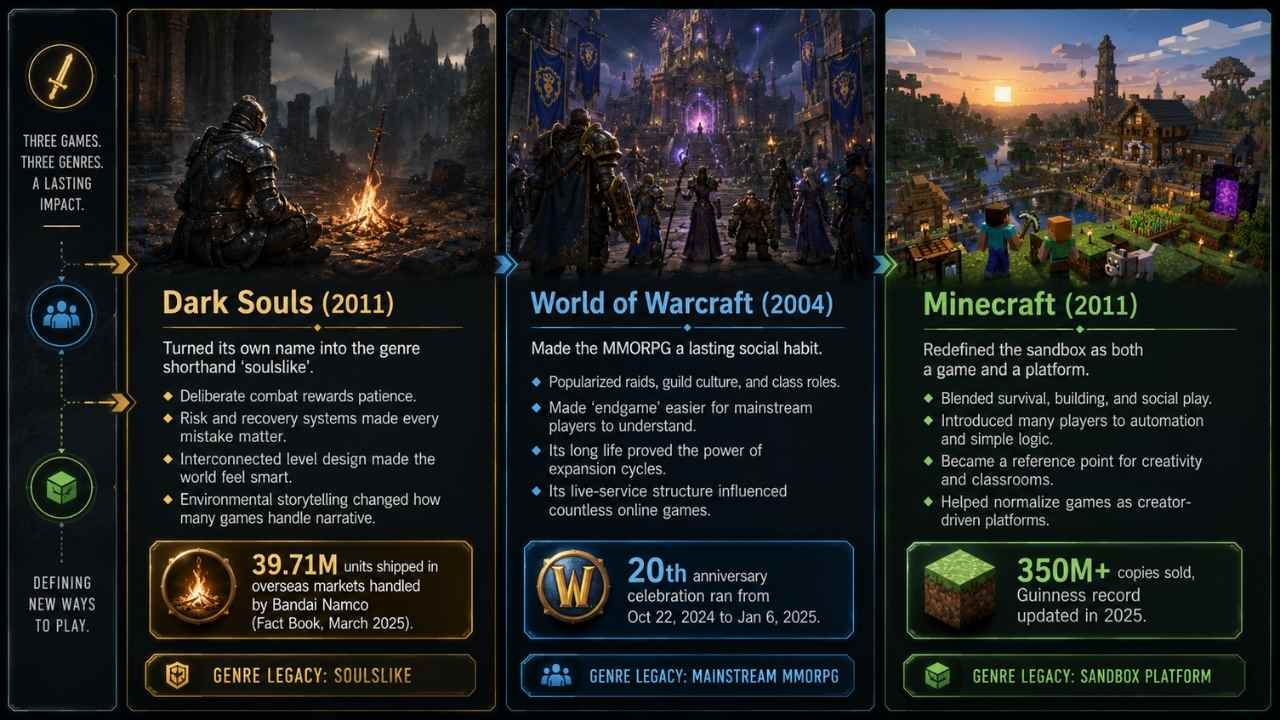
Some titles do more than refine a format. They create a new label that players and developers keep using for years. That is about as strong a mark on the medium as a game can leave.
Dark Souls (2011)
Dark Souls became so influential that its name turned into a genre shorthand. Players now say “soulslike” to describe games built around deliberate combat, risky recovery systems, sparse checkpoints, and storytelling hidden in item text, level layout, and atmosphere.
As of March 2025, Bandai Namco’s Fact Book lists Dark Souls series shipments at 39.71 million units in the overseas markets it handled. That scale matters because it shows this was not just a cult favorite. It was a design school with a commercial footprint.
- Combat rewards patience, not button mashing.
- Level design loops back on itself, which makes the world feel smart and interconnected.
- Failure teaches timing and space, rather than just punishing the player.
- Story lives in the environment, which changed how many teams handle narrative in games.
World of Warcraft (2004)
World of Warcraft turned the MMORPG into a social habit for millions of people. Raids, guilds, class roles, expansion cycles, and the language of “endgame” all became much easier to understand once Blizzard packaged them in a more welcoming format.
Its long life is part of the influence. The Strong put it in the Hall of Fame’s inaugural class, and Blizzard’s official 20th anniversary celebration ran from October 22, 2024, to January 6, 2025. Few games stay central to player routines for that long.
If you want to see its legacy today, look at any live-service title built around group identity, seasonal return visits, and social coordination.
Minecraft (2011)
Minecraft changed what players expected from a sandbox. It gave them a survival loop, a construction set, a shared social space, and a beginner-friendly path into systems like circuitry, automation, and simple logic.
Its scale backs that up. Guinness updated the game’s record in 2025 after Mojang reported more than 350 million copies sold, and official Minecraft materials still highlight Bedrock cross-platform play as a core feature. That combination, massive reach plus easy multiplayer, is why Minecraft became a default reference point for indie games, classroom creativity, and player-made storytelling.
It also helped normalize the idea that a game can be both a product and a platform. That same logic later powered creator-focused spaces in Fortnite and many other social games.
Final Thoughts
The most influential video games do not all look alike. Some rewrote game design. Some pushed hardware and engines forward. Some changed who played, how people talked about games, or what the business wanted to build next.
If you replay Pong, Doom, Super Mario Bros., World of Warcraft, or Minecraft with that in mind, you can still see the blueprint. Their ideas keep showing up across gaming culture, modern game genres, and the best new releases. Keep playing, keep noticing, and you will start spotting influence everywhere.
Frequently Asked Questions (FAQs) About the Most Influential Video Games of All Time
1. What makes the most influential video games of all time stand out?
They change game design, and they shift the whole industry, by adding fresh gameplay, strong storytelling, or new tech that others copy.
2. Which video games really changed things?
Think early arcade hits, classic platformers, first-person shooters, open-world adventures, and online multiplayer games, these titles rewrote the rulebook and shaped many genres.
3. How do these games affect modern game design?
They set templates for level design, player choice, and pacing, and they push graphics and storytelling forward, so new games borrow their best ideas.
4. Are those old games still fun today?
Yes, many still play well, they teach new players, thrill old fans, and they often feel like a favorite song, the tune still sticks.