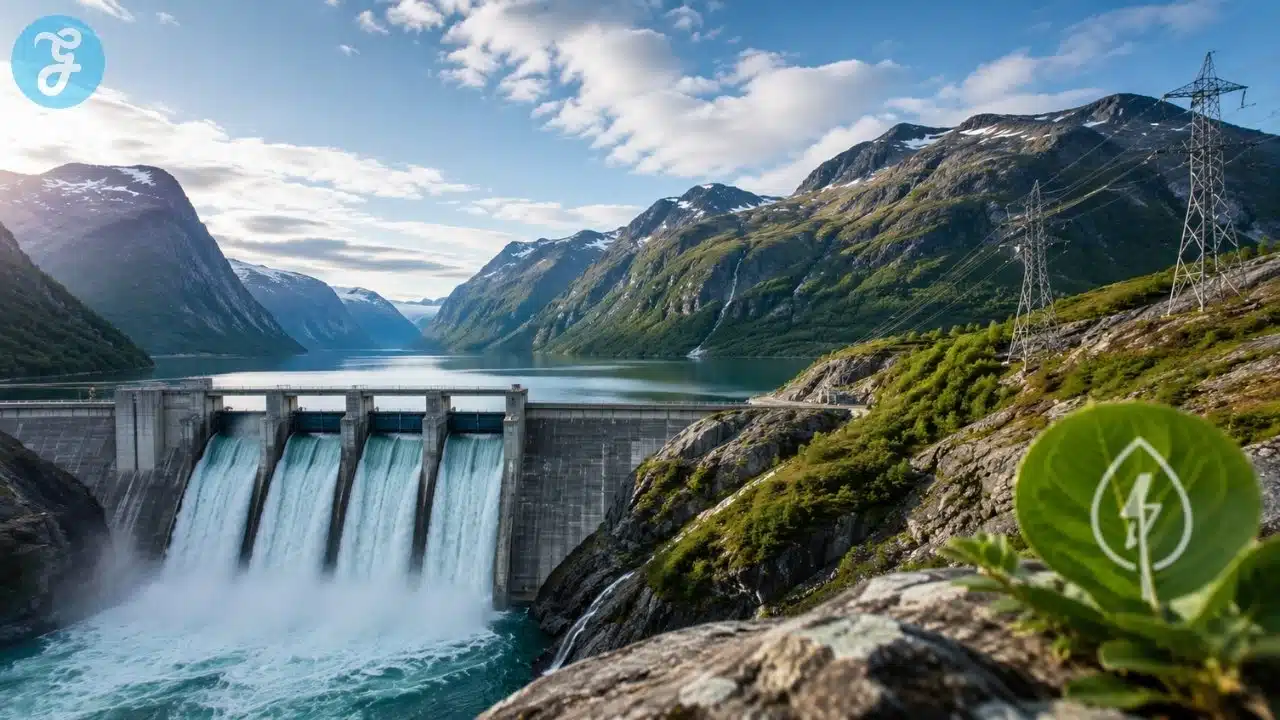
Norway is one of the rare countries where electricity does not mainly come from coal, gas, or nuclear power. It comes from water moving through mountains, rivers, reservoirs, and turbines. That sounds simple, almost poetic, but the system behind it is a highly engineered national asset that has shaped Norway’s industries, homes, emissions profile, and energy politics for more than a century. Understanding Norway’s Power from Hydroelectricity is not just about admiring waterfalls. It is about understanding how geography, public ownership, engineering, climate, and electricity markets work together.
The headline claim is mostly true, but it needs precision. Norway does not get “all” of its total energy from hydropower. It still produces oil and gas, and those sectors matter economically. But when we talk about electricity, Norway is extraordinary: the IEA lists hydropower as Norway’s largest electricity source in 2024, producing about 89% of total generation, while Statkraft cites NVE data showing hydropower at about 88% of Norway’s power production in 2024.
Our Selection Criteria
To keep this guide useful, the focus is not just on impressive numbers. The selected facts explain how Norway’s hydropower system works, why it became dominant, what advantages it creates, and where the challenges are starting to appear.
Here is the selection logic used for this guide.
| Selection Factor | Why It Matters |
|---|---|
| Electricity Share | Hydropower dominates Norway’s electricity generation |
| Geography | Mountains, rivers, and rainfall make the system possible |
| Storage Capacity | Reservoirs help Norway manage seasonal power supply |
| Climate Impact | Hydropower gives Norway one of Europe’s cleanest power systems |
| Industrial Impact | Cheap renewable electricity shaped energy-intensive industries |
| Public Ownership | Ownership affects control, revenues, and energy policy |
| Grid Flexibility | Hydropower can balance demand and other renewables |
| Market Links | Norway trades electricity with neighboring countries |
| Climate Risk | Drought, rainfall changes, and snowmelt patterns affect supply |
| Future Limits | Norway cannot endlessly expand hydropower without trade-offs |
These facts are especially useful because Norway is often used as a clean-energy success story. It is a success story, but not a copy-and-paste model for every country.
15 Essential Facts About Generating Power from Hydroelectricity in Norway
Norway’s hydropower story is not one single miracle. It is a combination of geography, engineering, policy, ownership, and long-term infrastructure choices.
1. Norway Gets Nearly 90% of Its Electricity from Hydropower
Norway’s power system is one of the most renewable electricity systems in the world. The IEA lists hydropower as Norway’s largest electricity source in 2024, accounting for about 89% of total electricity generation. Statkraft also cites NVE data showing that 88% of all power production in Norway came from hydropower in 2024.
This is why people often say Norway generates “almost all” its electricity from hydropower. The phrase is directionally correct, but technically it means almost all electricity, not all total energy. Norway still uses fossil fuels in transport, industry, and oil and gas production.
Best for:
- Understanding Norway’s global renewable electricity reputation
- Readers who want the headline number behind the hydropower story
Why We Chose It:
- It explains why Norway is treated as a hydropower benchmark
- It separates electricity from total energy use
- It gives readers the clearest starting point
- It anchors the article in verified 2024 figures
Things to consider:
- Hydropower’s share varies by year depending on rainfall, snowmelt, and demand
- Norway’s oil and gas economy is separate from its domestic electricity mix
2. Norway’s Geography Is Basically Built for Hydropower
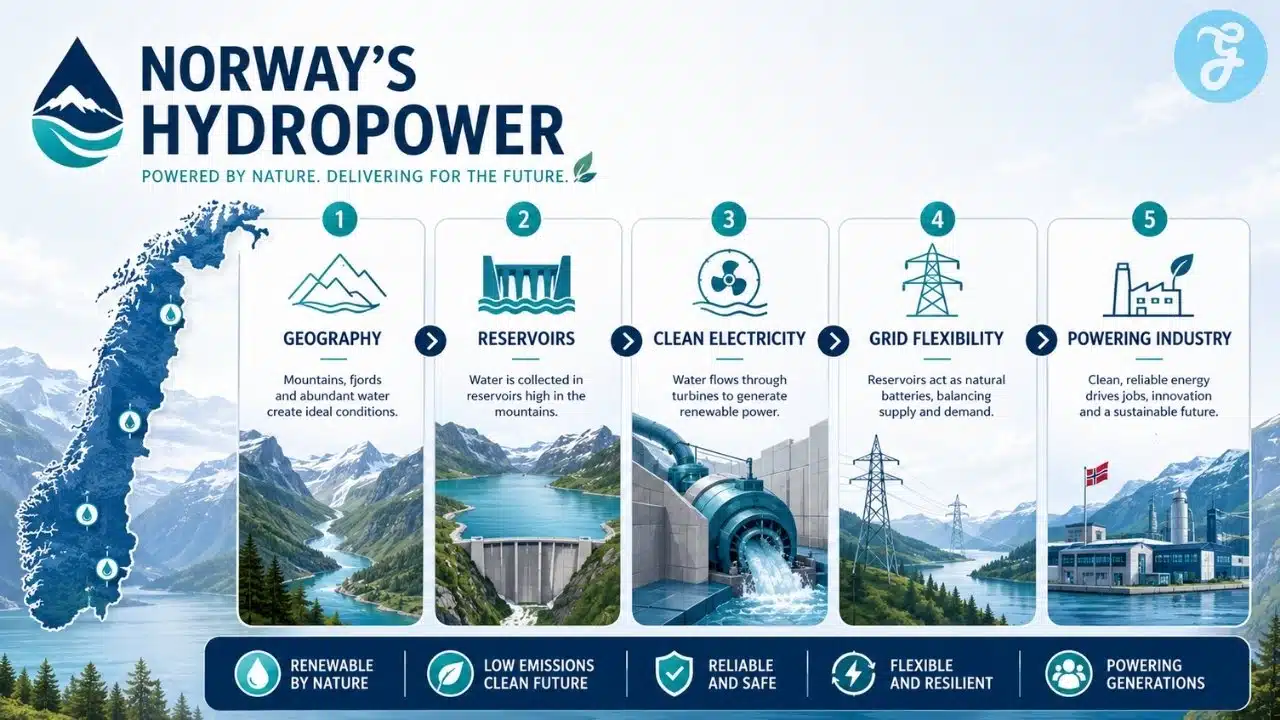
Norway has steep mountains, deep valleys, high rainfall, snowmelt, rivers, lakes, and fjords. That combination creates huge potential energy. Water stored at elevation can be released downward through turbines, turning natural terrain into electricity infrastructure.
This is the geographical reason Norway could build such a hydropower-heavy system. A flat, dry country cannot simply copy Norway’s model by wanting it badly enough. Hydropower depends on the physical landscape.
Best for:
- Understanding why Norway is different from most countries
- Readers comparing hydropower with solar and wind
Why We Chose It:
- Geography explains Norway’s natural advantage
- Mountains and rainfall make reservoir hydropower practical
- The system is rooted in landscape, not only policy
- It shows why hydropower is not equally available everywhere
Things to consider:
- Geography creates opportunity, but engineering turns it into reliable power
- Strong hydropower potential does not remove environmental trade-offs
3. Reservoirs Are the Secret Behind Norway’s Flexible Hydropower
Many people imagine hydropower as water flowing through a dam in real time. Norway’s system is more powerful than that because many plants use reservoirs. Reservoirs store water and allow operators to generate electricity when demand is higher or when prices make production more valuable.
This makes Norwegian hydropower flexible. Unlike solar and wind, which depend more directly on weather at the moment of production, reservoir hydropower can store energy in the form of water. That stored water becomes a strategic energy reserve.
Best for:
- Understanding why Norwegian hydropower is more than river flow
- Readers interested in grid flexibility
Why We Chose It:
- Reservoirs help manage seasonal electricity needs
- Stored water can support winter demand
- Flexible generation helps balance the grid
- It explains why hydropower is valuable beyond simple renewable generation
Things to consider:
- Reservoir levels depend on precipitation and snowmelt
- Environmental concerns can arise when water levels and river flows are altered
4. Norway Has One of Europe’s Cleanest Power Sectors
Norway’s electricity sector has extremely low emissions compared with countries dependent on coal or gas. Norwegian Energy Facts states that Norway has the highest share of electricity produced from renewable sources in Europe and the lowest emissions from the power sector.
This is one of the biggest benefits of Norway’s hydropower dominance. Clean electricity allows homes, businesses, and industries to use electricity with far lower carbon intensity than in fossil-fuel-heavy systems.
Best for:
- Climate and sustainability readers
- Explaining why Norway’s grid is so often praised
Why We Chose It:
- It links hydropower to low electricity emissions
- It explains Norway’s clean power advantage
- It shows why grid composition matters for electrification
- It helps readers connect hydropower with climate policy
Things to consider:
- Low-emission electricity does not mean the entire Norwegian economy is emission-free
- Norway’s oil and gas exports remain a major part of its national energy story
5. Hydropower Helped Norway Build Energy-Intensive Industries
Norway’s abundance of affordable hydropower has shaped its industrial development. The IEA notes that affordable hydropower enabled the development of energy-intensive industries and a high level of electrification in homes and businesses with limited greenhouse gas emissions.
Industries such as aluminium, metals, chemicals, and other power-heavy sectors benefit from reliable electricity. This is one reason hydropower is not just an environmental story in Norway. It is also an economic story.
Best for:
- Understanding the link between electricity and industry
- Readers studying green industrial strategy
Why We Chose It:
- It shows how hydropower shaped Norway’s economy
- Affordable electricity supports industrial competitiveness
- It connects renewable power with jobs and exports
- It explains why electricity policy is also industrial policy
Things to consider:
- Energy-intensive industries still need careful environmental oversight
- Cheap clean power can create demand pressure as more sectors electrify
6. Norway’s Electricity Is Renewable, But Its Economy Is Still Tied to Oil and Gas
This is one of the most misunderstood parts of Norway’s energy story. Norway’s electricity is overwhelmingly renewable, but Norway is also a major oil and gas producer. So, the country is both a clean electricity leader and a fossil fuel exporter.
That tension matters. Norway can truthfully claim a very clean domestic power system, but its national wealth and global energy role are also deeply connected to petroleum. This makes Norway’s energy identity more complicated than a simple “green country” label.
Best for:
- Readers who want a more balanced view
- Avoiding oversimplified clean-energy claims
Why We Chose It:
- It separates domestic electricity from total energy economics
- It gives a more honest view of Norway’s energy profile
- It prevents greenwashing-style confusion
- It adds necessary context to the hydropower success story
Things to consider:
- Hydropower dominance is still real and impressive
- The oil and gas issue does not erase Norway’s clean electricity achievement
7. Hydropower Makes Norway Highly Electrified
Norway’s abundant clean electricity has encouraged high electricity use across homes, businesses, transport, and industry. The IEA says affordable hydropower helped create a high level of electrification in Norwegian homes and businesses.
This matters because clean electricity becomes more valuable when more parts of society can use it. Norway’s electricity system supports electric heating, industrial power use, and electric mobility far more easily than countries still dependent on fossil-fuel-heavy grids.
Best for:
- Understanding Norway’s electrification advantage
- Readers studying clean-energy transitions
Why We Chose It:
- It connects hydropower with everyday energy use
- It explains why clean grids matter for decarbonization
- It shows how electricity can replace fossil fuels in many sectors
- It gives context to Norway’s broader climate strategy
Things to consider:
- Electrification increases demand for power
- More electricity demand can create pressure for new generation and grid upgrades
8. Wind Power Is Growing, But Hydropower Still Dominates
Norway is not only hydropower. Wind power has become a larger part of the electricity mix, but hydropower remains the foundation. The European Environment Agency notes that approximately 98% of Norway’s electricity production is from either hydro or wind power.
This is important because Norway’s future power system may depend on a combination of upgraded hydropower, more wind, offshore wind, grid expansion, and efficiency improvements. Hydropower is still the anchor, but the system is not frozen in time.
Best for:
- Readers interested in Norway’s future energy mix
- Understanding the role of wind beside hydropower
Why We Chose It:
- It shows Norway’s renewable mix is broadening
- It highlights hydropower’s continuing dominance
- It explains why wind is part of future planning
- It prevents the mistaken idea that Norway uses only one technology
Things to consider:
- Wind development can face local opposition and environmental concerns
- Hydropower remains more flexible than variable wind generation
9. Hydropower Can Balance Other Renewable Energy Sources
Reservoir hydropower is valuable because it can increase or reduce production relatively quickly. This flexibility helps balance electricity systems, especially as more variable renewables like wind and solar are added.
Norway’s hydropower system is therefore useful not only domestically, but also in regional electricity cooperation. When connected to neighboring markets, flexible hydropower can help support wider energy balancing.
Best for:
- Understanding why hydropower is strategically valuable
- Readers comparing hydropower with solar and wind
Why We Chose It:
- It explains hydropower’s grid-balancing value
- It shows why reservoirs are more than storage lakes
- It helps readers understand renewable integration
- It connects Norway to Europe’s broader power system
Things to consider:
- Grid interconnectors can also expose Norway to European price dynamics
- Balancing power must be managed alongside domestic supply needs
10. Public Ownership Plays a Major Role in Norway’s Power System
Norway’s hydropower sector is strongly shaped by public ownership and public regulation. The Norwegian Water Resources and Energy Directorate tracks power plant ownership, and its updated ownership material shows how central state, municipal, and county-level ownership remains in the sector.
This matters because hydropower is not just another private commodity in Norway. It is treated as a national resource with long-term public interest. Ownership affects revenue, licensing, reinvestment, and political debate.
Best for:
- Understanding Norway’s governance model
- Readers studying energy policy and public infrastructure
Why We Chose It:
- Ownership shapes how hydropower benefits are distributed
- Public control has historically been central to Norway’s energy model
- It helps explain why hydropower is politically important
- It adds governance context beyond engineering
Things to consider:
- Public ownership does not eliminate conflict over prices, exports, or environmental effects
- Local communities may still disagree with national energy decisions
11. Hydropower Production Can Change from Year to Year
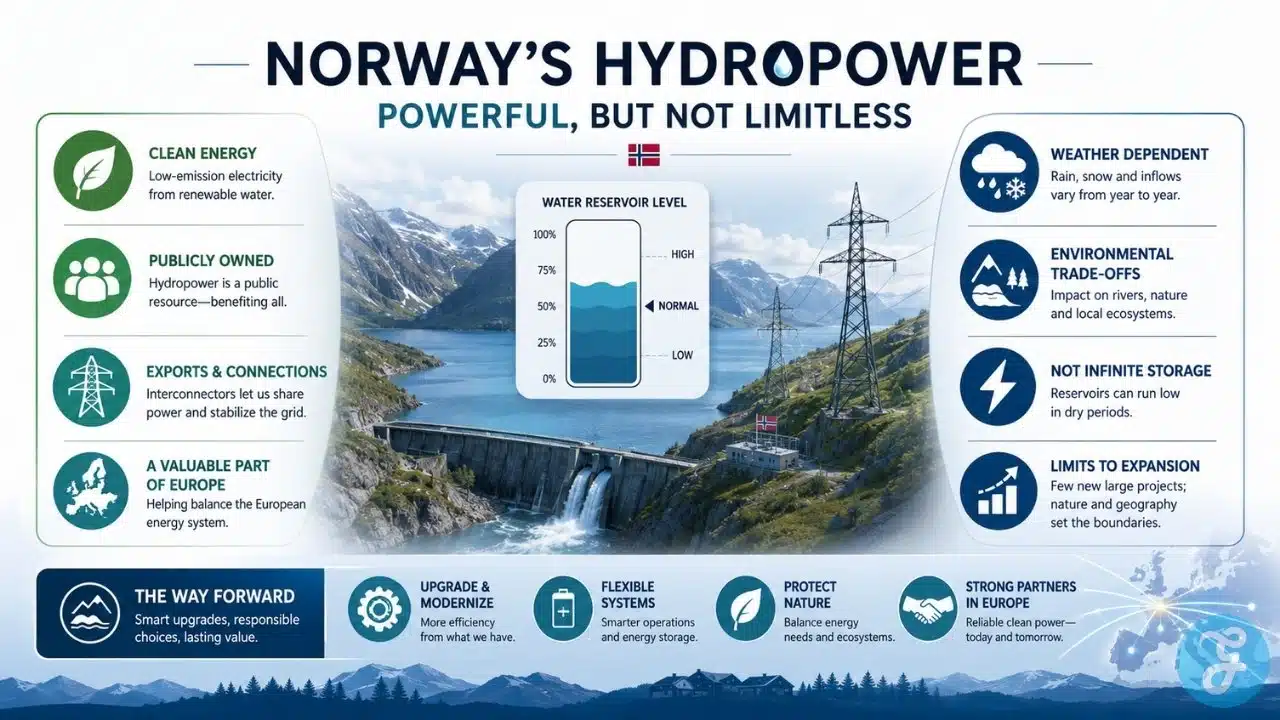
Hydropower depends on water. That means rainfall, snowpack, snowmelt timing, drought, and reservoir levels all matter. A wet year can produce abundant electricity, while a dry year can tighten supply and raise concerns.
This is one of hydropower’s biggest vulnerabilities. It is renewable, but not immune to weather. Climate change may make rainfall patterns, winter snow storage, and extreme weather events more important for long-term planning.
Best for:
- Understanding hydropower risk
- Readers who assume hydropower is automatically stable every year
Why We Chose It:
- It shows why reservoir management matters
- It explains annual variation in hydropower output
- It links hydropower to climate and weather uncertainty
- It adds realism to the renewable-energy story
Things to consider:
- Reservoir systems reduce some seasonal risk
- More grid flexibility and diverse renewables can help manage dry periods
12. Norway Exports and Imports Electricity Through Interconnectors
Norway is connected to neighboring power markets. It can export electricity when production is strong and import when needed. These links connect Norway to the broader Nordic and European electricity system.
This brings benefits and tensions. Interconnectors can improve energy security and market efficiency, but they can also make domestic electricity prices more sensitive to conditions outside Norway. That issue has become politically important when household power prices rise.
Best for:
- Understanding Norway’s role in European electricity markets
- Readers studying energy security
Why We Chose It:
- It shows Norway is not electrically isolated
- It explains how hydropower interacts with regional markets
- It highlights the benefits and debates around exports
- It connects domestic hydropower to European energy politics
Things to consider:
- Exports can create political debate during high-price periods
- Interconnectors are useful, but they must be managed with domestic expectations in mind
13. Norway’s Hydropower System Is Hard to Copy Elsewhere
Many countries would love to copy Norway’s low-carbon electricity system. The problem is that Norway’s model depends on geography, water availability, reservoirs, public investment, long-term planning, and grid integration.
A sunny desert country may be better suited to solar. A windy island may be better suited to wind. A country with limited water resources cannot become Norway by policy alone. Hydropower success is location-specific.
Best for:
- Global energy comparisons
- Readers asking why every country does not use hydropower like Norway
Why We Chose It:
- It explains why Norway is exceptional
- It prevents unrealistic policy comparisons
- It shows that clean-energy strategies must fit geography
- It frames Norway as a model, not a universal template
Things to consider:
- Some countries can still expand hydropower responsibly
- The better lesson is to use each country’s strongest renewable resources wisely
14. Environmental Trade-Offs Still Exist
Hydropower is low-carbon, but it is not impact-free. Dams and reservoirs can affect rivers, fish migration, ecosystems, landscapes, and local communities. Changing river flow can create environmental consequences even when the electricity produced is renewable.
This is why modern hydropower planning often involves environmental licensing, river management, fish protection, and debates over whether old plants should be upgraded instead of building entirely new infrastructure. Clean power still requires responsible planning.
Best for:
- Readers who want a realistic sustainability view
- Understanding the difference between renewable and impact-free
Why We Chose It:
- It adds balance to the hydropower story
- It recognizes ecological concerns
- It shows why licensing and regulation matter
- It prevents oversimplified “hydro is always perfect” messaging
Things to consider:
- Existing hydropower can often be upgraded for efficiency
- New hydropower projects may face stronger environmental scrutiny than older ones did
15. Norway’s Future Will Depend on Upgrading Hydropower, Not Just Building More
Norway already uses much of its best hydropower potential. Future gains may come from upgrading existing plants, improving turbines, expanding capacity where acceptable, adding pumped storage where feasible, strengthening the grid, and combining hydropower with wind and other renewables.
This is also why Norway continues debating other electricity options. A Norwegian government-appointed commission recently advised against starting a major nuclear power program for now, with Reuters reporting that the commission cited Norway’s strong hydropower resources and cheaper renewable alternatives.
Best for:
- Understanding Norway’s next energy challenge
- Readers interested in future clean-power planning
Why We Chose It:
- It looks beyond past success
- It explains why hydropower upgrades matter
- It connects electricity demand growth with future supply planning
- It shows that even Norway must make difficult energy choices
Things to consider:
- Electrification will increase pressure on the power system
- Future choices will involve trade-offs between cost, climate, nature, and security
An Overview Of 15 Facts About Power from Hydroelectricity in Norway
Norway’s hydropower system works because natural conditions and national decisions aligned unusually well. The country had the terrain, water resources, engineering capacity, public ownership model, and industrial demand to build a hydropower-dominated electricity system.
Overview Comparison Table
Here is a quick comparison to help readers connect each fact with the bigger lesson.
| Fact | Core Idea | Why It Matters |
|---|---|---|
| 1 | Nearly 90% of electricity comes from hydro | Establishes Norway’s global hydropower status |
| 2 | Geography made it possible | Shows why Norway has a natural advantage |
| 3 | Reservoirs create flexibility | Explains seasonal and grid-balancing value |
| 4 | The power sector is very low-emission | Connects hydropower with climate performance |
| 5 | Hydropower supports industry | Shows economic impact |
| 6 | Electricity is clean, but the economy still has oil and gas | Adds balance |
| 7 | Norway is highly electrified | Shows how clean power changes daily energy use |
| 8 | Wind is growing beside hydro | Explains the evolving power mix |
| 9 | Hydropower balances renewables | Shows strategic grid value |
| 10 | Public ownership matters | Explains governance and national control |
| 11 | Weather affects production | Highlights hydropower risk |
| 12 | Norway trades electricity | Connects Norway to Europe |
| 13 | The model is hard to copy | Prevents simplistic comparisons |
| 14 | Environmental trade-offs exist | Adds sustainability nuance |
| 15 | Upgrades matter for the future | Looks at the next phase |
Our Top 3 Picks And Why?
For readers who want the most important lessons, three ideas stand above the rest.
| Key Lesson | Why It Stands Out |
|---|---|
| Geography Is Destiny | Norway’s mountains, rainfall, rivers, and reservoirs made the system possible |
| Storage Is the Real Superpower | Reservoirs give Norwegian hydropower flexibility, not just generation |
| Clean Electricity Is Not the Whole Energy Story | Norway’s domestic power is renewable, but its oil and gas economy still matters |
These three points make the story more accurate. Norway is a hydropower success, but it is not a simple fairy tale.
The Real Lesson Behind Norway’s Water-Powered Grid
Norway’s hydropower system is impressive because it is not just a renewable-energy achievement. It is a national infrastructure story. The country used its geography intelligently, built reservoirs and turbines over generations, connected clean electricity to industry and households, and created one of the lowest-emission power sectors in Europe.
But the deeper lesson is not “every country should become Norway.” Most countries cannot. The real lesson is that clean-energy systems work best when they fit local strengths. Norway’s strength is water stored in mountains. Other countries may rely more on solar, wind, geothermal, nuclear, storage, or a mix of several technologies.
The uncomfortable truth is that even Norway’s Power from Hydroelectricity has limits. Climate patterns can shift. Reservoirs can run low. Rivers and ecosystems need protection. Demand is rising as transport, industry, and heating become more electrified. The future will not be solved by old dams alone.
Still, Norway proves one powerful idea: when natural resources, long-term planning, public infrastructure, and clean electricity align, a country can build a power system that looks almost impossible from the outside.
Frequently Asked Questions (FAQs) About Power from Hydroelectricity
Does Norway Get All Its Electricity from Hydropower?
No. Norway gets nearly 90% of its electricity from hydropower, not 100%. The IEA lists hydropower at about 89% of Norway’s electricity generation in 2024, while wind and other sources make up most of the remaining share.
Why Does Norway Use So Much Hydropower?
Norway has ideal geography for hydropower, including mountains, rivers, lakes, snowmelt, and high rainfall. These natural conditions make it possible to store water and release it through turbines to generate electricity.
Is Norway’s Hydropower Good for the Climate?
Yes, Norway’s hydropower-dominated electricity system gives it one of Europe’s lowest-emission power sectors. Norwegian Energy Facts states that Norway has Europe’s highest renewable electricity share and the lowest power-sector emissions.
Can Other Countries Copy Norway’s Hydropower Model?
Only partly. Countries need the right geography, rainfall, rivers, storage potential, and infrastructure. Norway is a useful model, but many countries will need different renewable strategies based on their own resources.
What Is the Biggest Challenge for Norway’s Hydropower Future?
The biggest challenges include rising electricity demand, climate-related water variability, environmental protection, grid expansion, and deciding how much to upgrade existing hydropower versus adding new renewable sources.