
Navigating endless options to Choose the Right University Abroad feels overwhelming when juggling costs, credits, and visas. Instead of chasing flashy names, prioritize academic alignment, budget, and lifestyle fit. While Open Doors reports nearly 300,000 American students studied overseas recently, with Italy, Spain, the UK, and France hosting 45 percent, these popular destinations should inspire, not dictate, the final decision.
To cut through the noise, smart applicants apply strategic filters to build a practical shortlist. Leveraging resources like QS World University Rankings and QS Apply helps identify institutions matching specific ambitions. Beyond rankings, critically evaluate transfer credit policies, financial aid, and regional work rules. Systematically assessing these essential factors allows prospective students to confidently select an ideal, rewarding international program.
Clarify Your Goals
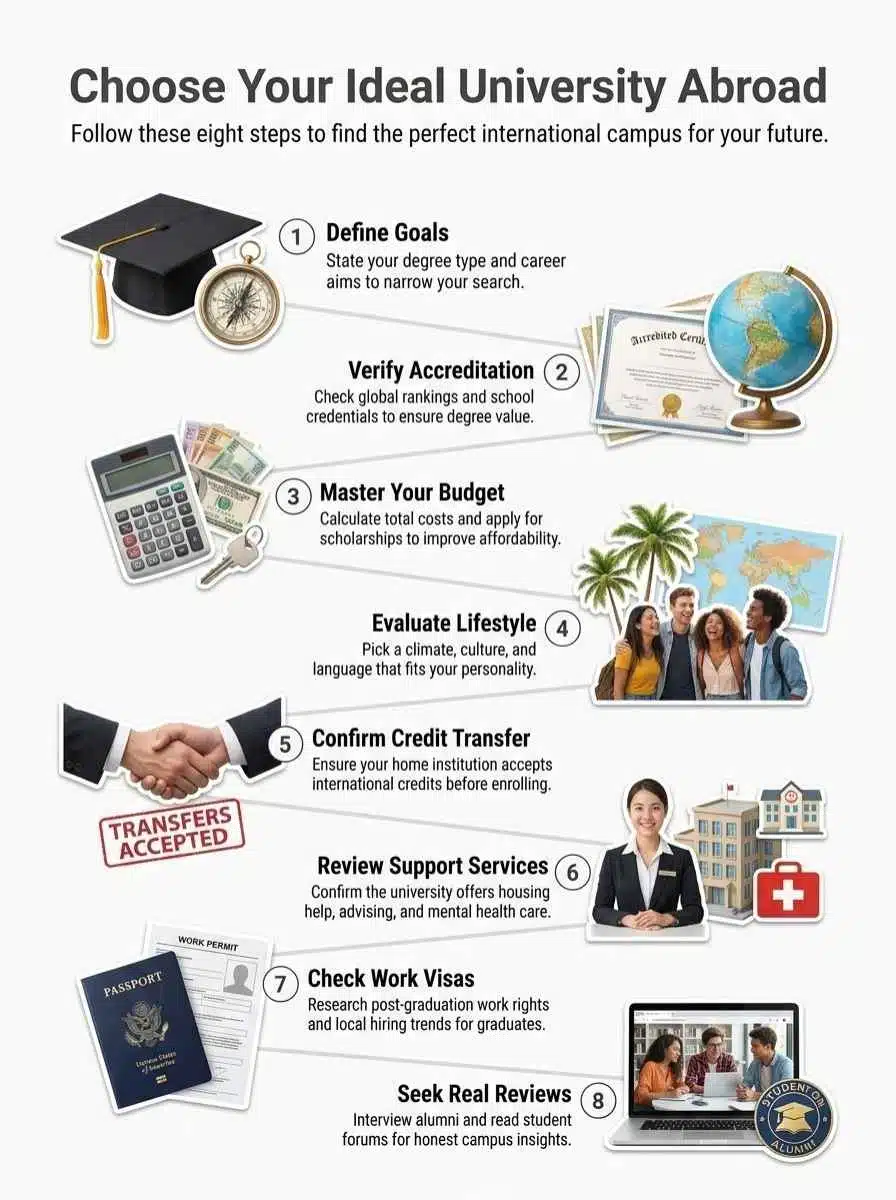
Before you compare Madrid, Florence, London, Prague, Tokyo, Kyoto, Copenhagen, or a smaller option in Costa Rica or Estonia, decide what you want your experience to do for you. A clear goal cuts through the noise fast.
Define your academic and career objectives
Start with one sentence: “I want this study abroad program to help me…” Then finish it with something concrete, like earning upper-level credits in international relations, improving Spanish, building a design portfolio, or testing whether you want a career overseas.
- Pick your main outcome: a bachelor’s degree abroad, semester credit, language learning, or career exploration.
- Name the field you want to study, because “good academics” is too vague to guide a real choice.
- Set one personal goal, such as cultural immersion, confidence, or personal growth.
- Set one practical goal, such as internship access, easier credit transfer, or lower cost of living.
If you are aiming for a bachelor’s degree abroad, read the major page before you read the marketing page. Check the required courses, internship options, grading style, and language of instruction first.
Specific examples help. Georgetown says its students study in 57 countries, and its Villa Le Balze near Florence suits readers who want a structured program in Italy with a strong academic setting. Temple University Rome, founded in 1966, organizes study abroad courses into tracks such as Architecture and Urban Studies, Visual Arts, International Business, and Humanities and Social Studies, so it works especially well when you already know your field.
Decide if you prioritize education, experience, or both
Your program model should match your personality. Yale’s study abroad guidance points out that direct enrollment usually gives you a more local university experience but expects more independence, while study centers and provider programs tend to offer more day-to-day support.
- Direct enrollment: best if you want real campus life with local students and can handle a more independent system.
- Provider model: good if you want built-in advising, orientation, and smoother pre-departure preparation.
- Faculty-led or short-term options: useful if your degree plan is tight and you want credits with less risk.
- Language immersion programs: strongest fit if your top goal is speaking the local language every day.
If language immersion matters most, choose a program that puts you in regular classes with local students or places you with a host family. If you want a softer landing, a provider with strong on-site staff, such as CIEE study abroad, can make culture shock easier to manage while you settle in.
Clear goals beat a long wish list. A short list of schools is where smart decisions start.
Research Universities and Programs
Once your goals are clear, start checking real program fit. This is where a school stops being an idea and starts becoming a serious option.
Explore universities that offer your desired program
Start with subject fit, not brand recognition. The QS World University Rankings by Subject 2026 covers 55 narrow subjects across five broad areas and includes more than 1,900 institutions, so it is far more useful than a generic top universities list when you need to judge your exact major.
Times Higher Education’s 2026 subject tables use 18 performance indicators across 11 subject areas. That makes them a smart second opinion if a university looks famous overall but seems weaker in your field.
| What to Check | Why It Matters | Helpful Tools |
|---|---|---|
| Subject ranking | A high score in your major matters more than an impressive overall rank. | QS World University Rankings, Times Higher Education |
| Course catalog | You need enough classes in your major, at the right level, in the right term. | University course pages, Terra Dotta listings, CollegeData |
| Language of instruction | This shapes your grades, social life, and how immersive the experience will feel. | Program pages, LanguageCourse, Duolingo |
| Student support | Strong advising and housing help can save you a lot of stress later. | Student services pages, CIEE study abroad, The Princeton Review |
| Daily fit | Cost of living, weather, commute, and housing style affect your life every day. | Official housing pages, student reviews, Go Overseas |
Check accreditation and global rankings
Rankings can open doors, but accreditation protects your credits and future options. The U.S. Department of Education explains that the school you want to attend, your employer, or a state licensing board decides how foreign qualifications are recognized, which means your home campus needs to confirm transfer rules before you commit.
- Ask your registrar whether credits from that university have transferred before.
- Ask your department chair if the exact classes can count toward your degree requirements.
- If you are in nursing, engineering, education, or another licensed field, ask about professional recognition early.
- Use rankings as a filter, then judge the actual department, course depth, and advising.
For college study abroad, a school with a lower overall rank but a stronger department, clearer course approvals, and better advising is often the smarter pick than a famous name that does not really fit your major.
Consider Your Financial Situation
Money shapes almost every part of studying abroad, so build your budget early. Guessing is where good plans start to break down.
Determine your budget for tuition and living expenses
Use a spreadsheet or bank app and price the full picture: tuition, housing, meals, local transit, flights, books, phone plan, passport, student visa fees, insurance, and an emergency fund. Georgetown’s study abroad cost of attendance also counts airfare, housing, meals, passport and visa fees, insurance, and personal expenses, and that is a smart model for your own budget sheet.
Do not assume your U.S. health coverage will protect you overseas. The State Department notes that Medicare and Medicaid do not cover expenses abroad, so travel health insurance belongs in your budget from the start.
Research available scholarships and financial aid
Funding can turn a “maybe” into a real option. The U.S. Department of State says some approved study abroad programs can use federal financial aid, so ask your home financial aid office whether your study abroad program qualifies before you rule it out.
| Funding Source | Who It Fits | Why It Helps |
|---|---|---|
| Federal and home-campus aid | Students using approved programs through their U.S. institution | Can reduce out-of-pocket cost if your home school packages the aid correctly |
| Gilman Scholarship | Pell Grant recipients | The official program says it will award nearly 3,000 scholarships this academic year, with awards up to $5,000 |
| Critical Language Scholarship | Students focused on language immersion | This fully funded summer program can deliver the equivalent of about one academic year of language study in eight weeks |
| Fulbright U.S. Student Program | Recent graduates and graduate students | Strong fit if you want post-grad study, research, or teaching abroad |
- File FAFSA and campus aid forms as early as possible.
- Ask whether grants travel with you, or whether only loans do.
- Check whether scholarship money can be used for housing, flights, and visa costs, not just tuition.
- Ask whether credits must transfer back for aid to stay valid.
If you are comparing two schools that feel equally strong, the one with clearer funding rules and lower hidden costs is usually the safer choice.
Evaluate Location and Lifestyle

The city you choose will shape your mornings, commute, stress level, and even how much you spend on lunch. This part matters more than many readers expect.
Assess language, culture, and climate preferences
Open Doors 2025 shows that Italy, Spain, the United Kingdom, and France stayed at the top for U.S. students, while Japan moved into fifth place for the first time in 2023/24. That tells you where study abroad infrastructure is well established, but fit still matters more than trendiness.
- If Madrid or Mexico City interests you, check whether your classes are in Spanish, English, or a mix.
- If Florence or Rome appeals because of art and history, look at how much on-site instruction the program includes.
- If Copenhagen or other Denmark options are on your list, think about winter daylight, bike-based commuting, and housing pressure before you fall for the brochure.
- If Tokyo or Kyoto is your dream, decide whether you want full language immersion or an English-taught track with Japanese support.
Use Duolingo, FluentU, and short placement tools from Language Course to test whether daily life in the local language feels exciting or exhausting. Ten minutes a day for a month will teach you more than a glossy gallery.
The CDC advises students studying abroad to bring official immunization records and plan ahead for both physical and mental health care. That matters even more if you manage medication, counseling, or a disability accommodation at home.
Determine proximity to home and ease of travel
If quick trips home matter, look at total travel time, not just miles. A cheaper city with two awkward connections can feel farther away than a more expensive hub with one simple route.
- Check the nearest airport or rail connection and how long it takes to reach campus.
- Look at holiday and break travel, because peak-season prices can change your budget fast.
- Think about time-zone distance, especially if you want to stay closely connected with family.
Before departure, enroll in the Smart Traveler Enrollment Program, or STEP. It is free and sends U.S. embassy and consulate alerts while you are abroad, which is a simple safety step too many students skip.
Check Program Details and Support
This is where strong options get separated from risky ones. Small details here can save you a semester of frustration later.
Verify if credits will transfer to your home country
Ask for written approval before you pay a deposit. In Europe, the ECTS framework treats 60 credits as a full academic year, so one semester is often about 30 ECTS. That gives you a useful starting point, but your home university still decides how those credits count toward your degree.
- Get the syllabus for every class you hope to take.
- Ask your academic advisor or registrar to approve exact equivalents, not just general electives.
- Save the Learning Agreement, course descriptions, and grading scale.
- If you plan to enter a licensed field, ask the department chair or licensing board whether the coursework will count.
Terra Dotta can help if your campus uses it. The platform is built to manage study abroad catalogs, applications, documents, and approvals in one place, which makes the application process easier to track.
Ensure the program offers student support services
Strong support should be visible before you apply. Look for academic advising, mental health counseling, disability support, housing help, emergency contacts, tutoring, and career services on the program page, not buried in a brochure.
- Check whether the program has an on-site staff member, not just a general email address.
- Look for housing support, especially in expensive cities with tight rental markets.
- Ask how orientation works and whether it covers culture shock, local safety, and everyday logistics.
- Find out who helps if a class is canceled, housing falls through, or you need medical support.
If you want high-touch support, provider models can be useful. CIEE study abroad programs, for example, highlight resident directors, support staff, and health and safety teams, which can matter a lot if this is your first long stay overseas.
The CDC also recommends that students share chronic mental health conditions and support needs with their international programs office before departure. That step can feel personal, but it often decides how smooth your first month will be.
Investigate Post-Graduation Opportunities
If you may want to intern, work, or stay abroad after graduation, check those rules before you fall in love with a campus. This is one of the biggest gaps in weaker guides.
Look into employability and career prospects
Start with hard signals: internship pipelines, employer fairs, alumni outcomes, and whether career services actively support international students. A beautiful city will not help much if the program has weak employer ties or little résumé support.
- Look for internship modules, work placement offices, and employer events tied to your major.
- Check recent alumni paths on LinkedIn to see where graduates actually land.
- Ask whether career services help international students with local hiring rules and job search strategy.
- Give extra credit to programs that blend academics with internships or research.
Consider visa and immigration requirements for work
Work rules vary a lot by country, and they can change quickly. As of May 2026, the United Kingdom’s Graduate visa lasts 2 years if you apply on or before December 31, 2026, then drops to 18 months for applications on or after January 1, 2027. PhD graduates still get 3 years.
| Country | Typical Post-Study Work Option | Why It Matters |
|---|---|---|
| United Kingdom | Graduate visa, 2 years through December 31, 2026, then 18 months from January 1, 2027 | Useful if you want time to job hunt after graduation |
| Canada | Post-graduation work permit can last up to 3 years at eligible institutions | Strong option if you want an open work permit after graduation |
| New Zealand | Post Study Work Visa can last up to 3 years, depending on the qualification | Helpful if you want a smaller market with a clear post-study path |
Use these immigration requirements as a filter, not a promise. A university can look perfect on paper, but if its program does not connect well to local employers or to a realistic student visa and work pathway, it may not serve your long-term plan.
Seek Insights and Reviews
Official pages tell you what a program promises. Students tell you what daily life actually feels like.
Talk to current students and alumni for their experience
Reach out through LinkedIn, alumni offices, student clubs, and campus forums. Ask short, specific questions, because you will get much better answers.
- How easy was course approval before departure?
- What did housing really cost each month?
- Did you make local friends, or mostly stay with other U.S. students?
- How strong were advising, counseling, and career services once you arrived?
- What surprised you most about language immersion, culture shock, or the workload?
Read testimonials and reviews about the university
Use Go Overseas, CollegeData, The Princeton Review, and student communities like Reddit as a reality check, then verify every hard rule on the official university page. Reviews are excellent for spotting patterns about food, commute stress, housing quality, and social life. They are a poor place to trust visa deadlines or transfer credit rules.
Use reviews to understand the experience. Use official documents to make the decision.
Make Your Decision

Once you have a short list, stop researching in circles and compare the same factors for each option. A simple system beats endless scrolling.
Compare pros and cons of your shortlisted options
| Factor | What to Compare | Smart Question to Ask |
|---|---|---|
| Academics | Major fit, course depth, subject ranking, teaching style | Will this school clearly move me closer to my degree or career goal? |
| Affordability | Tuition, cost of living, flights, insurance, visa costs | Can I afford the real total, not just the tuition headline? |
| Support | Advising, housing help, health services, orientation | If something goes wrong, who actually helps me? |
| Location | Language, climate, transit, safety, distance from home | Can I picture a normal week here, not just a fun weekend? |
| Future options | Internships, alumni network, post-grad work rules | Does this choice open doors after graduation? |
A short scorecard works better than endless tabs. Give each school a 1 to 5 score for academics, cost of living, support, cultural immersion, and career outcomes, then add one note about gut fit.
Trust your instincts and plan your application timeline
Your timeline matters more than most readers expect. Build one calendar for transcripts, references, language tests, scholarships, passport renewal, and student visa paperwork, then another for housing and pre-departure preparation.
- If the United Kingdom is on your list, learn the UCAS rhythm early. In the 2026 cycle, applicants could submit up to five undergraduate choices, and most equal-consideration applications were due January 14, 2026, with an October 15, 2025 deadline for Oxford, Cambridge, and most medicine, dentistry, and veterinary courses.
- If you are applying through a provider or your home university, ask whether advisor approvals or Terra Dotta forms have earlier campus deadlines than the host school.
- If you need IELTS, TOEFL, or another test, book it earlier than you think. Score reporting can quietly slow the whole application process.
- If scholarships matter, finish your shortlist first. Strong essays explain why that exact university, city, and study abroad program fit your academic goals.
Trust your instincts, but do it after the facts are on the page. If one school keeps winning on program fit, support, and finances, that is usually your answer.
Final Thoughts
You do not need the perfect school, you need the right study abroad choice for your goals, budget, and future plans. If you compare subject strength, real costs, transfer credit, support, and post-grad options before you apply, you will save money and avoid painful surprises later.
Start your short list today, talk with an academic advisor, and move one step at a time. A smart decision now makes the whole studying abroad experience feel a lot easier.
Frequently Asked Questions (FAQs) About Choosing the Right University Abroad
1. How do I pick the right country and university to study abroad?
Start with your goals, budget, and language needs, then match programs and places that fit. Check program reputation, course rankings, visa requirements, tuition fees, and living costs, and kick the tires with a visit or a virtual tour.
2. Do program reputation and course rankings matter?
They matter for jobs and funding, but fit with your goals and the course content often matters more.
3. How can I manage tuition fees, living costs, and find scholarships?
Make a clear budget that covers tuition fees, living costs, and housing. Search scholarships and other financial aid, learn the application process, and check part-time work rules.
4. How do I check campus life, accommodation, and meet application requirements?
Talk to current students, read forums, and tour campus, ask, “What is daily life like?” Look at housing options, student services, and safety. Follow the application process, meet language requirements, and prepare visa documents.