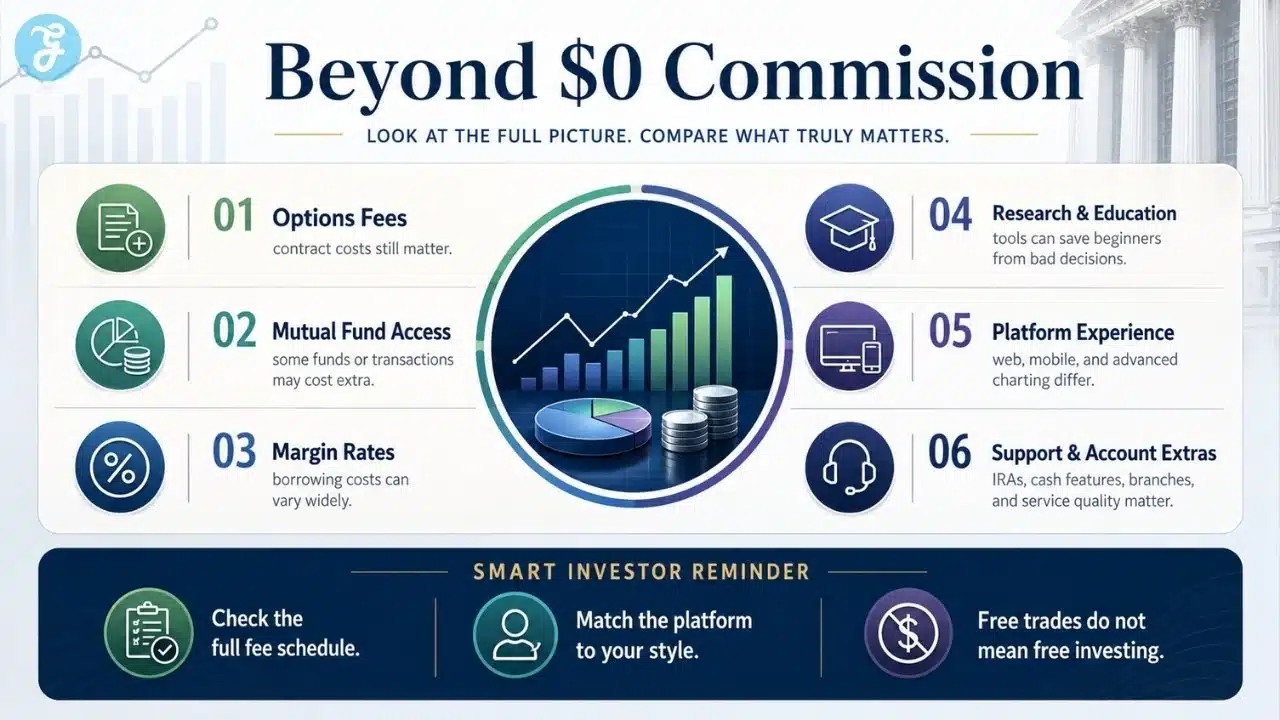
Picking a brokerage account in 2025 is both easier and more annoying than it used to be. Easier because many major brokers now offer $0 online stock and ETF trades. Annoying because “$0 commission” does not mean “everything is free,” despite what marketing departments would love you to believe while smiling beside a stock chart.
The best US Brokerage Accounts are no longer separated only by trading fees. The real differences now come from options contract fees, mutual fund access, cash features, margin rates, research tools, trading platforms, fractional shares, retirement tools, customer support, and how painful the app feels after five minutes. For this comparison, I focused on five strong brokerage accounts for different investor types: Fidelity, Charles Schwab, Vanguard, E*TRADE, and Interactive Brokers.
Our Selection Methodology
This comparison focuses on mainstream brokerage accounts that are widely available to U.S. investors and useful for long-term investing, self-directed trading, ETFs, mutual funds, retirement planning, or active market research.
Here is the selection logic used for this guide.
| Selection Factor | Why It Matters |
|---|---|
| Stock And ETF Costs | Most investors now expect $0 online U.S. stock and ETF trades |
| Options Fees | Options traders still pay per-contract fees at many brokers |
| Account Minimums | Beginner investors need low barriers to start |
| Investment Choices | Stocks, ETFs, mutual funds, bonds, options, and international access all matter |
| Research Tools | Better research helps investors make more informed decisions |
| Platform Experience | Mobile apps, web platforms, and advanced tools affect daily usability |
| Long-Term Investor Fit | Retirement tools, index funds, and low-cost portfolios matter |
| Active Trader Fit | Order tools, margin rates, and market access matter for frequent traders |
One note before we start: brokerage fees change, and some costs depend on trade type, account type, account size, order routing, fund family, or optional services. Always check the broker’s latest official fee schedule before opening or funding an account.
Whom This Is For
This guide is useful for beginners, long-term investors, ETF investors, retirement savers, casual stock buyers, active traders, and anyone comparing brokerage accounts by fees and features.
It is especially relevant for:
- new investors opening their first brokerage account;
- ETF and index fund investors;
- options traders comparing contract fees;
- long-term retirement-focused investors;
- advanced traders who need better platforms;
- investors deciding between full-service brokers and low-cost trading platforms.
Now let’s compare the five brokerage accounts that stand out.
5 Best US Brokerage Accounts Compared By Fees And Features
These are not ranked only by cost. Most major brokers are already cheap for basic stock and ETF trades. The better question is which broker gives you the right mix of price, features, tools, support, and investment access.
1. Fidelity Brokerage Account
Fidelity is one of the strongest all-around choices for investors who want low costs, strong research, retirement tools, mutual funds, ETFs, fractional shares, and a polished customer experience. Fidelity says its brokerage account has no annual account fee, no minimum to open, and $0 commission for online U.S. stock, ETF, and option trades, although options contract fees still apply.
Fidelity is especially attractive for long-term investors because of its research tools, retirement planning features, zero-expense-ratio index funds, and wide product lineup. It also offers competitive margin rates “as low as 7.50%,” according to its pricing page, though margin rates depend on debit balance and can change.
Best for:
- Long-term investors who want a strong all-around brokerage
- ETF, mutual fund, retirement, and research-focused investors
Why We Chose It:
- $0 online U.S. stock and ETF trades
- No minimum to open a standard brokerage account
- Strong research, screening, and retirement tools
- Good balance between beginner usability and advanced features
Things to consider:
- Options trades still have contract fees
- Some niche ETFs or products may have extra platform or transaction considerations, so check the latest fee schedule before trading
2. Charles Schwab Brokerage Account
Charles Schwab is another excellent all-around brokerage account, especially for investors who want strong customer support, branch access, research, education, banking integration, and trading platforms inherited from the TD Ameritrade integration. Schwab lists $0 online commissions for listed stocks and ETFs, $0 online base commission for options, plus a $0.65 per-contract fee, and no account or trade minimums.
Schwab is strong for investors who want more than a simple trading app. It offers broad investment choices, educational resources, retirement accounts, cash and banking features, and advanced trading through thinkorswim. Schwab’s pricing page also says there are no fees to open and maintain a Schwab account.
Best for:
- Investors who want strong tools, support, and branch access
- Active traders who want thinkorswim plus a full-service brokerage ecosystem
Why We Chose It:
- $0 online listed stock and ETF trades
- No account minimums for standard brokerage accounts
- Strong trading platform options
- Good mix of education, research, banking, and support
Things to consider:
- Options still cost $0.65 per contract
- Some mutual funds, broker-assisted trades, OTC equities, and foreign securities can carry additional fees
3. Vanguard Brokerage Account
Vanguard is best known for long-term, low-cost investing, especially index funds and ETFs. It is not the flashiest trading platform, and that is kind of the point. Vanguard works best for investors who want to buy diversified funds, keep costs low, and avoid turning investing into a hobby that eats their weekends.
Vanguard’s brokerage account can hold mutual funds, ETFs, stocks, bonds, and more. Its fee pages show a $25 annual account service fee for brokerage accounts, but Vanguard says this fee can be avoided under certain conditions, including qualifying assets and account setup rules.
Best for:
- Long-term index fund and ETF investors
- Retirement-focused investors who prefer simple, low-cost portfolios
Why We Chose It:
- Strong reputation for low-cost index investing
- Excellent fund lineup for long-term investors
- Good fit for retirement accounts and buy-and-hold strategies
- Less tempting for overtrading, which is a feature if we are being honest
Things to consider:
- Platform and trading tools are less advanced than Schwab, Fidelity, or Interactive Brokers
- Investors should check account service fee waiver conditions before opening an account
4. E*TRADE Brokerage Account
E*TRADE is a strong choice for investors who want a polished online brokerage with solid research, good mobile tools, options trading features, and a broad account lineup. E*TRADE says standard commissions for stock and options trades are $0, with an additional $0.65 per options contract.
E*TRADE also notes that the options contract fee can fall to $0.50 for customers who execute at least 30 stock, ETF, and options trades per quarter. That makes it more attractive for moderately active options traders than brokers that keep everyone at the standard contract fee.
Best for:
- Options traders and self-directed investors who want a polished platform
- Investors who want a strong mix of web, mobile, research, and trading tools
Why We Chose It:
- $0 online stock and ETF trades
- Options fee discount is available for active traders
- Strong platform experience for self-directed investors
- Broad account types and investment choices
Things to consider:
- Options contract fees still apply
- Very advanced traders may prefer Interactive Brokers for global markets and professional-grade pricing
5. Interactive Brokers
Interactive Brokers is best for advanced investors, active traders, global market access, low margin rates, and people who do not faint when they see a platform with more buttons than a spaceship cockpit. It offers two main plans: IBKR Lite and IBKR Pro. IBKR says IBKR Lite provides commission-free trades for U.S. exchange-listed stocks and ETFs for eligible U.S. and Singapore residents, subject to rules and exclusions.
Interactive Brokers stands out because of its global market access, sophisticated tools, margin pricing, and professional-style trading infrastructure. IBKR Lite is more approachable for casual U.S. stock and ETF investors, while IBKR Pro is better for active traders who care about routing, margin, and international access. Its comparison page shows IBKR Lite has commission-free U.S. exchange-listed stocks and ETFs, while IBKR Pro uses fixed or tiered pricing.
Best for:
- Active traders and globally focused investors
- Investors who care about advanced tools, margin, and international market access
Why We Chose It:
- IBKR Lite offers $0 commissions on eligible U.S.-listed stocks and ETFs
- Strong global market access
- Advanced tools for experienced traders
- Strong fit for margin-aware and multi-asset investors
Things to consider:
- Less beginner-friendly than Fidelity, Schwab, or Vanguard
- Pricing is more complex, especially outside simple U.S. stock and ETF trades
An Overview Of 5 US Brokerage Accounts Compared By Fees And Features
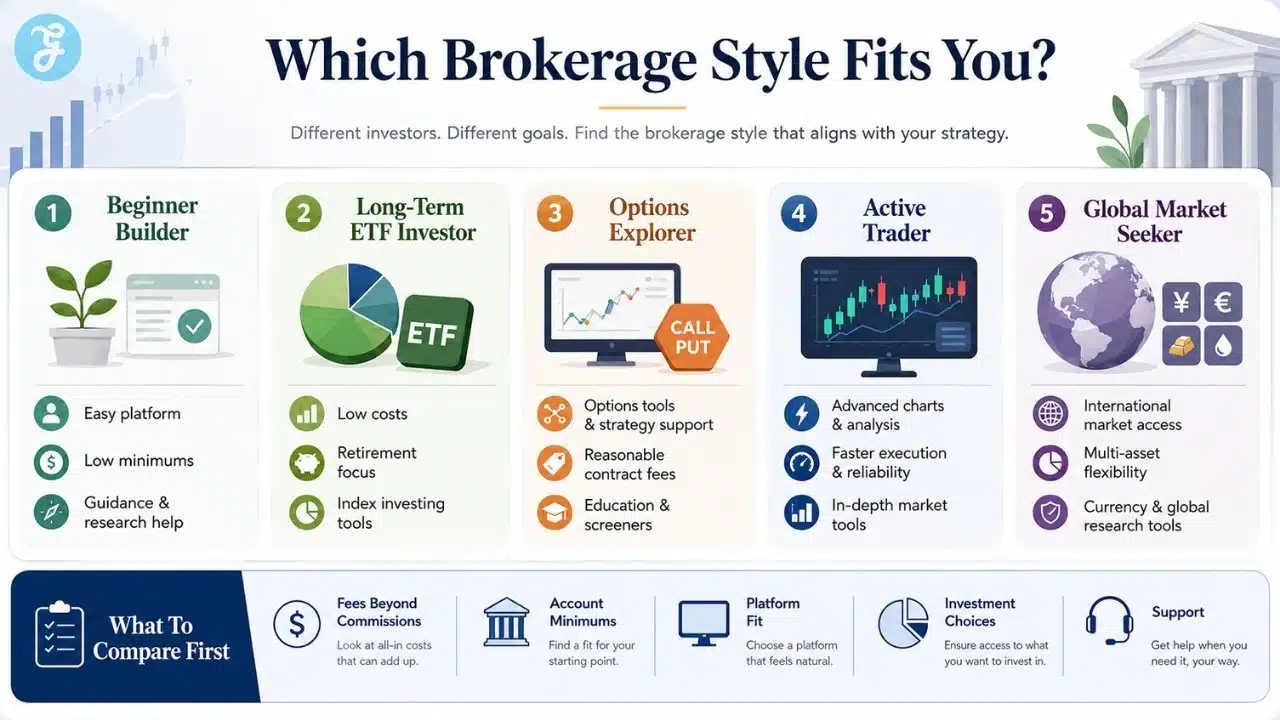
All five brokers are strong, but they serve different investors. Fidelity and Schwab are the safest all-around picks. Vanguard is strongest for long-term fund investors. E*TRADE is a good middle ground for self-directed and options-focused investors. Interactive Brokers is best for advanced traders and global market access.
Overview Comparison
Here is a simple comparison to help readers quickly match each brokerage account with the right use case.
| Brokerage Account | Stock And ETF Commission | Options Cost | Best Strength | Best Fit |
|---|---|---|---|---|
| Fidelity | $0 online U.S. stocks and ETFs | Contract fee applies | Best all-around investor experience | Long-term investors and researchers |
| Charles Schwab | $0 online listed stocks and ETFs | $0.65 per contract | Support, tools, thinkorswim, branch access | Full-service self-directed investors |
| Vanguard | Check latest schedule | Check latest schedule | Low-cost index funds and retirement investing | Buy-and-hold fund investors |
| E*TRADE | $0 standard stock trades | $0.65 per contract, or $0.50 with 30+ trades per quarter | Strong web and options platform | Self-directed and options investors |
| Interactive Brokers | IBKR Lite: $0 eligible U.S.-listed stocks and ETFs | Plan-based pricing | Global markets and advanced trading | Active and advanced investors |
Our Top 3 Picks And Why?
These three stand out because they solve the most common investor needs.
| Pick | Why It Stands Out |
|---|---|
| Fidelity | Best overall balance of low fees, research, retirement tools, and ease of use |
| Charles Schwab | Best for investors who want strong tools, support, and thinkorswim access |
| Interactive Brokers | Best for advanced traders and global market access |
Vanguard deserves special mention for long-term index investors, but it is less of a full-featured trading platform. E*TRADE also remains a strong pick for options-focused self-directed investors.
How To Choose The Right US Brokerage Accounts By Yourself
Choosing a brokerage account should start with how you actually invest. A beginner buying ETFs once a month does not need the same platform as an active options trader. A retirement investor does not need a global derivatives workstation. A day trader does not need a broker whose main personality trait is “please do less.”
The Selection Framework:
- Start With Your Investing Style: Long-term ETF investors, options traders, retirement savers, and active traders need different platforms.
- Check Real Costs: Look beyond stock commissions and compare options fees, mutual fund transaction fees, margin rates, wire fees, and account service charges.
- Match Tools To Skill Level: Beginners need clarity; advanced traders need routing, charting, margin, and multi-asset tools.
- Look at Account Ecosystem: IRAs, banking, fractional shares, cash sweep, research, and support can matter as much as commissions.
The Final Checklist
Before opening a brokerage account, ask these five questions.
- Does it charge $0 for the trades I will actually make most often?
- Are options, mutual funds, bonds, or margin costs reasonable for my needs?
- Is the platform simple enough for me to use confidently?
- Does it offer the account types I need, including taxable accounts and IRAs?
- Can I get support when something goes wrong?
The Best Brokerage Is The One That Matches Your Behavior
The brokerage war has mostly moved beyond simple stock commissions. Most major brokers now offer $0 online stock and ETF trades, so the winner depends on features, service, investing style, and hidden or secondary costs. Reuters reported in 2026 that commission-free trading has reshaped the U.S. brokerage and ETF market, with brokers looking for new revenue sources as trading commissions fell toward zero.
That is why the best US Brokerage Accounts are not automatically the cheapest accounts on the homepage. Fidelity is the best all-around pick for many investors. Schwab is excellent for tools, support, and active trading access. Vanguard is ideal for disciplined long-term fund investors. E*TRADE is strong for options and self-directed investors. Interactive Brokers is a serious platform for advanced traders and global access.
The uncomfortable truth is that a good brokerage account will not make you a good investor by itself. It can reduce friction, lower fees, and give you better tools. But it cannot stop panic selling, meme-stock chasing, or buying something because a stranger with a ring light said it was “about to explode.” Choose the account that supports your actual strategy, not your fantasy version of yourself.
Frequently Asked Questions (FAQs) About US Brokerage Accounts
What Are US Brokerage Accounts?
US Brokerage Accounts are investment accounts that let investors buy and sell assets such as stocks, ETFs, mutual funds, bonds, and options. They can be taxable accounts or retirement accounts, depending on the account type.
Which Brokerage Account Is Best For Beginners?
Fidelity and Charles Schwab are two of the strongest beginner-friendly choices because they combine $0 online stock and ETF trades with research, education, support, and broad investment choices. Vanguard is also strong for beginners who want simple long-term index investing.
Do US Brokerage Accounts Charge Fees?
Many major brokers charge $0 for online U.S. stock and ETF trades, but other fees may apply. Options contract fees, broker-assisted trades, mutual fund transaction fees, margin interest, wire fees, and account service charges can still matter.
Which Brokerage Is Best For Long-Term Investors?
Fidelity, Schwab, and Vanguard are all strong for long-term investors. Vanguard is especially strong for low-cost index fund investors, while Fidelity and Schwab offer broader research, tools, and account features.
Which Brokerage Is Best For Active Traders?
Interactive Brokers is one of the strongest choices for advanced active traders because of its tools, global market access, and pricing structure. Schwab is also strong because of thinkorswim, while E*TRADE is useful for self-directed and options-focused traders.