Commercial real estate faces mounting pressure from soaring utility costs, stricter regulations, and tenant demands for superior indoor air quality. Navigating these modern challenges requires a strategic approach to Green Building Real Estate Investment. Research from the Massachusetts Institute of Technology confirms a distinct “green premium” for sustainable spaces, while Environmental Protection Agency data demonstrates that high-performing properties significantly reduce operating expenses.
These sustainable practices directly translate into immediate savings, rapidly boosting net operating income (NOI). Beyond simple cost-cutting, eco-friendly commercial assets attract premium tenants, secure stronger leasing rates, and facilitate smarter long-term deals. Discover how optimizing property performance goes beyond meeting environmental standards—it actively transforms baseline sustainability into reliable cash flow and a formidable competitive advantage in today’s demanding market.
The Rise of Green Buildings in Commercial Real Estate
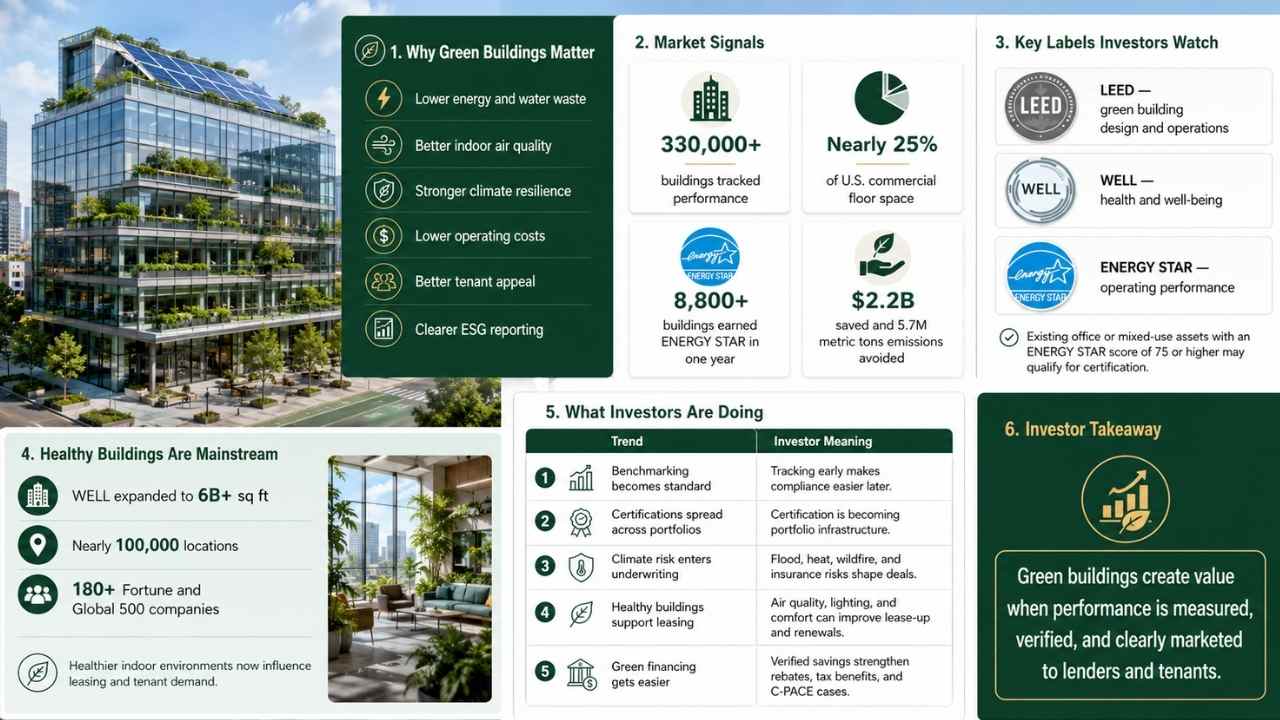
Green buildings moved from a nice extra to a real investment filter. In the latest EPA figures, more than 330,000 buildings, representing nearly 25% of U.S. commercial building floor space, used ENERGY STAR Portfolio Manager to track performance. That matters because the investors who measure first usually underwrite better and spot waste sooner.
It also shows how mainstream this has become. In the same data set, more than 8,800 commercial buildings earned the ENERGY STAR in one year, saving more than $2.2 billion and avoiding more than 5.7 million metric tons of emissions.
Definition and Importance of Green Buildings
At the property level, green buildings are simply assets designed or operated to use less energy, waste less water, improve indoor air quality, and hold up better under climate stress. The money shows up through lower operational costs, better tenant appeal, and cleaner reporting for environmental, social, and governance goals.
Green buildings create value when performance is measured, verified, and marketed clearly to lenders and tenants.
The main labels investors see in the U.S. are LEED, from the U.S. Green Building Council, WELL, which focuses on health and well-being, and ENERGY STAR, which benchmarks operating performance. If an existing office or mixed-use asset earns an ENERGY STAR score of 75 or higher, it may qualify for certification, which gives you a simple third-party signal during leasing and refinancing.
Healthy building features now carry more weight than they did a few years ago. In July 2025, the International WELL Building Institute said WELL had expanded to more than 6 billion square feet across nearly 100,000 locations, with more than 180 Fortune and Global 500 companies using it. For investors, that is a clue: healthier space is no longer a niche request from a few tenants.
Growth of Green Investments in the Real Estate Sector
Green investments keep growing because they solve several problems at once. They cut bills, help meet tenant sustainability targets, and make aging assets easier to defend against stricter building standards.
| Trend | What it means for investors |
|---|---|
| Benchmarking is becoming standard | EPA says seven states and 48 local governments rely on ENERGY STAR Portfolio Manager for benchmarking and transparency rules. If you track early, compliance becomes far less painful later. |
| Certifications are spreading through portfolios | Hines reported more than 164 million square feet certified under green building systems in 2024, plus 151 ENERGY STAR building certifications. Large owners are treating certification as portfolio infrastructure, not a one-off marketing move. |
| Climate resilience is entering underwriting | Hines also said it assessed physical climate risk across 81% of its assets under management in 2024. That tells you insurance, flood, heat, and wildfire exposure are now core deal questions. |
| Healthy buildings are part of leasing strategy | WELL adoption and tenant demand for better indoor environments mean air quality, lighting, and comfort can now influence lease-up speed and renewal quality. |
| Green financing is easier to justify | Once energy savings are documented, owners can support applications for tax deductions, clean electricity credits, utility rebates, and C-PACE financing with much stronger numbers. |
Financial Benefits of Green Buildings
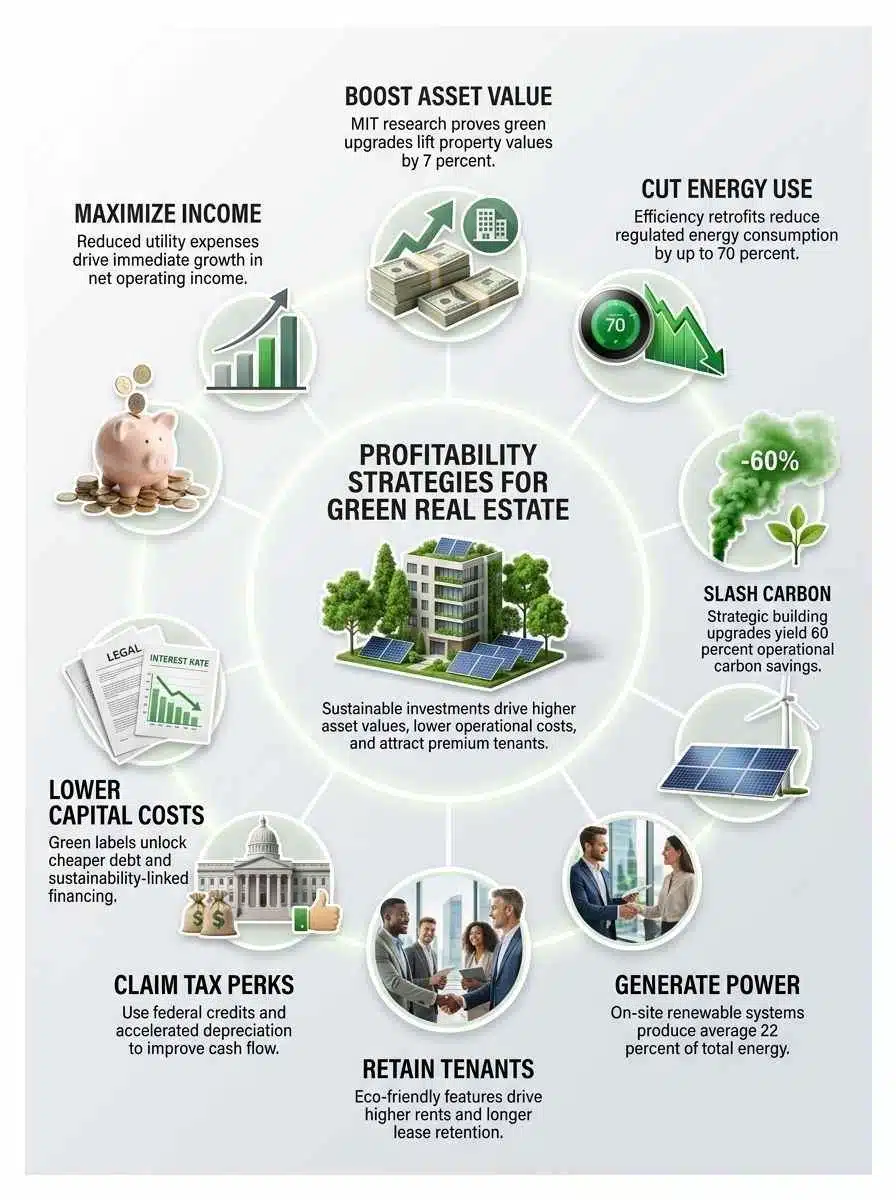
The financial case for green building investments is stronger than a lot of investors realize. You can save money every month, improve resale value, and widen your financing options without relying on rent growth alone.
Lower Operating Costs
This is where many deals start to make sense. ENERGY STAR says high-performing buildings save about $0.60 per square foot a year on operations and maintenance, $0.50 per square foot on janitorial costs, and $0.53 per square foot on utilities compared with typical buildings. On a 150,000-square-foot office asset, that is real money.
The quickest savings usually come from boring upgrades, which is why they work. LED lighting, controls, HVAC recommissioning, variable speed drives, and tighter scheduling often cut waste before you touch the building envelope.
A practical example comes from South Park Center in Los Angeles. Its lighting retrofit produced energy savings of more than 675,000 kWh a year and about $152,000 in annual savings. That kind of result is why experienced operators start with a benchmark and a low-cost retrofit list before planning a major capital project.
Lower utility bills do not just save cash, they create cleaner, more defendable NOI.
- Benchmark the property in ENERGY STAR Portfolio Manager before spending on equipment.
- Fix lighting and controls first if your building still has old fixtures or poor scheduling.
- Recommission HVAC before replacement, because many buildings waste money through bad settings, not bad hardware.
- Track indoor air quality and energy together so comfort improvements do not quietly erase savings.
Increased Asset Value
The value uplift is not one single number, but the pattern is clear. ENERGY STAR’s business case notes that energy-efficient buildings have shown sale prices from 1% to 31% higher, rental premiums from 3% to 16% higher, and occupancy up to 10% higher than typical buildings.
That spread matters because it tells you something simple: the upside depends on market, asset quality, and execution. A well-located Class B office with verified energy performance can often avoid the brown discount that drags on older stock, while a trophy asset may use green features to protect pricing power.
| Value driver | Why it matters |
|---|---|
| Higher rent potential | Efficient, certified space gives tenants lower operating exposure and stronger ESG reporting support. |
| Higher occupancy | Buildings with strong performance are easier to lease when tenants compare total occupancy cost, not just face rent. |
| Better financing | ENERGY STAR notes labeled buildings often get lower interest rates, usually about 30 to 35 basis points better, plus longer interest-only periods. |
| Lower risk perception | Certified and benchmarked assets are easier for buyers and lenders to diligence. |
Access to Incentives and Tax Benefits
Smart investors do not pay for every upgrade with ordinary equity. They stack incentives, tax treatment, and financing so the project clears a much lower hurdle rate.
- Use the Section 179D deduction for qualifying efficiency work: In the December 2025 IRS instructions for Form 7205, the 2026 maximum deduction is listed at $5.94 per square foot for projects meeting prevailing wage and apprenticeship rules, or $1.19 per square foot without the increased amount. The deduction starts at 25% energy savings and rises with deeper performance.
- Move quickly if 179D is part of your plan: Those same IRS instructions say the deduction was terminated for property whose construction begins after June 30, 2026. If you are underwriting a retrofit now, timing is part of the return.
- Look at the Clean Electricity Investment Credit for solar, storage, and certain generation assets: As of January 2026, the IRS lists a 6% base credit, which can rise to 30% for projects that meet prevailing wage and apprenticeship rules, with possible bonus points for domestic content and energy community location.
- Use transferability or direct pay where it fits: That can make clean energy upgrades more usable for owners who do not want to hold the full tax appetite themselves.
- Consider C-PACE for larger capital stacks: The EPA describes Commercial Property Assessed Clean Energy as a tool that helps owners finance energy efficiency, water efficiency, renewable energy, and resilience upgrades, often with terms that match the useful life of the work.
Attracting Premium Tenants Through Sustainability
Premium tenants do not just rent space, they rent predictability. They want lower operating surprises, healthier interiors, and buildings that support their own environmental and corporate social responsibility commitments.
Demand for Eco-Friendly Spaces
The tenant side is getting clearer. In the National Association of REALTORS’ 2025 commercial sustainability reporting, utility costs, indoor air quality, and energy efficiency were named as major drivers in commercial real estate decisions. That lines up with what landlords are seeing on tours and in RFPs.
EPA guidance on office buildings also makes the case for healthier interiors. Indoor air quality affects health, comfort, performance, and productivity, which means it affects tenant satisfaction even before a renewal conversation starts.
That is why sustainable features now need to be visible and easy to explain. A rooftop solar array is helpful, but so are ventilation improvements, better filtration, low-emitting materials, and clear performance dashboards that make the building feel managed instead of vague.
- Use certification language that tenants already recognize, such as LEED, WELL, and ENERGY STAR.
- Show how upgrades affect total occupancy cost, not just energy use.
- Highlight indoor air quality measures during leasing, especially in office, medical, and education-related space.
- Package renewable energy and efficiency as a business continuity benefit, not just an environmental benefit.
Higher Retention Rates of Quality Tenants
Retention usually improves when the building is easier to work in every day. Better thermal comfort, cleaner air, lower utility volatility, and fewer maintenance headaches reduce the quiet friction that makes tenants shop the market.
WELL points to peer-reviewed research showing stronger satisfaction in WELL Certified workplaces. One study cited by IWBI found a 28% improvement in overall workplace satisfaction and a 10-point increase in productivity scores. Even if you never pursue WELL itself, the lesson is useful: health-focused features can support lease renewals because employees feel the difference.
| Retention driver | Investor takeaway |
|---|---|
| Lower utility burden | Tenants notice cost stability, especially in office and mixed-use assets with large HVAC loads. |
| Better indoor air quality | Healthy buildings are easier to market to employers focused on attendance, comfort, and staff experience. |
| Green lease language | Shared data and agreed efficiency goals reduce landlord-tenant friction after move-in. |
| Recognized certifications | Third-party labels shorten explanation time and help justify premium positioning. |
| Visible building management | Tenants stay longer when the building feels professionally operated and responsive. |
Environmental and Social Impact of Green Buildings
Investors often start with profit, but the environmental impact and social side still matter because they shape regulation, reputation, insurance, and tenant demand. In practice, those are financial issues too.
Reduced Carbon Footprint
Green retrofits lower carbon footprint by cutting the energy a building needs in the first place. The strongest projects usually combine efficient lighting, better controls, electrified heating where it makes sense, tighter envelopes, and smarter operations instead of chasing one miracle technology.
USGBC highlights a Department of Energy review of 22 LEED-certified General Services Administration buildings that found 34% lower CO2 emissions, 25% less energy use, and 11% less water use. That is a useful reminder that performance is usually a stack of gains, not a single upgrade.
For investors, carbon reduction also lowers exposure to building performance standards and future retrofit mandates. ENERGY STAR says dozens of cities, counties, and states already require energy benchmarking and transparency, and many are moving toward building performance standards that define how much energy buildings are allowed to use.
- Start with load reduction before adding renewable energy.
- Replace old controls if the building still relies on fixed schedules and manual overrides.
- Use durable, lower-maintenance materials during repositioning so sustainability also trims future repair budgets.
- Track emissions and energy together, because carbon savings without operating data are hard to defend in underwriting.
Enhanced Community Reputation
A credible sustainability plan improves how a property is viewed by tenants, lenders, neighbors, and local officials. That matters more in urban development projects where approvals, public perception, and financing all touch the same deal.
A 2018 National Institute of Building Sciences study found that every $1 spent on mitigation saves $6 in response and recovery costs. It is an older figure, but it still captures why climate resilience belongs in your capex planning, especially in flood, wildfire, or extreme-heat markets.
Large owners are already treating resilience that way. Hines said it assessed physical climate risk across 81% of its assets under management in 2024 and requires management plans where projected impacts are materially high. That is a strong signal that climate resilience is now part of mainstream private real estate decision-making, not a side memo for the ESG team.
Strategies for Real Estate Investors to Maximize Profit
The most profitable green building investments usually follow a sequence: measure the building, fix cheap waste, line up incentives, finance the larger upgrade, then certify and market the result well.
Leveraging Green Certifications (e.g., LEED, WELL)
Certifications work best when you choose the right one for the asset. LEED O+M is often a practical fit for existing buildings that are already occupied, WELL is useful when tenant health and employee experience are part of the leasing pitch, and ENERGY STAR is the fastest way to benchmark operating performance against peers.
Timing matters here. The latest update from the U.S. Green Building Council says LEED v5 is now available for building design, interiors, and existing buildings, while most LEED v4 and v4.1 commercial registrations close on June 30, 2026. If you are already planning a certification path, waiting too long can create rework.
- Use ENERGY STAR first to benchmark and expose the easiest savings.
- Choose LEED if you need a broad, finance-friendly market signal that covers energy, water, materials, and indoor environmental quality.
- Use WELL when leasing depends heavily on healthy workplace claims.
- Market the certification in lender packages, OM language, and tenant tours, not just on the lobby plaque.
Incorporating Renewable Energy Systems
Renewable energy works best after efficiency upgrades lower the load. If you install solar before dealing with wasted lighting hours, bad controls, or leaky envelopes, you usually buy a bigger system than you need.
For many investors, the best renewable energy decision is not direct ownership in every case. It is choosing the structure that fits the deal, the tax situation, and the hold period.
| Option | Best use case | Main advantage |
|---|---|---|
| Direct purchase | Owners with tax appetite and longer holds | Captures more upside from credits and long-term savings |
| Power purchase agreement or solar lease | Owners who want lower upfront capital needs | Reduces capex pressure while still lowering grid dependence |
| Solar plus battery storage | Properties with demand charges or resilience needs | Can cut peak costs and support continuity during outages |
| Community solar participation | Assets without strong rooftop potential | Gives a renewable energy story without major onsite construction |
If the numbers are close, this is where green financing can rescue the deal. The Clean Electricity Investment Credit, C-PACE, and transferability rules can push a marginal project into a workable one.
Investing in Energy Efficiency Upgrades
Energy efficiency still gives investors the fastest and most reliable return because it cuts waste before you add complexity. It also supports indoor air quality and climate resilience better than a solar-only approach.
- Benchmark first. Use ENERGY STAR Portfolio Manager to find the gap between your asset and similar buildings.
- Fix lighting and controls. They are usually the cleanest first move in older office, retail, and mixed-use properties.
- Target HVAC next. Recommissioning, variable speed drives, better scheduling, and high-efficiency replacements often produce the biggest comfort gains.
- Watch air quality, not just energy. Devices such as uHoo Aura can monitor 13 indoor environmental quality factors, which helps property teams catch ventilation problems before tenants start complaining.
- Seal the envelope. Air leakage quietly hurts both tenant comfort and utility performance.
- Use one dashboard. If your engineers need five applications to understand the building, problems stay hidden longer than they should.
Case Studies of Profitable Green Real Estate Projects
Real projects tell the story better than any pitch deck. The best-known examples show that green investments can improve performance in very different types of buildings, from iconic towers to smaller retrofit opportunities.
Examples of Successful Green Building Investments
| Project | What was done | Measured outcome | Investor lesson |
|---|---|---|---|
| Empire State Building, New York | Deep efficiency retrofit, continuous performance work, and certification upgrades | Empire State Realty Trust reported a 49% energy reduction at the building in its 2025 sustainability reporting, and the tower became the first LEED v5 Platinum certified building in New York State | A famous asset can still improve NOI through disciplined retrofit work. Age is not an excuse. |
| Bullitt Center, Seattle | Ultra-efficient design, rooftop solar, low-toxicity materials, and a healthy building approach | The Bullitt Center says it generated 30% more energy than it used in its first 10 years and operated at an energy use intensity of 16 kBtu per square foot per year | Top-tier performance becomes a leasing and branding advantage when it is backed by real data. |
| South Park Center, Los Angeles | Lighting retrofit plus better controls in an already well-performing office asset | Annual savings exceeded 675,000 kWh and about $152,000 | You do not need a full redevelopment to improve profitability. Smaller retrofits still move the numbers. |
| University of California, Merced Science and Engineering retrofit | DOE-supported retrofit and central plant efficiency work | The case study targeted up to 30% energy reduction | Campus-style buildings can be useful models for older institutional and office assets with large mechanical loads. |
Lessons Learned from Industry Leaders
Industry leaders are treating sustainability as operating discipline. Hines has built it into underwriting, tenant engagement, and climate risk review, which helps explain why PERE recognized the firm as ESG Firm of the Year in 2024.
Empire State Realty Trust is another useful model. In its 2025 update, the company said 100% of its New York City commercial office portfolio was ENERGY STAR or ENERGY STAR NextGen certified, tying building performance directly to tenant value and market positioning.
- Benchmarking comes before storytelling.
- Tenant comfort matters as much as carbon math.
- Climate resilience belongs in acquisition and refinancing decisions.
- Portfolio systems beat one-off hero projects if you want repeatable profitability.
The Future of Green Buildings in Real Estate
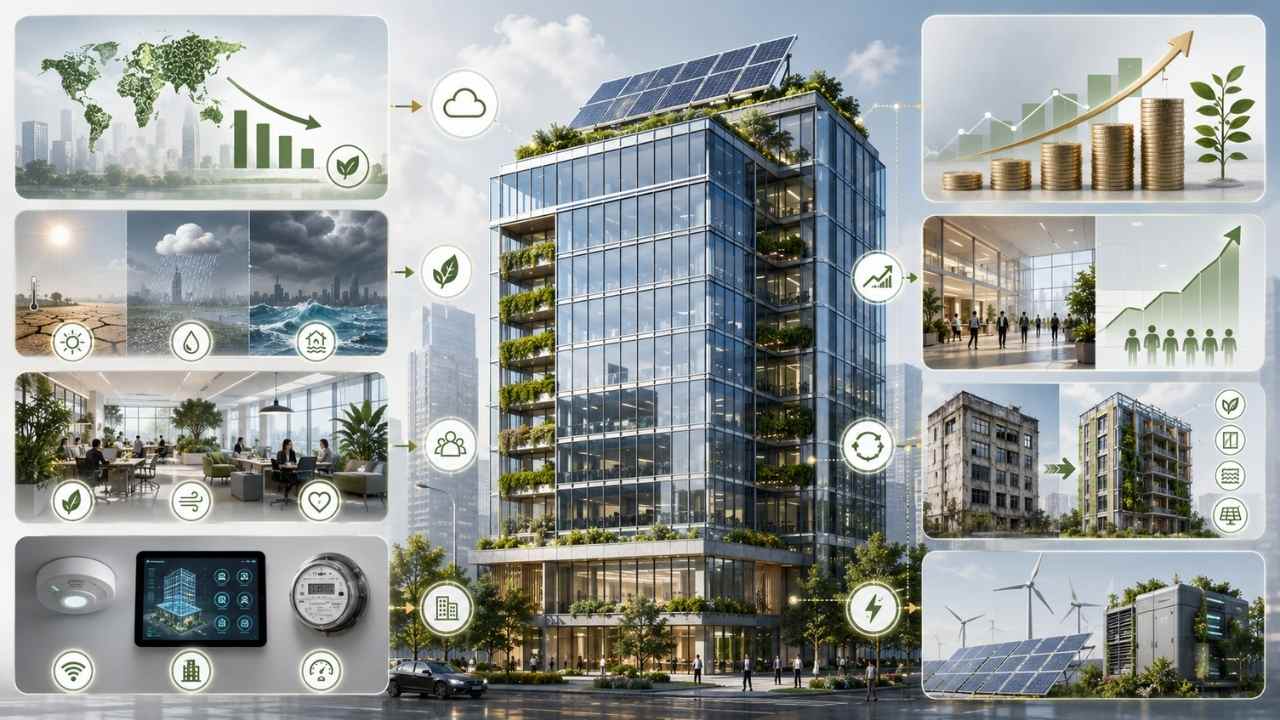
The future of green buildings looks less like a trend and more like a baseline requirement. The gap will likely widen between assets that can prove performance and assets that cannot.
Emerging Trends in Sustainable Real Estate
LEED v5 is a good example of where the market is going. It puts more focus on decarbonization, resilience, and human impact, which matches what lenders, cities, and tenants are asking for now.
WELL is also moving further into capital markets. IWBI said in 2025 that WELL had been incorporated into 12 types of financial instruments, including green bonds, social bonds, and sustainability-linked debt. That tells you healthy buildings are starting to matter in financing language, not just workplace design language.
The technology stack is becoming more practical too. Better meters, building automation, submetering, and indoor air quality sensors make it easier to prove performance month by month, which is exactly what investors need during hold periods and sale processes.
The Economic Case for Long-Term Green Investments
Long-term returns improve because green buildings stack multiple advantages. ENERGY STAR says certified buildings use 35% less energy than typical buildings on average. Its business case also points to rent premiums, better occupancy, and lower borrowing spreads for labeled assets.
Tenant demand should keep supporting that logic. ENERGY STAR notes that 98% of S&P 500 companies publish sustainability reports, and two-thirds of Fortune 500 companies have at least one climate or clean energy target. Those firms need buildings that help them hit those targets, not buildings that make reporting harder.
If you own or buy older stock, that is the real opening. The next winners in commercial real estate are likely to be investors who can reposition existing buildings with better energy efficiency, healthier interiors, renewable energy where it fits, and a clear path through green financing and tax incentives.
Final Thoughts
Commercial real estate investors are profiting from green buildings because the upside is coming from several places at once: lower operating costs, stronger tenant demand, cleaner underwriting, and better access to incentives.
You do not need to start with a massive overhaul. A benchmark, a short list of efficiency upgrades, and the right certification path can already improve net operating income and asset value.
Move early, document the results, and let the building prove the case for you.
Frequently Asked Questions (FAQs) About Green Building Real Estate Investment
1. How do green buildings make money for real estate investors?
Green buildings cut energy use, so operating costs fall. Investors can charge higher rents, win more tenants, and boost property value, so profits rise.
2. How do investors pay back the cost of upgrades?
They use incentives, rebates, and lower bills to shorten the payback time. Higher rents and better occupancy help recover the investment fast.
3. Will tenants actually pay more for green buildings?
Yes, many renters and buyers pick green buildings for comfort and lower utility bills, so demand and rents often go up.
4. What risks should investors watch when buying or upgrading green buildings?
Watch for high retrofit costs, fake claims about savings, and extra fees for green certification. Do solid energy studies, pick good contractors, and mind ongoing maintenance, or you can lose money.