
Before October 7, Nir Oz was quietly tucked just over three kilometers from the Gaza border. Its population of around 400 people lived in relative peace, many working farms or greenhouses, children walking along tree-lined lanes, neighbors greeting each other by name. It was not famous, not strategic in any obvious sense — a small kibbutz at Israel’s fringe, largely unknown to most.
Then came the attack. On that morning, Hamas and allied militants breached border defenses, launching a large-scale assault. Homes were invaded, secured fences overrun, residents awakened by gunfire. In Nir Oz the destruction was swift: houses and buildings were torched or blown apart, especially those close to the perimeter. Infrastructure — roads, electricity, water systems — was severely damaged or destroyed. Many who remained were killed outright or taken captive. Whole families, including infants and the elderly, vanished into Gaza.
Of the residents, more than a quarter were either murdered or abducted. The surviving community was shattered. Among those abducted from Nir Oz, a substantial number remained in captivity for years, some exceeding 700 days. Those who survived but were freed arrived emotionally and physically scarred. The majority of the community, unable to live amid ruins and trauma, relocated elsewhere; most have not returned.
Two Years of Waiting, Grief, and Partial Return
In the years since the attack, Reconstruction and healing have been incremental and painful. Some works were made to salvage utilities and clear rubble, but the depths of damage run far deeper than buildings. Memories, identities, and social bonds have fractured.
Families of captured or killed residents have lived suspended lives. The relentless uncertainty over who remains alive, who perished, and when or whether they might return has shaped every waking moment. Attempts at diplomatic negotiations, mediated by foreign governments and organizations — notably via Egypt, Qatar, and the United States — have proceeded intermittently. Partial hostage-prisoner exchanges earlier in 2025 yielded the release of dozens of hostages and bodies, but left many in captivity. In January 2025, a temporary ceasefire brought some of those exchanges.
It was widely understood within Israeli political and security circles that recovering the remaining hostages, rebuilding destroyed communities like Nir Oz, and defining Gaza’s future governance were existential challenges. Some kibbutz residents advocated rebuilding on the spot as a matter of symbolic resilience; others saw the ruins as a kind of memorial, preferring to relocate and carry remembrance forward elsewhere.
On July 3, 2025, Prime Minister Benjamin Netanyahu visited Nir Oz—his first public visit there since the attack. He walked among devastated streets, met survivors, and pledged the state would assist in returning the hostages, recovering remains, and rebuilding. Some greeted him with wary expectation, others with anger, pointing to security failures. During that visit, a mother, Einav Zangauker, whose son Matan remained captive, implored him for an agreement bringing all captives home.
The Day of Return: Gathering in Kiryat Gat
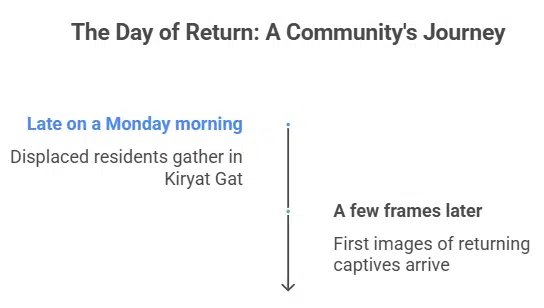
Late on a Monday morning, displaced residents of Nir Oz convened in Kiryat Gat, about 50 kilometers interior from the border. They used a community hall as their temporary gathering place — lights on, chairs set, screens ready, hearts full of anticipation. This was not only a moment of potential return; it was a collective threshold between two years in limbo and a new chapter.
Inside, tasks were underway: preparing refreshments, arranging seating, making last adjustments to display screens. In this hall, former neighbors, extended families, friends, and supporters mingled in strained optimism. Many wore symbolic bracelets or wristbands in solidarity with captives. Some kept photographs of missing loved ones; others carried notes or small tokens. All looked at the screen, hoping it would finally carry images of former residents returning.
A few frames later, one of the hall’s attendants announced that the first images of returning captives had arrived — among them, local names known in Nir Oz circles. There was an uptick in emotion: muted sobs, rising excitement, relief breaking through restraint. People leaned into one another, touching shoulders, clasping hands, steadying each other.
Four of Nir Oz’s captured residents were among those returning that day: Matan Zangauker, Ariel and David Cunio, and Eitan Horn. Their release had been confirmed by the mediator governments ahead of the public moments. Their names had been circulating in the exchange lists; their faces were now visible on the screen. At that point, people stood together, many murmuring — some cried openly.
Simultaneously, efforts were underway to manage the flow of people in and out, confirm identities, coordinate with Red Cross representatives, and align with security protocols. The hall’s staff and volunteers coordinated discreet logistics: who goes when, who greets whom on the stage, how the returnees would be ferried from border crossings to safe spaces, how media would be managed, and how families would be reunited in private.
While this first group was processed, another wait ensued for the next that would be released. As hours passed, moods fluctuated between high relief and tense impatience. Some attendees urged media crews not to shift their focus away from returning captives, to keep the narrative centered on those coming back. They felt the political spectacle around them risked overshadowing deeply personal moments. One community member quietly chided broadcasters to stay with the story of homecomings. Others remained glued to cell phones, scanning feeds and border crossing updates.
Trump’s Arrival & Media Shift
At this same juncture, U.S. President Donald Trump landed in Israel on a surprising, expedited visit. His arrival introduced a new narrative overlay to what was already the most emotionally charged day for thousands of families. Media coverage pivoted rapidly: screens split, commentators weighed between the spectacle of high diplomacy and the human drama of hostage reunions.
Trump’s visit included a stop at the Knesset (Israel’s parliament) in Jerusalem. During his address, he framed the hostage release and ceasefire as a diplomatic victory, linking it to his broader vision for the region. He declared a new “dawn of a Middle East,” promising expanded normalization among Arab states and gestures toward peace with Iran — though he offered no detailed roadmap or reconciliation of security operations in Gaza.
In that moment, across Israel, the narrative began to shift: from “these people are coming home” to “this is Trump’s triumph.” Broadcasters alternated between coverage of returning captives and the motorcade, the stadium of applause for the president, and the halls of political theater. From Kiryat Gat, some residents felt disoriented: they came to see their loved ones, but now the stage had expanded.
Netanyahu, in his speeches, embraced Trump as Israel’s strongest ally in the U.S. and praised his role in negotiating the deal. Trump in turn called Netanyahu courageous and claimed the outcome as a victory for his foreign policy involvement. In one moment during his Knesset address, Trump asked President Herzog to pardon Netanyahu — a symbolic gesture pointing to the Israeli premier’s ongoing corruption trials. The act itself became a minor media sensation, pulling further attention from the hostages.
Some kibbutz members voiced frustration at the shifting spotlight. They reminded media teams that their loved ones, their community, were not yet fully restored. The optics and power displays felt secondary to the raw moment of return. Within the hall in Kiryat Gat, elders and younger adults exchanged glances: “Our people remain inside,” they would note to each other, unwilling to let the political narrative eclipse the human one.
The Exchange, the Numbers, the Pain
By the end of the day, the last 20 living hostages held in Gaza since October 7, 2023, had been released under the terms of the ceasefire agreement mediated by the U.S. and regional actors. Israel reciprocated by releasing nearly 1,900 Palestinian detainees, many of them women, minors, or lower-risk prisoners.
This exchange marked a dramatic moment: after years of stalled negotiations, the final living captives returned to Israeli territory. The state immediately coordinated medical evaluations, psychological support, and reunification steps. But even as families rejoiced, the broader toll was evident.
Not all returns were complete. As per the agreement, only four of 28 deceased hostages’ bodies were repatriated. Dozens of other bodies remain unrecovered; some were never located, others were held in contested zones or destroyed during operations. The gap between those brought back and those still missing remains one of the deepest scars for families.
Within Nir Oz itself, numerous members had died in captivity or were never found. Some of the newly returned hostages bore physical and psychological injuries; others were simply shell-shocked. In public briefings, Israeli officials acknowledged ongoing efforts to investigate deaths, identify remains, and provide closure where possible.
The context of the exchange was not isolated. It was part of a larger diplomatic push: the Sharm el-Sheikh Summit convened in Egypt on the same day, attended by about 30 nations (though Israel and Hamas were not directly represented). The summit endorsed a “Trump Declaration for Enduring Peace and Prosperity” aimed at postwar Gaza reconstruction, regional security, and normalization of relations.
Yet important questions remain unresolved: Who will govern Gaza? Will Hamas retain influence or be dissolved? What kind of security guarantees will Israel demand? How will humanitarian aid flow into a territory that has been severely depopulated, bombarded, and fragmented? Will the ceasefire hold? Analysts quickly labeled the agreement a breakthrough, but warned that its durability hinges on political will, enforcement, and trust among adversaries.
Community Aftermath, Symbolic Weight, and Futures
In Kiryat Gat, following the formal handover, families and community members dispersed into smaller clusters. Returnees were led to private “safe rooms,” debriefed, medically assessed, and given space before meeting extended families. Some encounters took place in hospital corridors; others in temporary housing units arranged by the state and NGOs.
Members of Nir Oz continued to circulate among the crowd, scanning faces, checking lists, and marking who remained unaccounted for. For each reunion, there was joy — a resurgence of possibility. But for every empty seat, there remained a question: who will never come back?
They also observed how the optics of the day had shifted. Media crews set up giant LED screens, light projections, aerial shots; banners praising political leaders and Trump proliferated. Some local residents bristled at the visuals co-opting their pain for spectacle. They felt that the heart of the matter — community, loss, remembrance — must remain anchored in stories of returning neighbors, not in diplomatic pageantry.
Elsewhere, across Israel, public squares filled with cheering crowds. In Tel Aviv, “Hostages Square” (where families have long held vigils) erupted into mass celebration. In Gaza and parts of the West Bank, crowds greeted returning Palestinian prisoners. The symbolism of prisoners on both sides moving toward release created mirrored narratives of national redemption and grief.
Trump’s visit to Israel was, in some ways, scheduled for that symbolism. His presence heightened the day’s tension between personal human drama and international diplomacy. Israeli leadership heaped acclaim on him; opposition voices cautioned that political leverage or promises must translate into policy and accountability.
Netanyahu’s role, in particular, stood subject to renewed scrutiny. Accusations over security lapses on October 7 remain unresolved. His earlier corruption charges and legal trials were tabbed into the backdrop of the ceasefire speech, even as he accepted praise for the hostage return. In public messaging, Netanyahu reaffirmed that Israel would continue operations to recover missing bodies, secure its borders, and rebuild communities like Nir Oz.
For Nir Oz, the union of return and ruin is paradoxical. The land once punctuated by orchards, field plots, and community buildings stands largely obliterated. Ruin stretches into the horizon. The decision remains: rebuild in place, reconstruct from scratch, relocate and memorialize. Government funds amounting to tens of billions of shekels have been pledged for reconstruction across affected border communities and war zones, but execution may take years — and the process itself can reopen wounds.
Broader Stakes and Unfinished Chapters
This return does not erase the trauma. Physical wounds will heal slowly; emotional ones may never fully do so. For many, the war launched not just a geopolitical conflict but a rupture of everyday life — of trust, of security, of normalcy.
The exchange and the summit represent a moment of possibility, not closure. For Israel, they offer breathing room to redefine strategy toward Gaza: what security buffer, what governance, what mechanisms of oversight, what role for international actors, and what conditions for reconstruction. For Palestinians, the release of prisoners and the promise of stabilization carry hopes — but also skepticism, especially among Gaza’s remaining population facing widespread destruction, displacement, and humanitarian needs.
The role of the United States and other mediators now becomes critical. How they enforce the terms, monitor adherence, coax political reforms, and sustain aid delivery will influence whether this moment becomes a turning point or a short-lived truce.
For the people of Nir Oz, this day of partial return is also a starting line. Families reunited, communities reborn, memory anchored, but many questions still unanswered: who will return permanently, who must mourn forever, who rebuilds, who stays displaced, and how to carry forward a vision for life beyond war.
On this day, the people of Nir Oz were no longer just symbols of tragedy and endurance — they became a living testament to the costs of war, the resilience of community, and the fragility of peace.