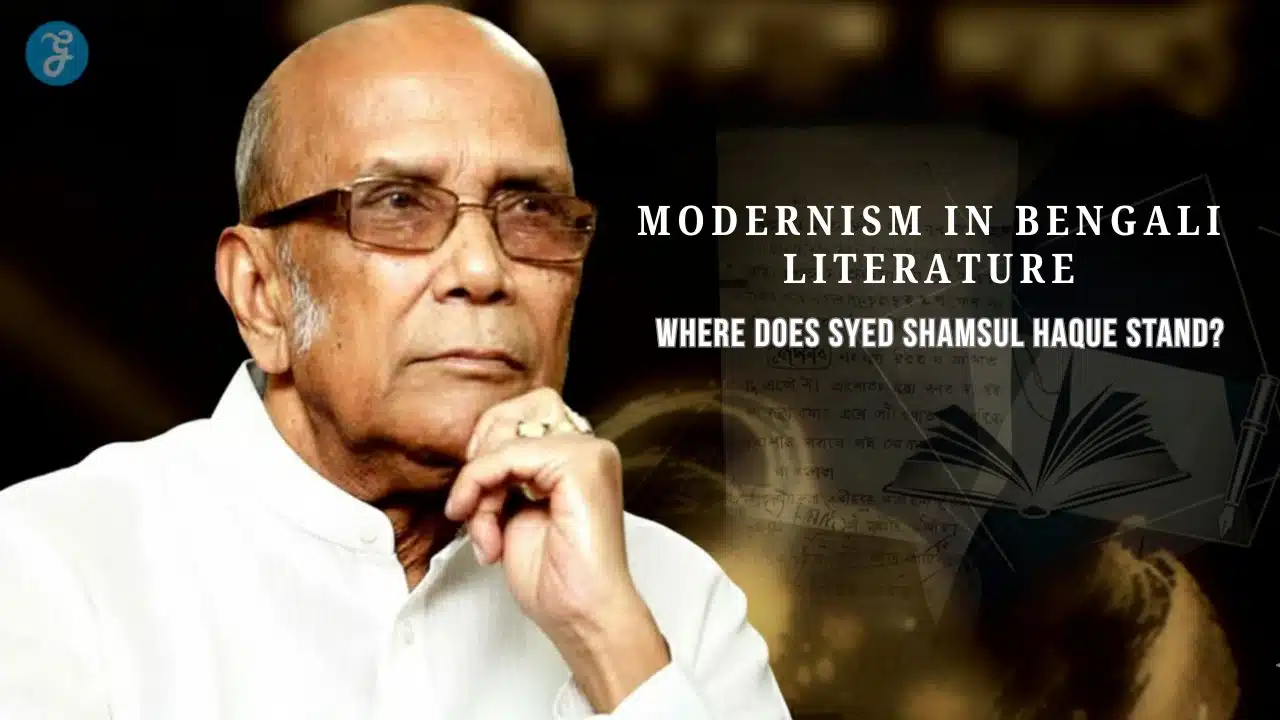
Modernism in literature is often seen as a break from tradition—a movement that redefined how writers expressed human experience in the face of war, colonialism, and rapid social change. In Bengali literature, modernism took root in the mid-20th century, moving beyond the romanticism of Rabindranath Tagore and creating space for new voices. Among these voices, Syed Shamsul Haque (1935–2016) stands out as one of the most versatile and daring.
Syed Shamsul Haque chose clear words and tight lines. He spoke for people, for language, and for the country he loved. His voice still feels fresh. It still questions power. It still comforts readers. He worked in many forms—poetry, verse drama, novels, short stories, essays, and lyrics—and he left a mark on every one of them.
Known as a sabyasachi (all-rounder) writer, Haque mastered every form of writing: poetry, plays, novels, essays, translations, and even song lyrics. On the 9th anniversary of his passing, it is worth asking—where does Syed Shamsul Haque stand in the landscape of Bengali modernism?
Why Syed Shamsul Haque Matters Now
Haque’s writing meets this moment because it joins beauty with duty. Readers today want clarity and courage, not obscurity. He gives both. His pages speak to language rights, civic ethics, and the everyday dignity of people who do not often get a microphone.
At the same time, his craft rewards slow reading and rereading. That mix—public urgency and private music—keeps him current for classrooms, stages, and serious readers.
At a Glance: Reasons Syed Shamsul Haque Remains Relevant
| Reason he matters | What it means today | Reader takeaway |
| Breadth of work | Poetry, plays (often in verse), novels, essays, lyrics | Many entry points for different readers |
| Moral clarity | Speaks to power without jargon | Useful for debates about rights and identity |
| Classroom presence | Appears in school and university curricula | Each generation meets his ideas afresh |
| Translation & staging | English editions and ongoing productions | His voice travels beyond Bangla |
A Brief Biography Anchored to Milestones
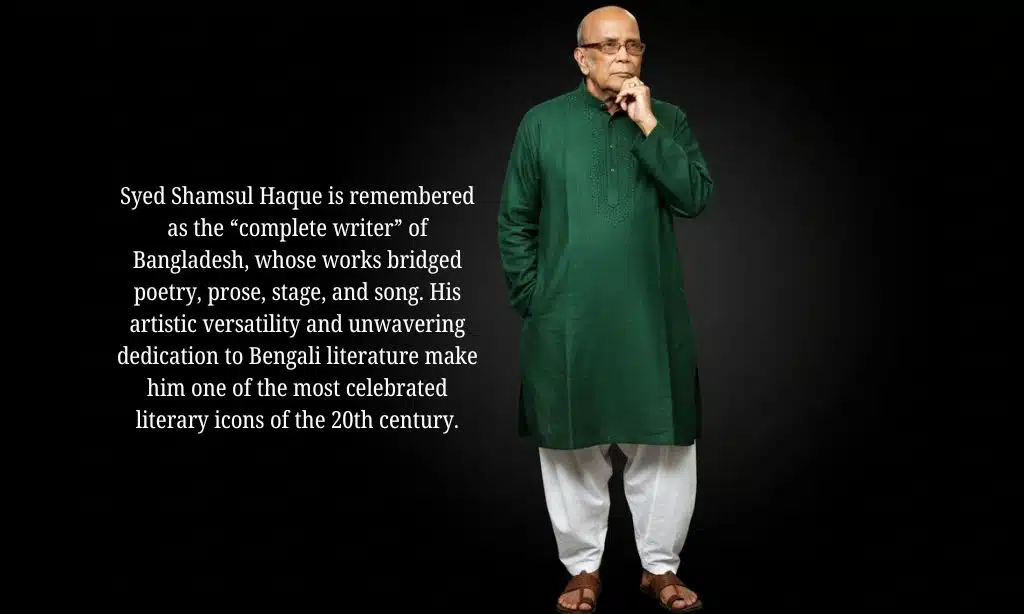
A straight timeline never captures why a writer lasts. For Haque, the turning points reveal a pattern: early range, fearless experiments, and national recognition that arrived without softening his voice. Each milestone is more than a date—it marks a change in scale.
He starts local, speaks to a nation, and then writes across borders through translation and performance. Place, family, and work come together to form a career that mirrors the growth of a young country.
| Year | Event | Why it matters |
| 1935 | Born in Kurigram (then British India) | Northern roots shape images, landscapes, and memories |
| 1950s | Early publications in magazines and journals | Signs of range appear very young |
| 1966 | Bangla Academy Literary Award (then youngest recipient) | Early national recognition for craft |
| 1970s–1990s | Major poems, novels, and verse plays | Expansion across forms and themes |
| 1984 | Ekushey Padak | Honors service to Bangla language and literature |
| 2000 | Independence Day Award | Highest civilian award in Bangladesh |
| 2016 | Died in Dhaka (lung cancer), aged 81 | Tributes confirm stature and reach |
Understanding Modernism in Bengali Literature
Modernism in Bengal emerged as a response to both global and local realities. Writers after Tagore were influenced by European modernists like T.S. Eliot, James Joyce, and Virginia Woolf, while also reflecting the unique anxieties of Bengal—famine, Partition, urban alienation, and political turbulence.
Key features of Bengali modernism included:
-
A rejection of romantic idealism.
-
Themes of isolation, identity crisis, and existential angst.
-
Experimentation with form—free verse, fragmented narratives, and symbolism.
-
A deep engagement with the political realities of the time, especially the 1947 Partition and later the Liberation War of 1971.
This was the soil in which Syed Shamsul Haque began to write.
Syed Shamsul Haque’s Entry into the Literary Scene
Born in Kurigram in 1935, Haque came to Dhaka in his youth and was drawn into the city’s vibrant literary scene. His early years were marked by both financial struggle and an unshakable urge to write. Though he briefly studied English literature at Dhaka University, he left without completing his degree after his father’s death, taking on the responsibility of supporting his family.
His first works in the 1950s quickly revealed his unconventional voice. From the beginning, he refused to confine himself to one genre. This versatility became his modernist signature—the belief that literature should be free, experimental, and alive in many forms.
Poetry—A Modernist Voice of Intimacy and Rebellion
In his poetry, Haque explored themes that echoed modernist concerns: death, love, freedom, and the absurdity of existence. His lines often broke away from traditional rhythm and meter, using free verse and bold imagery.
Unlike the lyrical romanticism of earlier poets, his poetry carried a sense of rebellion. He wrote about the struggles of ordinary people, the silence of alienation, and the intensity of personal desire. His work placed him alongside Jibanananda Das, but his style was more direct, sometimes even provocative, making his voice uniquely modern.
Drama—Breaking Conventions with Payer Awaj Pawa Jai
If his poetry established his modernist identity, his plays cemented it. Payer Awaj Pawa Jai (“We Hear the Footsteps”) remains one of the most powerful plays in Bangladeshi theater. Written in verse, the play is both political allegory and artistic experiment.
The story reflects a nation on the verge of liberation, blending personal sacrifice with collective struggle. Instead of conventional dialogue, Haque used symbolism, rhythm, and chorus-like voices, turning the stage into a space of modernist expression.
Through drama, he showed that theater could be both political and poetic, deeply rooted in Bangladesh’s reality while still reflecting global modernist aesthetics.
Novels and Prose—Modernism in Narrative Experiment
Syed Shamsul Haque’s novels pushed the boundaries of social conventions. Works like Nishiddho Loban, Khelaram Khele Ja, and Neel Dangshon explored taboo subjects—sexuality, freedom, and moral decay.
These novels were unapologetic, rejecting the didactic tone of earlier fiction. Instead, they embraced psychological complexity and existential doubt, hallmarks of modernist prose worldwide.
Like global modernist novelists, Haque experimented with structure and perspective, giving readers fragmented, multi-layered stories. This placed him firmly in the tradition of modernist fiction while keeping his narratives distinctly Bengali.
Syed Shamsul Haque’s Signature Works Worth Reading First

A deep shelf can overwhelm a first-time reader. This section curates a small set that represents his voice at full strength: a verse play where history walks on stage, a novel that sharpens conflict without noise, and poems where a nation speaks in human scale. These titles do not exhaust his range; they open a door. Start here to grasp his rhythm and return later for the rest.
| Title (English/Transliteration) | Genre | Why it matters |
| Payer Awaj Pawa Jai (“At the Sound of Marching Feet”) | Verse play | Landmark political drama of the Liberation War; explores power, gender, and community; often taught and staged |
| Nuruldiner Sara Jibon (“Nuruldin’s Entire Life”) | Verse play / staged poem | Reimagines folk resistance and a people’s hero; fuses history with ritual |
| Neel Dongshon / Neel Dangshon (“The Blue Bite”) | Novel | Sparse prose; tight scenes; shows range beyond poetry and drama |
| Nishiddho Loban (“Forbidden Incense”) | Novel | Bold and debated; tests social limits and form |
| Khelaram Khele Ja | Novel | Voice-driven, frank, and formally risky |
| Selected Poems (e.g., “Amar Parichoy,” “Tomake Abhibadan, Bangladesh”) | Poetry | Lyric clarity with civic feeling; widely recited |
Haque’s Translation of Shakespeare—A Modernist Bridge
Another remarkable aspect of Haque’s career was his translation of Shakespeare into Bengali, including Macbeth, The Tempest, and Troilus and Cressida.
This was more than translation; it was cultural transformation. By reimagining Shakespeare in a modern Bengali idiom, he created a bridge between Western classics and Bangladeshi audiences. It also influenced his own dramatic style—blending universal human conflict with local linguistic rhythm.
Position Among His Contemporaries
Syed Shamsul Haque’s contemporaries included Shamsur Rahman, Al Mahmud, and Selim Al Deen, each of whom shaped modern Bengali literature in their own way.
-
Shamsur Rahman was primarily a poet.
-
Al Mahmud was known for his lyrical yet politically charged verse.
-
Selim Al Deen revolutionized Bangladeshi theater with his epic plays.
But Haque was unique: he did everything. Poetry, prose, drama, translation, lyrics for songs, and even film scripts. This unmatched versatility is why critics often call him the most complete modern Bengali writer.
Enduring Relevance in Today’s Bangladesh
Nearly a decade after his death, Haque’s works remain fresh. His themes of identity, freedom, and social struggle continue to resonate with young readers. Plays like Payer Awaj Pawa Jai are still staged, and his novels are taught in universities.
At a time when Bangladesh faces new challenges of globalization, inequality, and cultural shifts, Haque’s voice feels prophetic. His words remind us that modernism is not just about style but also about confronting uncomfortable truths.
Takeaways
Syed Shamsul Haque stands as a pillar of Bengali modernism. His work was not confined to one genre, nor to one theme. Instead, he expanded the very idea of modernism—turning it into a living, breathing force in Bangladeshi culture.
On his 9th death anniversary, remembering him is not only about honoring the past. It is about recognizing that the questions he raised—about life, love, politics, and freedom—are still with us today. His voice remains a guiding light for writers who wish to experiment, rebel, and dream.
Syed Shamsul Haque’s place in Bengali modernism is clear: he was both its torchbearer and its boundary-breaker.