If you’re still using a gaming PC built before 2017, especially one with a GeForce GTX 900 or 10-series graphics card, big changes are coming your way. Nvidia has officially announced a major update to its driver support roadmap, impacting both older GPUs and Windows 10 users. These changes will affect millions of PC gamers still relying on aging but widely used graphics cards.
Let’s break down what this means for your system—and when you’ll need to take action.
End of Game Ready Driver Updates for Maxwell, Pascal, and Volta GPUs
What’s Happening?
Nvidia has confirmed that starting October 2025, it will no longer provide Game Ready driver updates for graphics cards based on its Maxwell, Pascal, and Volta architectures. These include:
-
Maxwell GPUs: GeForce GTX 750, 750 Ti, 950, and 960
-
Pascal GPUs: GeForce GTX 1050, 1060, 1070, 1080, and the popular 10-series lineup
-
Volta GPUs: Rare workstation and AI cards like the Titan V
That means graphics cards like the GTX 1060—which is still one of the most used GPUs worldwide—will no longer receive game-specific optimizations, performance enhancements, or bug fixes once the deadline passes.
Why Is Nvidia Doing This?
The company says it’s focusing its development efforts on supporting newer GPUs that can handle the demands of modern games and AI-driven features like ray tracing, DLSS 3.5, and Nvidia Reflex. These features aren’t available or fully compatible with older architectures, and continuing to develop drivers for them limits innovation for newer hardware.
This move follows Nvidia’s long-term strategy of gradually phasing out older architectures. The company previously ended support for the Kepler GPU line in 2024, and this is the next step in that transition.
Security-Only Driver Updates Will Continue Until October 2028
Even though these GPUs are losing access to new Game Ready drivers, they’re not being fully abandoned—at least not immediately.
What Will Still Be Available?
Nvidia will continue to deliver quarterly security updates for Maxwell, Pascal, and Volta-based GPUs until October 2028. These updates will patch any known vulnerabilities that may expose users to GPU-related security threats, such as buffer overflows or memory execution flaws.
However, it’s important to understand what you won’t be getting:
-
No performance tuning for new game titles
-
No compatibility fixes for newly released PC games
-
No support for future game APIs like DirectX 13 or Vulkan 2.0
In short, your older card will continue to work, but it won’t perform optimally in newer titles, and features introduced in future Nvidia technologies won’t be backported.
CUDA Support Already Frozen for Older Architectures
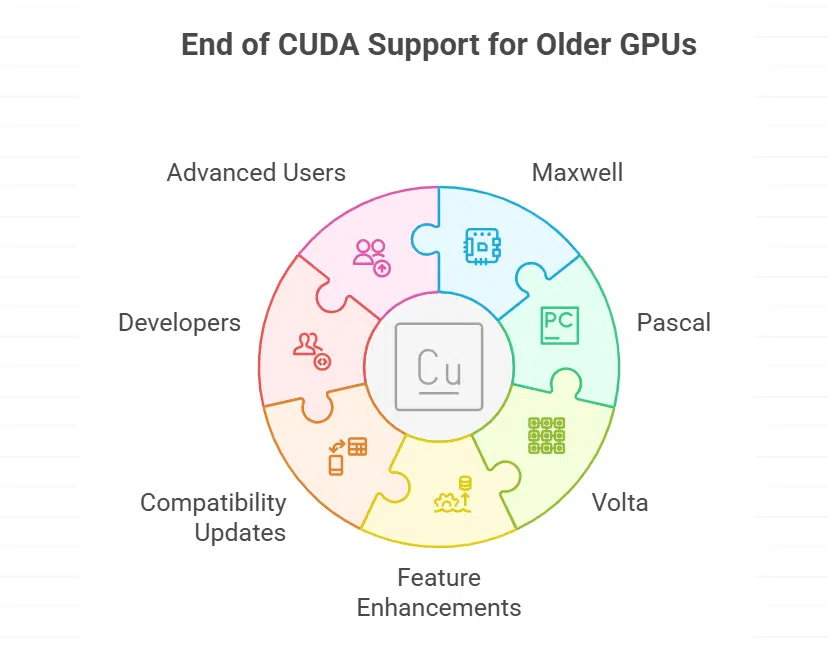
Earlier this year, Nvidia announced that CUDA support for Maxwell, Pascal, and Volta was considered “feature complete” and had been frozen. CUDA, Nvidia’s parallel computing platform used for AI and scientific computing, will no longer receive feature enhancements or compatibility updates for these GPU generations.
This was an early indicator that full driver support was nearing its end, particularly for developers and advanced users relying on GPU compute capabilities.
Windows 10 Driver Support Will End in October 2026
What’s the Timeline?
Nvidia also shared its roadmap for Windows 10 users. The company will continue to release Game Ready driver updates for all supported GPUs running Windows 10 until October 2026. This timeline extends support one full year beyond Microsoft’s own end-of-life date for Windows 10, which is October 14, 2025.
This move gives users more flexibility, especially those who aren’t ready to migrate to Windows 11 or purchase new hardware yet.
What Happens After 2026?
Starting in October 2026, Game Ready drivers will only be available for Windows 11 users. Anyone still on Windows 10—even with newer RTX 30- or 40-series cards—will no longer receive:
-
Game optimizations
-
Day-one patches for new releases
-
Feature updates like DLSS, Frame Generation, or AV1 encode support
To continue receiving full driver support, users must upgrade to Windows 11 or newer.
Why This Is a Big Deal for Gamers
Popular Cards Are Still in Use
Many of the GPUs affected by this change—especially those from the Pascal generation (GTX 10-series)—are still extremely common. According to the June 2025 Steam Hardware Survey, cards like the GTX 1060, 1050 Ti, and GTX 1070 remain in use across millions of PCs.
For example, the GTX 1060 alone still powers about 3–5% of gaming rigs globally. These cards, while aging, continue to handle older and mid-range modern games like Minecraft, Valorant, and Roblox quite well.
Losing access to Game Ready drivers won’t make these cards unusable—but performance in newer, AAA games will gradually degrade, especially as developers stop optimizing for them.
What You Should Do If You’re Affected
Here’s a breakdown of what actions you might consider:
| Situation | Recommended Action |
|---|---|
| Using GTX 10-series or earlier | Consider upgrading to an RTX 30/40/50-series GPU before late 2025 |
| Using RTX GPU on Windows 10 | Plan your upgrade to Windows 11 before October 2026 |
| Using older cards for basic games | Continue with quarterly security updates through 2028 |
| Not upgrading OS or hardware | Expect degraded performance and lack of future features |
Is It Time to Upgrade?
If you’re a casual gamer playing low-resource games, you might not notice much change right away. But if you’re looking forward to upcoming titles like Elder Scrolls VI, Cyberpunk 2077 2.0, or any next-gen ray-traced titles, your old GPU will struggle—both in performance and compatibility.
Now might be the ideal time to:
-
Upgrade to Windows 11
-
Move to a modern RTX 40-series or 50-series GPU
-
Explore Copilot+ PCs or systems built around Nvidia’s latest Ada Lovelace or Blackwell GPU architectures
Nvidia’s decision to phase out Game Ready support for Maxwell, Pascal, and Volta GPUs is a strategic and expected shift. It reflects the reality that modern games and AI-driven features require hardware that’s up to the task.
While the company is offering a generous transition period—with security support extending to 2028 and Windows 10 support lasting until 2026—users relying on older systems will soon hit the limits of what their hardware can handle.
To stay secure, optimized, and compatible with new software and games, most gamers will eventually need to upgrade both their GPU and operating system. If you’ve been holding on to that trusty GTX 1060 or still running Windows 10, now’s the time to start planning your next move.