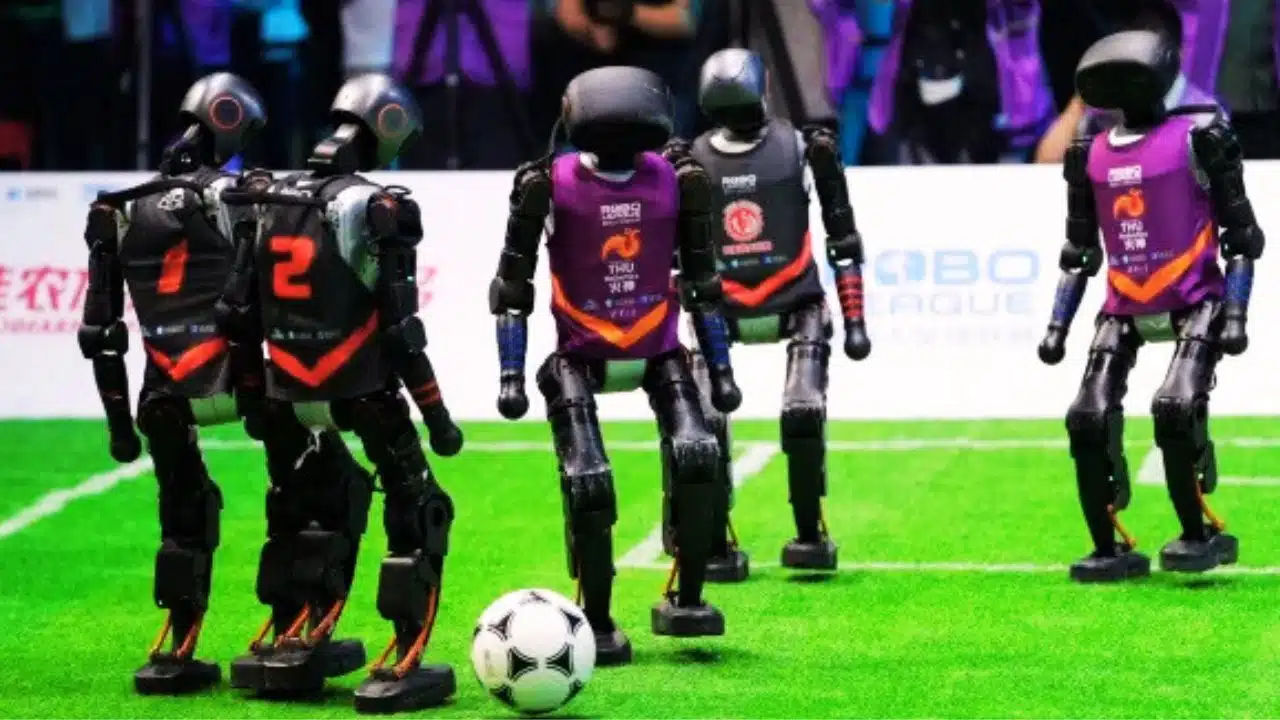
In a quirky and visually amusing event that took place in Beijing over the weekend, child-sized humanoid robots faced off in a 3-on-3 soccer match. But despite their unsteady movements, stumbles, and occasional face-plants, the technology behind the match marks a significant milestone in the world of autonomous robotics and artificial intelligence (AI).
From the outside, it looked like a robotics version of little league soccer, with frequent pileups, missed goals, and an evident lack of defensive tactics. Robots collided in slow-motion, fell over one another, and struggled to regain their footing. Some tried to monopolize the ball, others barely managed to stand upright. At least two or three had to be physically removed from the field using stretchers after toppling awkwardly, showcasing just how far these machines still have to go in replicating human athleticism.
Yet behind the humor lay cutting-edge technology. These robots weren’t remote-controlled or operated by humans. They were fully autonomous, making every decision and movement independently, based on AI algorithms, without any real-time human supervision or intervention.
AI at the Helm: Fully Autonomous Soccer Bots
Each robot team in the tournament operated using advanced artificial intelligence. The systems integrated real-time visual processing, spatial navigation, and strategic decision-making. Using high-resolution vision sensors and real-time computing capabilities, the robots could detect the ball, track its movement, scan the positions of other players, and make calculated movements toward the goal.
The robots were programmed with the ability to regain their balance and stand up after falling—a crucial feature given how frequently they collapsed. However, some were unable to self-correct and required human intervention, including one robot that was dragged off the field after falling awkwardly near the goalpost.
While the gameplay lacked polish, the underlying technological achievement was impressive. Building robots capable of playing a real-time team sport with no human controls is a complex feat. It requires the integration of advanced perception systems, locomotion control, object detection, and cooperative AI strategy.
China’s Race in Robotics Innovation
This event wasn’t just for entertainment. It served as a showcase of China’s rapidly growing investments and ambition in the field of robotics. China is racing to become the global leader in next-generation robotic technologies. According to Morgan Stanley research, the country’s robotics market is expected to grow at an annual rate of 23%, reaching an estimated $108 billion by 2028. Currently, it stands at approximately $47 billion.
Looking further ahead, projections suggest that by the year 2050, China could have over 302 million humanoid robots in operation, far surpassing the United States’ projection of around 77.7 million. These robots are anticipated to play key roles in performing repetitive, simple, and structured tasks, especially in sectors like manufacturing, logistics, and public services.
Experts have observed that the Chinese government’s robust support for what is known as “embodied AI”—AI technology physically implemented into machines or robots—is stronger than in any other nation. This includes large-scale funding, policy support, and national-level initiatives to integrate robotics into everyday life.
Sports as a Testing Ground for Robots
Saturday’s match was more than a gimmick. It was part of China’s larger effort to use sports as a proving ground for humanoid robotics. Sports offer the perfect environment to test the limits of physical motion, reaction time, endurance, and decision-making in high-stakes scenarios. Unlike controlled laboratory settings, sports fields are unpredictable, which makes them ideal for pushing the boundaries of robot development.
Earlier this year in April, 21 humanoid robots participated in a half-marathon event in Beijing. Out of those, only six managed to complete the race, which again underscored the challenges developers face. Still, the marathon—and now the soccer match—offer real-world feedback loops that help refine both hardware and software.
These events are contributing to the momentum building toward the 2025 World Humanoid Robot Games, which China is set to host in Beijing from August 15 to 17. The event will be held alongside the prestigious World Robot Conference and is expected to feature 11 different robot sports, including soccer, gymnastics, and track and field.
The upcoming games will be held at some of Beijing’s most iconic venues, including the “Bird’s Nest” (National Stadium) and the “Ice Ribbon” (National Speed Skating Oval). These high-profile locations signify the importance that China is placing on this new frontier of competitive robotics.
How the Robots Were Built and Trained
The robots used in Saturday’s match were supplied by Booster Robotics, a Chinese tech firm that specializes in robotic hardware. However, the AI that controlled each team was developed independently by different university groups, such as Tsinghua University and China Agricultural University. These teams were responsible for designing their own autonomous algorithms, including visual recognition, movement coordination, team strategy, and pathfinding.
In the final match of the tournament, Tsinghua University’s team outscored China Agricultural University’s team by 5–3. While the competition had its fair share of technical hiccups, the overall performance highlighted just how far humanoid robotics has come in real-world environments.
Developers observed that while the robots can perform complex tasks such as passing, tackling, and positioning, their agility, stability, and endurance are still in developmental stages. However, every fall or misstep captured valuable data, helping to accelerate improvements in future models.
China’s Broader Strategy: Leading Through Embodied AI
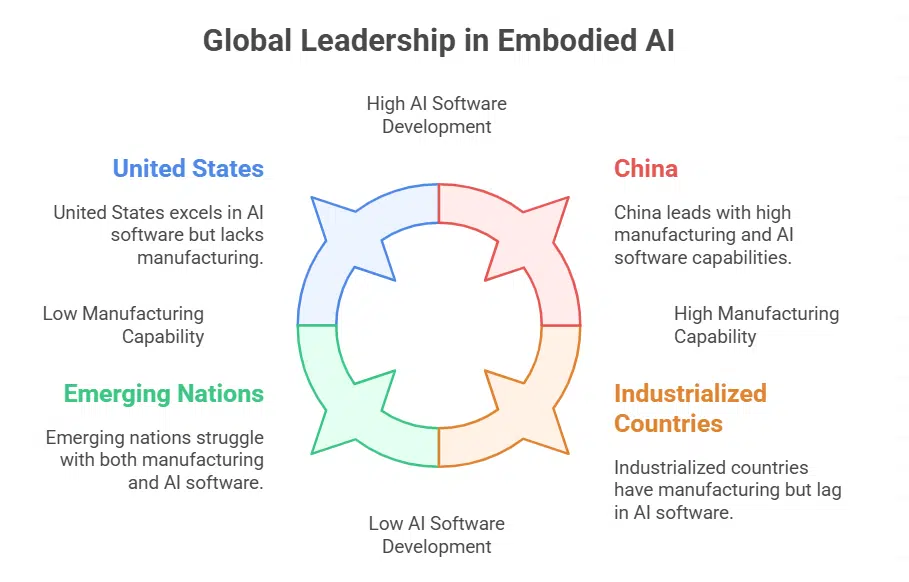
China is pushing beyond traditional robotics into the realm of fully embodied AI systems. These are robots that not only think and process information but also move and interact with their environments. This holistic integration of physical and cognitive intelligence is seen as essential for the next generation of robotics.
Public and private sectors in China are working hand-in-hand to advance embodied AI. Government funding is backing research institutes, while companies like UBTECH, Fourier Intelligence, and Xiaomi are introducing commercial humanoid robot models with increasing capabilities.
While countries like the United States excel in software-based AI development, China’s advantage lies in its ability to manufacture at scale and deploy robotics across industries. Analysts suggest that unless other countries significantly increase investment and collaboration in this space, China will continue to widen its lead.
The Future of Robot-Human Interaction in Sports
According to engineers and company leaders involved in the event, the long-term goal is not just to improve robot capabilities, but to create scenarios where robots and humans can play and work together. For example, a human and a humanoid robot could eventually form a mixed soccer team—not necessarily to compete, but to demonstrate collaboration, trust, and safety.
This kind of interaction could help the public grow more comfortable with robots in daily life. It would also serve to refine user interfaces, safety protocols, and communication methods between humans and intelligent machines.
What looked like a clumsy robot soccer game in Beijing was actually a window into the future of robotics. While the matches brought laughter with their slow-motion tumbles and missed kicks, they also demonstrated remarkable progress in fully autonomous AI systems. The field of humanoid robotics is advancing rapidly, and China is leading the charge.
Through sports and real-world experimentation, these robots are becoming more capable, more agile, and more intelligent. The 2025 World Humanoid Robot Games will be a major milestone in this journey, and Saturday’s event was just the beginning.
The information is collected from ESPN and Yahoo.