Many sites promise cloud hosting, yet they lag in uptime or cost too much. You might lose data or face constant outages. You want secure, low-cost hosting for your decentralised applications.
Blockchain networks use smart contracts and a consensus mechanism to fix this. A leading fact: over half of new hosting services will use blockchain technology by 2025. This post shows five top blockchain platforms.
You’ll see how a permissioned blockchain, a blockchain VM, and other tools can help you host with more security and less cost.
Curious? Read on.
Key Takeaways
- Over half of new hosting services will use blockchain by 2025 to cut costs and boost uptime.
- Ethereum runs smart contracts on its EVM with Truffle and web3 wallets. Its large community on GitHub and Discord drives fast innovation.
- IBM Blockchain uses Hyperledger Fabric, AES-256 encryption, private channels, and digital certificates for enterprise-grade security and fast audits.
- Hyperledger Fabric has a plug-and-play, modular design that scales for any size. Tezos adds on-chain votes and Proof-of-Stake to save over 90% energy.
- EOSIO’s 2023 Taurus and 2024 Savanna upgrades boost throughput to thousands of transactions per second. Its C++ SDK lets coders build dapps fast.
Ethereum

Ethereum’s on-chain protocols power hosting networks by using code agreements that cut out middlemen. Developers tap into the Ethereum Virtual Machine, use the Truffle Suite, and link a browser wallet to deploy fresh dapps.
Smart contracts for decentralized hosting
Smart contracts run on the Ethereum Virtual Machine and power hosting without a middleman. Developers write them in the Solidity language, like crafting a rulebook for sites. A web IDE or a blockchain framework can test code and spin up simple decentralized applications.
You skip cloud providers and pay only for uptime blocks recorded on a public blockchain.
Hosts earn tokens when they meet contract clauses. EVM verifies each action in real time, so you get a clear audit trail. Smart contracts link fees, service-level checks, and data storage rules.
You mix decentralized finance and hosting in one neat package.
Large developer community
Developers swarm to Ethereum like bees to honey. They test and share smart contract code in Solidity and web3 libraries on the blockchain. Programmers post on GitHub, Discord, and the Ethereum Foundation forum.
They ask and answer, they build libraries, and write tutorials. This public blockchain technology hosts thousands of decentralized applications (dapps); apps like a well-known decentralized exchange and a popular NFT marketplace run on it.
Enterprise Ethereum Alliance brings big firms and startups together. Tools such as Geth and Infura keep nodes in sync. This vast group drives fast innovation and finds bugs quick.
IBM Blockchain
IBM Blockchain runs on a private distributed ledger. It links a fabric framework with identity checks, so you get enterprise-grade security, fast transactions, and no gatekeepers crashing the party.
Enterprise-grade solutions
The platform integrates with existing business infrastructures, so teams can keep legacy systems. The network uses permissioned blockchain and keeps data private. Big corporations support it as a go-to blockchain technology platform.
The design uses distributed ledger technology under Linux Foundation. It runs on Hyperledger Fabric, so teams tap into a proven stack. Users may set up consortium blockchain groups and private blockchains.
Industries see faster audits and lower costs in supply chain management.
Enhanced security features
IBM Blockchain Platform locks down data using permissioned nodes. Companies enforce identity management via digital certificates. Every transaction logs onto a distributed ledger. AES-256 encryption guards corporate information at rest and in transit.
Vetted partners gain access to channels based on roles.
Private channels hide sensitive details from outsiders. Zero-knowledge proofs let networks verify facts without revealing data. IBM Food Trust shows supply chain trust across 20+ brands.
Developers leverage Hyperledger Fabric APIs, R3 Corda modules, and ConsenSys Quorum clients for custom setups. Organizations meet Enterprise Ethereum Alliance standards and enjoy strong audit trails.
Hyperledger Fabric
Hyperledger Fabric runs on a permissioned blockchain, and it snaps smart contracts into place like Lego bricks for sleek dapps. This distributed ledger technology, backed by the Linux Foundation, scales fast from small pilots to sprawling enterprise networks.
Modular architecture
The Hyperledger Fabric network splits its services into plug-and-play modules like Lego blocks. This modular architecture uses peer nodes, orderer nodes, and chaincode interfaces. It runs on a permissioned blockchain set by the Linux Foundation.
It locks data in private channels tied to each shared ledger, a feature of distributed ledger technology.
Developers add or swap modules for consensus, identity, and logging. They craft customized solutions for finance, health, and supply chains. Dapps on this structure scale fast and meet strict data privacy rules.
Scalable and customizable hosting options
Hyperledger Fabric uses a modular architecture to power blockchain technology. An orchestration platform and container tools spin up peer nodes and order services. Teams adjust consensus algorithms, governance rules, and smart-contract settings.
IT teams deploy networks on cloud servers or private data centers. They tailor resource pools to match enterprise needs and control data visibility. This permissioned blockchain showcases distributed ledger technology at scale.
Tezos
Tezos adapts fast, thanks to on-chain governance and a Proof-of-Stake model. Developers cook up dapps in SmartPy and turn them into Michelson code with Taquito, for apps that stay lean and energy-friendly.
On-chain governance for adaptability
Protocol upgrades run through chain governance. Stakeholders on a public blockchain cast votes on upgrade proposals. Smart contracts count each token vote. This decentralized autonomous organization avoids manual patches.
It speeds changes and blocks forks.
The network leads with on-chain governance for adaptability. It uses proof of stake rules. It adapts to new demands without network splits. Developers can deploy dapps on a chain that learns and grows.
The model keeps the protocol fresh, meets shifting needs, and holds each upgrade within the ledger.
Energy-efficient consensus mechanism
Tezos uses proof of stake to validate new blocks. That consensus model reduces energy use, cutting power draw by more than 90%. Developers build smart contracts and decentralized applications (dapps) on this public blockchain.
Enterprises run NFT marketplaces and other enterprise applications with the network.
Token holders stake XTZ via digital wallets to secure the ledger. Validators earn rewards while saving power, unlike mining operations. On-chain governance lets stakeholders vote on protocol changes.
Projects in decentralized finance (defi) tap this system for low fees and fast finality.
EOSIO
EOSIO sprints like a gazelle, handling thousands of operations each second, with fees that slip by unnoticed. Its EOSIO SDK toolset cuts down development time, so coders launch peer-to-peer applications with almost no friction.
High transaction throughput
Sites choke when they face a crowd. The 2023 EOSIO-Taurus upgrade speeds block time to handle thousands of transactions per second. It taps a P2P network and uses Byzantine fault tolerance to cut delays.
Smart-contracts and dapps run on a distributed ledger, like a slick content delivery network.
Upgrades include the Savanna consensus model from 2024. It shifts to proof-of-stake and trims latency. Developers laud the high throughput for real-time trading and non-fungible token creation.
Public blockchains gain new life with this throughput boost.
User-friendly development environment
EOSIO, one of the leading blockchain platforms, gives a smooth developer setup. It uses a web IDE and CLI tools on top of distributed ledger technology. Developers write C++ code for smart contracts, and they launch dapps fast.
It feels like a friendly workshop. Many game studios and streaming services pick it now. They enjoy high transaction speeds, and they avoid complex setup woes. The toolchain also links to a local node, so testers see live data.
It taps into public blockchain technology, and it uses proof-of-stake to save energy. It secures data with fine-grained privacy options. Sample apps and docs guide new coders step by step.
Community-run forums host tips, and meetups pop up often. Teams focus on features, not on setup chores.
Key Advantages of Blockchain-Based Hosting Platforms
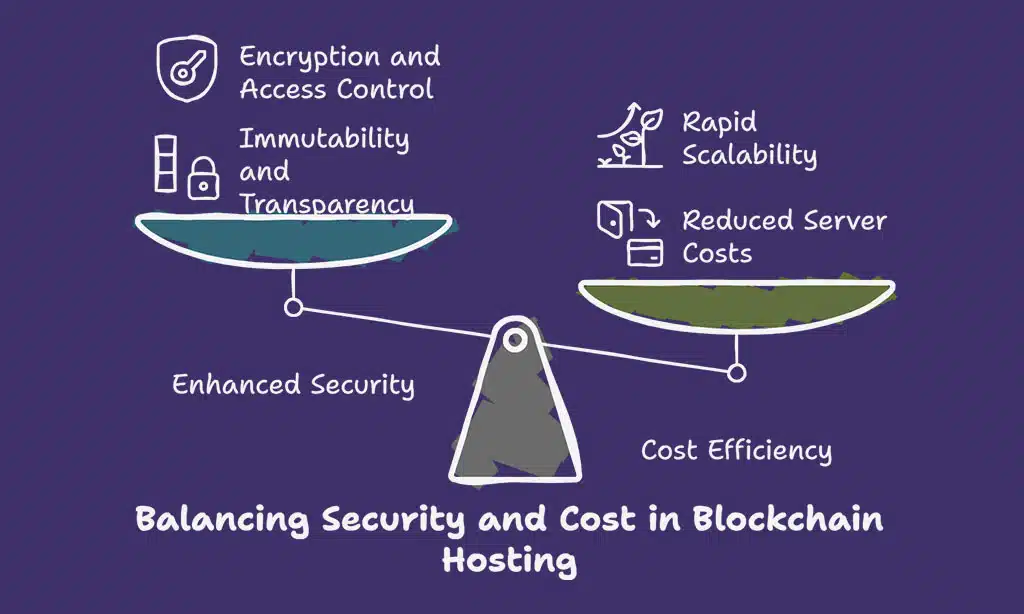
Blockchain hosting boosts security with a shared ledger and cuts fees on cloud servers. It runs chain code on Fabric to protect files and spin up dapps in minutes.
Enhanced security and transparency
Distributed ledgers lock data in time, which stops tampering. This immutability stops fraud on public blockchain networks. Encryption seals files with secure keys, boosting data security.
Auditors can track each change in a shared distributed ledger.
Smart contracts record each step on decentralized applications, offering open logs for defi uses. Zero-knowledge proofs hide private details yet grant proof for digital identity checks.
Hyperledger Fabric runs as a permissioned blockchain, limiting users by role. Developers combine these tools with non-fungible tokens to track ownership on public blockchain.
Cost efficiency and scalability
A peer-to-peer network model removes intermediaries to reduce costs. Smart contracts on a public blockchain run at fixed gas fees, so companies spend less on server bills. Growing businesses scale storage and traffic without extra license fees.
Shared ledger tech boosts node count to match demand. Teams spin up nodes in minutes, rather than buy extra servers. This rapid scale saves money and works with dapps and distributed ledger technology alike.
Takeaways
Platforms like Ethereum use smart contracts to guard apps. IBM Blockchain Platform shields data in big firms. Hyperledger Fabric’s modular design scales with ease. Tezos adapts rules on chain and trims power use.
EOSIO speeds transactions in a friendly dev space. No more guesswork for hosts. Preferences now shift toward distributed ledger technology. Pick your platform and set sail toward smoother hosting.
FAQs
1. What is a permissioned blockchain fabric?
Think of it as a digital vault. It is a hosting platform on a permissioned blockchain. It uses distributed ledger technology, smart contracts, and modular parts. This locks data and speeds transactions.
2. How does an enterprise ledger help with hosting?
It acts like a private club for data. Only approved members can join. This distributed ledger uses strong data privacy and no public mining. You can build dapps, track IoT events, and run smart contracts in a safe space.
3. What can a private Ethereum network do?
Picture a mini Ethereum world, open only to your team. It joins the Enterprise Ethereum Alliance. It uses proof of stake, ERC-20 tokens, and smart contracts. You get DeFi, NFTs, stablecoins, or any dapp without public fees.
4. Why is the BNB network so popular?
The BNB network, once called the Binance Smart Chain, is like a fast highway for blockchains. It uses proof of stake authority. It hosts smart contracts and manages DeFi, NFTs, and dapps. It has low fees and high speed.
5. How does modular architecture boost hosting?
Modular architecture is like Lego bricks, letting you drop in consensus engines or privacy walls. Platforms such as permissioned ledger sawtooth mix and match parts. This makes it easy to adjust for traceability, IoT, or social media platforms.
6. Can these platforms power DeFi and dapps?
Yes, they all host decentralized applications, from DeFi to NFTs. They run smart contracts on a distributed ledger. They let you choose public or permissioned nodes. They add data privacy and support CBDCs or content delivery networks.