


It was an era when video games were simple things. You put in a coin, the game started, and you survived for so long or saw the fright message—Game Over. You might have been allowed three lives, lucky you. Then, if you wished to play again, another coin, but that was it, and nobody minded.
Nowadays, it’s not like that. Nowadays, games don’t just ask for a coin, they tempt you with virtual treasure chests. They whisper to you: “Go on, just one more. There might be something special in there.” And you might roll your eyes at it all, but you still can’t help but think what’s in the box. Maybe something odd. Maybe something pointless. Maybe nothing at all, but you won’t know if you don’t open it.
And so, here we are, in a gaming world where digital cases, crates, and boxes are as much a part of the process as the game itself.
The Emergence of CSGO Cases
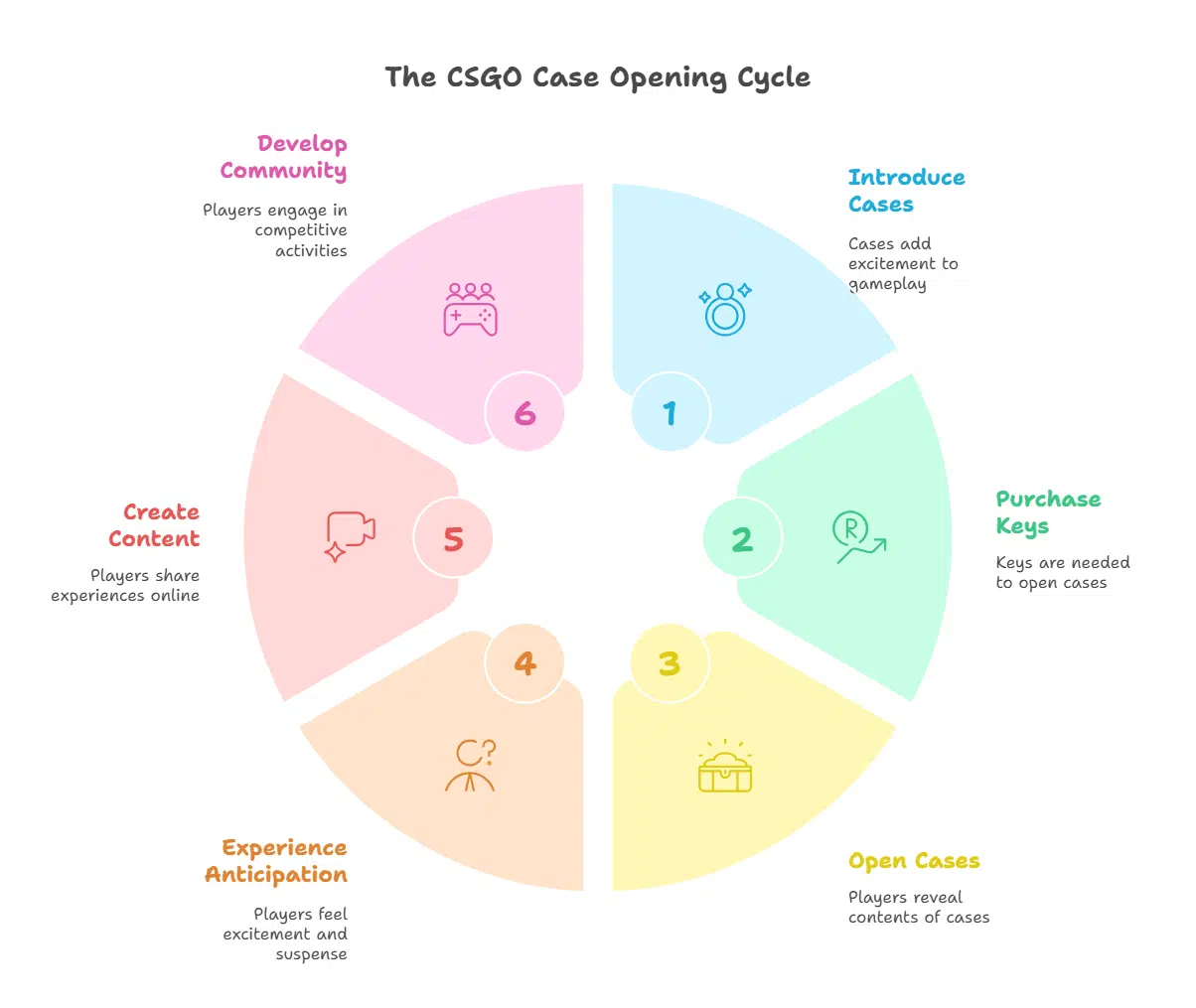
It started innocently enough. Counter-Strike: Global Offensive (CSGO) created weapon cases back in 2013—a minor added element, really, nothing more than a way to put some pizzazz on your gun with a new digital coat of paint. You couldn’t buy the skins directly; no, that would be too simple. You had to open a case instead. And to open a case, you needed to buy a key. And what was inside the case? That was a mystery. Maybe a flashy, super-rare skin. Maybe something boring and underwhelming. But the moment you opened one, you were able to see the draw: the anticipation, the unveiling, the microseconds of “what if?”
It did not take long before the community turned case-opening into an event. Players taped themselves opening cases in marathon streams, responding as if they’d just won the lottery or, more regularly, as if they’d been personally wronged by the algorithm. With CSGO case battles, another twist on the whole experience, gamers wouldn’t just open cases—They’d fight to see who could rack up the most loot.
It added a degree of added tension, a competitive twist to the unpredictability, and before long, it was a healthy subculture unto itself.
The Spread of Loot Boxes Across Gaming
Success from CSGO instances did not go unnoticed. Other game producers, eyes aglow with dollars, saw it. Loot boxes were ubiquitous sooner or later. FIFA had Ultimate Team bundles. Overwatch introduced loot crates. Call of Duty introduced supply drops. If the game included any type of customisation, the game suddenly required a loot box system. And if it wasn’t customisable, well, developers created space for it to be so.
It wasn’t that players loved loot boxes. It was that they were spending money on them. More, in certain cases, than on the games themselves. And the industry exploited this, some titles effectively built around them. Mobile gaming, at least, was flooded with what were effectively not games at all—merely shiny, tap-tapping slot machines posing as strategy or action or puzzle games.
The trend was set: the real thrill wasn’t in the winning, it was in the potential for winning.
Gambling? Or Just a Bit of Fun? This is where things start to get a little fuzzy. On the one hand, loot boxes are just part of a game. Nobody is forcing you to open them. And yet, if you’ve ever clicked through case after case, just one more because the next one might be the big one, you start to see the similarities.
And if you’ve ever found yourself sitting there watching someone else opening them—yes, just watching, as though it’s some kind of spectator sport—well, it’s hard not to think of slot machines, blinking lights, and the clinking of coins into a tray.
There’s a reason that, in the last few years, loot boxes have been on the legal chopping block. Some countries have categorized them as gambling. Others have demanded that developers reveal the odds, so the player knows exactly how slim their chances are before they click the “open” button.
Where Does It End?
Despite the controversy, the influence of loot boxes has bled over into the rest of the entertainment industry. You see the mechanics everywhere now. TV shows and streaming services are experimenting with randomised rewards and surprise digital content drops. Even the old sports have adopted the idea, with mystery merchandise boxes and blind-packaged trading cards making a comeback.
And still, even while a few games deviate from loot boxes—adapting to battle passes or simply flat-out buys—the essence persists. The thrill of possibility, the thrill of discovery, the minor rush of dopamine that loops users back. Perhaps it was destined to be thus with video games. Digital entertainment as an industry relies on attention, on how to capture individuals viewing, playing, and paying. Loot boxes are just a part of that, a gentle nudge to keep you playing. And while the trend may shift, while the developers may change their ways, the idea will remain the same.
Because ultimately, it’s not the skin, or the special item, or the virtual trinket.
It’s the instant before you open the box. The possibility. The promise. The hope.





















