

Decentralized Finance, commonly known as DeFi, is revolutionizing the way we think about money and finance. By leveraging blockchain technology, DeFi aims to create a permissionless, transparent, and open financial system, eliminating intermediaries like banks and brokers.
Over the past few years, it has grown into a multi-billion-dollar ecosystem, attracting innovators, investors, and institutions.
However, despite its promise, DeFi is not without challenges. At the same time, it presents numerous opportunities to reshape the global financial landscape. In this article, we’ll explore the challenges and opportunities in DeFi, highlighting its potential and the obstacles it must overcome to achieve mainstream adoption.
Understanding DeFi and Its Impact
What Is DeFi?
DeFi refers to a decentralized financial ecosystem built on blockchain networks, primarily Ethereum, which offers financial services like lending, borrowing, trading, and yield farming without relying on centralized institutions. Unlike traditional finance, where banks and intermediaries control access, DeFi is open to anyone with an internet connection and a crypto wallet.
Smart contracts—self-executing code—power DeFi protocols, ensuring transparency and trust. The accessibility and transparency of DeFi systems have sparked widespread interest among developers and users alike, making it a cornerstone of the Web3 movement.
Moreover, DeFi’s use cases are expanding into insurance, gaming, and supply chain management, showing its versatility.
The Growing Influence of DeFi in Global Finance
DeFi is reshaping global finance by making financial services more accessible, transparent, and inclusive. It empowers individuals in underserved regions to participate in financial markets and allows investors to earn competitive returns through innovative mechanisms like liquidity provision and staking.
As of 2025, the total value locked (TVL) in DeFi protocols exceeds $100 billion, showcasing its rapid adoption. Notable projects like Uniswap, Compound, and Aave have become key players in this transformation, offering diverse use cases that challenge traditional financial norms.
For example, Uniswap alone facilitates over $1 billion in daily trading volume, reflecting the rising demand for decentralized exchanges.
Challenges Facing Decentralized Finance
Decentralized Finance, or DeFi, has garnered significant attention for its ability to reshape traditional finance systems. Yet, like any revolutionary technology, it faces several challenges that must be addressed to unlock its full potential. In this section, we delve into the core obstacles hindering DeFi’s growth and development.
1. Scalability Issues in Blockchain Networks
Scalability remains one of the biggest hurdles for DeFi. Most DeFi platforms rely on Ethereum, which struggles with limited transaction throughput and high latency. The Ethereum network can only process about 15 transactions per second, leading to congestion during peak times. As a result, users face delayed transactions and exorbitant fees.
These limitations hinder the mass adoption of DeFi, particularly for high-frequency trading or applications requiring real-time processing. For instance, during the NFT boom of 2021, gas fees on Ethereum spiked to over $100 per transaction, deterring smaller investors.
Proposed Solutions:
- Layer 2 Scaling Solutions: Optimistic Rollups and zk-Rollups reduce congestion by processing transactions off-chain and settling them on Ethereum.
- Alternative Blockchains: Networks like Solana, Binance Smart Chain, and Avalanche offer higher throughput and lower fees, making them attractive alternatives.
- Sharding in Ethereum 2.0: By splitting the blockchain into smaller parts, or shards, Ethereum can process transactions more efficiently.
Comparison Table: Ethereum vs. Alternative Blockchains
| Feature | Ethereum | Solana | Binance Smart Chain |
| Transactions/Second | ~15 | ~65,000 | ~60 |
| Average Transaction Fee | High | Low | Moderate |
| Consensus Mechanism | Proof of Stake | Proof of History | Delegated Proof of Stake |
2. Security Vulnerabilities and Hacks
Security breaches and hacks have plagued the DeFi space. Smart contract vulnerabilities and poorly audited protocols have led to billions of dollars in losses. For instance, the 2022 Ronin Bridge hack resulted in $600 million being stolen.
These incidents erode trust among users and highlight the need for better security measures. Another notable example is the 2021 Poly Network hack, where $611 million was drained, though most funds were later returned.
Proposed Solutions:
- Rigorous Audits: Reputable firms like CertiK and ConsenSys conduct thorough audits to identify vulnerabilities.
- Bug Bounty Programs: Platforms like Immunefi reward ethical hackers for finding and reporting bugs.
- Decentralized Insurance: Protocols like Nexus Mutual and Cover Protocol offer coverage against hacks and exploits.
Key Statistics on DeFi Hacks:
| Year | Total Value Lost (USD) | Major Incident |
| 2020 | $120M | Harvest Finance Hack |
| 2021 | $1.3B | Poly Network Exploit |
| 2022 | $3.8B | Ronin Bridge Hack |
3. Regulatory Uncertainty Across Regions
Regulators worldwide are still grappling with how to address DeFi. The lack of clear guidelines creates uncertainty for developers and users. Some governments see DeFi as a threat to monetary stability, while others worry about its role in money laundering and tax evasion.
This fragmented regulatory environment hinders innovation and deters institutional participation. For example, China has outright banned cryptocurrency-related activities, while Singapore has taken a more supportive approach, fostering innovation in the DeFi space.
Proposed Solutions:
- Regulatory Sandboxes: Create environments where DeFi projects can operate under temporary regulatory frameworks.
- Decentralized Compliance Tools: Tools like Chainalysis and Elliptic enable real-time transaction monitoring while maintaining user privacy.
Regional Overview of DeFi Regulations:
| Region | Regulatory Stance | Notable Actions |
| United States | Ambiguous | SEC scrutiny of tokens as securities |
| EU | Cautiously supportive | MiCA framework for crypto-assets |
| Asia | Mixed (Supportive/Restrictive) | China bans, Singapore encourages |
4. High Gas Fees and Cost Barriers
The cost of interacting with DeFi protocols can be prohibitive, especially for small investors. Ethereum’s high gas fees, which often spike during network congestion, deter many potential users. This creates a barrier to entry and reinforces wealth disparities within the ecosystem. In January 2023, average gas fees on Ethereum ranged from $20 to $40 per transaction.
Proposed Solutions:
- Ethereum 2.0 Transition: Sharding and Proof of Stake mechanisms aim to significantly reduce fees.
- Adoption of Layer 2 Solutions: Platforms like Arbitrum and Optimism are already reducing transaction costs for users.
Gas Fee Comparisons Across Networks:
| Blockchain | Average Gas Fee (USD) | Typical Use Case |
| Ethereum | $20-$40 | High-value transactions |
| Binance Smart Chain | <$1 | Everyday transactions |
| Polygon | <$0.01 | Microtransactions |
5. Limited User Experience and Accessibility

DeFi platforms often lack user-friendly interfaces, making them inaccessible to non-tech-savvy users. Setting up wallets, understanding protocols, and managing private keys can be intimidating. This steep learning curve limits adoption and prevents DeFi from reaching its full potential. Additionally, wallet recovery remains a significant pain point for users who lose access to their private keys.
Proposed Solutions:
- Simplified Wallets: Solutions like Argent and MetaMask Mobile offer user-friendly experiences.
- Education Initiatives: Platforms like DeFi Pulse Academy provide resources to help users navigate DeFi.
Common User Barriers in DeFi:
| Barrier | Description |
| Complex Interfaces | Difficult for non-technical users to navigate |
| Wallet Management | Challenges in securing private keys |
| Lack of Education | Insufficient resources for first-time users |
Opportunities Driving the Growth of DeFi
While the challenges in DeFi present obstacles, they also pave the way for innovation and growth. DeFi’s opportunities lie in its ability to create an inclusive financial ecosystem, provide lucrative earning mechanisms, and bring real-world assets onto the blockchain.
In this section, we’ll explore how these opportunities are shaping the future of decentralized finance.
6. Financial Inclusion Through Decentralization
DeFi’s decentralized nature makes it a powerful tool for financial inclusion. It provides access to financial services for the unbanked and underbanked populations globally. In regions with unstable banking systems, DeFi offers an alternative for savings, loans, and cross-border transactions.
For instance, in Venezuela, citizens have turned to stablecoins like USDT to counteract hyperinflation and store value securely.
Examples:
- Peer-to-Peer Lending: Platforms like Aave allow borrowing without a credit score.
- Stablecoins: Enable users in volatile economies to preserve value and facilitate international transactions.
Benefits of DeFi for Financial Inclusion:
| Benefit | Impact |
| Accessibility | Services available 24/7 globally |
| Cost-Effectiveness | Lower fees compared to traditional banks |
| Empowerment | Users control their financial assets |
7. Yield Farming and Staking Innovations
Yield farming and staking have transformed DeFi into a lucrative space for earning passive income. Users can provide liquidity to protocols and earn rewards in return.
For instance, platforms like Curve Finance and Yearn Finance offer competitive annual percentage yields (APYs). Yield farming rewards users who contribute liquidity, while staking allows users to lock tokens in exchange for interest.
Examples of APY Rates in DeFi (2025):
| Platform | Yield Farming APY | Staking APY |
| Curve Finance | 5%-10% | N/A |
| Aave | N/A | 3%-6% |
| Yearn Finance | 7%-15% | N/A |
8. Tokenization of Real-World Assets
DeFi enables the tokenization of physical assets like real estate, art, and commodities. Tokenization democratizes access to investments and enhances liquidity. By allowing fractional ownership, DeFi opens up investment opportunities to a broader audience.
For instance, platforms like RealT tokenize real estate properties, enabling users to own fractions of properties in high-value markets.
Use Cases for Asset Tokenization:
| Asset Class | DeFi Application |
| Real Estate | Fractional ownership through tokens |
| Art | Digital certificates for provenance |
| Commodities | Blockchain-based trade and tracking |
9. Evolution of Decentralized Autonomous Organizations (DAOs)
DAOs represent a new governance model where token holders collectively make decisions. They are transforming how organizations operate, offering transparency and decentralization. MakerDAO, for example, governs the DAI stablecoin and ensures its stability through community voting mechanisms.
Notable DAOs:
- MakerDAO: Governs the DAI stablecoin, with over $6 billion in circulation.
- Uniswap DAO: Oversees protocol upgrades and liquidity incentives.
10. Interoperability Across Blockchain Networks
Interoperability is key to DeFi’s future. Cross-chain solutions allow users to seamlessly move assets between different blockchains, enhancing usability. Projects like Polkadot and Cosmos are pioneering interoperability solutions. For example, Cosmos’ Inter-Blockchain Communication (IBC) protocol has facilitated over 10 million transactions between chains since its launch.
Interoperability Benefits:
| Benefit | Description |
| Asset Mobility | Transfer assets across chains easily |
| Ecosystem Expansion | Collaboration between blockchains |
| Enhanced Efficiency | Streamlined operations for users |
Comparing Challenges and Opportunities in DeFi
Balancing Risks and Rewards
Navigating the challenges and opportunities in DeFi requires a balanced approach. While scalability and security remain concerns, the innovations in yield farming and DAOs promise a bright future. Users must weigh risks like regulatory uncertainty against potential rewards such as high returns and financial empowerment.
Strategies for Sustainable DeFi Growth
- Encouraging open dialogue between developers, regulators, and users.
- Investing in education and community building.
- Enhancing interoperability and scalability to meet global demand.
Future Outlook for DeFi
Emerging Trends in Decentralized Finance
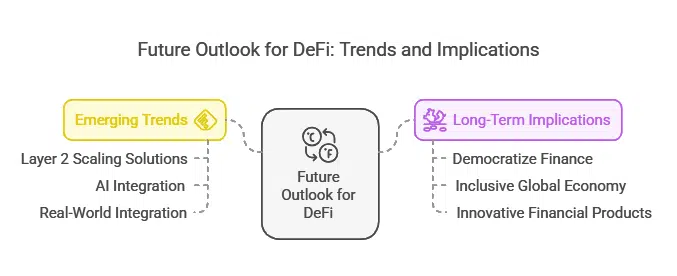
The future of DeFi is shaped by trends like:
- Layer 2 Scaling Solutions: Increased adoption of platforms like Arbitrum.
- AI Integration: Enhanced risk management and fraud detection using artificial intelligence.
- Real-World Integration: Expansion into sectors like healthcare and supply chain through tokenization.
Long-Term Implications for the Financial Ecosystem
DeFi’s long-term impact could be revolutionary. It has the potential to:
- Democratize finance by eliminating intermediaries.
- Create a more inclusive global economy.
- Introduce innovative financial products and services.
Takeaways
The journey of decentralized finance is a mix of challenges and opportunities. While hurdles like scalability, security, and regulatory uncertainty persist, the potential for financial inclusion, innovation, and growth is immense.
By addressing its limitations, DeFi can pave the way for a more transparent, accessible, and decentralized financial future. As the ecosystem evolves, stakeholders must work together to overcome challenges and unlock the full potential of this groundbreaking technology.
























