
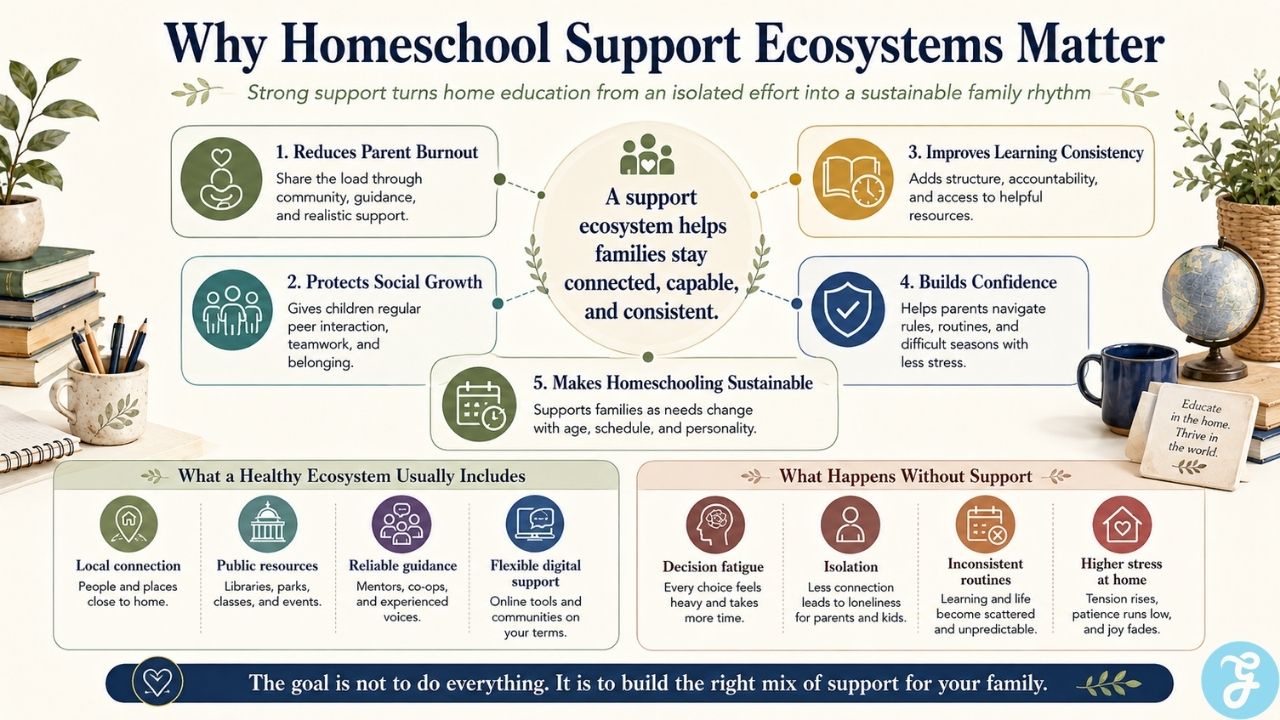
Embracing home education offers undeniable freedom, but it can quickly become an isolating experience for both parents and children if you try to manage everything in a vacuum. Stripping away the built-in social environment of traditional schooling means parents must intentionally construct a brand-new ecosystem of support. Finding the right homeschool community resources is the difference between a thriving, sustainable educational journey and rapid parent burnout.
Many families dive into home education focusing entirely on text-based curriculum or digital software, treating socialization as an afterthought. However, finding peers, collaborative teaching opportunities, and legal protection requires a completely different set of tools. Navigating the sheer volume of choices can be overwhelming for beginners, which is why having an experienced editorial perspective is essential to separate high-value networks from unorganized online noise.
9 Top Vetted Homeschool Community Resources for Modern Families
Letting go of conventional school structures requires understanding the operational commitment each alternative demands. Some networks function as low-pressure social clubs, while others require mandatory parent teaching rotations or financial investments. This breakdown explores nine of the most reliable avenues for building a local and digital support system, highlighting the practical friction you should anticipate with each.
1. Local Homeschool Co-ops and Collaborative Pods
A traditional co-op relies on a simple trade: parents pool their time, talents, and resources to teach groups of children collectively. One parent might handle high school chemistry while another guides elementary art. This structure provides a built-in social group for students and splits the academic burden across multiple families, making it an incredibly popular option for those seeking collaborative learning.
The practical challenge lies in the human element. Co-ops are entirely dependent on the volunteer labor and personalities of the participating parents. If a co-op lacks clear leadership or if disagreements arise over teaching styles, scheduling, or behavior management, the environment can become deeply stressful. They also demand a rigid weekly time commitment that can conflict with a family’s desire for scheduling flexibility.
2. Home School Legal Defense Association (HSLDA)
While primarily known as a legal advocacy group, HSLDA serves as a massive operational anchor for families navigating state regulations. Every state maintains unique laws regarding attendance tracking, standardized testing, and portfolio reviews. HSLDA clarifies these complex legal frameworks through plain-language guides and provides direct legal defense for member families facing bureaucratic hurdles from local school districts.
Beyond legal protection, the platform offers practical homeschool resources like high school transcript generators, educational consultants for special needs, and regional support group directories. The friction here is financial; full access to their legal defense network requires an annual paid membership. For families in highly regulated states, this expense is often considered a non-negotiable insurance policy, whereas parents in low-regulation states might only utilize their free public resources.
3. Regional and State-Level Homeschool Associations
Every state features at least one dedicated non-profit organization focused entirely on defending local educational freedom and organizing large-scale community events. Groups like the Texas Home School Coalition or the Christian Home Educators of Colorado host massive annual conventions, curriculum fairs, and graduation ceremonies that bring thousands of families together.
These associations are invaluable when you need localized advice on state-specific compliance or when you want to look at physical textbooks before buying them. However, many of these long-standing organizations are explicitly faith-based. If your family is seeking a purely secular educational path, you may find that the leadership culture and speaker lineups at these large state conventions do not align with your specific goals, requiring you to look for regional secular alternatives instead.
4. Wild + Free Nature Groups
For parents who favor a Charlotte Mason approach or early childhood experiential learning, Wild + Free has evolved into a global network of local chapters. These groups gather weekly at local parks, hiking trails, and nature preserves to emphasize outdoor exploration, handcrafts, and literature read-alouds. It acts as an antidote to screen fatigue and provides a highly relaxed environment for parents to connect.
The friction with nature-based groups is entirely dependent on weather and geography. If you live in an area with harsh winters or limited public park infrastructure, maintaining consistent community connection through the colder months becomes difficult. Additionally, as children grow into middle and high school ages, the loose, play-centric structure of park days often needs to be supplemented with more rigorous academic support networks.
5. TheHomeSchoolMom Directory
When you are brand new to home education and have no local connections, locating active homeschool community resources in your immediate zip code is an uphill battle. TheHomeSchoolMom functions as a massive, volunteer-updated database that catalogs local co-ops, field trip clubs, and support groups across the United States. It serves as a comprehensive parents homeschool guide for identifying nearby activities.
Because the site relies heavily on crowdsourced data and manual updates from group leaders, you will occasionally encounter digital dead ends. It is common to find listings for co-ops or clubs that disbanded a year prior or links to stale email addresses. Treat this directory as a starting point for discovery, but expect to do some digital detective work to verify if a group is still actively meeting before showing up.
6. Public Library Homeschool Networks
Local libraries have quietly transformed into major hubs for day-time educational communities. Recognizing that a significant portion of their community is home during school hours, many library systems offer specialized morning workshops, LEGO clubs, book discussions, and science labs tailored specifically for home-educated students.
These programs provide excellent, zero-cost access to high-quality instruction and physical materials without any long-term commitment. The limitation is that these events are typically episodic rather than sequential. A library might host an incredible engineering workshop one Tuesday, but it won’t function as a continuous, daily academic community. Use it to supplement your routine and meet local parents, but don’t expect it to replace a dedicated learning co-op.
7. Classical Conversations Communities
If you desire a highly structured, rigorous academic framework combined with local accountability, Classical Conversations is a heavily managed international model. Families meet once a week at a local host facility, where trained parent-tutors guide students through a standardized, classical curriculum focused on memorization, debate, and rhetoric.
This system removes the guesswork from lesson planning and ensures your child sees the exact same peer group every single week. The operational trade-offs are twofold: cost and rigidity. Classical Conversations requires significant annual tuition fees per child, and you are locked into their exact curriculum choices. If your child struggles with their specific style of rote memorization, you cannot easily modify the coursework while remaining an active part of the local community.
8. Moderated Online Forums and Regional Social Networks
When local physical groups are unavailable or too far away, digital forums like Reddit’s r/homeschool community or localized Facebook groups provide 24/7 access to collective wisdom. These digital spaces are excellent for crowdsourcing curriculum reviews, trouble-shooting math roadblocks, or finding local families interested in organizing casual park meetups.
The glaring drawback to online spaces is the lack of editorial curation and the presence of unsolicited opinions. Homeschooling styles vary wildly, from radical unschooling to ultra-strict school-at-home models. Posting a simple question in an unmoderated forum can quickly expose you to intense judgment from parents who believe their specific philosophy is the only correct path, creating unnecessary anxiety for beginners who are simply trying to find their footing.
9. Interactive Digital Learning Hubs with Peer Communities
Modern digital platforms like Miacademy or online social clubs have integrated community features directly into their educational frameworks. These platforms go beyond standard video screens by offering moderated chat rooms, student-led newspapers, and interest-based clubs where children can share projects and interact with peers safely.
These platforms serve as excellent homeschooling tools for independent learners or introverted students who find large physical co-ops overwhelming. The reality is that digital peer interaction cannot fully replace the physical, real-world social dynamics of playing in a park or working face-to-face on a group project. It should be treated as a valuable supplement rather than the sole source of a child’s social development.
The Boring Check That Matters
Before committing your time or financial resources to any community network, it is critical to evaluate the structural expectations and alignment with your lifestyle.
| Resource Type | Core Benefit | Main Operational Requirement | Potential Point of Friction |
| Volunteer Co-ops | Low financial cost and shared teaching load | Active parent teaching or administrative work | Group politics and inconsistent teaching quality. |
| Structured Franchises | High academic accountability and fixed peer groups | Significant annual tuition and rigid curriculum | Zero flexibility to adapt materials to your child. |
| Public Infrastructure | Completely free workshops and high-quality materials | Manual tracking of local library event calendars | Non-sequential classes that do not build a core curriculum. |
| Online Communities | Instant access to global curriculum crowdsourcing | Strong digital literacy and boundary setting | Unsolicited criticism and conflicting educational philosophies. |
Before You Choose
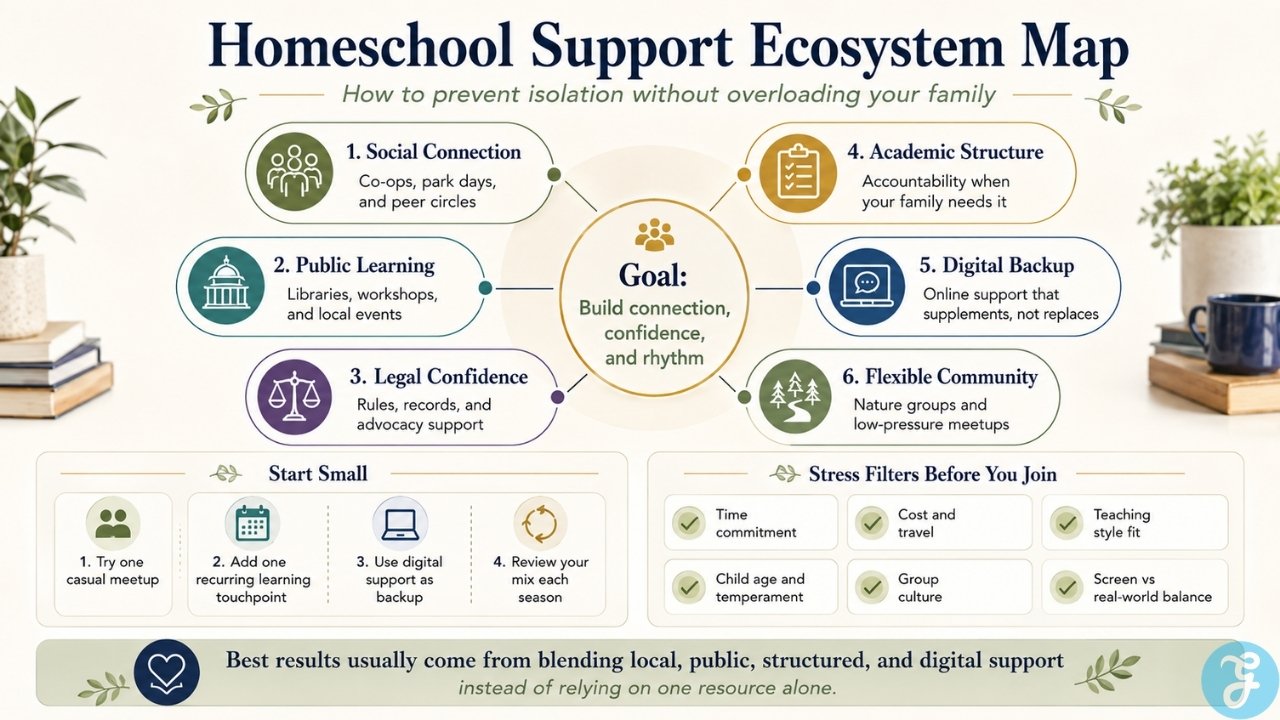
Building a supportive network takes time, and the best arrangement usually involves blending multiple elements rather than relying on a single solution. If you are feeling overwhelmed by the sheer volume of choices, the easiest path forward is to start small by attending a casual library meetup or a local park day. This allows you to observe local dynamics without making a heavy financial or administrative commitment.
As your family becomes more comfortable with home education, you can gradually introduce more structured homeschool community resources like co-ops or legal advocacy tools to reinforce your daily routine. Remember that your community needs will change as your children grow. What works beautifully for an active seven-year-old may feel entirely inadequate for a teenager prepping for college applications. Remain flexible, protect your family’s schedule from over-commitment, and prioritize networks that offer genuine support rather than added stress.
Frequently Asked Questions (FAQs) About Homeschool Community Resources
Do homeschool co-ops satisfy the legal requirements for schooling in my state?
In most regions, co-ops do not count as official schools or satisfy legal mandates on their own. They are considered supplemental learning groups, which means parents still bear the ultimate responsibility for registering their homeschool status and tracking state-required subjects.
How do I find active secular homeschool groups if most local options are religious?
While many long-standing associations have religious foundations, regional directories allow you to filter groups by philosophical alignment. Checking local public library bulletin boards or starting a casual neighborhood park day is often the fastest way to locate and attract other secular homeschooling families in your immediate area.
Is there a financial cost associated with joining these community networks?
Costs vary entirely based on the structure of the resource you choose. Public library events and casual nature playgroups are completely free, whereas volunteer co-ops usually charge small fees to cover raw materials, and managed academic franchises require substantial annual tuition per child.
Can home-educated students participate in local public school sports or clubs?
This depends entirely on your specific state laws, which are commonly referred to as Tim Tebow laws. Many states legally mandate that public school districts allow home-educated students to try out for sports teams and join extracurricular clubs, while other regions leave that choice completely up to the discretion of individual school principals.
What is the best way to handle legal compliance and protect my homeschool?
Joining a national legal defense association provides direct access to educational lawyers who understand the nuances of local regulations. Additionally, keeping meticulous contemporary records of your child’s attendance, completed coursework, and annual standardized testing scores ensures you stay perfectly aligned with your local school board’s rules.