

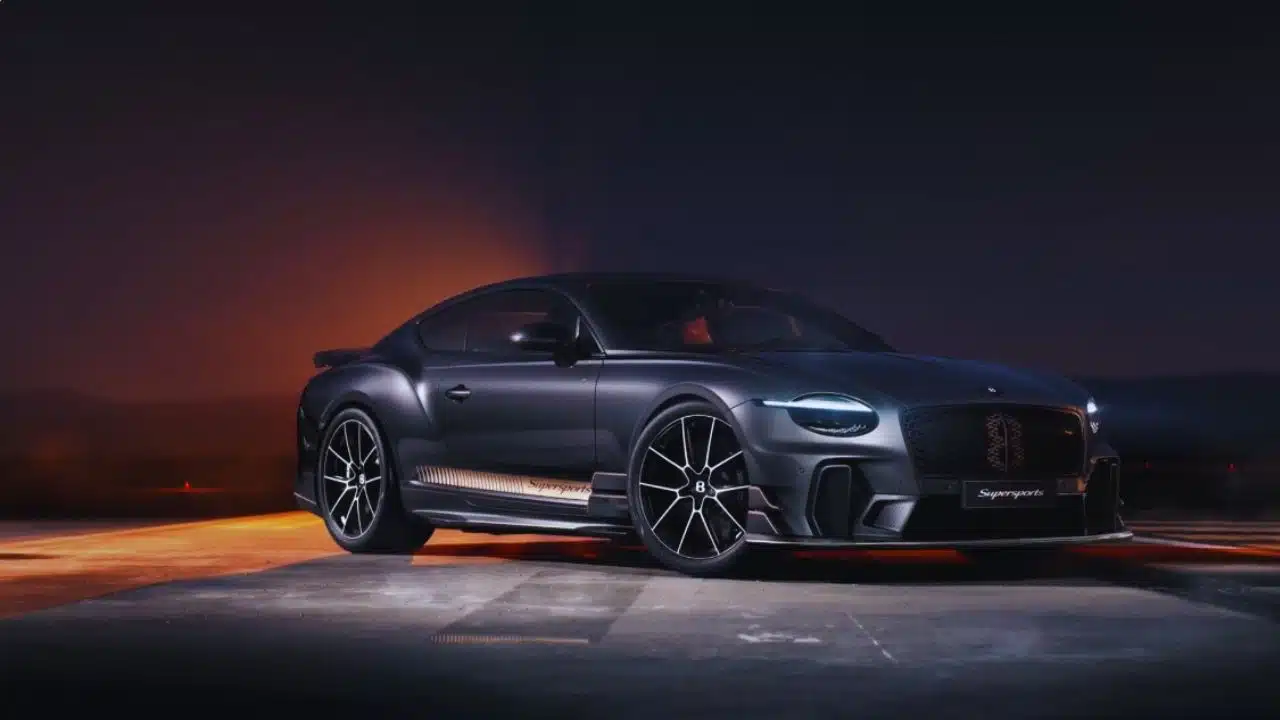
A full century after Bentley’s original Super Sports model shattered the 100 mph barrier on public roads in 1925, the luxury automaker is reviving the iconic nameplate with a groundbreaking new edition. The 2026 Bentley Continental GT Supersports emerges as the brand’s most engaging and driver-oriented road car yet, stripping away excess weight and complexity to deliver a pure, exhilarating grand tourer that weighs under two tonnes for the first time in over 85 years. This limited-run model, capped at just 500 individually numbered examples worldwide, honors Bentley’s heritage of blending opulent British craftsmanship with uncompromised performance, all while marking a deliberate shift back to non-hybrid, internal combustion engineering in an increasingly electrified automotive landscape.
Bentley Motors unveiled the Continental GT Supersports at a dedicated event, positioning it as the fourth iteration of the Supersports badge in the company’s 106-year history. Hand-assembled at the historic Crewe facility in England, this two-seater ditches the all-wheel-drive system and plug-in hybrid powertrain found in recent Continental GT variants, opting instead for rear-wheel drive to enhance agility and reduce mass. The result is a vehicle that’s not only the lightest production Bentley since the 1930s but also the most powerful V8-equipped model ever to roll out of Crewe, boasting 666 PS (657 horsepower) and 800 Nm (590 lb-ft) of torque from a heavily revised 4.0-liter twin-turbo V8 engine. This power density—reaching 166.5 PS per liter—represents the highest output per liter of any engine in Bentley’s lineup, achieved through meticulous upgrades including a reinforced crankcase, enhanced cylinder heads, and larger twin-scroll turbochargers that spool up quicker for sharper throttle response.
Dr. Frank-Steffen Walliser, Chairman and CEO of Bentley Motors, emphasized during the reveal that the Supersports transcends mere acceleration figures. This car embodies our commitment to creating more extreme vehicles that fuse exceptional versatility with genuine driver connection, all while serving as bespoke masterpieces tailored to individual owners,” he stated. Walliser highlighted how the model signals a broader direction for Bentley, promising future “extreme” variants that prioritize engagement over outright efficiency, drawing on the brand’s racing pedigree to appeal to enthusiasts seeking a more visceral luxury experience.
Performance with Poise
At its core, the Continental GT Supersports refines the grand tourer’s inherent poise and long-distance comfort, but it infuses these qualities with precision-engineered elements borrowed from motorsport. By eliminating the hybrid system’s batteries and electric motors—along with the front differential and associated AWD hardware—Bentley engineers shaved hundreds of kilograms, achieving a kerb weight of approximately 1,995 kg, which is about 100 kg lighter than the outgoing Continental GT Speed. This rear-wheel-drive configuration, a first for any production Continental GT, transforms the car’s dynamics, allowing for more playful handling and a rearward bias in weight distribution that shifts from 54:46 at standstill to even more rear-focused as speeds increase, promoting better traction during acceleration and cornering.
Power flows through a recalibrated ZF eight-speed dual-clutch automatic transmission, featuring new clutches and software tweaks for lightning-fast upshifts and more stable downshifts under heavy braking. An electronic limited-slip differential at the rear, combined with brake-based torque vectoring, intelligently distributes torque to individual wheels, minimizing wheelspin and maximizing grip on varied surfaces. Bentley quotes a 0-62 mph (0-100 km/h) sprint of 3.7 seconds—impressively close to the hybrid GT Speed’s quicker times despite the power deficit—and an electronically limited top speed of 192 mph (310 km/h), with final figures pending full homologation testing. While these numbers prioritize feel over brute force, the real standout is the lateral performance with optional Pirelli P Zero Trofeo RS tires, the Supersports achieves up to 1.3 g of cornering grip, roughly 30% more than the GT Speed, enabling it to lap tracks or twisty roads with confidence.
Braking duties fall to the largest carbon-ceramic system ever fitted to a Bentley 440 mm (17.3-inch) front rotors gripped by 10-piston calipers and 410 mm rear discs with six-piston units, sourced from the same supplier as those on high-performance models like the Lamborghini Urus. These provide fade-resistant stopping power even after repeated hard use, with pedal feel tuned for progressive modulation. The chassis benefits from a widened rear track by 16 mm (0.6 inches), rear-wheel steering for tighter turning radii at low speeds, and an advanced three-chamber air suspension with twin-chamber dampers that independently control compression and rebound for a supple ride or taut handling on demand. Bentley’s Dynamic Ride 48-volt active anti-roll system counters body lean in just 0.3 seconds, while three selectable drive modes—Touring for serene highway runs, Bentley for everyday balance, and Sport for aggressive track sessions—adjust everything from throttle mapping and exhaust valves to stability control thresholds. In Sport mode, drivers can fully disable electronic aids for controlled oversteer, and standard launch control ensures repeatable sub-4-second sprints.
Complementing the mechanical upgrades is a full-length titanium exhaust system co-developed with Akrapovič, which not only trims weight but amplifies the V8’s naturally aspirated-like roar without any synthetic cabin sound augmentation—ensuring every rev and gear change feels authentic and immersive. Lightweight 22-inch forged aluminum wheels, engineered in collaboration with Manthey Racing (a Porsche tuning specialist), further reduce unsprung mass, enhancing ride quality and responsiveness across the 21-spoke design.
Design Defined by Function
The Supersports’ exterior evolves the Continental GT’s flowing silhouette into something more purposeful and aggressive, where every stylistic choice directly supports aerodynamic efficiency and weight reduction without compromising the marque’s signature elegance. Up front, the most prominent change is the largest splitter ever integrated into a Bentley road car, spanning the full width of a redesigned bumper and channeling airflow to cool the engine bay and massive front brakes while generating front-end downforce. Flanking this are quad carbon-fiber dive planes that slice through turbulent air, new B-shaped vents in the fenders to vent wheel-arch pressure, and extended side sills that smooth underbody flow, all contributing to a 30% improvement in high-speed stability.
At the rear, a fixed carbon-fiber wing, full-width diffuser, and reshaped bumper work in tandem to produce over 300 kg (661 lbs) of additional downforce compared to the Continental GT Speed—more than double in some scenarios—while maintaining balanced aerodynamics to prevent lift at either end. This setup not only pins the car to the road during fast sweeps but also improves brake cooling and fuel efficiency at cruising speeds. The roof panel, now constructed from carbon fiber instead of steel, lowers the center of gravity by several millimeters and saves an additional 10 kg, preserving structural rigidity through advanced composite layering techniques. These exposed carbon elements are finished in high-gloss, satin, or raw weave options, visually underscoring the car’s performance intent while integrating seamlessly with the body’s aluminum-intensive architecture.
Wheel and tire choices emphasize function the standard 22-inch Manthey Racing wheels pair with Pirelli P Zero tires, but the optional Trofeo RS semi-slicks unlock the full dynamic potential for spirited driving. Overall, the design achieves a drag coefficient that’s marginally higher than the standard GT due to the added aero protrusions, but the net gain in downforce and stability far outweighs any minor efficiency trade-offs.
Inside, the cabin shifts to a strict two-seat layout, replacing the rear bench with a lightweight carbon-fiber tub that further aids the sub-two-tonne target. New sports seats, positioned 15 mm lower than before, offer enhanced bolstering for lateral support during hard cornering, upholstered in combinations of premium leather, Alcantara-like Dinamica microfiber, and carbon-fiber accents for a race-inspired yet luxurious feel. The seats feature 18-way power adjustment, heating, ventilation, and massage functions, ensuring long-haul comfort matches the performance credentials. The dashboard and center console retain the familiar 12.3-inch digital instrument cluster and 10.9-inch touchscreen infotainment system, running Bentley’s Rotating Display interface with Apple CarPlay, Android Auto, and an optional Naim audio setup tuned specifically for the front seats to optimize sound staging while trimming weight by focusing speakers forward.
Personalization shines through Mulliner, Bentley’s bespoke division, allowing owners to select from 24 standard exterior paint shades—ranging from deep metallics to vibrant hues—or commission fully custom colors. Five curated Design Themes, such as the shadowy “Nightfall” with Anthracite base, Camel racing stripes, and an “8”-inspired grille badge, or the brighter “Daybreak” in Jetstream Matte accented by Arctica and Portofino trims, exemplify how the Supersports can shift from stealthy predator to elegant cruiser. Interior options extend to monotone, duo-tone, or tri-tone leather schemes, with Dark Chrome hardware, embroidered plaques denoting the car’s limited-edition status (e.g., “1 of 500”), and intricate details like diamond-quilted panels or engine-turned aluminum inlays.
Handcrafted Rarity
Every Continental GT Supersports undergoes meticulous hand-assembly at Bentley’s Crewe headquarters, where skilled artisans spend over 200 hours on the interior alone, stitching leathers by hand and fitting carbon components with precision tolerances measured in microns. The Mulliner personalization process, available from order placement, elevates this further: customers can specify unique paint formulas, embroidered motifs, or even custom treadplates engraved with personal messages, ensuring no two examples are identical despite the shared platform.
Launch specifications like “Nightfall” capture the model’s dual personality—subtle aggression in its gloss black finish and subtle stripes, ideal for understated sophistication—while “Daybreak” leans into contrast with matte exteriors and bold accents, appealing to those wanting a more extroverted presence. Additional options include illuminated Bentley wings emblems, deployable rear spoilers in alternative materials, and wheel finishes from diamond-cut to painted inserts. Orders commence in March 2026, with production ramping up in Q4 of that year at Crewe, followed by first customer deliveries in early 2027. Availability spans key markets including the United States, Europe, the United Kingdom, the Middle East, Canada, Australia, and select Asian regions like Malaysia and Japan. Pricing details remain under wraps, but expect a starting figure north of £350,000 (around $450,000 USD), reflecting the exclusivity and advanced engineering.
A Legacy Reborn
The Supersports legacy began in 1925 with the Bentley 3 Litre Super Sports, a shortened-wheelbase variant of the brand’s inaugural model that delivered 100 mph capability through an uprated 3.0-liter engine and lightweight construction—remarkable for an era when most cars struggled to reach 60 mph. Just 18 units were produced, but its speed and durability propelled Bentley to early victories at the Le Mans 24 Hours, cementing the “Super Sports” moniker as a symbol of unbridled performance.
The nameplate resurfaced in 2009 on the first-generation Continental GT, creating a 631 hp, 204-mph two-seater that was 100 kg lighter than its siblings and tuned for sharper responses, appealing to a new wave of affluent driving enthusiasts. The 2017 iteration amplified this further, introducing W12 power and advanced chassis tech to define the pinnacle of that model’s range. Codenamed Project Mildred in tribute to Mildred Mary Petre—a trailblazing 1920s racer who set multiple endurance records at the Montlhéry circuit in France, including a solo 24-hour run averaging over 60 mph—this latest Supersports continues the tradition by emphasizing driver involvement over the hybrid era’s focus on peak power outputs.
In a market dominated by electrification, the 2026 model’s pure V8 setup—without batteries or electric assistance—revives Bentley’s roots in high-revving, naturally responsive engines, offering a counterpoint to the 782 PS hybrid Continental GT. As Walliser articulated, it paves the way for additional “extreme” Bentleys that balance heritage with innovation, ensuring the brand remains at the forefront of luxury performance for another century.






















