
For nearly fifteen years, digital publishing operated on a relatively simple, predictable piece of math. You hired specialized writers, built an optimization strategy around user intent, earned authoritative backlinks, and watched that effort translate into stable search traffic. That traffic was the lifeblood of the open web. It fed the programmatic ad networks, fueled the affiliate conversion pixels, and gave publishers a predictable funnel to convert casual readers into paid subscribers.
That contract is dead.
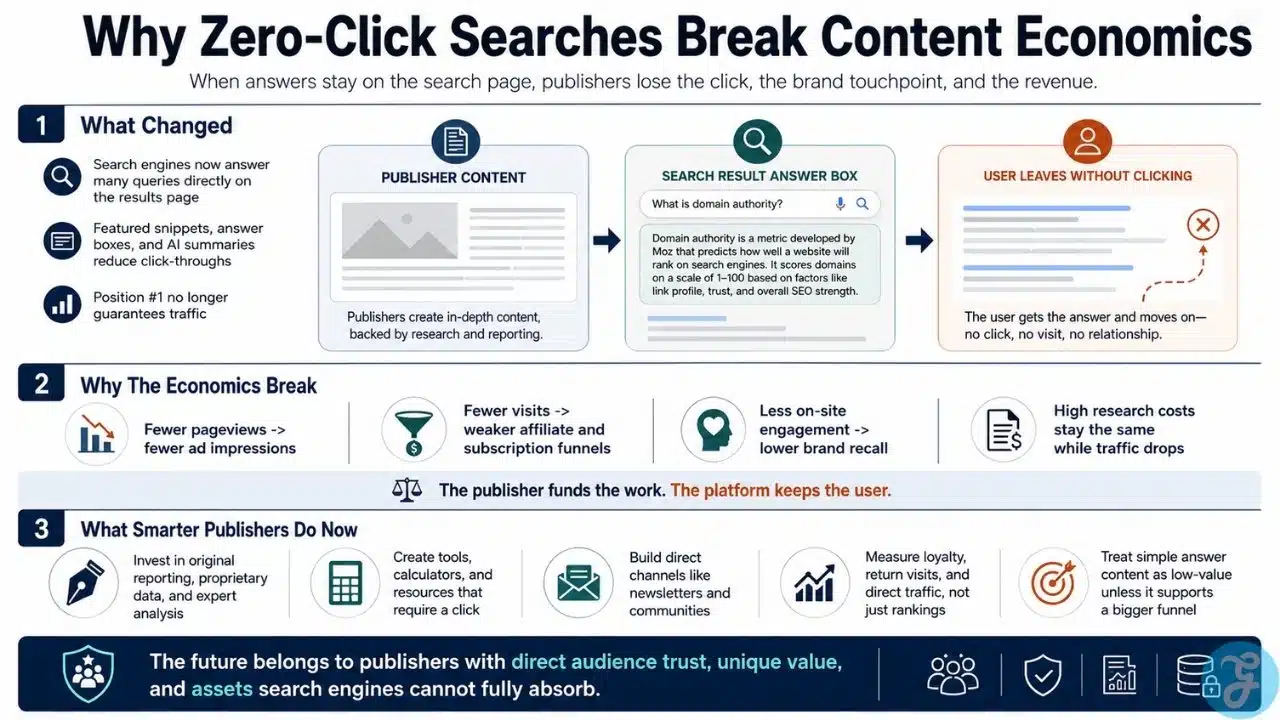
Google didn’t just tweak the rules of distribution; they fundamentally changed the destination. The rise of zero-click searches, where an algorithm scrapes a web page, distills the core answer, and surfaces it directly on the search engine results page (SERP), has shifted the web from an open ecosystem of discoverable links into a closed destination. Users get their immediate fix without ever setting foot on the digital property that funded, researched, and wrote the information. For anyone running a media company or managing a corporate content budget, zero-click search economics is not a technical optimization problem. It is a slow-motion collapse of the business model behind online publishing.
The View From The Analytics Cliff
It is easy to look at industry-wide charts and treat this as a macroeconomic trend, but the reality is much uglier when you are looking at a dashboard on a Tuesday morning.
A few years ago, I oversaw a portfolio of technical tutorials and finance guides. One of our foundational pieces was a highly detailed guide on a common programming syntax issue, specifically, Python dictionary comprehension. For three years, it was a beautifully consistent asset. It ranked position one, held the top spot through multiple core updates, and brought in roughly 8,000 to 9,000 highly targeted monthly pageviews. When engineers landed on that page, they stayed. They clicked internal links to deeper tutorials, interacted with our code sandboxes, and occasionally registered for our premium technical newsletter.
Then Google expanded its featured snippet real estate for technical queries. Within two weeks, our position-one ranking didn’t move, but our organic traffic to that URL cratered by more than 60%.
When we looked at the live SERP, the reason was obvious. Google had extracted our clean, multi-line code block and placed it inside a dominant gray box at the very top of the page. The user didn’t need to click our link anymore. They copied the syntax directly from the search results, pasted it into their local IDE, and went about their day.
The remaining traffic we kept was messy, mostly users with highly specific edge cases that the snippet couldn’t answer. The high-value, high-intent traffic that built our baseline audience simply vanished. The content itself was still pristine; it was just rendered invisible by its own clarity. We had optimized ourselves right out of the click.
The story was identical in our consumer finance vertical. A comprehensive piece on credit card rewards structures lost almost half its volume in less than a quarter because a new interactive comparison widget appeared directly above the fold on Google. Our revenue models weren’t built to survive that kind of immediate traffic evaporation. Programmatic ad inventory requires impressions to generate revenue, and affiliate partners don’t pay out commissions based on how many people read a pulled snippet on a search page. They pay when a human being lands on your site and clicks a tracking link.
How Zero-Click Search Economics Breaks The Publisher Model
The core issue here is a phenomenon we can call brand extraction. When information is stripped of its context and displayed as a universal truth on a search results page, the concept of brand equity disappears.
Imagine a user searching for updated international tax brackets or real-time mortgage calculations. If a publisher like NerdWallet or Bankrate spends thousands of dollars on legal review, compliance updates, and engineering resources to keep that data accurate, they do so with the expectation that the user will engage with their brand.
When that data is scraped and formatted into a clean, interactive box at the top of the search engine, the user gets their answer in four seconds. They might glance at the tiny favicon or the small text credit attributing the source, but they do not register the publication. To the consumer, Google answered the question.
The publisher takes 100% of the operational risk and bears 100% of the content production cost, while the platform captures 100% of the user retention. This dynamic completely breaks the traditional ROI of editorial investment. Deep-dive, authoritative content is incredibly expensive to produce. If the reward for creating the definitive guide on a topic is that your traffic gets cut in half because your answer was “too good,” the rational business decision is to stop investing in deep-dive content entirely.
That is the worst part of zero-click search economics. The exact material required to feed search features and answer engines becomes less financially viable for the publishers producing it.
This decay is felt most sharply in programmatic advertising. Modern ad stacks rely heavily on user behavior data, scroll depth, session duration, and multi-page journeys, to command high cost-per-thousand (CPM) rates from premium advertisers. When zero-click features siphon off the top-of-funnel traffic, the overall pool of impressions shrinks, but the operational costs of running the site remain fixed. You are left running a more expensive operation for a smaller, less engaged audience.
The Illusion Of “Easy” Digital Pivots
When you talk to traditional search consultants about this shift, the advice is almost always a collection of high-level platitudes. They tell you to “diversify your traffic channels,” “build a community,” or “convert your search visitors into newsletter subscribers.”
Anyone who has actually managed an editorial balance sheet knows that these pivots are incredibly difficult, capital-intensive, and fundamentally change what a media company is.
Building an active email newsletter with half a million loyal subscribers requires an entirely different operational architecture than managing a search-driven content engine. Search traffic is driven by immediate, transactional intent: a user has a specific problem right now, and they want an answer. Email marketing, on the other hand, relies on continuous, habit-based relationship building.
You cannot simply place a subscription box on a site that has lost 50% of its incoming traffic and expect to build a sustainable business model overnight. The math does not work. If your conversion rate from an organic visit to an email sign-up is a healthy 2%, and your raw traffic drops from 100,000 monthly visits to 40,000, your subscriber acquisition pipeline is effectively crippled.
Furthermore, relying purely on direct-to-consumer models like paid premium subscriptions or community paywalls narrows your addressable market dramatically. Only a tiny fraction of the internet population is willing to enter a credit card number to read a technical tutorial or a financial explainer. The open web worked because free access was subsidized by aggregated attention. Once that attention is intercepted at the search layer, the economic foundation underneath that subsidy falls away.
Operational Adjustments For An Unforgiving Landscape
Surviving this environment requires a ruthless reappraisal of what you choose to publish and how you measure success. If you continue to build content designed to be neatly summarized in a four-line bulleted list, you are essentially volunteering to produce free training data for platforms that have no intention of sending you traffic.
The first major shift must happen in editorial strategy. Publishers have to stop treating simple, transactional answers as reliable business assets. If a query can be fully satisfied by a definition, a short list, or a basic calculation, that query belongs to the search platforms now. Trying to fight for visibility there is a waste of capital.
Instead, editorial resources must be reallocated toward content that requires deep human nuance, subjective judgment, or proprietary data that cannot be cleanly scraped. This means focusing on:
Primary Source Journalism And Investigative Reporting: Interviews, field research, and internal company leaks cannot be synthesized by a scraper because the data does not exist anywhere else on the open web.
Highly Complex, Multi-Variable System Design: A guide on “how to structure an enterprise data pipeline across three legacy cloud systems” cannot be condensed into a featured snippet. The answer is too dependent on context, risk tolerance, and architectural trade-offs.
Proprietary Data And Industry Surveys: Conducting original research and publishing raw datasets means you own the underlying asset. Even if a search engine highlights your conclusion, serious industry professionals will still need to click through to download the full report or verify the methodology.
Internally, key performance indicators must also change. If your editorial team is still being incentivized based on raw pageviews or keyword rankings, you are optimizing for a ghost economy. A position-one ranking that yields a zero-click snippet is a vanity metric that will not pay your payroll.
Instead, track metrics that measure real human attachment: return visitor rate, direct traffic sessions, newsletter click-through rates, and average time-on-site for non-search referrals. These figures show you the true size of your core audience, the people who actively seek out your domain name because they trust your specific voice, not the people who happened to stumble onto your content through an intermediary.
The New Equilibrium For Publishers
The digital content economy is experiencing a permanent structural downsizing. The era of building massive, bloated media properties purely on the back of aggregate search arbitrage is over. The search platforms have realized that their primary loyalty is to user convenience and ad-space retention on their own pages, not to the health of the third-party ecosystem.
This does not mean publishing is dead, but it does mean it is becoming a much smaller, tougher, and more disciplined industry. The publishers who survive the zero-click era will be those who refuse to build their houses on rented land. They will be smaller operations with hyper-focused audiences, unique editorial voices, and direct distribution lines that do not rely on a search box to find their readers.
The answer to zero-click search economics is not more generic content, more keyword stuffing, or another desperate attempt to win a snippet that might steal the click anyway. The smarter move is to build assets search cannot fully absorb: reporting, tools, proprietary data, expert judgment, community trust, and direct audience relationships.
For everyone else, the math is simple: if your business model requires Google to give you a click just because you wrote a good answer, it is time to rewrite your business model.