

Your best workers are leaving. They quit their jobs and move to other companies. You watch them go, and you wonder why they could not stay. The truth is simple: they did not feel valued at work. They did not see a path to grow. They did not trust their leaders. Have you ever felt that exact frustration? A 2025 Gallup report found that only 32% of US employees actually feel engaged in their work. That is a massive wake-up call.
Here is a helpful secret I have learned. Companies with a strong workplace culture keep their top workers around 22 percent longer. It means less time spent hiring new people and training them. Your company saves money and gets better results.
I am going to walk you through exactly how to build a workplace culture for talent retention. We will look at simple, actionable steps together.
The Importance of Workplace Culture in Employee Retention
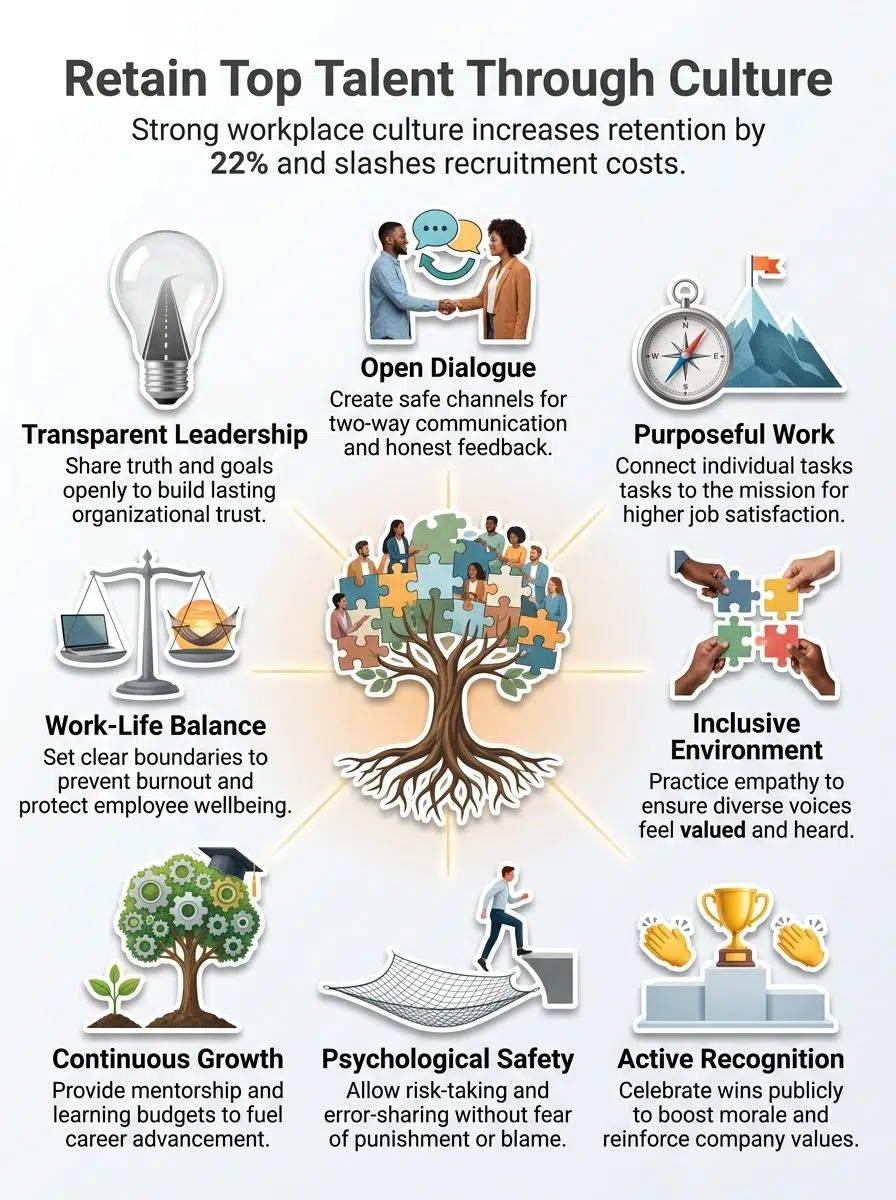
Top talent walks out the door when workplace culture fails them. Companies lose skilled workers to competitors who offer better environments, stronger leadership practices, and genuine employee well-being support. A strong company culture acts like glue. It holds your best people in place while weak cultures leak talent like a broken bucket.
Organizations that invest in positive workplace environments see lower turnover rates and higher job satisfaction scores. The financial impact is huge. A 2025 report by Insignia Resources highlights that replacing a single employee can cost up to a third of their annual salary. That makes culture an urgent financial priority, not just an HR goal.
Employees spend roughly one-third of their lives at work, so they deserve spaces where they feel valued and heard. When leadership communicates with honesty, people stay. They build careers instead of just collecting paychecks.
People will forget what you said, people will forget what you did, but people will never forget how you made them feel. – Maya Angelou
Talent development and organizational commitment go hand-in-hand with retention metrics that actually matter. Companies use specialized survey tools like Culture Amp or Lattice to measure employee engagement accurately. They discover exactly what keeps workers motivated and what drives them away.
Feedback mechanisms help managers catch problems early before frustration turns into resignation letters. Organizations that prioritize talent management see their best performers stay longer and contribute more. The investment pays off through reduced recruitment costs, increased productivity, and teams that operate smoothly.
Core Elements of a Positive Workplace Culture
A strong workplace culture rests on five main pillars. These foundations shape how your team members feel about their jobs, their colleagues, and the company itself.
Honest and Transparent Leadership
Leaders who share the truth build stronger teams. Your employees want to know what is happening in the company. They want to understand why decisions get made and how those choices affect their jobs. Honest leadership means telling staff about wins and losses alike.
The 2025 Edelman Trust Barometer revealed a fascinating fact. A massive 77% of US employees say they trust “My Employer” more than government or media institutions. You have their trust, so you must protect it actively.
Transparent leaders share company goals and financial performance with their teams. This openness creates trust. Trust forms the foundation of strong organizational commitment. Employees who trust their leaders feel valued and stay longer.
They work harder because they believe in the mission. Transparent communication also cuts down on rumors and confusion. When leaders keep information locked away, employees fill the gaps with negative guesses.
Honest leaders stop this problem before it starts. They hold regular meetings, send clear emails, and answer tough questions directly. Companies that practice honest leadership see lower turnover rates and stronger team dynamics.
Open Communication Channels
Your team members need to hear from you, and you need to hear from them. Open communication channels form the backbone of a strong workplace environment. When your staff can share ideas and feedback without fear, magic happens.

The most important thing in communication is hearing what isn’t being said. – Peter Drucker
Create multiple ways for people to connect and be heard. Town halls, suggestion boxes, and direct messaging platforms like Slack or Microsoft Teams all work wonderfully. The key is making sure people actually use them and that you listen to what they say.
Transparency from leadership builds trust across your organization. Explain decisions that affect them, even when those choices are hard. This kind of honest dialogue strengthens team collaboration. Your talent retention improves because employees feel like insiders.
Meaningful Work and Growth Opportunities
People stay at companies where they feel their work matters. Meaningful work gives employees a sense of purpose that goes far beyond a paycheck. Talented staff members want to solve real problems and create a real impact.
Organizations that connect daily tasks to bigger company goals see higher job satisfaction. Managers should talk openly about how each team member drives the mission forward. This conversation builds pride in the work.
Growth opportunities act like a magnet for ambitious talent. LinkedIn’s 2025 Workplace Learning Report found that 88% of organizations worry about retention, and providing learning opportunities is now the number one strategy to keep people. Employees crave learning experiences that sharpen their abilities.
Empathy and Inclusion
Empathy forms the foundation of strong workplace environments. Leaders who listen to their employees create spaces where people feel valued, not just tolerated. Your team members share different backgrounds and life experiences that shape how they work.
A 2025 Edelman Trust Barometer report states that 67% of people have experienced discrimination at work. Managers who practice empathy recognize these differences and adapt their leadership practices to fix this issue directly. This approach transforms how employees engage with their jobs.
Inclusive workplaces attract top talent because workers see themselves reflected in the company culture. To make inclusion real, look into starting Employee Resource Groups (ERGs). These employee-led groups foster a diverse, inclusive workplace where everyone has a voice.
Recognition and Rewards
Your top performers crave recognition. They want to know their hard work matters. A solid recognition program fuels job satisfaction and keeps your best people around. Celebrate wins, both big and small.
Gallup data shows that employees who feel recognized are 63% more likely to stay with their employer. Public praise costs nothing but pays massive dividends.
To build a culture of appreciation, try implementing a few structured rewards:
- Peer-to-Peer Recognition: Use software like Bonusly to let team members publicly reward each other with points for great work.
- Spot Bonuses: Give immediate financial rewards for exceptional effort on a specific project.
- Wellness Perks: Offer gym stipends or subscriptions to mental health apps to support employee wellbeing.
- Extra Time Off: Reward long hours with an unexpected Friday afternoon off.
Strategies to Build a Culture That Retains Top Talent
Building a strong workplace culture requires concrete steps. You need to act right now. Your best people will leave if you do not create an environment where they feel valued.
Hire for Cultural Alignment
Your hiring process shapes your entire organization. Talent management starts the moment you post a job opening. You need to screen candidates for cultural fit alongside their skills.
- Define your organizational values clearly before you start recruiting, so every team member knows what behaviors matter most.
- Ask interview questions that reveal how candidates think about collaboration and work-life balance rather than just technical abilities.
- Include current employees in the interview process to see if applicants will mesh well with your team dynamics.
- Look for candidates who show genuine interest in your mission, because people who care about your purpose stay longer.
- Hire people who demonstrate empathy and emotional intelligence to strengthen employee engagement across the board.
Foster Psychological Safety
Psychological safety means your team members feel comfortable taking risks without fear of embarrassment or punishment. Employees speak up with ideas, admit mistakes, and ask for help when they need it.
The American Psychological Association’s 2025 Work in America survey found a staggering 51% of US workers feel “used up” at the end of the day. A psychologically safe environment directly combats this emotional drain. Leaders build this foundation by responding to failures with curiosity instead of blame.
They ask genuine questions, listen without interrupting, and show vulnerability about their own struggles. Workers who feel safe contribute more to organizational development and stay longer at the company. Psychological safety transforms how teams work together.
Provide Continuous Learning and Development
Your top talent craves growth like plants crave sunlight. Companies that invest in professional development see employees stick around much longer.
- Offer tuition reimbursement programs so employees can earn degrees or certifications that advance their careers.
- Create mentorship initiatives that pair experienced staff with newer team members to foster knowledge transfer.
- Build an internal library of online courses through platforms like LinkedIn Learning or Coursera, giving your workforce instant access to thousands of expert-led lessons.
- Establish clear career advancement pathways so workers understand exactly what steps to take next.
- Allocate annual learning budgets, empowering employees to choose development opportunities that fit their goals.
Engage in Regular Feedback and Check-Ins
Regular feedback and check-ins form the backbone of strong employee engagement and professional growth. These conversations keep your team connected and motivated.
- Schedule monthly one-on-one meetings to discuss progress, challenges, and career aspirations in a safe space.
- Ask open-ended questions like “What support do you need right now?” to spark meaningful dialogue.
- Provide specific, actionable feedback that focuses on both strengths and areas for improvement.
- Document key points from each check-in, including goals discussed and any action items.
- Connect feedback directly to career advancement opportunities within your organization.
Promote Work-Life Balance
Burnout destroys talent retention faster than almost anything else. Employees who work constantly without breaks become exhausted and ready to leave. In fact, a 2025 report from Wellhub found that 28% of US employees report feeling completely burnt out.
Smart leaders protect their team’s personal time. They set clear boundaries around work hours, encourage vacation days, and discourage after-hours emails. Establishing a strict “right to disconnect” policy is a highly effective way to enforce these boundaries.
Flexible schedules matter too. Offering remote work options or flexible start times shows your organization values employee well-being. Healthy employees perform better, stay longer, and actually enjoy coming to work.
Examples of Companies With Successful Workplace Cultures
Several organizations stand out for their exceptional talent retention strategies and strong company culture. They understand that job satisfaction flows from real investment in people.
| Company | Key Retention Strategy | Why It Works |
|---|---|---|
| The famous “20% time” policy. | Let’s employees spend one day a week on personal projects, fueling innovation and professional growth. | |
| Costco | Industry-leading compensation. | As of March 2025, they raised minimum pay to $20/hour, with an average US hourly wage topping $31. This builds immense loyalty and stability. |
| Salesforce | Comprehensive wellbeing support. | Offers heavy mental health support and wellness stipends, showing workers they matter beyond their job titles. |
| Netflix | Radical transparency. | Uses direct feedback mechanisms, letting employees know exactly where they stand and what they need to improve. |
These companies prove that workplace environment quality directly impacts talent development and long-term success. Their approaches show that recognition programs and genuine leadership support create workplaces where people actually want to stay.
Measuring the Impact of Workplace Culture on Retention
You can track how your workplace culture affects employee retention by looking at real numbers and real feedback from your team members.
Employee engagement surveys
Employee engagement surveys give you a clear window into how your team really feels about their work. These surveys ask workers direct questions about job satisfaction, workplace environment, and leadership support. Using specialized tools like Qualtrics or Glint makes collecting and analyzing this data incredibly simple.
Your staff answers honestly, and you get real data to work with. The results show you where your company shines and where it needs work. High scores mean your talent retention strategies work. Low scores tell you what problems exist right now, before your best people walk out the door.
Running these surveys regularly keeps your finger on the pulse of your organization. If surveys reveal that employees crave more professional growth opportunities, you build better training programs.
Retention and turnover metrics
Tracking retention and turnover metrics gives you real data about whether your culture actually works. Numbers do not lie. These metrics reveal patterns that gut feelings miss.
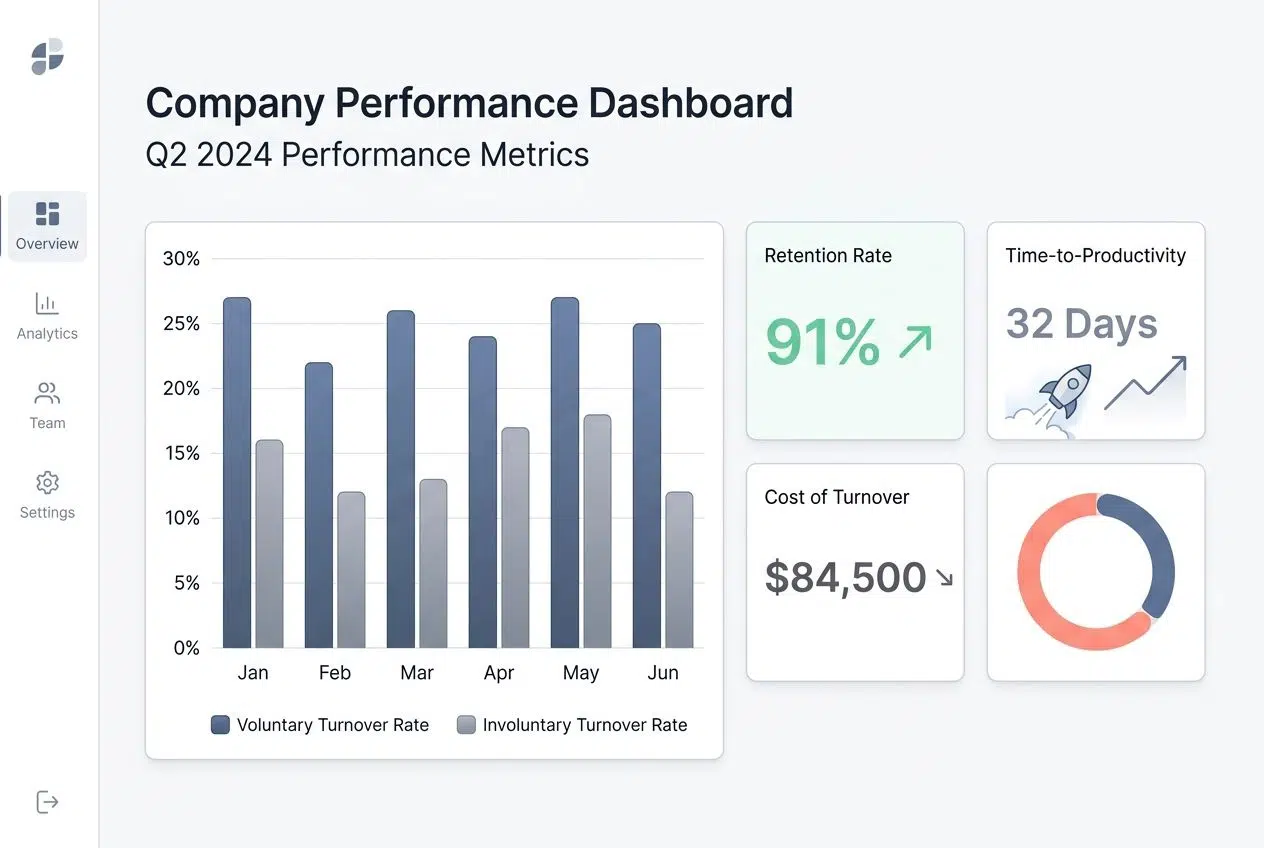
| Metric | What It Measures | Why It Matters |
|---|---|---|
| Voluntary Turnover Rate | Percentage of employees who leave by choice during a set period. Calculate it by dividing departing employees by your average workforce size, then multiplying by 100. | Shows whether top performers are jumping ship. High rates signal culture problems before they become catastrophic. Your best people vote with their feet first. |
| Involuntary Turnover Rate | Percentage of staff terminated or laid off. Track this separately from voluntary departures. | Reveals whether your hiring process matches cultural fit. Too many terminations mean you are hiring wrong or managing poorly. |
| Retention Rate | Percentage of employees who stay with your organization. Subtract turnover from 100 to get this number. | Provides the positive flip side of turnover data. A 90% retention rate looks better than a 10% turnover rate, even though they are identical. |
| Time-to-Productivity | Days or weeks for new hires to reach full performance levels. Strong cultures typically see this happen faster. | Indicates onboarding quality and cultural integration speed. Shorter timelines mean better mentoring and support systems. |
| Regrettable vs. Non-Regrettable Turnover | Separates departures of valued staff from those you did not mind losing. Categorize each exit as regrettable or non-regrettable. | Helps you focus on keeping rock stars. Losing mediocre performers might actually improve culture. Losing superstars indicates serious problems. |
| Cost of Turnover | Total expense of replacing an employee, including recruitment, training, and lost productivity. Research suggests replacement costs range from 50% to 200% of annual salary. | Puts turnover in financial terms that leadership understands. A single departure of a $100,000 employee might cost your company $50,000 to $200,000. |
| Department-Level Turnover | Turnover rates broken down by department or team. Some areas may bleed talent while others thrive. | Pinpoints where culture is failing. One toxic manager can create a departing exodus in their team while the rest of the company stays stable. |
| Tenure Distribution | Breakdown of how long employees have worked at your organization. Shows the age of your workforce in terms of tenure. | Reveals whether you are building institutional knowledge or constantly starting over. A healthy mix includes veterans and newcomers. |
Measuring these metrics monthly or quarterly keeps culture issues from festering. You spot problems when they are small, not when your star performer already has another job lined up. Data transforms culture from a vague feeling into something actionable and concrete.
Feedback from exit interviews
Exit interviews give you pure gold. Departing employees share honest thoughts about what went wrong, what worked, and why they left. You learn about management gaps, workplace environment issues, and job satisfaction problems.
This feedback reveals patterns you might miss otherwise. Pay close attention to what top talent says on their way out. A great insider tip is to have a neutral third party, or an HR representative, conduct the exit interview rather than the employee’s direct manager. People are much more likely to be candid when speaking to someone outside their immediate chain of command.
Ask open-ended questions. Listen more than you talk. Record the key themes, because trends matter more than single complaints. Your organization gains real insight into talent development gaps and leadership practices through these conversations.
Challenges in Building and Maintaining a Positive Culture

Building a strong workplace culture feels like herding cats sometimes. You start with great intentions, roll out new policies, and then reality hits. Scaling company culture becomes harder as your team grows.
Different departments develop their own mini-cultures, and suddenly your organization feels fragmented. Remote and hybrid work arrangements add another layer of difficulty. According to a 2025 Gallup study, 1 in 3 US employees describe their workplace as isolated or impersonal. This makes face-to-face connections tougher than ever.
Here are the most common roadblocks you will face:
- Leadership Turnover: New managers bring different values and approaches, disrupting established team dynamics.
- Budget Constraints: A lack of funds limits your ability to invest in professional growth programs or wellness benefits.
- Resistance to Change: Some team members cling to old ways of doing things, and shifting their mindset takes patience.
- Toxic High-Performers: A top salesperson with a bad attitude can poison an entire team if leadership fails to address the behavior.
Measuring culture improvements proves tricky. You cannot always see the direct link between your efforts and actual retention numbers. Your company values sound great on paper, yet employees need to see leaders actually living those values every single day. Building trust takes years, but losing it takes seconds.
Wrapping Up
Your organization stands at a crossroads. Top talent walks out the door, or your best people stay and thrive. The difference comes down to your approach to building a workplace culture for talent retention. Companies that invest in honest leadership, open communication, and genuine recognition see their employees stick around. Employees want more than paychecks. They crave meaningful work, chances to grow, and leaders who actually listen.
Your team collaboration improves when people feel valued. Your organizational commitment strengthens when workers see a real path forward. Start small if you must. Pick one area, like feedback mechanisms or professional growth opportunities, and do it well.
Track your employee engagement scores and watch your retention numbers climb. Talk to people who leave, and learn from their exit interviews.
The companies winning at talent management right now simply treat their people like humans, not resources. They build workplaces where job satisfaction matters as much as quarterly earnings. Lead with empathy, act with intention, and watch your workplace environment transform into something people actually want to be part of.
Frequently Asked Questions (FAQs) on Workplace Culture for Talent Retention
1. How do you start building a workplace culture that keeps top talent?
Start with psychological safety, where people feel comfortable speaking up without fear. According to a 2024 Gallup study, employees who strongly agree they can voice their opinions are 4.6 times more likely to feel empowered to perform their best work. Listen genuinely and act on good ideas to show your team they truly matter.
2. What role does leadership play in retaining skilled employees?
Leaders set the tone for everything. A 2024 study by MIT Sloan found that toxic culture is 10 times more predictive of attrition than compensation, and managers drive that culture daily through their actions.
3. Why is open communication important for keeping great workers?
Clear communication stops misunderstandings before they snowball into bigger problems. When people know what’s happening and why, they feel connected to the mission rather than left in the dark.
4. Can small perks or flexible hours really help keep talented staff from leaving?
Absolutely, the little things add up fast. FlexJobs reported in 2024 that 63% of US workers would consider leaving a job that didn’t offer flexible work options, making it one of the top retention factors today.