
Search engine marketing (SEM) is entering a new phase in 2026, where automation, machine learning, and real-time bidding intelligence are reshaping how advertisers compete for visibility. The debate is no longer just about budget allocation—it’s about control versus automation. Should marketers trust algorithm-driven Smart Bidding systems, or stick with the precision and flexibility of Manual bidding strategies?
As platforms like Google Ads continue to evolve, Smart Bidding promises efficiency, predictive optimization, and scale powered by AI. Meanwhile, Manual bidding still attracts advertisers who value granular control, testing freedom, and direct decision-making over every click. Each approach has clear strengths—but also hidden trade-offs that can significantly impact ROI.
This article breaks down the key differences between Smart Bidding and Manual bidding in 2026, explores real-world performance factors, and helps you decide which strategy truly wins in today’s competitive SEM landscape.
What Is the Difference Between Smart Bidding and Manual CPC?
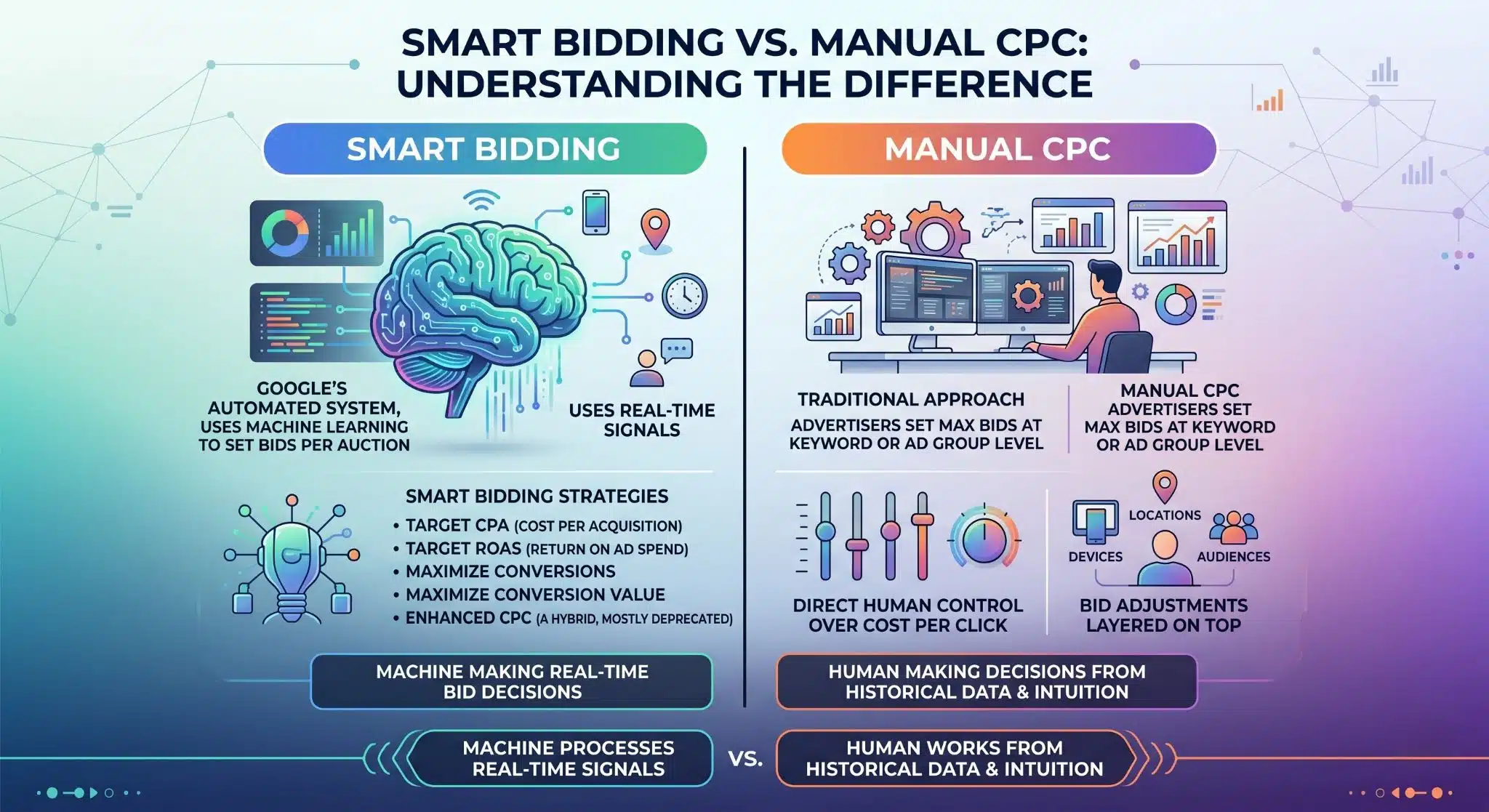
Smart Bidding is Google’s automated bid management system that uses machine learning to set bids for every auction. Manual CPC is the traditional approach where advertisers set maximum bids at the keyword or ad group level themselves.
Smart Bidding strategies include:
- Target CPA (cost per acquisition)
- Target ROAS (return on ad spend)
- Maximize Conversions
- Maximize Conversion Value
- Enhanced CPC (a hybrid, now largely deprecated in favor of full automation)
Manual CPC gives advertisers direct control over how much they’re willing to pay per click. Adjustments for devices, locations, and audiences can be layered on top, but the base bid is set by the advertiser.
The core difference comes down to who makes the bid decision — a machine processing real-time signals, or a human working from historical data and intuition.
How Does Smart Bidding Actually Work in 2026?
Smart Bidding evaluates contextual signals at the moment of each auction and adjusts bids automatically to hit a defined goal. Google’s system processes signals that advertisers cannot access or act on manually.
Signals Smart Bidding uses at auction time:
- Device type and operating system
- Physical location and location intent
- Time of day and day of week
- Search query (exact terms, not just keywords)
- Audience list membership
- Browser type
- Remarketing status
- Ad characteristics (format, extension availability)
In 2026, Google has continued expanding the signal set, particularly around first-party audience data as third-party cookies have largely disappeared. Advertisers who connect their CRM data via Customer Match or enhanced conversions give Smart Bidding significantly better inputs to work with.
Common mistake: Running Smart Bidding without conversion tracking properly set up. If the system can’t measure what it’s optimizing for, it will optimize for the wrong thing — or nothing at all.
When Does Manual Bidding Still Make Sense?
Manual bidding wins in specific, well-defined situations. It’s not the right default for 2026, but it’s the right tool for certain jobs.
Choose manual CPC if:
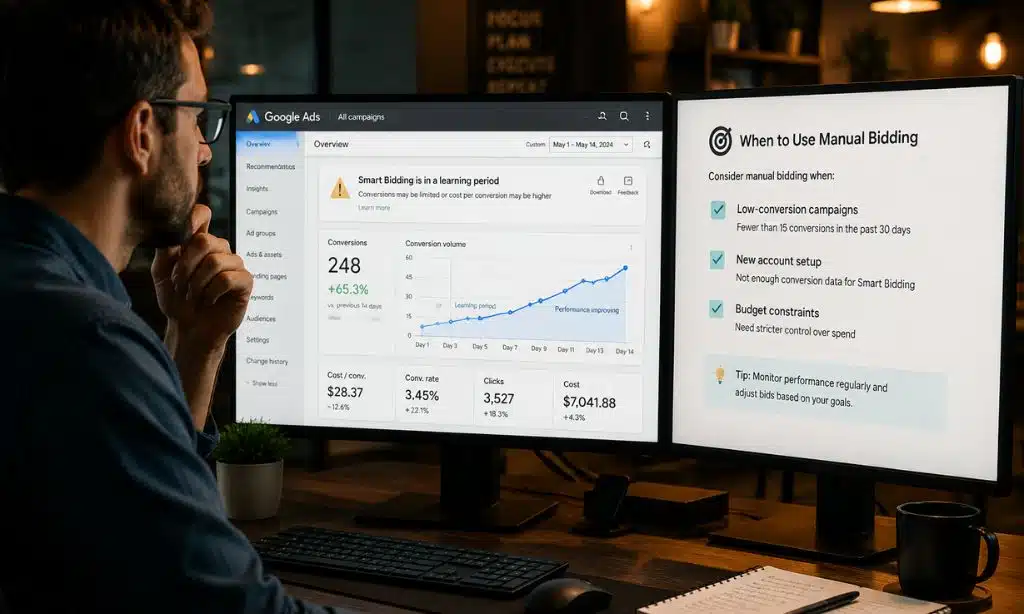
- The campaign has fewer than 30 conversions per month (Smart Bidding won’t have enough data to learn effectively)
- The account is brand new with no conversion history
- The campaign targets highly specific, low-volume keywords where auction behavior is erratic
- Budget is extremely tight and overspending even by 10–15% is not acceptable
- The goal is impression share or click volume, not conversions
- Brand keyword campaigns where the CPC is already well-known and stable
Choose Smart Bidding if:
- The campaign consistently generates 30+ conversions per month
- The goal is tied to a specific CPA or ROAS target
- The account has reliable conversion tracking in place
- Scale is a priority and manual management time is limited
Edge case: Some SEM professionals use manual bidding for brand campaigns and Smart Bidding for non-brand campaigns within the same account. This hybrid approach lets them protect branded traffic economics while letting automation handle the more complex non-brand auctions.
What Is the Best SEM Bidding Strategy in 2026 for Lead Generation?
For lead generation campaigns in 2026, Target CPA is the strongest Smart Bidding strategy once sufficient data exists. For accounts still building volume, Maximize Conversions is the recommended starting point.
Step-by-step approach for lead gen:
- Set up conversion tracking first — phone calls, form submissions, and qualified lead events should all be tracked.
- Start with Maximize Conversions with a daily budget cap. Run for 2–4 weeks.
- Evaluate conversion volume. If hitting 30+ conversions per month, move to Target CPA.
- Set the Target CPA at or slightly above your actual average CPA from the Maximize Conversions period. Setting it too low starves the algorithm.
- Wait another 2–4 weeks before judging performance. The learning period is real.
- Adjust target incrementally — no more than 15–20% changes at a time to avoid resetting the learning period.
Common mistake: Setting a Target CPA that’s significantly below the historical average. The algorithm will reduce traffic to hit the target, often resulting in far fewer conversions at a technically “lower” CPA that doesn’t reflect real business value.
What Is the Best SEM Bidding Strategy in 2026 for E-Commerce?
For e-commerce, Target ROAS is the go-to Smart Bidding strategy when transaction data is sufficient. It tells Google to maximize conversion value while hitting a specific return on ad spend ratio.
| Strategy | Best For | Minimum Data Needed | Risk Level |
|---|---|---|---|
| Target ROAS | E-commerce with varied product values | 50+ conversions/month | Medium |
| Target CPA | Lead gen, fixed-value conversions | 30+ conversions/month | Low–Medium |
| Maximize Conversion Value | Scaling e-commerce, no ROAS constraint | 15+ conversions/month | Medium–High |
| Maximize Conversions | New campaigns, lead gen scale | 10+ conversions/month | Medium |
| Manual CPC | New accounts, brand campaigns | No minimum | Low (control) |
For small e-commerce businesses with fewer than 50 monthly transactions, Maximize Conversion Value (without a ROAS target) is often more practical than Target ROAS. It gives the algorithm room to find volume without being constrained by a target it can’t reliably hit.
How Does SEM Bidding Strategy in 2026 Differ From Previous Years?
The biggest shifts in SEM bidding strategy in 2026 compared to 2023–2024 come from three areas: the deprecation of third-party cookies, the expansion of Performance Max campaigns, and the growing importance of first-party data signals.
Key changes in 2026:
- First-party data is now essential. Customer Match lists and enhanced conversions feed Smart Bidding with audience signals that used to come from third-party cookies. Advertisers without clean CRM data are at a measurable disadvantage.
- Performance Max has matured. PMax campaigns use Smart Bidding by default and now account for a significant share of Google Ads spend. Understanding how PMax interacts with standard Search campaigns is critical for budget allocation.
- Broad match + Smart Bidding is now Google’s recommended default. The combination works better than it did in 2021–2022 because Smart Bidding has more data to filter irrelevant queries. But it still requires careful negative keyword management.
- Manual CPC has fewer advantages than before. Google has reduced the number of bid signals available to manual bidders while expanding automation capabilities. The gap between what Smart Bidding can process and what a human can manage has widened.
What Are the Biggest Mistakes in SEM Bidding Strategy in 2026?
Most SEM bidding mistakes in 2026 fall into a few predictable patterns. Knowing them in advance saves significant budget.
Top mistakes to avoid:
- Switching bid strategies too frequently. Every major change resets the learning period (typically 1–2 weeks). Constant changes mean the algorithm never stabilizes.
- Setting unrealistic targets. A Target CPA of $20 when historical CPA is $80 will choke traffic, not create efficiency.
- Running Smart Bidding without conversion tracking. This is the most expensive mistake possible. The system will optimize for nothing meaningful.
- Ignoring the learning period. Pausing or significantly changing campaigns during the learning period wastes the data already collected.
- Using Target ROAS on low-volume campaigns. Below 50 conversions per month, ROAS targets create too much variance in results.
- Neglecting negative keywords with broad match + Smart Bidding. Automation doesn’t replace keyword hygiene — it makes it more important.
- Not segmenting campaigns by intent. Mixing branded and non-branded keywords in the same campaign confuses bid strategy goals.
Final Thoughts: Which Approach Wins in 2026?
Smart Bidding wins for most advertisers in 2026 — but only when the conditions are right. The algorithm’s ability to process dozens of real-time signals gives it a structural advantage over manual bidding at scale. That advantage grows as first-party data inputs improve and conversion tracking becomes more precise.
Manual bidding still has a place. New accounts, brand campaigns, and low-volume niches all benefit from the control it provides. The mistake is treating it as a long-term default rather than a starting point.
Actionable next steps:
- Audit your conversion tracking today. If it’s not accurate, no bid strategy will perform well.
- Check monthly conversion volume per campaign. Under 30 conversions? Start with Maximize Conversions, not a target-based strategy.
- Set up a bid strategy experiment in Google Ads before making a full switch. Let data drive the decision.
- Connect first-party data via Customer Match or enhanced conversions to improve Smart Bidding signal quality.
- Review bid strategies every 2–4 weeks — not every day. Frequent changes disrupt learning periods and create noise in performance data.
- Use the hybrid model where it makes sense: manual for brand, Smart Bidding for non-brand, and PMax for incremental reach.
The best SEM bidding strategy in 2026 isn’t a single answer — it’s the right tool matched to the right campaign conditions, backed by clean data and consistent review.
Frequently Asked Questions (FAQs)
Does Smart Bidding work for small budgets?
Smart Bidding can work with small budgets, but it needs enough conversion volume to function well. If a campaign generates fewer than 15–20 conversions per month, Maximize Conversions (not Target CPA or Target ROAS) is the safest starting point. Very small budgets may see erratic results until data accumulates.
How long does the Smart Bidding learning period last?
Google’s learning period typically lasts 1–2 weeks after a significant change (new bid strategy, major budget change, or large keyword additions). During this time, performance may fluctuate. Avoid making major changes until the learning period ends.
Can manual and Smart Bidding be used in the same account?
Yes. Different campaigns within the same account can use different bid strategies. A common setup is manual CPC for brand campaigns and Target CPA or Target ROAS for non-brand campaigns.
What happens if Smart Bidding isn’t hitting my Target CPA?
First, check if the target is realistic based on historical performance. If the target is too aggressive, raise it by 15–20% and wait two weeks. Also verify that conversion tracking is accurate and that the campaign has sufficient budget to give the algorithm room to work.
Is Enhanced CPC still worth using in 2026?
Enhanced CPC (ECPC) is largely being phased out by Google in favor of fully automated strategies. For most advertisers, moving directly to Maximize Conversions or Target CPA is a better path than using ECPC as an intermediate step.
How do I know if Smart Bidding is actually performing better than manual?
Run a controlled experiment using Google Ads‘ built-in Experiments tool. Split traffic between the two strategies for 4–6 weeks and compare CPA, conversion volume, and conversion value. This is the most reliable way to measure the difference for a specific account.