
If football is treated like a religion, then the Latin American nation of Brazil is undoubtedly one of its greatest temples. From the magical rise of 17-year-old Pelé in Sweden in 1958 to Ronaldo Nazário’s unforgettable comeback in Yokohama in 2002, Brazil has given world football five golden World Cup titles.
Yet alongside this glorious golden history, one question often circles in the minds of football lovers: why does Brazil have only three World Cup trophies despite winning the tournament five times?
To understand this fascinating mystery, we have to dive into the early history of world football, the thrilling story of trophy theft, and the long, complicated path of FIFA’s legal rules regarding World Cup trophies.
Uruguay’s Four-Star Mystery and the Historic Rules of the Jules Rimet Trophy
The four stars on Uruguay’s national team jersey and the early rules around trophy ownership are two highly important chapters in football history. These chapters help explain how pre-World Cup football competitions laid the foundation for the modern tournament we know today.
Below is a detailed look at those historical events and the original ownership conditions of the Jules Rimet Trophy, which gives us the first conceptual clue behind why Brazil has only three World Cup trophies despite winning five times.
The Early History of Uruguay’s Four-Star Jersey and FIFA’s Olympic Recognition
Uruguay has officially won the FIFA World Cup only twice – first in 1930 on home soil and again in 1950 at the Maracanã Stadium, where they stunned host nation Brazil.
Even so, Uruguay’s football jersey carries four stars, which often confuses ordinary football fans.
The reason goes back to the period before the official FIFA World Cup began in 1930. At that time, FIFA had recognized the Olympic football tournament as a form of world championship. Uruguay won Olympic gold medals in football in both 1924 and 1928.
Later, FIFA withdrew that “world championship” status from the Olympic tournaments, but the Uruguayan Football Association refused to accept the change. They treated those two Olympic gold medals as equivalent to World Cup titles and decided to keep four stars on their jersey. This decision led to a long legal dispute with FIFA.
The Jules Rimet Trophy Rule and the Permanent Ownership Condition After Three Wins
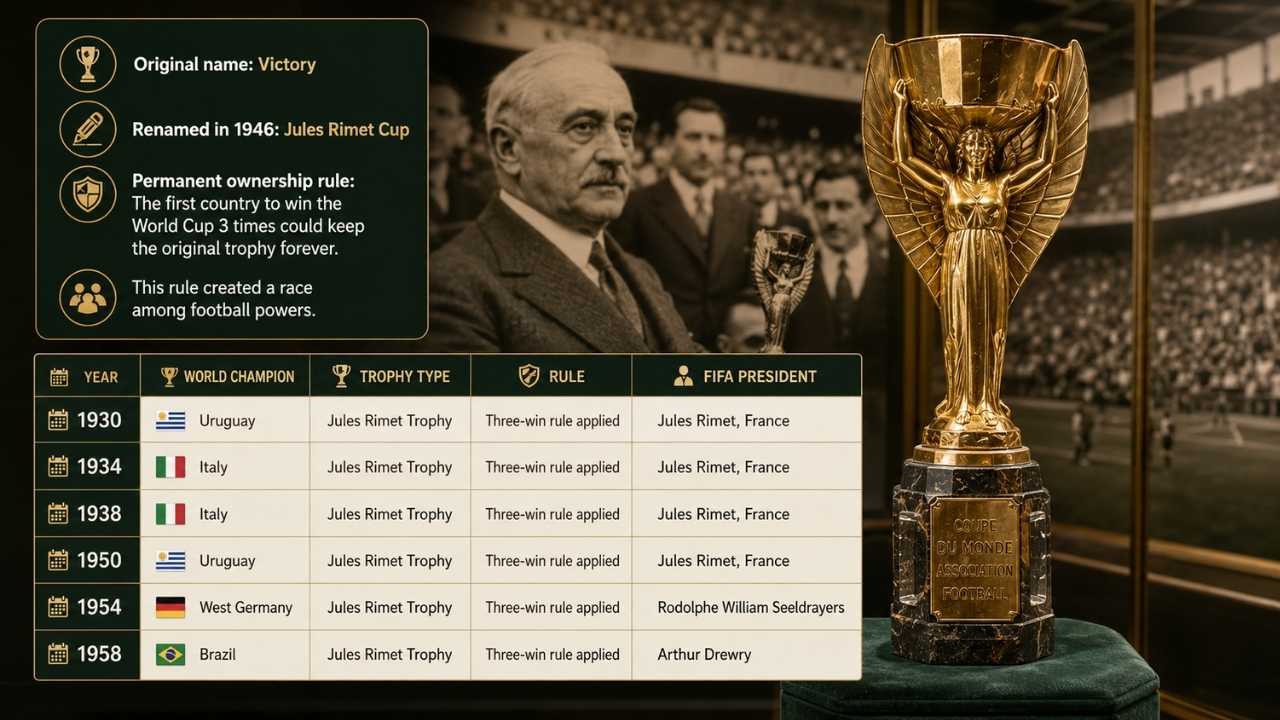
When the first World Cup was held in 1930, the original trophy was known as “Victory.” In 1946, in recognition of the contribution of longtime FIFA president Jules Rimet, the golden trophy was renamed the “Jules Rimet Cup.”
When this trophy was introduced, Jules Rimet attached a special and historic condition to it. The condition was that the first country to win the World Cup three times would earn the right to keep the original golden trophy permanently in its own country.
This rule later created great excitement in world football. It also started an invisible race among football powerhouses to become world champion three times.
| Year | World Champion | Trophy Type | Permanent Ownership Rule | FIFA President at the Time |
| 1930 | Uruguay | Jules Rimet Trophy | Three-win rule applied | Jules Rimet, France |
| 1934 | Italy | Jules Rimet Trophy | Three-win rule applied | Jules Rimet, France |
| 1938 | Italy | Jules Rimet Trophy | Three-win rule applied | Jules Rimet, France |
| 1950 | Uruguay | Jules Rimet Trophy | Three-win rule applied | Jules Rimet, France |
| 1954 | West Germany | Jules Rimet Trophy | Three-win rule applied | Rodolphe William Seeldrayers |
| 1958 | Brazil | Jules Rimet Trophy | Three-win rule applied | Arthur Drewry |
The Dramatic 1966 London Theft and the Heroic Story of Pickles the Dog
A few months before the 1966 World Cup in England, the original World Cup trophy was stolen from London. At the time, this was seen as a major embarrassment for Britain’s national security.
The incident shook football associations around the world and brought trophy security into the spotlight. Below is the story of the incredible theft, the Scotland Yard investigation, and the unlikely heroism of an ordinary dog.
Daylight Theft from Westminster Central Hall and the Stampex Exhibition
In January 1966, FIFA handed the original Jules Rimet Trophy to the English Football Association. In March, at the request of the famous stamp company Stanley Gibbons, the trophy was allowed to be displayed at the “Stampex” exhibition at Westminster Central Hall in London.
Although the display came with strict security conditions, including 24-hour guarding, thieves slipped through a gap in surveillance on Sunday, March 20. They broke through a wooden door at the back of the hall, entered the exhibition area, smashed the lock on the glass display cabinet, and escaped with the golden trophy.
The trophy was valued at around £3,000. Strangely, the thieves did not touch the rare stamps worth nearly £3 million kept beside the cabinet.
Scotland Yard, Edward Betchley and the Mysterious £15,000 Ransom
Once news of the theft spread, panic erupted across the world. Scotland Yard took charge of the investigation.
The day after the theft, FA chairman Joe Mears received an anonymous letter along with a removable part from the top of the trophy. The letter demanded £15,000 in exchange for the safe return of the trophy and threatened to melt it down if the police were informed.
Under the leadership of Detective Inspector Charles Buggy, undercover police set up a ransom trap at Battersea Park. There they arrested Edward Betchley, a middleman involved in the ransom attempt. However, Betchley claimed he was only acting as an intermediary and refused to reveal the location of the real thieves or the trophy.
Pickles the Dog and David Corbett’s Accidental Discovery
Just when England was drowning in shame, an unbelievable incident took place on the morning of March 27 in Upper Norwood, South London.
David Corbett, a 26-year-old man, was walking his beloved mixed-breed collie dog, Pickles. During the walk, Pickles began sniffing intensely at a heavy package wrapped in newspaper and placed under a bush beside a parked car.
Curious, David tore part of the package and saw a shining golden figure inside. The names of Brazil, Germany, and Uruguay were engraved on it. He quickly took it to the local police station, and that is how the missing crown of the World Cup was recovered.
For his heroism, Pickles received a silver medal, and David received a reward of more than £5,000.
The FA’s Secret Replica and FIFA’s Record-Breaking 1997 Auction Purchase
Terrified by the London theft, the English Football Association secretly commissioned an exact bronze replica of the trophy so that the original would no longer need to be used for public exhibitions.
After England’s historic 4-2 win in the 1966 final, the players celebrated on the pitch with the real trophy. But inside the dressing room, the bronze replica was secretly swapped with the original.
The secrecy was so complete that even FIFA did not know the replica existed.
In 1997, when the secret replica appeared at an auction in London, FIFA suspected it might be the original trophy and bought it for £254,500, almost ten times its actual value. Later scientific testing proved that it was actually the bronze replica made by England.
| Stage of Theft | What Happened | Main Character | Legal and Social Reaction |
| Beginning of theft | Thieves broke a weak wooden rear door and display lock to steal the trophy | Unknown thieves | A major security failure for British sport and intense worldwide criticism |
| Ransom stage | Anonymous £15,000 ransom demand and threat to melt the trophy | Edward Betchley, middleman | Scotland Yard quickly set a trap and arrested Betchley at Battersea Park |
| Recovery stage | Trophy found wrapped in newspaper under a bush | Pickles the dog and David Corbett | Pickles became a national hero overnight and was celebrated worldwide |
| Later protection | Exact bronze duplicate created secretly for display security | English Football Association | The original trophy was quietly sent back to Zurich while the replica was used for display purposes |
Why Brazil Has Only Three World Cup Trophies Despite Winning Five Times

One of the biggest curiosities and mysteries in Brazil’s football history is why their cabinet shows only three World Cup trophy versions or replicas despite their glorious five World Cup victories.
In 1970, led by Pelé, Brazil earned the right to keep the Jules Rimet Trophy forever. But they could not protect that priceless symbol from thieves.
The infamous Rio theft of 1983 and FIFA’s new trophy policy after later World Cup wins created the long-standing question: why does Brazil have only three World Cup trophies despite winning five times?
The Dark Night of December 19, 1983 and the Raid on Rua da Alfândega
At midnight on December 19, 1983, a notorious robbery took place at the headquarters of the Brazilian Football Confederation, or CBF, on Rua da Alfândega in Rio de Janeiro.
The Jules Rimet Trophy was displayed on the ninth floor of the CBF building inside a bulletproof glass cabinet. But the cabinet had one fatal flaw. The front was made of bulletproof glass, but the back was attached with a thin wooden frame.
At night, the thieves attacked the building’s only elderly night watchman, João Batista, beat him, tied his hands and feet, and used a simple crowbar to break the wooden frame with ease. They escaped with the Jules Rimet Trophy, along with two other valuable trophies named Equitativa and Hurito.
Mastermind Sérgio Peralta and His Accomplices
The mastermind behind the sensational theft was Sérgio Peralta, a banker and occasional football club agent who took advantage of the weak security at the CBF building.
To carry out the job, he hired former police officer Francisco Rivera, known as Chico Barbudo, and professional decorator José Luiz Vieira, known as Luiz Bigode.
Peralta first invited a famous safecracker named Antônio Setta to take part in the crime. But Setta refused, claiming he was a patriot. His brother had died of a heart attack from joy when Brazil won the World Cup in 1970, so he did not want to be part of stealing the country’s priceless trophy.
The Fate of the Criminal Gang: Mysterious Deaths, Prison and Escape
After the theft, Brazilian police launched an unprecedented investigation and eventually arrested Peralta and his associates.
But after the tragedy, the lives of the criminals moved toward strange and tragic endings.
In 1989, one of the main suspects, Chico Barbudo, was shot seven times by unidentified attackers in a bar in Rio de Janeiro. Key witness Antônio Setta died in a mysterious road accident in 1985, just days before he was due to testify in court.
The main planner, Sérgio Peralta, served time in prison, was released in 1998, and died of heart disease in 2003.
Because the accused remained fugitives for a long time after the theft and avoided court rulings, Brazil’s legal system faced heavy criticism.
The Claim That the Jules Rimet Trophy Was Melted and the Role of Juan Carlos Hernández
During the investigation, Brazilian police claimed that shortly after the theft, the trophy had been handed over to a notorious Argentine gold dealer named Juan Carlos Hernández.
According to police, Hernández melted the trophy in his secret workshop in Rio de Janeiro and sold it as gold bars.
However, Hernández strongly denied this claim in court. Tests on ashes from his workshop also found no match with the trophy’s materials. Even so, police convicted him for receiving stolen goods.
Many metal experts believe the Jules Rimet Trophy was not solid gold. Instead, it was made of gold-plated sterling silver, meaning it would have been impossible to melt it into gold bars. As a result, the story of the trophy being melted may have been fabricated, and the trophy may still exist today in the basement of some secret collector.
| Criminal or Figure | Role in the Theft | Legal Sentence or Verdict | Death or Later Fate |
| Sérgio Peralta | Main planner of the theft and identifier of the security flaw | Sentenced to nine years in prison; arrested after remaining a fugitive for a long time | Died of heart disease in 2003 |
| Francisco Rivera, Chico Barbudo | Former police officer who directly helped break the cabinet and steal the trophy | Found guilty in court and given a long sentence | Killed by gunmen in 1989 |
| José Luiz Vieira, Luiz Bigode | Decorator who directly helped break the cabinet and steal the trophy | Sentenced to prison; later released in 1998 | Now lives away from public attention |
| Juan Carlos Hernández | Main suspect accused of buying and melting the trophy into gold bars | Convicted of receiving stolen goods, later fled to France | Arrested again in 1998 for drug trafficking |
Silvio Gazzaniga’s Modern FIFA World Cup Trophy and FIFA’s New Policy
After the Jules Rimet Trophy permanently went into Brazil’s cabinet in 1970, FIFA had to create an entirely new trophy.
This new-era trophy was not only different in shape, but it also came with revolutionary rules and legal structures designed to protect it. These strict regulations provide the main administrative explanation for why Brazil has only three World Cup trophies despite winning five times.
The New Trophy: Silvio Gazzaniga’s Artwork and Its Deeper Meaning
In 1971, FIFA organized a competition to design a new trophy. The winning design came from the famous Milanese sculptor Silvio Gazzaniga.
Gazzaniga gave the trophy a unique artistic form that was completely different from earlier geometric trophies. Made from solid 18-carat gold and standing 36.8 centimeters tall, the trophy shows two human athletes lifting the Earth on their shoulders in celebration after hard work and triumph.
Gazzaniga described it as a symbol of dynamic strength and the joy of victory. At the base are two green malachite layers that resemble a green football field.
Cancellation of Permanent Ownership and the Gold-Plated Replica Policy
When FIFA introduced the new “FIFA World Cup Trophy,” it learned from past experience and made a major change to its rules.
Under the new rules, no country can ever keep the original golden trophy permanently, no matter how many times it wins the World Cup.
After the final, the original trophy is handed to the winning team only for a few minutes during the celebration. Once the team photos are taken, it is immediately returned to FIFA officials.
Instead, the winning national football federation receives an official replica trophy made of bronze and carefully gold-plated. This replica is slightly lighter and smaller than the original trophy kept in Zurich.
Rediscovery of the Original Jules Rimet Trophy Base in FIFA’s Archive in 2015
After the Jules Rimet Trophy was stolen from Brazil, years of research followed. Then, in 2015, an incredible discovery was made in the basement of FIFA’s headquarters in Zurich, Switzerland.
The original blue lapis lazuli base of the Jules Rimet Trophy was found after being neglected for many years.
Before the 1958 World Cup, the trophy’s earlier four-sided base had been replaced with a new octagonal base so that more winners’ names could be engraved on it. The old original base had been preserved in FIFA’s archive, where it was later lost.
That base remains the only original part of the Jules Rimet Trophy still preserved intact at the FIFA Museum.
Eastman Kodak’s 1.8-Kilogram Gold Replica and the Current CBF Museum Display
After the deep humiliation of the 1983 theft, CBF commissioned the famous camera and technology company Eastman Kodak in 1984 to make an exact replica of the Jules Rimet Trophy and restore a sense of historical memory.
The replica used 1.8 kilograms of pure gold and was officially handed over to Brazil’s then-military president, João Figueiredo.
Today, visitors to the CBF Museum in Rio de Janeiro can see the Eastman Kodak replica of the Jules Rimet Trophy, along with the two official replicas received from FIFA after Brazil’s 1994 and 2002 World Cup victories.
In other words, the three trophies displayed in Brazil are all replicas, while the original Jules Rimet Trophy has been lost forever.
| Trophy Detail | Jules Rimet Trophy | Modern FIFA World Cup Trophy |
| Maker | Sculptor Abel Lafleur, France | Silvio Gazzaniga, Italy |
| Design | Greek goddess of victory Nike holding a cup above her head | Two athletes lifting the Earth on their shoulders |
| Metal and weight | Gold-plated silver weighing 3.8 kilograms | Solid 18-carat gold weighing 6.17 kilograms |
| Legal distribution policy | Permanently awarded to the country that won three times | Never given permanently; a replica is awarded instead |
| Current location | Permanently missing after being stolen in Brazil in 1983 | Kept in a special strongroom at FIFA headquarters in Zurich |
Brazil’s Modern Trophy Drought, the European Curse and the 2026 World Cup Failure
After winning their fifth title in 2002 through Ronaldo’s magic in Asia, Brazilian football entered a long dry spell.
Since then, Brazil’s performance on the world stage has steadily declined, marking the longest World Cup trophy drought in their football history. For 28 years, they have not touched another World Cup trophy, leaving their supporters deeply frustrated.
To end this long drought, Brazil must now aim for the “hexa,” or sixth title, at the 2030 World Cup.
The Long Trophy Drought After the 2002 Yokohama Victory and the European Wall
Since 2002, Brazil’s World Cup dreams have been shattered in every tournament by European teams in the knockout rounds.
In 2006, they lost 1-0 to France. In 2010, they were knocked out by the Netherlands after a 2-1 defeat.
The biggest disaster came in 2014, when Brazil hosted the tournament and suffered a historic 7-1 humiliation against Germany in the semifinal.
Then, in 2018, they lost 2-1 to Belgium. In 2022, Croatia eliminated them on penalties after a 1-1 draw.
This repeated European dominance has exposed the weaknesses within Brazil’s football culture.
Carlo Ancelotti’s Tactical Mistakes and Brazil’s Tragic Exit Against Norway in the 2026 FIFA World Cup
Brazil’s hexa mission under new coach Carlo Ancelotti ended in complete failure at the 2026 World Cup, as they were knocked out in the round of 16 after losing 2-1 to Norway.
Ancelotti made several serious lineup mistakes in this match. Instead of using the experienced Neymar in a creative role in place of injured Lucas Paquetá, he started Gabriel Martinelli, who managed only 20 successful passes throughout the match.
In the first half, despite several key players being on the pitch, defensive midfielder Bruno Guimarães was sent to take a penalty. His slow and weak run-up allowed the Norwegian goalkeeper to save it easily.
After Guimarães was substituted in the second half, Brazil’s midfield control completely collapsed. Erling Haaland scored twice for Norway, and Brazil were eliminated from the tournament. Endrick also missed a very easy open chance.
The Decline of Jogo Bonito and the Transformation of Brazilian Football Culture
According to football experts, Brazil’s historic decline is not only about tactics on the pitch. It also reflects a deeper social and psychological transformation.
Brazil’s traditional beautiful football, known as “Jogo Bonito,” is fading as modern players increasingly imitate the mechanical football style of Europe.
Once, football was life and emotion in every alley and street of Brazil. But in today’s digital era, younger generations are increasingly drawn toward video games and other forms of entertainment.
In addition, because of weaknesses in domestic football infrastructure, young players leave for European clubs at a very early age. As a result, their emotional connection to the national team jersey and their willingness to give everything for it have weakened.
| World Cup Year | Exit Stage | Opponent | Final Score | Brazil’s Trophy Drought |
| 2006 | Quarterfinal | France | 0-1 | 4 years |
| 2010 | Quarterfinal | Netherlands | 1-2 | 8 years |
| 2014 | Semifinal | Germany | 1-7 | 12 years |
| 2018 | Quarterfinal | Belgium | 1-2 | 16 years |
| 2022 | Quarterfinal | Croatia | 1-1, penalties 4-2 | 20 years |
| 2026 | Round of 16 | Norway | 1-2 | 24 years |
Final Thoughts
Each of Brazil’s five golden stars on the world football stage represents a unique story of greatness. But the emptiness in their trophy cabinet tells a permanent story of pain.
When we analyze the historical events, it becomes clear that the main reason Brazil has only three World Cup trophies despite winning five times is the cursed Rio theft of 1983, when the original Jules Rimet Trophy that Brazil had earned permanently disappeared forever.
The thieves turned the country’s priceless treasure into one of the greatest crimes in football history.
Later, after Brazil’s 1994 and 2002 victories, FIFA’s stricter rules meant that Brazil received only gold-plated bronze replica trophies, ending the possibility of permanently keeping the original trophy.
Today, the Jules Rimet replica made by Eastman Kodak and the two official replicas from later victories displayed at the CBF Museum prove that the physical form of Brazil’s golden history now survives only in memory and carefully crafted metal copies.
Even so, Brazil’s five World Cup victories shine far brighter than any metal trophy. Their greatness in world football will remain forever alive in the hearts of football lovers.