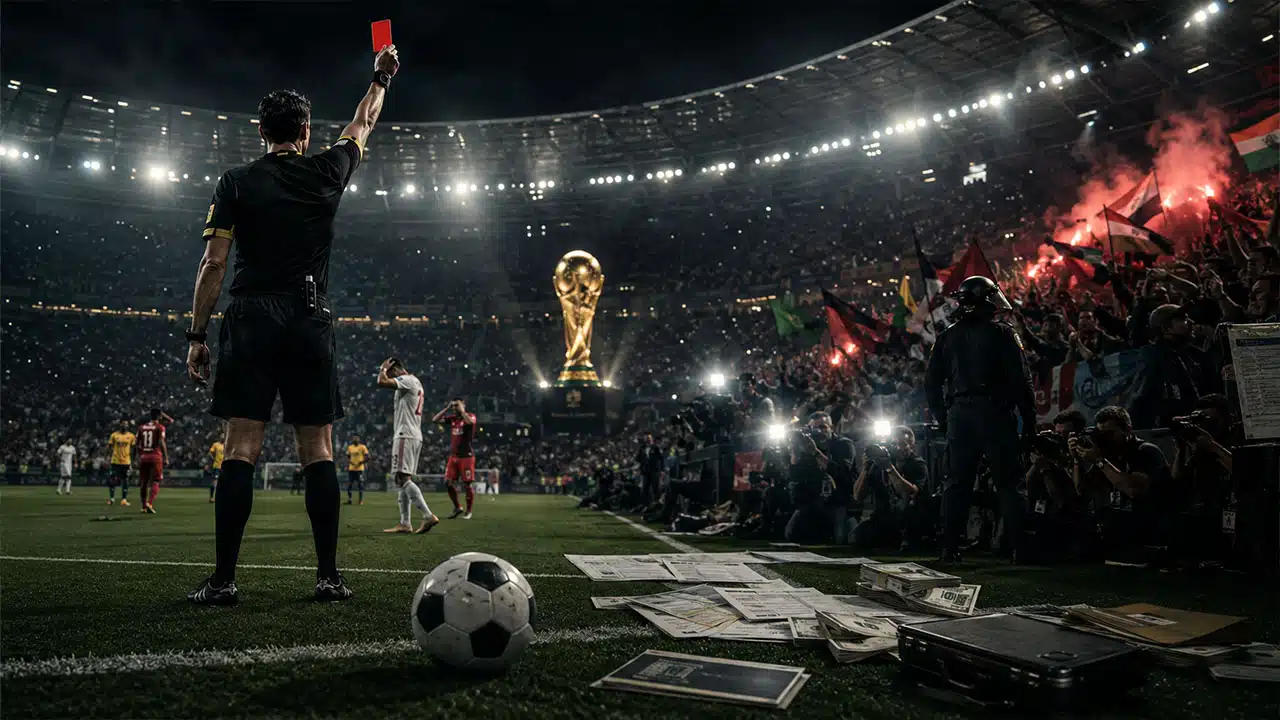
Football is the world’s most popular sport, and the FIFA World Cup is its ultimate stage. Every four years, it brings billions together. But the grim reality is hiding behind the “Beautiful Game.”
I didn’t just track the 90 minutes on the pitch. I dug into the backroom politics, the massive cash grabs, and the abuse of power that repeatedly tarnishes this mega-event. These FIFA World Cup controversies aren’t isolated incidents; they’re a structural disease.
Here is the objective, fact-based history of the World Cup’s dark side. We’ll look at everything from the DOJ’s explosive investigations to referee blunders, sponsorship clashes, tech debates, and political meddling. You can’t truly understand football until you acknowledge its shadows.
Hosting Rights Corruption: Power Behind the Scenes
Hosting a World Cup brings massive economic perks. Naturally, the fierce bidding wars attract shady deals and political lobbying, keeping investigative journalists incredibly busy.
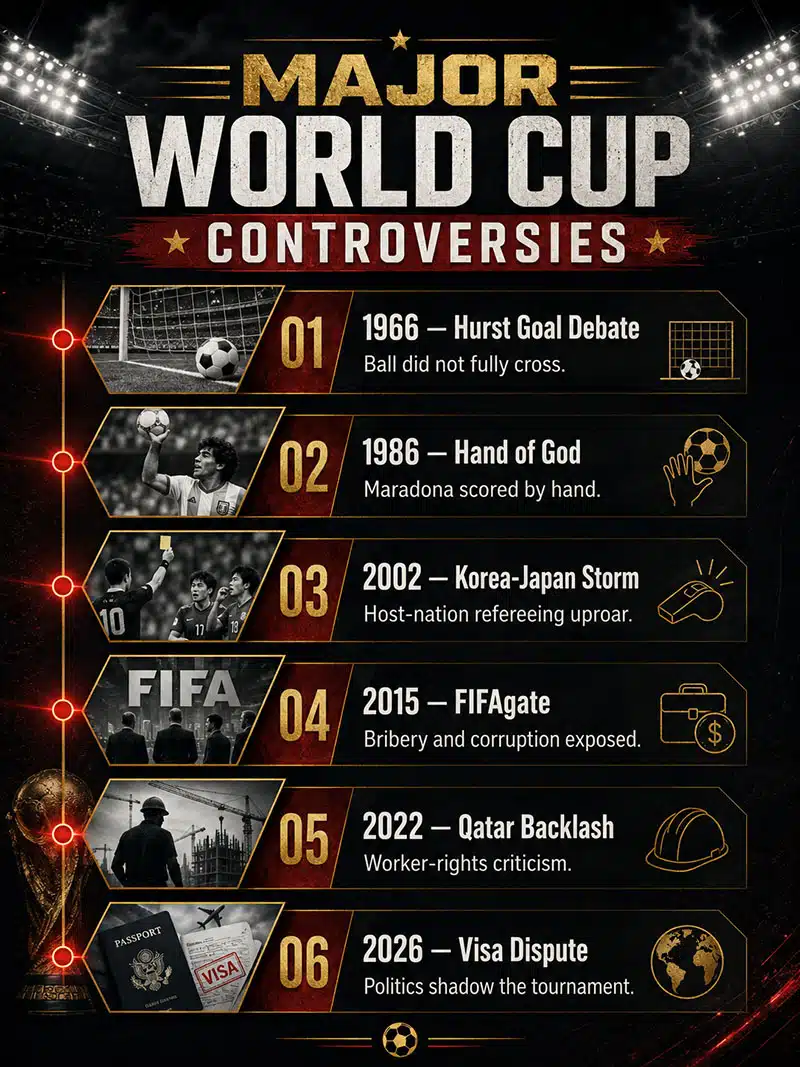
The 2015 FIFAgate Scandal & DOJ Probe
I vividly remember that May morning in 2015. The sports world froze as Swiss police, hiding faces behind bedsheets, escorted FIFA’s top brass out of Zurich’s luxury Baur au Lac hotel. That joint raid by the US Department of Justice (DOJ) and Swiss authorities drove the final nail into FIFA’s empire of corruption.
- The Facts: The DOJ proved that over 24 years, officials exchanged roughly $150 million in bribes for broadcasting rights, sponsorships, and hosting duties. Former FIFA executive Chuck Blazer’s confession and secret tapes blew the case wide open. FIFA’s Ethics Committee ultimately banned President Sepp Blatter and UEFA President Michel Platini from all football activities.
- The Allegations: Many suspect the rot went much deeper. Critics claim almost every executive committee member was influenced by sponsors or broadcasters, though concrete legal proof remains elusive.
The 2018 Russia & 2022 Qatar Bidding Wars
When FIFA handed the 2018 and 2022 tournaments to Russia and Qatar in a single 2010 announcement, the football community was stunned.
- The Allegations: Western media outlets like The Sunday Times and various reporters alleged both nations bought their votes. While Michael Garcia’s internal FIFA investigation (The Garcia Report) highlighted massive flaws in the bidding process, it lacked the hard legal evidence to strip either country of its hosting rights.
- The Public Verdict: Fans still firmly believe that massive oil and gas wealth secured a summer World Cup in a country with extreme heat and zero footballing heritage.
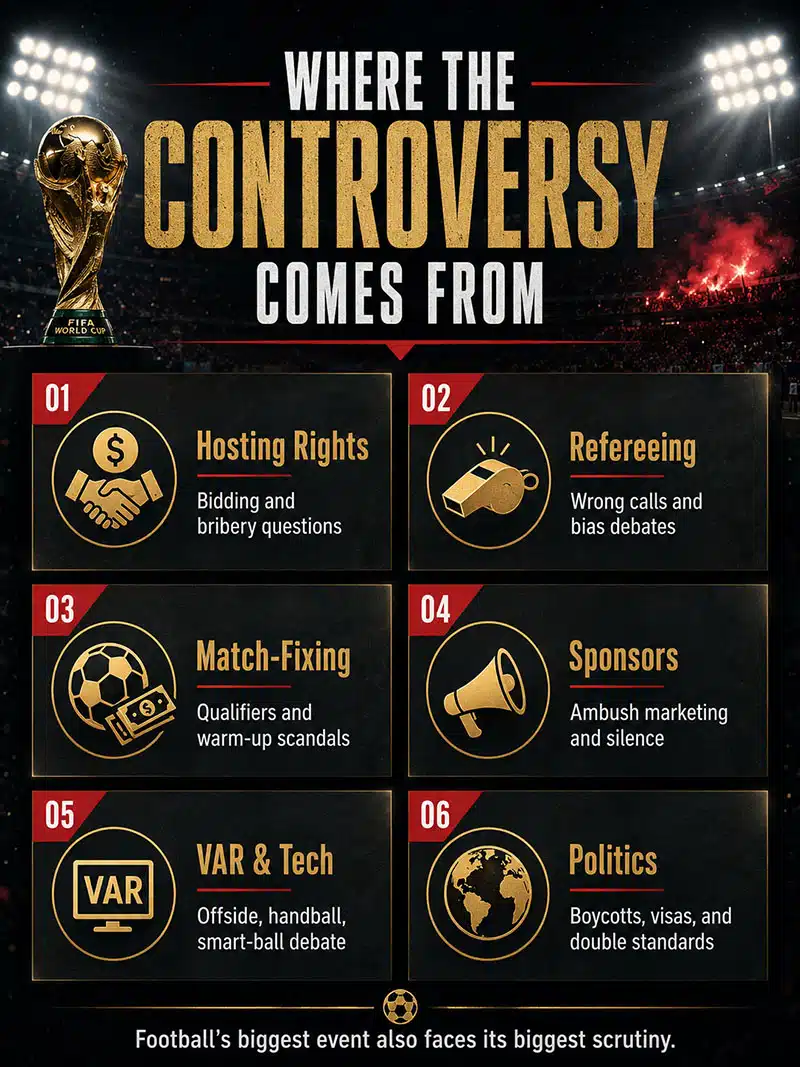
Refereeing and On-Field Bias: Pitch-Level Drama
FIFA World Cup controversies over referees’ decisions are as old as the game itself. A mix of human error and a lack of technology has created legendary debates that fans still argue about today.
1966: Geoff Hurst & 1986 and The ‘Hand of God’
- The Facts (1966): In the England vs. West Germany final, Geoff Hurst’s shot hit the crossbar and bounced down. Swiss ref Gottfried Dienst and Soviet linesman Tofiq Bahramov gave the goal, helping England win. Modern tech and Oxford University studies have since proven the ball never crossed the line.
- The Facts (1986): Argentina’s Diego Maradona famously punched the ball into the net against England. Referee Ali Bin Nasser missed it. Maradona later proudly admitted to using the “Hand of God.”
Maradona’s Foul Record: 1982 vs. 1986
To understand refereeing standards of the past, just look at how teams tried to stop Maradona.
- The Facts: In the 1982 second round, Italy beat Argentina 2-1. Italian defender Claudio Gentile fouled Maradona 23 times. That remains the World Cup record for the most fouls committed by one player against another in a single match.
- The Debate: Some view Gentile’s tactics as tough, legal man-marking. Others argue referees back then offered attackers zero protection. This wasn’t a conspiracy; it simply highlights the brutal marking tactics of that era.
The 1990 Final: Red Cards and a Phantom Penalty
The 1990 final between West Germany and Argentina was a gritty, defensive slog. It’s remembered more for controversy than beautiful football.
- The Facts: In the 65th minute, Mexican referee Edgardo Codesal showed Pedro Monzón a straight red for tackling Jürgen Klinsmann—the first-ever red card in a World Cup final. Later, in the 85th minute, Codesal awarded West Germany a penalty after Roberto Sensini tangled with Rudi Völler. Andreas Brehme scored the winner. Soon after, Argentina’s Gustavo Dezotti saw red, leaving his team with nine men.
- The Debate: Replays suggest Sensini’s foul happened outside the box, if it was a foul at all. Yet, earlier in the match, Codesal ignored a much stronger penalty shout for West Germany.
- Unproven Claims: In 2014, a former Mexican refereeing official claimed Codesal’s father-in-law pressured him to ensure Argentina lost. This remains entirely unproven. Codesal strongly denies it, stating he actually wanted Argentina to win.
2002 Korea-Japan and the VAR Era
Modern football’s darkest refereeing hour arguably came in 2002. Decisions by Ecuadorian ref Byron Moreno and Egypt’s Gamal Al-Ghandour in South Korea’s matches shocked the world.
- The Rumor: Italian and Spanish fans still believe referees actively rigged matches to push the host nation into the semi-finals.
- The Facts: FIFA admitted to massive refereeing mistakes but found no evidence of financial corruption or match-fixing.
- Even with Video Assistant Referees (VAR) introduced in 2018 and 2022, the debates rage on. Millimeter offsides and constantly changing handball rules keep referees in the hot seat.
Match-Fixing and Betting Scandals: The Stain on the Game
Direct match-fixing in the actual World Cup tournament is rare thanks to heavy FIFA surveillance. However, the dark web of betting definitely creeps into qualifiers and warm-ups.
- 2010 Warm-Ups: Right before the South Africa World Cup, fixers rigged several friendly matches. FIFA found that notorious Singaporean fixer Wilson Raj Perumal controlled the results using a corrupt referee syndicate.
- 2018 Qualifiers: Ghanaian referee Joseph Lamptey awarded a completely imaginary penalty during a South Africa vs. Senegal match. FIFA banned him for life, the Court of Arbitration for Sport (CAS) upheld it, and the match was replayed.
Sponsorships and Commercial Clashes: The Money Game
Modern football is a billion-dollar corporate machine. How mega-brands influence FIFA is a massive story for any sports journalist.
Adidas vs. Nike & Ambush Marketing
Brands pay billions to sponsor the tournament. Non-sponsors try to steal the spotlight using “ambush marketing.“
- The Facts: In 2010, Dutch beer brand Bavaria sent 36 women in branded orange dresses to a Netherlands match. Budweiser was the official sponsor. FIFA immediately had the women ejected and arrested, sparking a massive global backlash.
Qatar Worker Rights & Sponsor Complicity
The Qatar World Cup controversy wasn’t just about football. The deadly conditions for migrant workers building the stadiums caused global outrage.
- The Facts: Amnesty International and Human Rights Watch proved the brutal reality of Qatar’s “Kafala” system.
- The Allegations: Activists slammed major sponsors like Coca-Cola, McDonald’s, and Adidas for staying quiet and failing to pressure FIFA or Qatar, putting profits over human lives.
The Ball Debate: Tech Advancements or Conspiracy?
Adidas always makes the World Cup match ball, and every new design brings fresh complaints and adds a new angle to the FIFA World Cup Controversies.
The Jabulani & Al Rihla
- The Facts (2010): The Jabulani ball was notoriously unpredictable in the air. Goalkeepers called it a “beach ball.” NASA proved it lacked enough seams, making it aerodynamically unstable. It wasn’t corruption; it was just a bad design.
- The Facts (2022): The Al Rihla ball featured an internal motion sensor (IMU) to help VAR with offside calls. Despite initial skepticism, it proved to be a highly accurate, FIFA-approved tech upgrade.
The Messi Conspiracy Theory
- The Rumor: Social media constantly claims Adidas gives high-profile stars like Lionel Messi secretly enhanced boots or balls to manipulate games.
- The Reality: This is completely baseless. No institutional or legal investigation has ever found evidence of secret “match-fixing tech.” Brands design boots with player input—that’s standard marketing, not a global conspiracy.
Politics and Boycotts: Football as a Weapon
Football and politics are forever linked. World leaders constantly use the World Cup to boost their image or push agendas.
1978: The Argentina Junta
- The Facts: General Jorge Videla’s military dictatorship hosted the 1978 tournament while actively disappearing political dissidents.
- The Rumor: Many believe the Junta used the event to distract the world. Some still claim Argentina’s crucial 6-0 win over Peru was fixed via political grain deals, though this remains unproven.
2026: The USA/Iran Visa Dispute
Politics are already casting a shadow over the 2026 tournament.
- The Facts: Strict US immigration policies prevented Iranian Football Federation President Mehdi Taj from attending meetings in Canada, and his US visa was rejected. Iran had to move its training camp to Mexico and leave the US immediately after matches. US politicians openly celebrated Iran’s exit, which the Iranian coach called “hostile” and “oppressive.”
- The Debate: The US claims these were routine security checks. Iran calls it political revenge.
The Iraqi Photographer Incident
Visas became a nightmare for several Muslim-majority nations.
- The Facts: US customs denied entry to Iraq’s official team photographer, Talal Salah, despite him holding a valid visa and FIFA accreditation, citing vague “vetting concerns.” Somalian referee Omar Abdulkadir Artan faced the same rejection.
- The Context: Human Rights Watch points to these events as evidence of structural issues in US immigration policies, raising major concerns about their ability to host global events fairly.
Russia Banned, Israel Plays: The Double Standard Debate
This is currently the most explosive human rights debate in football.
- The Facts: Following the invasion of Ukraine, FIFA suspended Russia from all competitions. However, despite the war in Gaza, Israel has faced no such bans.
- The Criticism: Palestine’s FA and international bodies accuse FIFA of blatant Western bias and double standards.
- FIFA’s Defense: FIFA argues that multiple European nations flat-out refused to play Russia, making the tournament impossible to run. No such institutional boycott happened with Israel, and the Israeli FA hasn’t broken any FIFA rules.
The Future of Football
The World Cup is more than just spectacular goals and underdog stories. It’s a complex web of politics, money, and power. The 2015 FIFAgate scandal forced the organization to clean house, but the job isn’t done. We have to keep spotlighting these dark corners of FIFA World Cup Controversies. Technology like VAR helps on the pitch, but shady sponsorships, political meddling, and zero transparency remain massive threats. If we want future World Cups to stay clean, FIFA, host nations, and the fans need to demand better.
Frequently Asked Questions (FAQs)
1. What is the biggest corruption scandal in World Cup history?
The 2015 “FIFAgate” scandal. The US DOJ proved executives took millions in bribes for broadcasting and hosting rights, leading to massive arrests and the ban of President Sepp Blatter.
2. What was the “Hand of God”?
In the 1986 quarter-final, Argentina’s Diego Maradona punched the ball into the net against England. The referee missed it, and Maradona later dubbed it the “Hand of God.”
3. Why was the 1990 World Cup final penalty controversial?
Referee Edgardo Codesal awarded West Germany an 85th-minute penalty. Replays showed the foul likely happened outside the box or wasn’t a foul at all, sparking endless debate.
4. Why was the Qatar World Cup so controversial?
Mainly two reasons: unproven allegations of bribery during the 2010 bidding process, and heavily documented human rights abuses against migrant workers building the stadiums.
5. Has VAR completely fixed refereeing issues?
No. While it fixes obvious errors, highly subjective rules regarding millimeter offsides and handballs still cause massive weekly controversies.
6. Has a World Cup match ever been fixed?
Direct fixing in the main tournament is incredibly rare. However, betting syndicates have successfully fixed World Cup warm-ups and qualifiers, leading to lifetime bans for corrupt referees.
7. Did Adidas give Lionel Messi secret tech to help him win?
Absolutely not. This is a baseless internet conspiracy theory. Brands customize boots for comfort and marketing, not secret match-fixing advantages.
8. What happened with the Iran team ahead of the 2026 World Cup?
Due to strict US immigration laws, Iran’s federation president was denied a visa, and the team faced severe travel restrictions. Iran called it political hostility, while the US cited standard security protocols.
9. Why did FIFA ban Russia but not Israel?
Critics call it a double standard. FIFA claims they banned Russia because multiple European nations boycotted matches, making the tournament unplayable. They state Israel’s FA is following the rules and hasn’t faced a similar institutional boycott.