
Have you ever typed who is rick rubin into a search bar and felt stuck? You might spot his name when reading about rap or rock. He co-founded Def Jam Recordings while in a New York University dorm.
He then helped LL Cool J and Public Enemy find their sound.
In this post, I will trace his path from college dorm to world stage. I will look at American Recordings, Johnny Cash hits, and Red Hot Chili Peppers streak. I will break down his production style and how he sparks new life in songs.
Keep reading.
Key Takeaways
- He co-founded Def Jam Recordings at New York University in 1984 with Russell Simmons and produced LL Cool J’s “I Need a Beat,” which sold 100,000 copies.
- He fused rap and rock on Run-DMC’s “Walk This Way” in 1986 and guided the Beastie Boys from punk to hip hop.
- He launched American Recordings in 1994 to revive Johnny Cash’s career with spare, analog sessions that led to the Grammy-winning American IV in 2002.
- He led Columbia Records as co-chairman (2007–2012), won Producer of the Year Grammys in 2007 and 2009, Album of the Year for The Chicks (2007) and Adele’s 21 (2012), and made Time’s 100 Most Influential People list in 2007.
- He wrote The Creative Act in 2023, earned 3.99 stars from 68,608 Goodreads votes, and uses a minimalist style that strips songs to their core.
Early Life and Beginnings
Frederick Jay Rubin, born March 10, 1963, in Long Beach, New York, grew up in a Jewish home. His mother, Linda, stayed at home and ran daily chores. His father, Michael, sold shoes to local stores.
Rick Rubin started playing guitar by age fifteen.
He formed The Pricks, a high school group. They played loud shows at CBGB using a simple console. Club staff kicked them off stage more than once. Rubin used audio gear to capture their sound.
He knew then that music would drive his life.
Founding Def Jam Recordings
Rick Rubin co-founded Def Jam Recordings in 1984 with Russell Simmons while at New York University. They launched the label from a dorm room. He layered samples and beats with a drum machine and a mixing board.
Their first release, LL Cool J’s “I Need a Beat,” sold 100,000 copies.
He produced Run-DMC’s “Walk This Way” with Aerosmith in 1986. That track fused rap and rock and shook up the industry. The Beastie Boys moved from punk to rap under his guidance.
Def Jam soon signed Public Enemy and other top rappers.
Establishing American Recordings
After a fallout with Def Jam president Lyor Cohen in 1988, Rubin set up Def American Records in Los Angeles. It took on a new name in 1993, holding a mock funeral for the word def and becoming American Recordings.
Johnny Cash’s American Recordings album dropped in 1994 under that new banner. It revived Cash’s career, thanks to raw takes on folk and gospel tunes.
Career Highlights
Rubin revived Johnny Cash with minimalist, haunting sessions on American Recordings, laying down raw vocals on a mixing console. He fused rap and rock, drove LL Cool J’s beats on a drum machine, and sparked new fire in Red Hot Chili Peppers tracks with a digital audio workstation.
Revival of Johnny Cash’s Career
Rick Rubin signed Johnny Cash to his American Recordings label in the early 1990s. The american record producer tracked six spare albums using analog tape and a vintage compressor.
The producer pitched Nine Inch Nails’ Hurt for a bold Cash cover. That song became one of Cash’s defining tracks.
American IV The Man Comes Around dropped in 2002. It claimed a Grammy in 2003 for Give My Love to Rose. Fans old and new flocked to his shows. His voice took center stage on country radio again.
Understanding Rick Rubin’s Role in Music Production
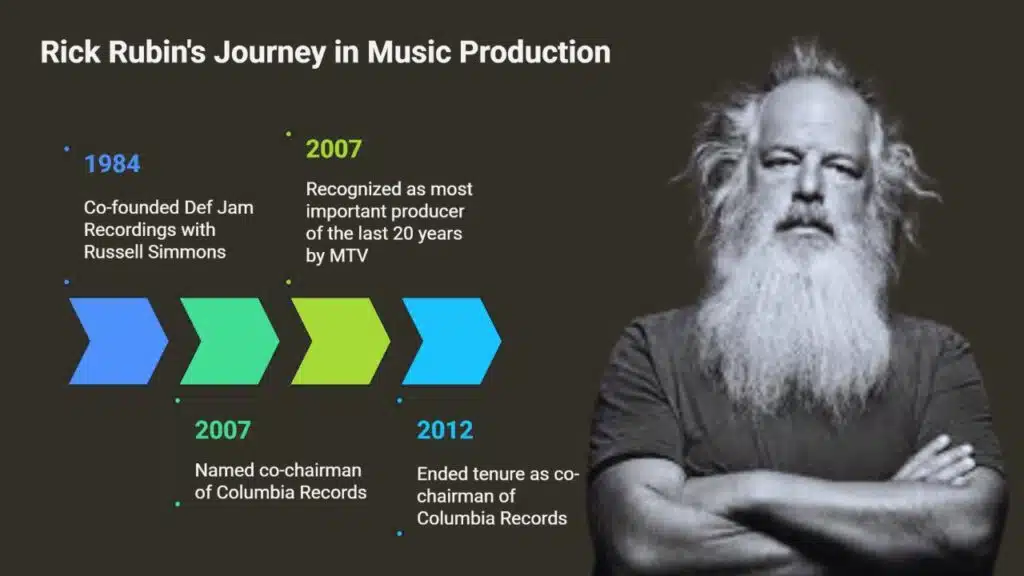
Rubin co-founded Def Jam Recordings in 1984 with Russell Simmons. He served as co-chairman of Columbia Records from 2007 to 2012. The producer strips songs to their core. He focuses on voice and rhythm.
He blends hip hop, rock, and heavy metal. Artists find a clear canvas.
Microphone placement, a recording desk, digital audio workstation, compression, and reverb make his palette. He mixes tracks with sampling and layering. He scorns overdone loudness and fights recent trends in compression.
MTV named him the most important producer of the last 20 years in 2007.
Production Style and Philosophy
Rick Rubin uses silence to shape a song. He carves away extra layers like a sculptor. That gives space for a singer’s soul. A single mic sits at the edge of a wood floor. LL Cool J lays down beats.
Public Enemy chants hit harder. He trimmed tracks at Def Jam Recordings too. He blends analog tape, compressor, equalizer. His studio feels like a zen garden. Johnny Cash found that vibe at American Recordings.
Tom Petty felt that stillness at Columbia Records.
He pushes tracks to the edge of loudness. Critics hit him for the loudness war. They point at Red Hot Chili Peppers’ Californication in 1999. They name Metallica’s Death Magnetic in 2008.
They note Black Sabbath’s 13 in 2013. That recent history of highly compressed and loudly mastered music drains dynamic range. Digital clipping and heavy limiter use steal air from a mix.
Yet, those albums still fill stadiums and stream millions. Grammy Awards still line his shelves.
Influence on the Music Industry
His bold mixes reshaped hip hop, rock, country and heavy metal. Labels at Columbia Records felt his impact in the 1980s and beyond. MTV named him the most important producer of the last 20 years in 2007.
Time magazine added him to its 100 Most Influential People in the World list that same year. He used sampling and reverb on Def Jam Recordings cuts for Run-D.M.C., LL Cool J and Public Enemy.
Beastie Boys tracks drew from his raw drum loops on a mixing console.
A Grammy Award for Producer of the Year, Non-Classical landed in his hands in 2007 and 2009. Artists from Johnny Cash to Red Hot Chili Peppers felt his fresh vision. Studio teams mention his sparse beats and fierce mastering on a mixing board.
American Recordings grew from a raw sound and intense session setups. Young producers study his use of compression and EQ on classic tracks. Listeners hear his legacy in every clear drum hit and bold guitar line.
Praise and Recognition
Rick Rubin won the Grammy Award for Producer of the Year, Non-Classical, in 2007 and again in 2009. He also earned Album of the Year Grammys for The Chicks’ Taking the Long Way (2007) and Adele’s 21 (2012).
MTV called him the most important producer of the last 20 years that same year. Time magazine placed him on its 100 Most Influential People list that year.
Def Jam Recordings alumni like LL Cool J and Beastie Boys still hail his studio magic. Johnny Cash’s late career glow traced back to his American Recordings sessions. Critics salute his ability to shape rock and hip hop hits.
He stands tall among american record producers.
Criticism and Controversies
Critics blame Rubin for fuelling the loudness war. They note Californication (1999), Death Magnetic (2008), 13 (2013) all hit high loudness levels. The american record producer rick rubin mixed those albums.
Excessive compression squeezed dynamic range. Streams crackle under heavy gain. Fans say mixes feel flat and tiring. Engineers point to peak normalization, limiter settings.
Listeners use LUFS meters to check loudness. They claim Red Hot Chili Peppers, Metallica and Black Sabbath records lost depth. Rubin stands by his mix style. He sees loud records as bold statements.
Some study his extreme levels in home studios. They copy his compressor and equalizer settings.
Personal Life and Interests
Rick Rubin practiced Buddhism since his teenage years, and he uses a meditation cushion to focus on mindfulness. He stayed vegan for over 20 years before he added meat back. His home sits in Malibu, California with his wife, Mourielle Hurtado Herrera, and their son, born in 2017.
Old vinyl from Def Jam Recordings still spins on his turntables. Smoky Mountain Wrestling got his financial backing from 1991 to 1995. Balance defines his days as he shares family time and listens to hits he made for Def Jam and American Recordings.
Published Work: The Creative Act
The Creative Act: A Way of Being came out in 2023. This guide mixes insight and memoir from Def Jam Recordings and American Recordings eras. It spotlights studio tales with Beastie Boys, LL Cool J, Public Enemy, and Johnny Cash.
Goodreads readers rated it 3.99 stars from 68,608 votes.
Rubin lays out tips on the creative process with clear, live tools. He writes with a calm, chatty tone. Musicians and fans still talk about his advice on ideas, risk, and flow.
Legacy and Impact on Creativity
Rick Rubin helped reshape hip hop. He co-founded Def Jam Recordings with Russell Simmons in 1984. He worked with LL Cool J, Beastie Boys, Public Enemy, Run-D.M.C. His style cut layers, he stripped beats, he put focus on raw voice.
He revived Johnny Cash in 1994. Cash’s album American Recordings won a Grammy Award. He also produced the Chili Peppers on Blood Sugar Sex Magik in 1991 and on Stadium Arcadium in 2006.
Each record pushed artists to find fresh ideas. His focus on craft changed how musicians view the creative process.
Rubin wrote The Creative Act in 2023. He shared tips on studio recording. He asked artists to sit with silence, then craft new riffs. His book tied in concepts from his own path. Fans rate his prior book, Def Jam Recordings: The First 25 Years, at 4.12 on Goodreads.
He mixed tracks through a compressor, then set microphone placement with care. He urged heavy metal acts and rap hard rock bands to merge energy. System of a Down felt free to twist song form.
Linkin Park found fresh beats on Minutes to Midnight. Each session turned gear and concept into art.
Takeaways
His story leaps from a dorm room track to global charts. He held a mic as he shaped raw beats. He used a mixing console and a digital audio workstation to craft tight grooves. He changed how stars like Cash and Gaga sound on record.
His creative process feels like a jam session with ghosts of rock and rap. His legacy glows, like a lamp in a dark studio.
For a deeper dive into how Rick Rubin has revolutionized the music scene, explore our detailed feature on Rick Rubin’s innovative production techniques.
FAQs
1. Who is Rick Rubin?
Frederick Jay Rubin is an American record producer. He co founded Def Jam Records with Russell Simmons. He brings raw talent to life.
2. What artists did he launch?
He signed LL Cool J, Public Enemy, hip hop trio Beastie Boys and rap duo Run D.M.C. at Def Jam Recordings. He saw them light up the stage.
3. What is American Recordings?
American Recordings is his own label at Columbia Records. It gave Johnny Cash a new spark. It also worked with Neil Diamond and Tom Petty.
4. How did he shape rock music?
He shaped rock with Red Hot Chili Peppers on Blood Sugar Sex Magik. He then mixed raw grooves on Stadium Arcadium. Fans still feel the heat.
5. How did he work in metal and rap?
He pushed the limit on heavy metal by working with thrash group Slayer on Reign in Blood. He also teamed with Ozzy Osbourne and Tony Iommi for raw riffs. He even backed Geto Boys for a wild blend.
6. What is his creative process?
His creative process leans on raw takes, tight edits and loose sessions. He cuts the fat and hunts the soul. He blends silence and roar. He asks artists to tear down their walls.