
AI Companies Building Enterprise Knowledge Products are tackling a familiar business problem: useful information exists, but the people who need it cannot easily find, trust or reuse it. Canada has companies working on several parts of that problem, from enterprise search and customer-service knowledge to legal research, contract precedents and investment analysis. These twelve offer a useful view of the market—and of the different products buyers should actually compare.
A company-wide search assistant and an AI contract-review tool can both make knowledge more useful. They serve different users, need different source material and should be judged on different outcomes. Buying either because it has an impressive chat interface misses the more important question: what work becomes easier to complete and verify?
How We Selected These AI Companies Building Enterprise Knowledge Products
This research-led list was checked against company product pages, technical documentation and Canadian location evidence on November 13, 2026. “Canadian” refers to documented Canadian founding roots or a substantive Canadian company base. It does not imply exclusively Canadian ownership, an entirely domestic workforce or automatic Canadian data residency.
For this article, an enterprise knowledge product helps a business retrieve, organise, interpret or apply information in a repeatable workflow. That includes specialist professional knowledge, not only an internal employee wiki. Each entry identifies the actual product area so readers can distinguish direct alternatives from complementary tools.
We selected companies with identifiable products and business use cases, rather than general AI consultancies. This is not a hands-on benchmark, a funding ranking or a claim that every product fits every enterprise. Fit assessments are editorial judgments based on documented capabilities. Availability, integrations and commercial scope should be confirmed for a proposed deployment.
The Twelve Companies at a Glance
| Company | Canadian connection | Knowledge product focus | Likely buyer |
|---|---|---|---|
| Cohere | Founded in Toronto | Enterprise AI workspace and information retrieval | Enterprise IT and AI teams |
| Coveo | Québec-based Canadian company | Enterprise search and generative answers | Search, digital experience and service teams |
| Unblocked | Vancouver office | Engineering context across code and workplace information | Software engineering organisations |
| Ada | Canadian company with a Toronto office | Knowledge-grounded customer-service agents | Customer-experience leaders |
| Procedureflow | Saint John, New Brunswick | Visual procedures and guided execution | Contact-centre and operations teams |
| Klue | Vancouver head office | Competitive intelligence and win-loss knowledge | Product marketing and revenue teams |
| Arteria AI | Toronto company office | Financial-document data and workflow intelligence | Financial institutions |
| Wisedocs | Founded in Toronto | Claims records and medical-document intelligence | Insurers, claims teams and related professionals |
| Blue J | Toronto-based company | AI tax research and advisory work | Tax and accounting professionals |
| Alexi | Toronto office and Canadian roots | Legal research, firm knowledge and drafting | Law firms |
| Spellbook | Headquartered in St. John’s | Contract review, drafting and legal playbooks | In-house legal teams and law firms |
| Sibli | Toronto-based company | Institutional investment research and forecast knowledge | Asset managers and investment teams |
The sequence moves from broad information access to specialist workflows. It is not a best-to-worst ranking.
1. Cohere: Enterprise Knowledge Inside a Broader AI Workspace
Cohere was founded in Toronto and builds AI systems for enterprise use. North is its enterprise AI platform, while Compass addresses search and discovery across organisational information. This makes Cohere relevant when a business wants knowledge retrieval connected to a wider workspace for AI-assisted tasks.
Compass documentation describes document parsing, managed indexing and retrieval models, including Embed and Rerank. Those components matter because answering a question well starts before the answer is written: the system must interpret the files and retrieve relevant material. An organisation with presentations, spreadsheets and documents has a different ingestion problem from one with a clean text-only knowledge base.
Cohere is a candidate for teams that want control over deployment as well as model capabilities. Its materials describe private deployment options, but the configuration and commercial arrangement need confirmation. The reviewed Compass page also labels its coming cloud offering as a private beta; that should not be treated as generally available self-service access.
The evaluation should establish what is included in North, what retrieval infrastructure is required and who maintains the connected sources. Buying access to a model alone is a different project from deploying a supported employee knowledge product.
2. Coveo: Search Relevance With Grounded Answers
Coveo is a Canadian company with a long-standing focus on enterprise information access. The Government of Canada’s account of its platform development describes work to extend its enterprise platform with generative AI capabilities.
Its Relevance Generative Answering documentation provides a concrete explanation of the product. The system generates answers using specified indexed content, includes citations and operates within a Coveo-powered search experience. Traditional results and generated answers can therefore appear together, giving a user a way to inspect the underlying material.
That is attractive when an organisation already knows which repositories and customer-facing or employee-facing experiences need better search. The hard part is often deciding what should be indexed, which content is authoritative and how permissions apply—not simply adding a text-generation box.
Coveo documents Relevance Generative Answering as a paid product extension. Buyers should distinguish the underlying search licence from the generative capability and its implementation requirements. A useful evaluation includes a question with conflicting documents and another where the correct answer is available only to a restricted group.
3. Unblocked: The Reasons Behind the Code
Unblocked, which lists its office in Vancouver, concentrates on engineering knowledge. Its context layer connects code with conversations, issues, documentation and other systems used by development teams. The product’s value proposition is the organisational explanation surrounding a codebase, not just the code itself.
A developer may understand what a function does while still missing why a team chose that approach. The explanation could be buried in a closed issue, an architecture discussion or an old pull request. Unblocked’s developer Q&A and coding-agent integrations address that fragmentation.
This makes it particularly relevant to engineering organisations dealing with onboarding, internal support questions or coding agents that lack project context. It is a more focused purchase than a general employee search system. A team should judge whether the retrieved context explains real design decisions and points to evidence that engineers can inspect.
Repository and conversation access deserve careful scoping. Connecting every channel is not automatically the right starting point. Begin with a well-defined engineering area, compare answers with maintainers’ understanding and check how the product handles an obsolete decision that later changed.
4. Ada: Putting Approved Knowledge Into Customer Service
Ada identifies itself as a Canadian company and maintains a Toronto office. Its AI customer-service platform uses connected knowledge to respond to customer questions. The relevant knowledge product is the combination of content ingestion, article management and an agent that applies that information during support interactions.
Ada’s documentation describes connecting supported knowledge bases, importing website content and creating articles. Teams can include or exclude information from responses, rather than treating everything that has been uploaded as equally suitable for customer use. Its broader platform also supports actions and transfers to human agents.
The most natural buyer is a customer-experience team with a substantial body of support content and recurring questions. The quality of the knowledge library becomes operationally important: two conflicting refund policies can create a customer problem even if the agent retrieves them successfully.
Ada should be assessed on supported source connections, content freshness and escalation behaviour. An internal repository behind authentication may need a different ingestion route from a public help centre. For multilingual comparisons, Editorialge’s guide to Italian-language AI tools for customer-service teams offers a complementary market view.
5. Procedureflow: Knowledge That Explains the Next Step
Procedureflow, based in Saint John, New Brunswick, approaches knowledge as a sequence of decisions. Its platform turns procedures into visual, guided workflows. That is useful when staff do not merely need an answer; they need to know which step follows from a particular condition.
Consider a contact-centre process with different paths for account ownership, eligibility and exceptions. A long document can describe every rule without making the next action easy to find. A maintained visual flow can make the branching logic explicit and help teams use a shared procedure.
Procedureflow positions this structured knowledge for both human users and AI-supported execution. Its public materials describe AI and automation capabilities alongside governance and authoring. Buyers evaluating an agent-facing API should confirm its current release status and supported deployment scope rather than assume a beta announcement means full production availability.
The fit is strongest where approved processes change often or inconsistent execution creates rework. The necessary investment is process ownership: someone must validate the steps, approve revisions and retire outdated flows. AI assistance cannot determine the organisation’s correct procedure without that input.
6. Klue: Competitive Knowledge for Revenue Teams
Klue lists its head office in Vancouver and builds an AI platform for competitive intelligence and win-loss analysis. Its knowledge is commercial: what competitors are doing, what buyers say and what a seller needs to understand about a live opportunity.
The platform combines collection and curation of competitive information with buyer and deal insights. Its current product materials describe a Compete Agent and capabilities for delivering intelligence into other AI workflows. This is a specialist knowledge layer for product marketing and sales, rather than a replacement for every corporate document repository.
A useful application is keeping a sales team’s competitor guidance current. An old battlecard may contain a once-accurate claim that no longer reflects the market. The buyer should examine how source material becomes a usable insight and how a content owner corrects or withdraws it.
Klue is worth considering when competitive information is plentiful but poorly distributed. Its usefulness depends on the quality and coverage of the inputs. A sales anecdote, a recorded buyer interview and a competitor’s published feature description should not acquire the same evidential weight merely because they appear in one interface.
7. Arteria AI: Turning Financial Documents Into Usable Data
Arteria AI has a Toronto office and develops enterprise AI for financial services. Its platform centres on documentation: extracting information, generating documents, maintaining an intelligent repository and moving data between documents and core systems.
This is a different knowledge problem from searching an employee handbook. Financial institutions may need to compare terms across agreements or make a documented fact available inside an operational workflow. Arteria’s platform describes document-level data models, search and categorisation, clause comparison and natural-language interaction with documents and data.
The appeal is turning information trapped in files into something that can support repeatable work. For a bank, the relevant output might be a structured field connected to its source document, not a paragraph summarising an entire folder.
Arteria is a specialised enterprise candidate, so the evaluation should include the institution’s actual document types and system interfaces. Extraction accuracy must be checked at the field level, with exceptions routed to people who understand the underlying transaction. A polished summary is not a substitute for a correct value in a downstream system.
8. Wisedocs: Knowledge From Complex Claims Records
Wisedocs was founded in Toronto to address medical-record review. Its claims-documentation products organise records, surface information within a claim file and connect findings to supporting material. The company also describes human oversight as part of its approach.
The current platform includes capabilities for preparing records, identifying medical events and care gaps, collaborating with stakeholders and examining patterns across claims. That makes it relevant to insurers and other professionals whose work starts with large, inconsistent collections of documents.
The business value to investigate is not simply a shorter file. It is whether a reviewer can understand the record, locate the relevant event and return to the original page. Duplicate records and documents belonging to the wrong person are examples of problems that can distort downstream analysis.
Wisedocs belongs on a specialist claims shortlist. It should not be treated as a clinical decision-maker or a general enterprise search engine. A pilot needs representative record quality, reviewer feedback and clear responsibility for checking conclusions before they influence a claim decision.
9. Blue J: A Specialist Knowledge Product for Tax Teams
Toronto-based Blue J builds AI tax research and advisory tools. Its Canadian product describes answers accompanied by verifiable sources, giving tax professionals a starting point for evaluating a question and the authorities relevant to it.
The specialisation matters. A generic assistant may produce fluent tax language without retrieving the appropriate jurisdiction’s material. A tax-focused product can organise the research workflow around relevant content, but the practitioner must still determine whether an authority applies to the client’s facts.
Blue J is a sensible candidate for firms where repeated research questions consume professional time. The evaluation should focus on the reasoning trail: which sources were used, whether they address the specific issue and how the system deals with incomplete facts. An answer that is easy to review can be more useful than one that merely arrives quickly.
Confirm jurisdiction coverage and the scope of any advisory or workflow features included in the proposal. Canadian company roots do not mean every tax system is supported equally. This is specialist research assistance, not an assurance that an AI-generated conclusion can be adopted without professional review.
10. Alexi: Applying a Law Firm’s Collective Knowledge
Alexi has Canadian roots and lists a Toronto office alongside its US presence. Its platform is built for law firms and combines legal research, document analysis, drafting and firm-specific workflows.
A distinctive part of its positioning is the use of a firm’s playbooks, templates and prior work. That addresses a persistent knowledge-management problem: valuable analysis often remains tied to an individual matter or lawyer instead of becoming a reusable resource for the firm.
Alexi’s product materials describe capabilities such as research memo generation and single-tenant deployment. These should be evaluated against the proposed configuration rather than assumed to be included in every purchase. The relevant buyer is a firm seeking a shared legal-work platform, not simply occasional text generation.
A meaningful demonstration would compare a draft against an approved template and explain which prior material influenced the result. Confidentiality boundaries between matters also need testing. Reusing institutional knowledge is helpful only when the material is appropriate to reuse and the user is authorised to see it.
11. Spellbook: Reusing Contract Standards and Precedents
Spellbook is headquartered in St. John’s, Newfoundland and Labrador, according to the Government of Canada’s company profile. Its contract AI products support drafting and review, including work inside Microsoft Word.
For enterprise knowledge, the important elements are precedents and playbooks. A legal team’s preferred negotiating positions are useful only if they can be applied consistently to a new agreement. Spellbook describes drafting from precedents and turning team standards into review checklists.
This makes it relevant to in-house teams and firms handling recurring contract types. The evaluation can be concrete: take an approved position, introduce an unacceptable variation and see whether the system identifies it and proposes an appropriate revision.
Its website also promotes a broader end-to-end contract offering under early access. Buyers should distinguish those developing capabilities from the review and drafting features available in their proposed plan. No contract tool should be judged solely by how confidently it redlines; the suggested change must preserve the intended commercial position and remain subject to legal review.
12. Sibli: Preserving the Logic Behind Investment Research
Toronto-based Sibli focuses on institutional investment teams. Its platform connects forecasts, research and the reasoning behind investment views, treating that accumulated work as an organisational knowledge asset.
The product describes forecast management, scenario analysis, research monitoring and structured data for risk and analytics workflows. The underlying problem is familiar to investment organisations: a spreadsheet may preserve a forecast while losing the assumptions and discussion that produced it.
Sibli is relevant when a firm wants to compare its views over time and understand why an estimate changed. Its materials describe version-controlled, auditable information and integration into existing workflows. These are capabilities to inspect with the investment team’s actual modelling process.
The buying criterion should be better traceability and more usable research, not an assumption of higher returns. A pilot can test whether an analyst can reconstruct an old forecast, identify the evidence behind a revision and distinguish an internal view from an external consensus estimate.
How to Compare Products That Solve Different Knowledge Problems
Start by naming the unit of work. “Help employees find information” is broad; “answer a policy question with the current approved source” is testable. So are “explain a code decision,” “apply a contract playbook” and “extract a term with a link to the original document.”
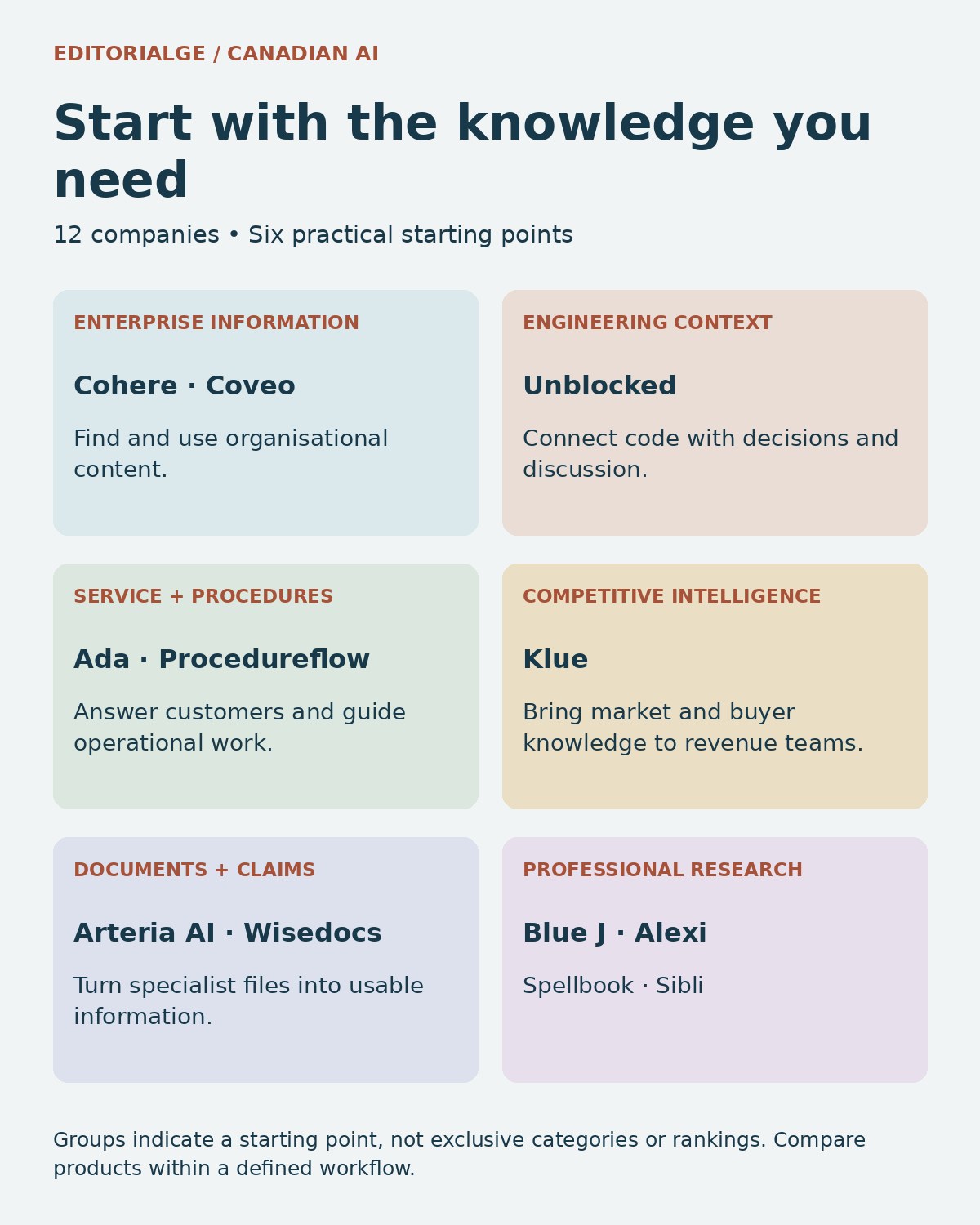
Cohere and Coveo are starting points for broader information access. Unblocked focuses on engineering context. Ada and Procedureflow apply knowledge to service or operational work. Klue supports competitive decisions. The remaining specialists serve financial documentation, claims, tax, legal and investment workflows. These groupings are useful starting points, not exclusive boundaries.
For another regional perspective, our article on Arabic-and-English AI providers for UAE business applications explores why language and deployment requirements can change a business shortlist.
Inspect the Evidence Behind an Answer
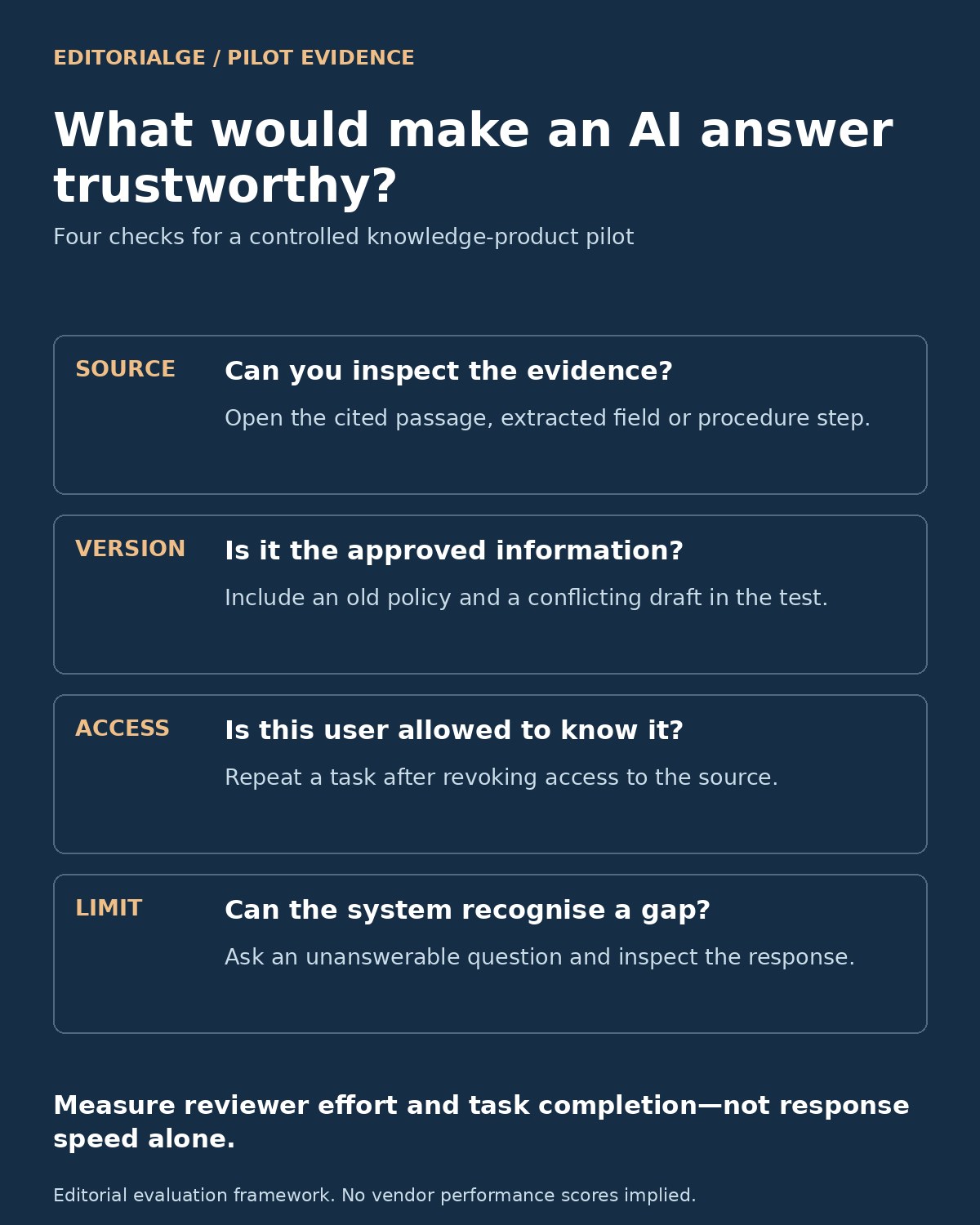
A citation is useful only if it supports the claim beside it. Give a pilot system an approved document, an outdated version and a conflicting draft. Assess whether it identifies the right source, explains uncertainty and avoids silently blending incompatible material.
For extraction products, inspect the exact field and source location. For process products, inspect the branch taken. For research products, inspect the cited authority and reasoning. A single generic accuracy score will not describe all three tasks adequately.
Treat Canadian Origin and Data Location Separately
Ask where original documents, indexes, prompts, outputs and backups are stored and processed. Identify the model providers and other subprocessors involved. A Canadian office or founder does not answer those deployment questions.
Similarly, an English-language demonstration does not establish performance on French content or mixed-language repositories. Where those needs matter, include representative material and bilingual reviewers in the pilot. Confirm that required permissions survive retrieval, generated answers and any connected action.
Price the Working Deployment
These products serve different markets, so a universal monthly price comparison would be misleading. Request a proposal for the same defined scope within each relevant category: users, source systems, document volume, query or processing demand, deployment environment and support requirements.
Separate recurring licences from implementation, source cleanup, connector work and ongoing content ownership. Establish whether specialist modules or generative features are additional purchases. A lower subscription can still leave more work for the internal team.
Choose the Knowledge Problem Before the AI Brand
The Canadian AI Companies Building Enterprise Knowledge Products in this list demonstrate how broad the category has become. Search, guided execution and specialist analysis all make information useful, but they require different inputs and different checks.
Choose a specific workflow, a responsible content owner and a small set of representative tasks. Then evaluate the relevant products on whether their output is useful, traceable and available to the right people. That provides a stronger basis for a purchase than the size of a funding round or the confidence of a generated answer.