
What are embeddings? Embeddings are learned numerical representations—dense arrays of floating-point numbers known as vectors—that transform text, images, products, and user queries into a high-dimensional mathematical space.
Unlike traditional lexical search that relies on exact keyword matching, an embedding model maps data based on underlying semantic meaning. This allows modern search engines, Generative Engine Optimization (GEO) models, and Answer Engine Optimization (AEO) platforms to retrieve relevant results even when queries and documents use completely different terminology.
By enabling machines to understand contextual similarity, embeddings serve as the foundation for semantic search, personalized recommendations, Retrieval-Augmented Generation (RAG), and AI-driven knowledge systems, bridging the gap between human search intent and information retrieval.
What Are Embeddings in Simple Terms?
An embedding represents an item as numbers.
A sentence might become something like:
[0.17, -0.42, 0.08, 0.31, …]
Real embedding vectors may contain hundreds or thousands of values, depending on the model.
Those individual numbers usually do not correspond to neat human-readable labels such as “about finance,” “positive,” or “formal.” The useful information is distributed across the vector.
What matters is how one vector relates to another.
Suppose a search index contains these sentences:
- “Employees receive 25 days of annual leave.”
- “How much holiday time do staff get?”
- “Reset your corporate email password.”
A retrieval-oriented embedding model should normally represent the first two as more similar to one another than either is to the password instruction.
The model has not discovered a dictionary entry saying that holiday equals annual leave. It has learned a representation in which their wider contexts and meanings can be compared.
That is the foundation of semantic search.
Embeddings Do Not Create a Universal Map of Meaning
Descriptions of embeddings often say that related concepts sit “close together in vector space.” That is useful shorthand, but it can make embeddings sound more universal than they are.
There is no single mathematical coordinate system for meaning.
The representation depends on:
- the model;
- its training data;
- its training objective;
- the type of information being embedded;
- how the vectors will be used.
A model trained for multilingual document retrieval may organize information differently from one developed for recommendations or image search.
Some systems even treat queries and documents differently. Cohere’s retrieval models, for example, distinguish between query and document input types so each side of a search interaction is represented appropriately.
This has an important consequence for developers: embedding scores are not universal percentages. A cosine similarity of 0.82 does not mean two passages are “82% similar.” A useful threshold for one model may be poor for another.
It also means embeddings produced by unrelated models should not casually be mixed inside the same search index.
How Embeddings Power Semantic Search
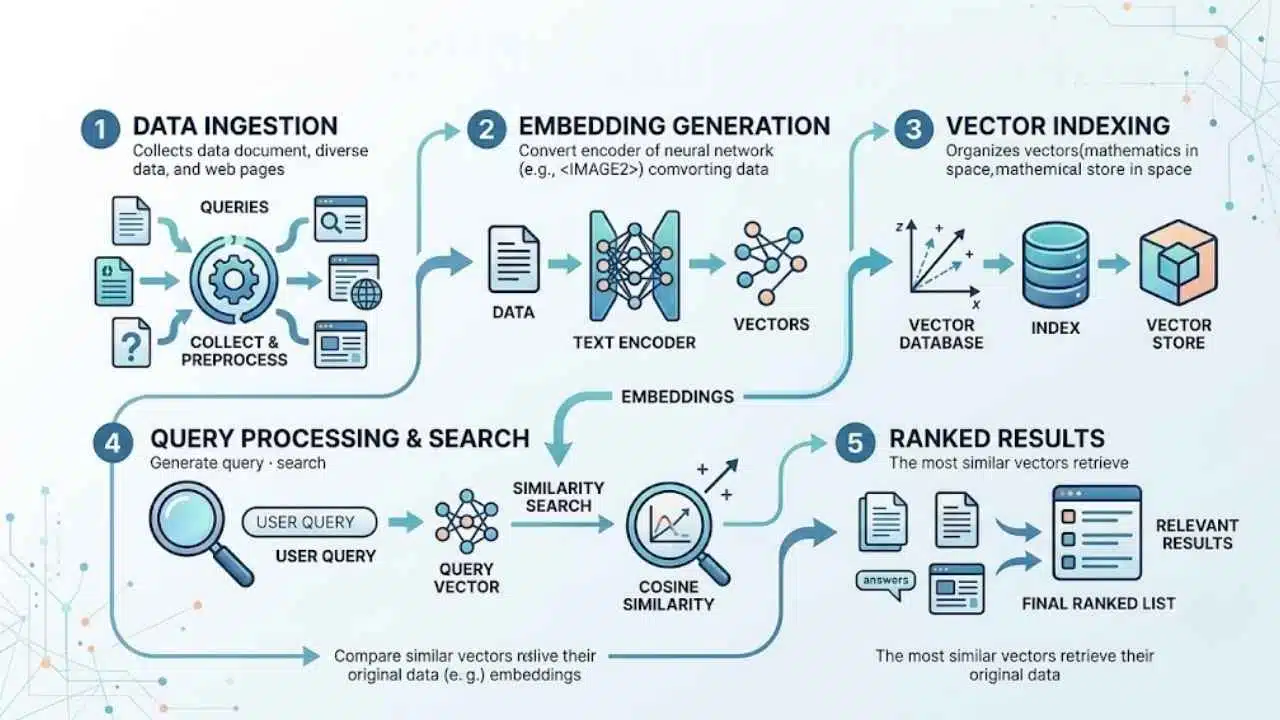
A basic embedding search system has a fairly understandable workflow.
First, the application decides what should be searchable.
That could mean:
- product descriptions;
- support articles;
- FAQ answers;
- policy sections;
- paragraphs from reports;
- individual knowledge-base entries.
Each piece of content is passed through an embedding model. The resulting vector is stored together with the original content and metadata. When someone enters a query, that query is embedded using a compatible model or retrieval configuration.
The system then looks for stored vectors that are closest to the query vector. Those nearby items become search candidates. This is known as nearest-neighbour search.
Similarity may be calculated using cosine similarity, dot product, or Euclidean distance. The appropriate choice depends on the model and how its vectors were produced or normalised.
The practical advantage is straightforward: the query does not need to copy the document’s vocabulary.
Someone searching for “connecting with coworkers” might retrieve an internal article titled “Joining Company Slack Channels.” A shopper searching for “warm coat for heavy rain” can find a waterproof insulated jacket without requiring that exact phrase in the product title.
Exact Search Still Matters
Embedding search can look dramatically better than keyword search when a demo is designed around paraphrasing.
Production search contains a lot of queries that are not paraphrases.
Consider:
ERR_CONNECTION_RESET
ISO 27001
WH-1000XM6
INV-839255
These queries contain exact information. An invoice ID, model number, legal standard, error code, or unusual surname should often receive strong lexical matching.
Traditional search engines are also much more capable than simple keyword matching suggests. Systems such as Elasticsearch can use BM25 ranking, stemming, phrase matching, field weighting, synonyms, spelling correction, and other signals.
Embeddings solve a different part of the relevance problem.
For this reason, replacing an established text-search system with pure vector retrieval is often unnecessary.
Hybrid Search Is a Stronger Default for Many Products
Hybrid search combines lexical retrieval with semantic vector retrieval.
The two approaches compensate for each other.
Lexical search is strong when exact wording matters. Vector search is useful when the user and the document express the same idea differently.
Imagine an electronics retailer.
A query for:
WH-1000XM6
should strongly favour the exact product.
A query for:
comfortable noise cancelling headphones for overnight flights
benefits from semantic matching.
A well-designed search product may need to answer both.
Platforms such as Elasticsearch and Google Cloud now support hybrid retrieval patterns. One common technique is Reciprocal Rank Fusion, or RRF, which combines ranked result lists without pretending that a BM25 score and a vector-similarity score use the same numerical scale.
Hybrid search is not automatically the right answer everywhere. A small system built mostly around product codes may get little value from semantic retrieval. A specialised semantic discovery tool might not need an elaborate lexical layer.
The sensible approach is to test real failed queries before adding more infrastructure.
Vector Search Becomes Harder at Scale
If an index contains a few thousand vectors, a system can compare a query against every vector and find the closest results.
That is exact nearest-neighbour search.
As the collection grows, comparing every vector can become too expensive for the required latency.
Approximate nearest-neighbour, or ANN, indexing reduces that workload by searching promising areas of the vector space rather than exhaustively checking every item.
The trade-off is recall.
An approximate index is designed to find good neighbours quickly. It may occasionally miss a result that an exact search would have returned.
HNSW, or Hierarchical Navigable Small World, is one widely used ANN approach. PostgreSQL users can see the trade-off directly through pgvector, which supports exact search as well as approximate HNSW and IVFFlat indexes.
HNSW often offers strong search performance, but it also requires more memory and can take longer to build.
These are ordinary infrastructure choices, not special AI magic:
- How fast must search respond?
- How much recall is acceptable?
- How often does the corpus change?
- How much memory can the index use?
- Are results heavily filtered?
- How large will the dataset become?
A knowledge base with 15,000 passages does not automatically need the same vector architecture as a recommendation platform serving hundreds of millions of items.
A Vector Database and an Embedding Are Different Things
These terms are often bundled together, which creates unnecessary confusion.
The embedding model creates the vector. The similarity measure defines how vectors are compared. The index helps find nearby vectors efficiently. The database or search platform stores those vectors, metadata, and often the source content.
A dedicated vector database is therefore optional. PostgreSQL can perform vector search with pgvector. Elasticsearch supports vector fields alongside conventional search. Other databases and cloud services now provide vector indexing as part of broader data platforms.
A dedicated vector system makes sense when scale, filtering, low-latency retrieval, or operational requirements justify it. For smaller applications, adding another production database simply because the project uses embeddings can create more complexity than value.
Chunking Often Matters More Than Teams Expect
A search engine also needs to decide what one embedding should represent.
Embedding an entire 50-page handbook as one vector usually produces weak passage-level retrieval because that single representation must cover many unrelated topics.
The standard solution is to divide long documents into smaller searchable units. This is called chunking.
There is no perfect chunk size.
Very small chunks may retrieve the exact sentence but lose the heading or surrounding context needed to interpret it. Very large chunks preserve context but make specific topics less distinct.
Fixed character limits can also split content in awkward places.
Better chunk boundaries often follow the document itself:
- headings;
- paragraphs;
- FAQ answers;
- product sections;
- policy clauses;
- technical procedures.
Metadata should stay attached to the chunk.
A retrieved paragraph becomes much more useful when the application also knows the source document, heading, publication date, version, URL, product category, or access permissions.
For RAG systems in particular, poor chunking can create answers that sound convincing while missing the part of the source that actually matters.
Why Embeddings Became Important to RAG
Retrieval-augmented generation, usually shortened to RAG, combines retrieval with a generative model.
Instead of asking a language model to answer entirely from information encoded in its parameters, the application first searches an external knowledge source.
Relevant material is then supplied to the model as context while it generates the answer.
The original RAG research used dense vector retrieval, and Dense Passage Retrieval showed how learned vector representations could support open-domain question answering.
That history explains why embeddings are closely associated with RAG.
Modern RAG systems are broader. Retrieval may combine:
- embeddings;
- BM25;
- metadata filters;
- reranking models;
- sparse learned retrieval;
- knowledge graphs.
Dense embeddings are common, but they are not mandatory for every RAG architecture.
The more important point is retrieval quality.
If the system retrieves an expired refund policy, an outdated product specification, or the wrong HR document, even an excellent language model can produce a polished answer from bad evidence.
Teams should therefore measure whether the right source was retrieved before judging the generated answer.
Changing Embedding Models Is More Than an API Update
Embedding models improve, and teams eventually want to change them.
The migration can be more involved than changing a model name.
A new model may use different dimensions or organise its vector space differently. Existing document embeddings may no longer be meaningfully comparable with new query embeddings.
That can require:
- regenerating document vectors;
- creating a new index;
- rerunning relevance tests;
- checking latency and recall;
- moving traffic after validation.
For a large document collection, re-embedding can involve meaningful compute, storage, and deployment work.
Store the original text and metadata needed to regenerate embeddings. The vector should normally be treated as derived data, not the only durable copy of the source.
Where Embedding Search Commonly Fails
Embedding systems can return impressively relevant results and still fail in ways that matter.
Similarity Is Not Authority
An outdated policy may be extremely similar to the current policy.
Vector similarity does not know which one the organisation considers authoritative unless the retrieval system includes version, publication date, status, or source controls.
The Closest Document May Still Be Irrelevant
A nearest-neighbour system can return the closest item even when nothing in the corpus answers the question.
Applications may need relevance thresholds, reranking, or a genuine no-result path.
Permissions Must Apply Before Retrieval
An enterprise search assistant should not retrieve confidential payroll information for someone without permission to see it.
Access controls should constrain candidate retrieval rather than trying to hide sensitive information after it has already reached a later processing stage.
Filters Change Performance
Real searches often include filters for language, region, product availability, tenant, date, or content type.
ANN performance with heavy filtering can differ from unfiltered benchmark results. Test the actual combination your product will use.
What Are Embeddings Useful for Beyond Search?
The same mathematical representation supports other applications.
Common uses include:
- recommendations;
- duplicate detection;
- clustering;
- classification;
- support-ticket routing;
- related-content systems;
- candidate generation;
- cross-language retrieval;
- image and multimodal search.
Recommendation systems, for example, can represent users and products in compatible vector spaces and retrieve likely candidates before applying a more expensive ranking model.
Embeddings are especially useful when relationships are difficult to represent through fixed categories or handwritten rules.
They are much less useful when a simple lookup or relational query already answers the problem cleanly.
What Embeddings Mean for SEO
Embeddings help explain why modern search can understand relationships beyond exact keyword matching. That does not mean publishers should try to “optimise their page embeddings.”
Google publicly describes systems such as BERT and RankBrain that help Search understand combinations of words, meaning, and relationships between concepts.
Google does not provide publishers with a public page-level embedding score or vector that can be inspected and manipulated.
For SEO, the practical lesson is familiar but important.
Use the words readers use. Explain entities, products, processes, and relationships clearly. Answer the complete search intent rather than repeating one target phrase.
At the same time, exact language still matters. Product names, technical terminology, model numbers, people, places, and descriptive headings help both readers and retrieval systems understand what the page contains.
Google’s Search Essentials continues to recommend using words people would use to find the content in prominent places such as titles and headings.
Semantic search reduces the value of awkward keyword repetition. It does not make precise wording obsolete.
For publishers building their own internal search, embeddings have a much more direct use. They can improve archive discovery, related-article recommendations, semantic site search, content clustering, and internal knowledge assistants.
That is a practical application of embeddings. Trying to reverse-engineer an imaginary Google vector score is not.
Final Thoughts
So, what are embeddings? They are learned numerical representations that allow software to compare complex information through vector relationships.Their biggest value in search appears when users and documents describe the same idea in different language.
But embeddings are not a complete search architecture. Strong systems still need useful source content, sensible chunks, metadata, permissions, filtering, lexical retrieval, ranking logic, and evaluation against real queries. At larger scale, teams also have to balance recall, latency, memory, and infrastructure cost.
Before introducing vector search, examine the queries your current system fails to answer. If exact and lexical search already return the right result, embeddings may only add operational overhead. If relevant content is routinely missed because users phrase ideas differently from the documents, semantic retrieval deserves a serious test. That is when embeddings stop being an AI feature added for presentation and start solving an actual search problem.