

The global supply chain is the backbone of modern commerce, ensuring that goods and services flow seamlessly across borders.
However, disruptions such as economic downturns, geopolitical conflicts, natural disasters, and cybersecurity threats can cause severe operational setbacks. Unforeseen events, such as the COVID-19 pandemic, the Suez Canal blockage, or semiconductor shortages, have demonstrated how vulnerable supply chains can be.
Understanding the best ways to mitigate risks in global supply chains is critical for maintaining resilience, efficiency, and profitability.
This article explores the top 10 ways to mitigate risks in global supply chains, offering actionable insights, practical strategies, and real-world examples to help businesses safeguard their operations. By implementing these strategies, companies can strengthen their supply chain framework and stay ahead of potential disruptions.
1. Diversify Supplier Base
In today’s interconnected world, supply chain disruptions can occur unexpectedly, causing significant financial and operational damage. One of the most effective ways to mitigate risks in global supply chains is by diversifying the supplier base.
This strategy reduces dependency on a single supplier, ensuring flexibility and continuity during disruptions. A well-diversified supplier network enhances resilience and minimizes business interruptions caused by unforeseen events.
Why Supplier Diversification Matters
A common mistake businesses make is relying too heavily on a single supplier or region. This dependency exposes companies to risks such as:
- Supply chain disruptions due to political instability, trade restrictions, or natural disasters.
- Price fluctuations caused by supplier monopolies or raw material shortages.
- Production halts if a single supplier fails to deliver, leading to delays and financial losses.
- Limited innovation and flexibility when businesses depend on a single production hub.
Example: Many global electronics manufacturers faced significant delays in 2021 due to the semiconductor chip shortage. Companies that had diversified their supplier base recovered faster than those relying on a single provider.
Strategies for Effective Supplier Diversification
- Source from multiple regions to reduce geographical risks.
- Work with local suppliers for quicker turnaround times and reduced transportation costs.
- Identify backup suppliers to maintain production consistency in emergencies.
- Use supplier scorecards to evaluate and select reliable partners based on quality, reliability, and cost-effectiveness.
- Build long-term partnerships with multiple vendors to create a resilient supplier network.
Benefits of Supplier Diversification
| Benefit | Impact on Supply Chain |
| Reduced dependency | Minimizes operational risks |
| Improved flexibility | Enhances adaptability to disruptions |
| Better cost control | Avoids supplier price monopolies |
| Stronger resilience | Ensures supply continuity |
2. Implement Supply Chain Risk Management [SCRM] Framework
![Implement Supply Chain Risk Management [SCRM] Framework](https://cdn1.editorialge.com/wp-content/uploads/2025/03/Implement-Supply-Chain-Risk-Management-SCRM-Framework.jpg.webp)
In an era where supply chain disruptions can arise from multiple sources, having a well-structured risk management framework is crucial. Companies must adopt proactive measures to identify, assess, and mitigate risks before they escalate into major crises.
One of the most effective ways to mitigate risks in global supply chains is by implementing a comprehensive Supply Chain Risk Management [SCRM] framework. This ensures that businesses are prepared for contingencies and can respond swiftly to unexpected challenges.
Key Components of an Effective SCRM
A well-structured Supply Chain Risk Management [SCRM] framework helps businesses anticipate and mitigate risks effectively. Key components include:
- Risk identification: Understanding vulnerabilities across supply chain networks.
- Risk assessment: Prioritizing risks based on severity and probability.
- Contingency planning: Developing backup strategies for unforeseen events.
- Continuous monitoring: Using real-time data analytics to track potential disruptions.
Tools for Risk Management
- Artificial Intelligence [AI]: Predicts supply chain disruptions before they occur by analyzing data patterns.
- Blockchain Technology: Ensures transparency and traceability across all supply chain touchpoints.
- Risk Simulation Software: Tests different disruption scenarios for preparedness.
- Third-party Risk Assessment Platforms: Evaluates supplier reliability and geopolitical risks in real time.
Case Study: Walmart successfully implemented AI-powered risk detection to analyze weather patterns and predict potential supply chain disruptions. This allowed them to reroute shipments before hurricanes impacted their logistics network.
3. Leverage Technology and Automation
In an increasingly digital world, leveraging technology is one of the most effective ways to mitigate risks in global supply chains. The adoption of automation, artificial intelligence, and data analytics helps businesses predict, monitor, and manage disruptions more efficiently.
By integrating smart technologies, companies can enhance visibility, reduce manual errors, and improve decision-making, making their supply chains more resilient against unforeseen challenges.
Digital Solutions for Supply Chain Optimization
- Internet of Things [IoT]: Enables real-time tracking of shipments and inventory, reducing losses and theft.
- Cloud-Based Inventory Management: Provides instant access to stock levels across locations, ensuring smooth operations.
- Predictive Analytics: Uses historical data to forecast demand and reduce overstocking.
- Robotic Process Automation [RPA]: Automates routine tasks, such as invoice processing and inventory updates.
Benefits of Automation
- Minimizes human error in order processing and inventory management.
- Enhances efficiency by reducing manual interventions and operational bottlenecks.
- Speeds up decision-making with real-time data insights.
- Reduces operational costs by optimizing labor and logistics.
Technologies Transforming Supply Chains
| Technology | Benefit |
| IoT | Real-time tracking & monitoring |
| AI & Machine Learning | Predicts risks & optimizes routes |
| Blockchain | Enhances transparency & security |
| RPA | Automates routine supply chain tasks |
4. Strengthen Supplier Relationships
Building strong supplier relationships is one of the most effective ways to mitigate risks in global supply chains. A well-managed supplier network ensures better coordination, improved quality control, and faster response times during disruptions. Companies that actively engage with their suppliers can foster trust, gain better contract terms, and enhance overall supply chain resilience.
Collaborative Approaches to Risk Mitigation
Building strong relationships with suppliers ensures smoother operations. Best practices include:
- Transparent communication: Share real-time demand forecasts.
- Joint risk assessment: Work together to address potential disruptions.
- Supplier development programs: Invest in training and quality improvement.
- Multi-year contracts with performance incentives to ensure supplier commitment.
Performance Monitoring and Audits
- Regular evaluations help track supplier efficiency and reliability.
- On-site audits ensure compliance with ethical and quality standards.
- Adoption of supplier performance KPIs such as on-time delivery, defect rate, and responsiveness.
Example: Automotive giant Toyota conducts regular supplier audits and workshops to ensure high-quality, uninterrupted supply chain flow.
5. Optimize Inventory Management
Effective inventory management plays a crucial role in reducing supply chain risks and ensuring smooth operations. Companies that optimize their inventory levels can better withstand unexpected disruptions, avoid overstocking costs, and prevent stockouts that can lead to production delays.
One of the most efficient ways to mitigate risks in global supply chains is by implementing strategic inventory management practices, balancing supply and demand while maintaining operational flexibility.
Adopting a Just-in-Case [JIC] Strategy
- Balancing Just-in-Time [JIT] and Just-in-Case [JIC] inventory models to reduce dependency on last-minute procurement.
- Reducing stockout risks by maintaining buffer stock for critical materials.
- Warehouse optimization to ensure efficient stockpiling without excessive costs.
Inventory Forecasting and Buffer Stock Planning
- Leverage AI-driven demand forecasting to predict inventory needs accurately.
- Set optimal safety stock levels to prepare for unexpected disruptions.
- Automate inventory tracking systems for real-time stock visibility.
Example: Retail giant Amazon integrates AI-powered demand forecasting and automated warehouse management to optimize inventory and prevent stockouts.
Inventory Optimization Strategies
| Strategy | Benefit |
| AI Forecasting | Improves demand accuracy |
| Safety Stock | Prevents supply shortages |
| Warehouse Automation | Enhances storage efficiency |
6. Establish Strong Logistics and Transportation Strategies
Efficient logistics and transportation systems are crucial for maintaining seamless global supply chains. Disruptions in transportation, such as port congestion, fuel price fluctuations, or extreme weather conditions, can lead to costly delays and inventory shortages.
One of the most practical ways to mitigate risks in global supply chains is to establish strong logistics strategies that prioritize flexibility, cost-efficiency, and contingency planning. Companies that optimize their logistics operations can improve delivery reliability and enhance supply chain resilience.
Enhancing Logistics Flexibility
- Multi-modal transportation [air, sea, rail, and road] to ensure supply chain adaptability.
- Local and regional distribution centers to reduce delivery lead times.
Contingency Planning for Disruptions
- Backup transportation providers to mitigate risks of carrier failures.
- Emergency logistics protocols for handling supply chain interruptions.
Example: FedEx uses AI-driven logistics networks to reroute shipments dynamically during weather disruptions.
7. Monitor Geopolitical and Economic Risks
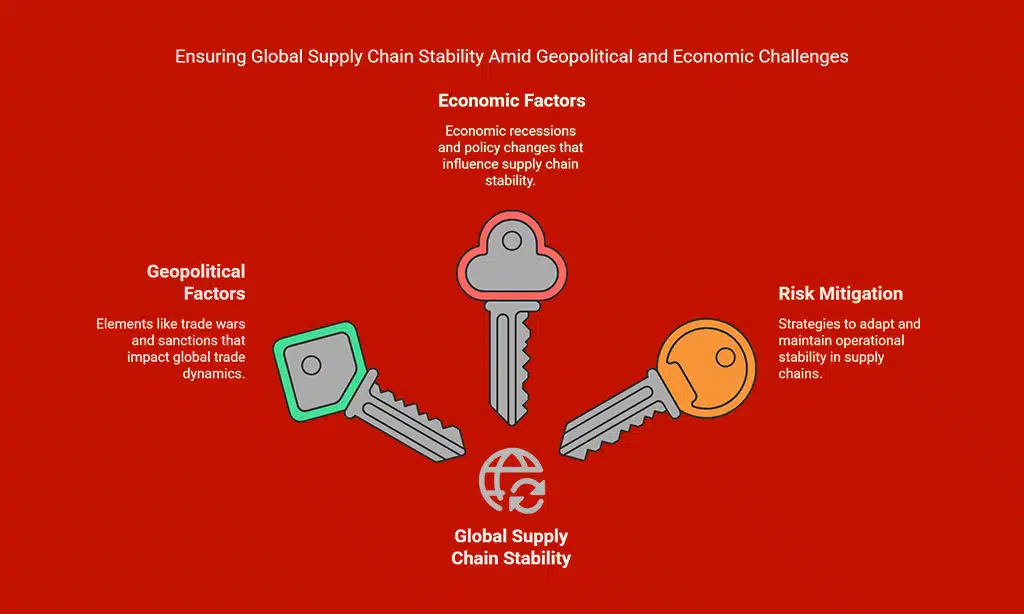
Geopolitical and economic factors play a crucial role in the stability of global supply chains. Trade wars, economic recessions, sanctions, and policy changes can create uncertainties that disrupt the flow of goods and services.
One of the most effective ways to mitigate risks in global supply chains is by continuously monitoring geopolitical developments and economic trends. Companies that proactively assess these risks can adapt their strategies to avoid disruptions and maintain operational stability.
Impact of Global Events on Supply Chains
- Trade restrictions and tariffs increase procurement costs and delays.
- Currency fluctuations affect material pricing and financial stability.
Strategies to Mitigate External Risks
- Monitor international trade policies for proactive planning.
- Diversify supply chain hubs across multiple stable regions.
Case Study: Apple shifted some production from China to Vietnam and India to reduce exposure to U.S.-China trade tensions.
8. Ensure Regulatory Compliance and Cybersecurity
As supply chains become increasingly global and digital, regulatory compliance and cybersecurity have never been more critical. Businesses must navigate complex international trade regulations, data protection laws, and industry-specific compliance requirements to avoid legal repercussions and operational setbacks. At the same time, cyber threats pose significant risks to supply chain security, making robust cybersecurity measures essential.
One of the most effective ways to mitigate risks in global supply chains is by ensuring strict regulatory adherence and implementing cutting-edge cybersecurity strategies to protect data, financial transactions, and operational integrity.
Addressing Regulatory Risks
- Stay updated with evolving trade laws to avoid penalties and fines.
- Conduct compliance audits to ensure adherence to industry standards.
Strengthening Cybersecurity in Supply Chains
- End-to-end encryption to prevent data breaches.
- Blockchain integration for secure transactions and product traceability.
Cybersecurity Strategies for Supply Chains
| Strategy | Benefit |
| Encryption | Protects sensitive data |
| Blockchain | Ensures transaction security |
| Cybersecurity Training | Reduces human error risks |
9. Develop a Business Continuity and Resilience Plan
Business continuity planning is essential for companies looking to withstand unexpected disruptions and maintain long-term stability. A resilient supply chain can adapt to changes and recover quickly from crises such as economic downturns, natural disasters, or cyberattacks.
One of the most crucial ways to mitigate risks in global supply chains is by developing a strong business continuity and resilience plan. By preparing for potential disruptions in advance, businesses can minimize downtime and financial losses while maintaining operational efficiency.
Creating an Effective Crisis Response Strategy
- Identify high-risk areas to develop targeted contingency plans.
- Establish rapid response teams to address emergencies swiftly.
Testing and Updating the Plan
- Regularly conduct supply chain risk simulations for preparedness.
- Update business continuity plans annually to reflect changing conditions.
Example: After the 2011 Fukushima disaster, Toyota revised its risk management strategy to include alternate sourcing and supply diversification.
10. Invest in Sustainable and Ethical Sourcing
Sustainability and ethical sourcing are becoming increasingly important in modern supply chains. Consumers and regulatory bodies now demand greater transparency, environmental responsibility, and ethical labor practices from businesses.
One of the most impactful ways to mitigate risks in global supply chains is by prioritizing sustainable and ethical sourcing strategies. Companies that embrace sustainability reduce exposure to legal risks, supply shortages, and reputational damage while fostering long-term resilience.
Importance of Ethical Sourcing
- Minimizes reputational risks by adhering to social responsibility practices.
- Encourages responsible supply chain management through fair labor policies.
Sustainable Practices for Risk Reduction
- Implement eco-friendly production techniques to meet environmental standards.
- Use renewable materials to reduce dependency on scarce resources.
Case Study: Patagonia incorporates fair trade sourcing and recycled materials in its supply chain to promote sustainability and ethical labor practices.
Takeaways
Successfully managing risks in global supply chains requires proactive planning, technological innovation, and strategic supplier partnerships. Companies that integrate AI-driven insights, blockchain security, and diversified supplier networks can better withstand disruptions.
By implementing these top 10 ways to mitigate risks in global supply chains, businesses can enhance resilience, reduce vulnerabilities, and ensure long-term operational stability. Staying adaptable in an ever-evolving global landscape will ensure that supply chains remain robust and efficient, even in the face of uncertainty.
Investing in supply chain risk mitigation today ensures a competitive advantage and sustainable business growth in the long run.





















