

Supply chain transparency is no longer a luxury—it’s a necessity. As businesses become more globalized and interconnected, customers, stakeholders, and regulatory bodies demand greater visibility into how products are sourced, manufactured, and delivered.
Without transparency, companies risk inefficiencies, compliance failures, and reputational damage.
In 2025, organizations must adopt modern technologies and best practices to create a supply chain that is secure, efficient, and fully transparent.
This article explores 10 key ways to enhance supply chain transparency, providing actionable insights and real-world examples that businesses can implement today.
1. Leverage Blockchain for Immutable Record-Keeping
Blockchain technology is transforming supply chain transparency by ensuring secure, tamper-proof, and decentralized record-keeping. It enhances traceability, making it easier to track goods from their origin to the end consumer. By creating a single source of truth, blockchain prevents fraud, reduces disputes, and increases trust between stakeholders.
How Blockchain Enhances Transparency
| Benefit | Impact on Supply Chain |
| Data Integrity | Prevents fraud and manipulation of records |
| Real-Time Access | All stakeholders have visibility into transactions |
| Decentralization | Eliminates reliance on a single authority |
| Smart Contracts | Automates compliance and transactions |
Industries Benefiting from Blockchain in Supply Chain
- Manufacturing: Ensures raw material authenticity and prevents counterfeits.
- Retail & E-commerce: Tracks product movement and reduces return fraud.
- Pharmaceuticals: Enhances drug traceability to prevent counterfeit medicines.
Case Study: How Walmart Uses Blockchain for Food Safety
Walmart partnered with IBM to implement blockchain for tracking leafy greens. The system reduced tracking time from 7 days to 2.2 seconds, enabling instant recalls and minimizing foodborne illness risks.
2. Implement AI-Powered Supply Chain Analytics
Artificial Intelligence (AI) enhances supply chain visibility by analyzing vast amounts of data, predicting demand trends, detecting anomalies, and optimizing logistics. AI-powered analytics allow companies to make data-driven decisions, reducing waste and improving efficiency.
Role of AI in Supply Chain Transparency
| AI Function | How It Enhances Transparency |
| Predictive Analytics | Forecasts demand and prevents overstocking |
| Anomaly Detection | Identifies fraud, errors, and inefficiencies |
| Automated Decision-Making | Improves response time and minimizes human errors |
| AI Chatbots | Provides real-time supply chain insights |
Best AI Tools for Supply Chain Visibility
- IBM Watson Supply Chain – AI-powered predictive analytics.
- SAP Integrated Business Planning – Demand forecasting and risk assessment.
- ClearMetal – AI-driven supply chain optimization platform.
Example: Amazon’s AI-Powered Supply Chain
Amazon uses AI algorithms to predict demand with 90% accuracy, optimizing inventory and reducing delivery times.
3. Utilize IoT for Real-Time Tracking and Monitoring
The Internet of Things (IoT) enhances supply chain transparency by using smart sensors, RFID tags, and GPS devices to track shipments, monitor environmental conditions, and prevent losses.
How IoT Improves Transparency
| IoT Feature | Benefit for Supply Chains |
| Real-Time Tracking | Monitors shipment locations 24/7 |
| Condition Monitoring | Ensures temperature & humidity compliance |
| Automated Alerts | Notifies about delays or disruptions |
| RFID & NFC Tags | Enhances product authentication |
Key IoT Devices for Supply Chains
- GPS Trackers: Provide real-time location updates.
- RFID Tags: Authenticate products and prevent counterfeiting.
- Smart Sensors: Monitor temperature, humidity, and storage conditions.
Example: Maersk’s Smart Containers
Maersk uses IoT-enabled smart containers that provide live updates on temperature, location, and security, reducing cargo losses by 30%.
4. Strengthen Supplier Collaboration and Visibility
A supply chain is only as strong as its weakest link. Poor supplier collaboration leads to inefficiencies, delays, compliance violations, and ethical sourcing issues.
Transparent supplier relationships ensure that all stakeholders have real-time access to data, allowing for better decision-making, ethical sourcing, and overall risk mitigation.
Companies that invest in supplier collaboration technology and clear accountability measures can significantly reduce inefficiencies and enhance supply chain visibility.
By ensuring open communication and mutual trust, businesses can proactively identify risks, optimize costs, and maintain compliance with international regulations.
Creating a Transparent Supplier Network
| Strategy | Impact on Transparency |
| Digital Collaboration Platforms | Enables real-time information sharing, improving supplier accountability |
| Blockchain-Verified Supplier Records | Ensures authenticity of supplier credentials and compliance with ethical sourcing standards |
| Automated Supplier Audits | Detects potential compliance violations early, reducing legal and reputational risks |
| Vendor Performance Monitoring | Tracks supplier reliability, product quality, and adherence to delivery schedules |
Example: How Apple Ensures Supplier Transparency
Apple takes supplier collaboration seriously and publishes an annual Supplier Responsibility Report, providing transparency on labor conditions, environmental sustainability, and ethical sourcing.
The company actively audits its suppliers, ensuring they comply with its strict labor and environmental standards. Since 2008, Apple has removed over 150 non-compliant suppliers from its network, reinforcing its commitment to supply chain integrity.
5. Adopt Cloud-Based Supply Chain Management (SCM) Solutions
Cloud-based SCM solutions have revolutionized supply chain transparency by offering real-time access to data, improved collaboration, and greater visibility across all supply chain operations. Unlike traditional on-premise systems, cloud-based platforms allow multiple stakeholders to access and update information instantly, reducing miscommunication and inefficiencies.
Companies using cloud-based SCM benefit from:
- Centralized data management, reducing errors and improving accuracy.
- Scalability, allowing businesses to expand globally without infrastructure limitations.
- Advanced analytics & AI integration, enabling real-time supply chain monitoring and predictive analysis.
Why Cloud-Based SCM Enhances Transparency
| Advantage | Impact on Supply Chain |
| Centralized Access | Ensures all stakeholders can track and manage supply chain data in real-time |
| Scalability | Supports global expansion without requiring costly infrastructure investments |
| AI & IoT Integration | Improves forecasting, automation, and operational efficiency |
| End-to-End Visibility | Eliminates blind spots in logistics, procurement, and distribution |
Leading Cloud SCM Platforms in 2025
- Oracle SCM Cloud – Provides AI-driven insights, predictive analytics, and real-time supply chain monitoring.
- SAP SCM – Delivers seamless inventory tracking, risk mitigation, and supplier collaboration features.
- Microsoft Dynamics 365 – Uses machine learning to optimize inventory management and logistics.
Case Study: How Unilever Transformed Supply Chain Transparency with Cloud-Based SCM
Unilever implemented SAP’s cloud-based SCM solution, reducing supply chain inefficiencies by 30% and cutting product delivery times by 20%. The system allowed Unilever to track sustainability compliance, reduce waste, and improve supplier relationships globally.
6. Enforce Regulatory Compliance and Ethical Sourcing
Governments and regulatory bodies are introducing stricter laws and compliance standards to ensure businesses maintain ethical supply chains. Companies that fail to comply risk legal penalties, reputational damage, and consumer distrust.
Ensuring regulatory compliance and ethical sourcing means businesses must:
- Conduct third-party audits to verify supplier practices.
- Implement digital tracking systems to monitor compliance across all supply chain levels.
- Use AI-driven compliance tools to assess risk in real time.
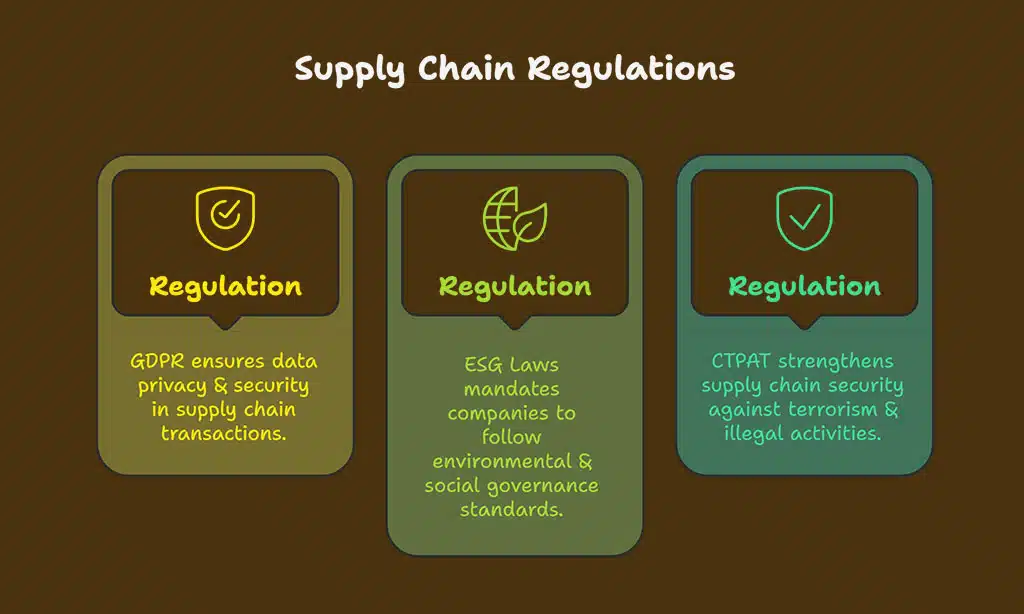
Key Regulations Driving Supply Chain Transparency
| Regulation | Region | Purpose |
| GDPR | EU | Ensures data privacy & security in supply chain transactions |
| ESG Laws | Global | Mandates companies to follow environmental & social governance standards |
| CTPAT | USA | Strengthens supply chain security against terrorism & illegal activities |
Tools for Ensuring Compliance and Ethical Sourcing
- EcoVadis – Monitors sustainability & social responsibility compliance.
- Sedex – Ensures ethical business practices across supplier networks.
- Resilinc – Uses AI-powered risk assessment to detect compliance violations.
Example: Patagonia’s Ethical Sourcing Model
Patagonia, a global apparel brand, ensures full supply chain transparency by publicly sharing supplier lists, factory audits, and environmental impact reports. The company actively works with Fair Trade Certified™ factories, guaranteeing ethical wages and sustainable sourcing practices.
7. Improve Data Sharing with Standardized Protocols
Data inconsistency is one of the biggest barriers to supply chain transparency. Many organizations use different software, formats, and reporting standards, leading to inefficiencies and errors. Standardized data-sharing protocols create a unified framework, allowing seamless communication across different systems and partners.
How standardized data-sharing protocols improve supply chain transparency:
- Eliminate data miscommunication by establishing a universal format.
- Enhance security through encryption and access control mechanisms.
- Enable seamless automation in supply chain transactions and compliance reporting.
Benefits of Standardized Data Formats
| Benefit | Impact on Supply Chain |
| Eliminates Miscommunication | Reduces costly errors caused by inconsistent reporting |
| Enhances Data Security | Protects sensitive supplier and customer information |
| Facilitates Automation | Enables AI-driven decision-making & predictive analytics |
8. Enhance End-to-End Supply Chain Visibility
End-to-end supply chain visibility ensures full transparency from raw materials to final product delivery. Companies with complete oversight can track shipments, detect inefficiencies, and improve response times to supply chain disruptions.
Strategies for Achieving 360° Supply Chain Insight
| Strategy | How It Improves Transparency |
| AI-driven Dashboards | Provides real-time visibility into inventory & logistics |
| IoT Integration | Tracks shipments, environmental conditions & asset location |
| Blockchain Verification | Ensures product authenticity & compliance records |
Example: Tesla’s Real-Time Supply Chain Visibility
Tesla integrates AI-powered logistics tracking, blockchain verification, and automated demand forecasting to optimize production efficiency. This approach has helped Tesla reduce component shortages and improve delivery precision.
9. Implement Digital Twin Technology for Simulations
Digital Twin Technology creates virtual models of supply chain operations, allowing businesses to run simulations and predict potential disruptions before they happen.
How Digital Twins Improve Decision-Making
| Advantage | Benefit |
| Predicts Bottlenecks | Prevents supply chain delays & inefficiencies |
| Enhances Risk Management | Identifies weak links in logistics & supplier networks |
Example: DHL’s Use of Digital Twin Technology
DHL uses digital twins to simulate warehouse logistics and optimize parcel distribution, reducing operational costs by 25%.
10. Utilize Smart Contracts for Automated Transactions
Smart contracts are blockchain-based agreements that execute automatically when conditions are met. They eliminate manual processing delays, ensuring faster and tamper-proof supply chain transactions.
How Smart Contracts Work in Supply Chain
| Feature | Benefit |
| Automates Payments | Reduces manual errors & delays |
| Ensures Compliance | Verifies transaction conditions before execution |
Example: Maersk’s Use of Smart Contracts
Maersk uses blockchain-based smart contracts to automate shipping and customs clearance, reducing paperwork by 50% and increasing delivery speed.
Takeaways
Supply chain transparency is the future of global trade. Companies that invest in blockchain, AI, IoT, cloud-based SCM, and standardized protocols will gain a competitive advantage, reduce inefficiencies, and build long-term trust with stakeholders.
Adopting these 10 powerful ways to enhance supply chain transparency will not only improve operations but also ensure compliance, sustainability, and customer trust in 2025 and beyond.





















