Water is life—no doubt about that. Humans use water for cooking, washing, and, of course, drinking. As a basic necessity in your everyday life, you may not always have an idea where it comes from and how you get it clean.
Before you get that potable water that flows through the taps in your home, it goes through a filtration process. Have you ever wondered how a water filtration system, like Puretec Water Purifier, works? This article will discuss everything you need to know about it and more. Read on!
Types Of Water Filtration Systems
-
Ceramic And Polypropylene Filtration Systems
Both filtration systems use the likes of mesh screens or cartridges, which are oftentimes made of tightly packed fibers, to sieve out dirt and impurities from the water.
As water passes through the cartridge, also called the cartridge candle, the impurities get trapped in there, while the clean water passes through with ease.
These filtration systems are affordable, simple, and straightforward to use, but they require a constant change of cartridges. Furthermore, although some ceramic and polypropylene filtration systems soften hard water, many of them can’t remove chemical impurities.
-
Activated Carbon Filtration System
This filtration system is quite close to the ceramic filtration system but is best suited for removing chemical impurities, like chlorine, manganese, iron, and hydrogen sulfide, as well as taste and odor.
The filtration system uses active carbon or activated carbon granules to trap the chemical impurities. As the water flows through the filtration system, the active carbon granules trap the dirt and other chemical particles through a process called absorption, and the clean water passes through and settles at the bottom.
The downside of this filtration system is that it doesn’t soften hard water and can’t often handle a number of strong metals. Also, it can get clogged easily, requiring replacement.
-
Reverse Osmosis Filtration System
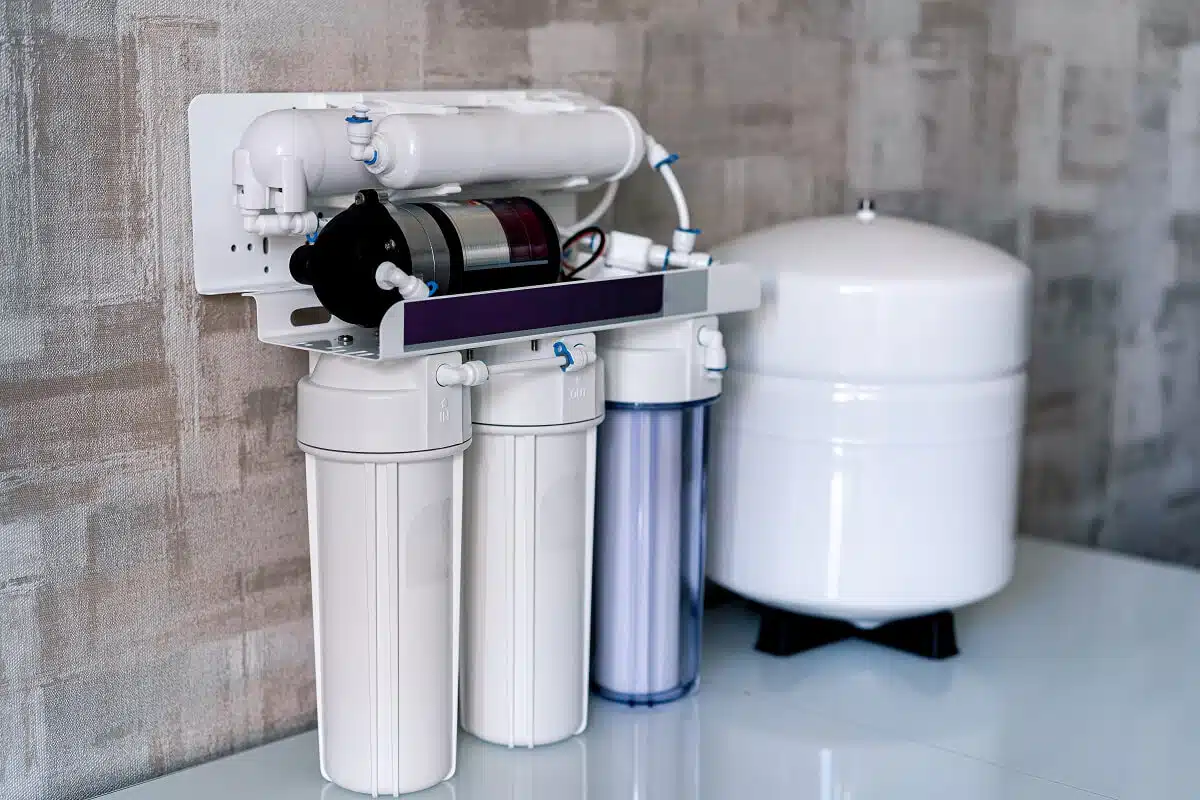
The reverse osmosis filtration system is one of the all-encompassing and most recommended filtration systems that remove not only general impurities but also most chemicals and bacteria.
The filtration system uses an utterly fine filter or membrane placed in between levels. The dirty or contaminated water is forced through the membrane. The pressure pushes the cleaner water down, while the contaminants remain on the fine filter.
The downside of this filtration system is that it doesn’t work effectively in acidic water, which contains hydrogen sulfide.
-
Distillation Filtration System
In times past, boiling water to make it potable was one of the most effective methods of water filtration and purification, and the distillation filtration system employs that and more.
To better understand the distillation process, here’s how it works:
- A container filled with impure or untreated water is heated until it reaches boiling point.
- The steam from the constantly boiling water passes through a tube into an awaiting stainless-steel condenser. It’s important to note that water evaporates at a lower temperature compared to many contaminants. Therefore, when boiling water turns into gas and moves to a new chamber, many contaminants and biological microorganisms found in the water can’t evaporate, and, thus, remain in the boiling container. Many of these contaminants include nitrate, mercury, lead, benzene, iron, etc.
- In the stainless-steel condenser, the steam begins to cool, and turn into water droplets.
- The collected water droplets are devoid of most contaminants and impurities. The water settles in another container, where it often goes through the final stage of filtration to remove any remaining impurities that could’ve escaped during the boiling and condensation processes.
- After going through the final filtration medium, the now clean water makes its way to another container.
The disadvantage of this method is that other contaminants boil at the same temperature as the water, therefore, they remain in the water, although in smaller quantities. Oxygen is also lost in the process, which is why many say that distilled water often has a flat taste.
-
Ion Exchange Filtration System
This filtration system entails the exchange of ions in the contaminated water to purify, soften, and deionized water. By using filter beads, which are often zeolite beads that contain sodium ions, the magnesium and calcium compounds in the water are attracted to the beads, while the sodium ions are left in the water for purification.
The downside to the method is that sodium is still present in the water after the process is done. This type of water may not be suitable for people on low-sodium diets or those that have a high intolerance to sodium. The process doesn’t fully decontaminate the water since it mainly targets the chemical components in the water than the biological ones.
Conclusion
Clean water is a major necessity of life. This is why homeowners, as well as public and private companies, employ one or more of the water filtration methods mentioned above to ensure the highest level of purification possible. By and large, consuming clean water protects anyone from direct ingestion of harmful substances and microorganisms present in untreated water.