Search in 2026 is a very different landscape from just a decade ago. Users no longer scroll through simple lists of blue links. Instead, answers appear in AI-powered overviews, featured snippets, knowledge panels, video carousels, voice assistants, and platform-native search interfaces. In this environment, content that is average, generic, or mechanically optimized gets ignored fast.
I’ve audited dozens of websites in the past year where technically “correct” pages still failed because they lacked clarity, judgment, or practical examples. That’s why modern SEO fundamentals are not optional; they are the bedrock of content survival and growth.
The goal today is simple in theory but challenging in practice: your content must be discoverable, understandable, trustworthy, and genuinely useful. Rankings are no longer the only metric that matters; visibility across AI-enhanced search experiences and the ability to be cited as the definitive answer are now equally critical.
Experience-Based Lessons From the Field
A few months ago, I worked with a mid-sized digital media company. Their traffic had plateaued despite aggressive efforts with new SEO tools, structured data, and keyword targeting. On paper, their content was technically solid: crawlable, indexed, and well-structured. Yet, their pages were consistently missing from AI summaries and featured snippets. Why? The content was “SEO-friendly” but not human-friendly. It lacked concrete examples, nuanced explanations, and editorial judgment.
Once we rewrote the content with practical insights, step-by-step examples, and internal linking that connected related topics, the same pages began appearing in AI Overviews and top search positions within weeks. That experience reinforced a lesson I’ve learned repeatedly: modern SEO fundamentals are about building content that deserves to exist, not content that just ticks technical boxes.
Why Modern SEO Fundamentals Are Still Vital
Many brands mistakenly assume that SEO is dead because clicks are declining or users are satisfied with AI-generated summaries. That couldn’t be further from the truth. The competitive pressure is higher than ever: search results are condensed, featured snippets dominate visibility, and AI agents sometimes provide answers without any human clicking at all.
In practice, this means your content must excel in three areas simultaneously:
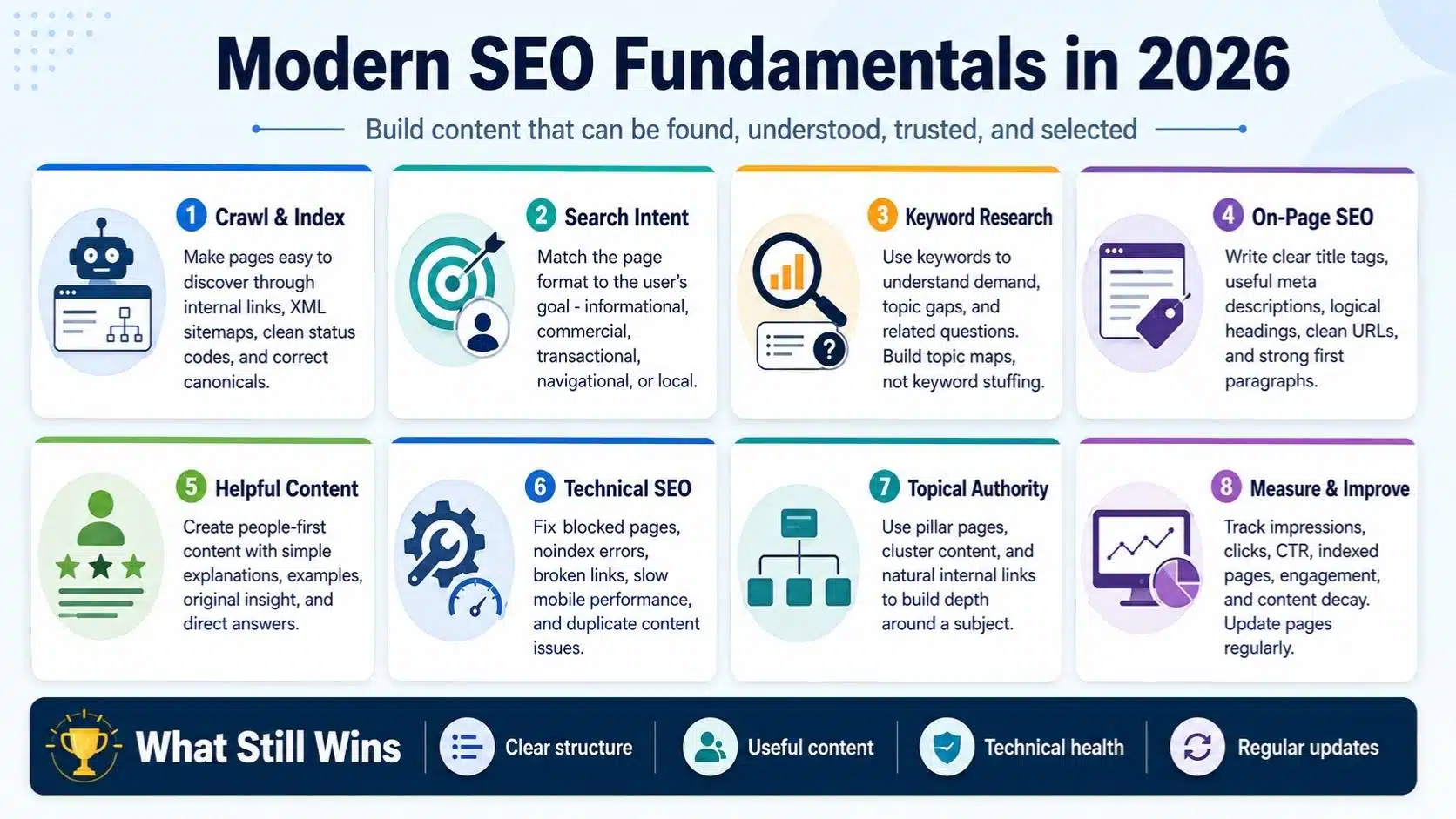
- Discoverability: Search engines and AI bots must be able to crawl and index your pages. If crawlers can’t access your content, it’s invisible.
- Understandability: Your content should clearly convey its topic, structure, and purpose. Even highly relevant content will be ignored if its presentation is confusing.
- Usefulness: The page must be compelling enough for search systems and readers to prefer it over similar content. That’s the difference between a page that ranks in AI summaries and one that languishes in obscurity.
Neglecting any of these pillars today doesn’t just hurt rankings; it guarantees that AI-enhanced search engines will bypass your page entirely.
From Keyword Obsession to Holistic SEO
It’s tempting to fall back on old habits. Years ago, SEO revolved around keyword density, exact-match phrases, and backlink quantity. Today, that approach is often counterproductive. In one audit I performed, a page packed with keywords failed to rank because it lacked context, clear structure, and real examples. Modern SEO is no longer about what you can stuff into a page; it’s about what you should include to genuinely satisfy the user’s query.
Modern SEO emphasizes:
- Usefulness: Answer the user’s question fully and accurately.
- Structure: Organize content for humans and machines alike.
- Intent alignment: Match the format, depth, and scope to the searcher’s goals.
- Credibility: Provide accurate, trustworthy, and current information.
Keywords are still a compass; they guide topic relevance, but they are not the destination.
How Search Engines Discover and Evaluate Content
Before content ranks, it must go through crawling, indexing, and serving. This process is deceptively simple in theory, but can make or break performance in practice.
Crawling: Search engine bots discover pages. A page may be invisible if blocked by robots.txt, hidden behind broken JavaScript, or orphaned without internal links.
Indexing: The engine analyzes the content and stores it in its database. Duplicate pages, missing canonical tags, or conflicting sitemaps can dilute ranking signals.
Serving: The search engine determines relevance and whether to display the page. Even excellent content may fail if it doesn’t align with search intent or if the technical setup impedes evaluation.
From real-world audits, I’ve learned that even perfectly written articles can underperform if they aren’t technically accessible. A human-edited audit often starts with crawlability and indexing checks before content quality is even considered.
Keyword Research in the AI Era
Keyword research hasn’t gone away; it’s evolved. Instead of chasing exact-match phrases, I now use keyword research to map intent, vocabulary, gaps, and topic relationships. The goal is to create content clusters and pillar pages that serve as definitive answers.
Consider a pillar on modern SEO fundamentals: it should explain crawling, indexing, keyword planning, meta optimization, internal linking, and expected AI-driven search behavior. Keyword research helps us identify which subtopics deserve cluster articles and how to phrase headings in natural, user-friendly language.
Search intent remains the most critical factor. Users often fall into one of these categories:
- Informational: Looking to learn or understand (“What are modern SEO fundamentals?”)
- Navigational: Searching for a specific tool or page (“Google Search Console login”)
- Commercial: Comparing options (“Best SEO tools for small businesses”)
- Transactional: Ready to take action (“Buy SEO audit service”)
- Local: Seeking nearby services (“SEO agency near me”)
Human editors create content that anticipates these needs, while generic AI output often answers the wrong intent or provides incomplete information.
Title Tags and Meta Descriptions: The Human Touch
Even in 2026, titles and meta descriptions remain pivotal. A title should not only contain your primary keyword but also convey clarity and tangible benefit. In one A/B test, I compared two titles for a technical SEO guide:
- “Modern SEO Fundamentals: Complete Guide for 2026”
- “Learn SEO Basics Fast with Modern SEO Fundamentals”
The second title performed better, likely because it offered a clear outcome, speed, and learning, rather than merely stating the topic. Humans respond to clarity and benefit, not mechanical keyword placement.
Similarly, meta descriptions are not magic ranking levers; they are mini-pitches. A strong meta description reassures users that they are about to find useful content:
“Master modern SEO fundamentals for 2026 with practical tips on crawling, indexing, keywords, and AI-ready strategies.”
Notice how it communicates value and outcome instead of repeating the topic verbatim.
Headers: Organizing for Humans and Machines
Header tags remain one of the simplest ways to improve readability. The H1 introduces the topic, H2s outline major sections, and H3s break down subtopics. But human editors often add commentary, examples, and practical warnings under these headings, which transforms a rigid structure into a story-like, digestible experience.
A good H2 could start with a challenge or anecdote: “Many sites fail at indexing because they hide important pages behind complex JavaScript.” This immediately connects the section to a real-world problem and signals practical insight, something AI alone rarely provides.
URL Structure and Internal Linking
URLs may seem trivial, but they influence clicks, sharing, and indexing. Short, descriptive, lowercase URLs perform best. Avoid date-based URLs unless absolutely necessary, as evergreen content benefits from timeless slugs.
Internal linking is equally crucial. A strong pillar page with natural links to cluster articles signals topical authority to AI systems and human editors alike. This isn’t just about SEO mechanics; it’s about guiding the reader logically through a content journey.
I’ve found that organic, well-placed internal links outperform any artificially stacked anchor-text strategy. Human judgment, deciding where a link genuinely adds value, is what makes the difference.
Content Depth and Practical Examples
Generic explanations like “Meta descriptions matter because they summarize your page” are insufficient today. Human-written SEO content excels when it includes:
- Case studies: Real campaigns, results, or mistakes.
- Comparisons: Showing differences between strategies and their impact.
- Step-by-step examples: Explaining a process from research to optimization.
- Editorial judgment: Highlighting which tactics are worth attention versus which are negligible.
These elements signal expertise and make content memorable, improving engagement and AI-selection likelihood.
Images, Visuals, and Structured Data
Visuals are no longer optional. Diagrams, screenshots, flowcharts, and annotated examples clarify complex concepts faster than text alone. But images must be original, descriptive, and purposeful. Naming an image image1.jpg is a lost opportunity; a descriptive name like modern-seo-fundamentals-checklist.jpg improves context for search systems.
Structured data complements content. Implement schema that accurately reflects visible content, FAQ schema for FAQs, HowTo for tutorials, etc. Misaligned schema can harm trust rather than help.
Technical SEO: The Silent Killer
Even excellent copy fails if technical fundamentals are weak. In past audits, I’ve encountered:
- Orphaned pages invisible to crawlers
- Accidental noindex tags are removing pages from search
- Duplicate pages dilute ranking signals
- Slow mobile rendering is causing high bounce rates
- Broken internal links frustrating readers and bots
Technical SEO is not glamorous, but a human-edited checklist can prevent years of wasted content effort.
Topical Authority and Cluster Strategies
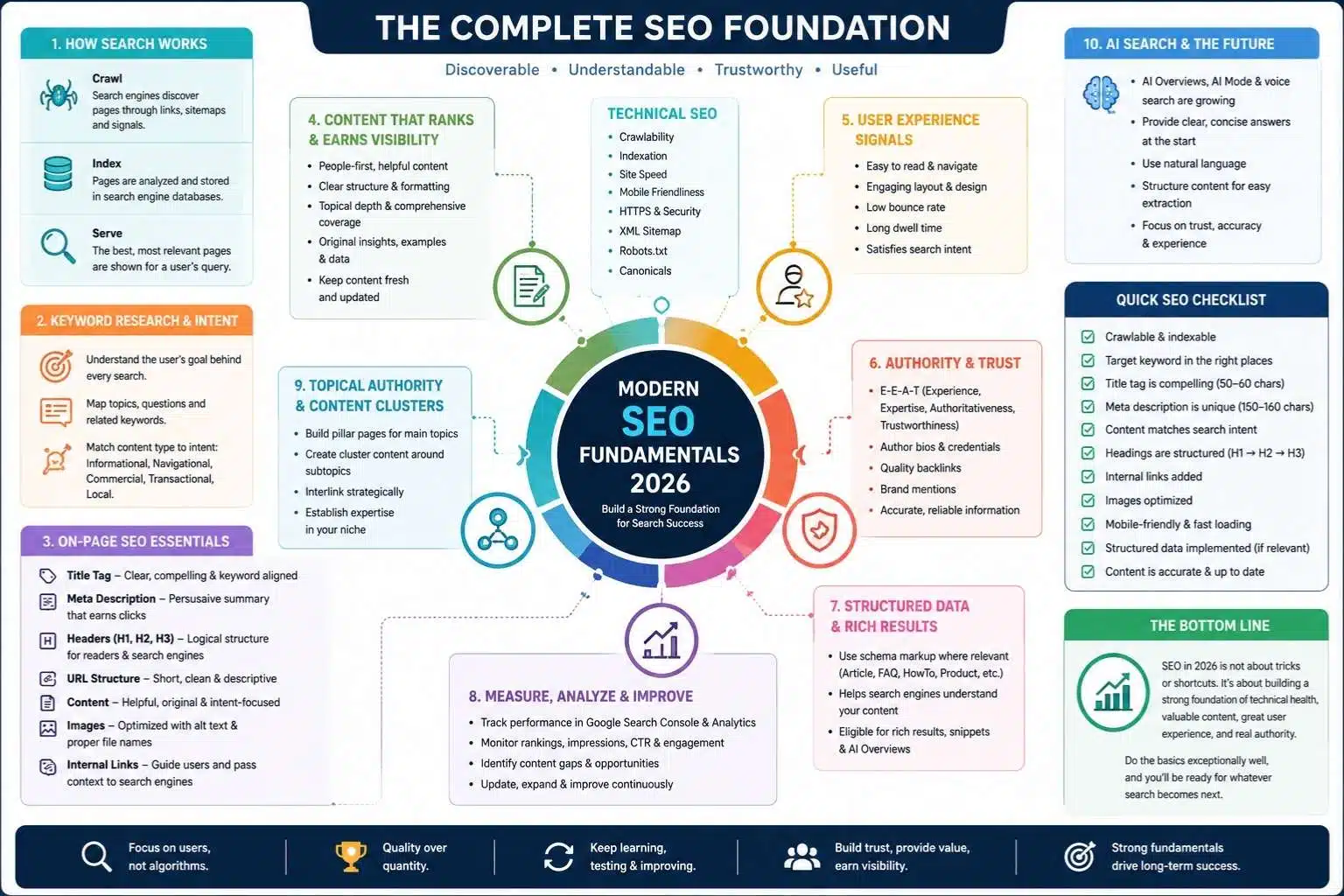
Topical authority is built over time, not in a single post. Pillar pages provide a strategic overview, clusters address depth, and internal linking signals expertise. Human judgment decides which topics need supporting clusters, how to connect them, and when to refresh content based on search intent shifts or AI overview changes.
Modern SEO Measurement
Traditional ranking metrics are insufficient. I recommend tracking:
- Organic clicks for true traffic
- Impressions to gauge visibility
- CTR to test titles and meta effectiveness
- Crawl errors for technical health
- Indexed pages for eligibility
- Engagement metrics for content usefulness
- Content decay to detect outdated material
Understanding these metrics requires interpretation, not just reporting, another layer where human input matters.
A Practical Workflow for 2026
- Define topic and intent: What problem are we solving?
- Research keywords and clusters: Include primary, secondary, and related terms.
- Audit competitors: Identify gaps and opportunities.
- Plan pillar-cluster architecture: Ensure connected, logically sequenced content.
- Outline with a human-first approach: Include examples, context, and practical advice.
- Optimize metadata and headings: Titles, meta, H1/H2, URLs, images.
- Integrate internal links naturally: Guide the reader through the content journey.
- Add visuals where they enhance understanding: Charts, flow diagrams, annotated screenshots.
- Technical check: Crawlability, indexing, schema, mobile usability.
- Monitor performance: Update content based on metrics and search changes.
Avoiding Common Pitfalls
Many failures are subtle, not obvious. Writers often blame AI or algorithms, but weak content fails due to:
- Writing solely for keywords
- Publishing thin, generic content
- Ignoring crawlability
- Using vague or generic titles
- Duplicating meta descriptions
- Overloading internal anchor text
- Letting content age without updates
- Over-reliance on rankings
- Misaligned structured data
Human editorial oversight is key to navigating these pitfalls.
The Future Beyond 2026
AI and multi-modal search will continue evolving. Voice, visual search, and AI-generated answers will increase. Yet the core fundamentals remain: crawlable, clear, useful, trustworthy, and connected content. Pages that master these principles today will adapt more readily to whatever the future of search brings.
Final Thoughts: Content That Deserves to Exist
Building an SEO foundation in 2026 requires experience, judgment, and narrative sense. Pages must be discoverable, understandable, useful, and connected. Editorial decision-making, knowing when a tactic matters and when it doesn’t, is what differentiates successful content from forgettable pages.
Invest in:
- Crawlability and indexing
- Keyword intent and topic coverage
- Title tags and meta clarity
- Header hierarchy and URL readability
- On-page optimization
- Cluster linking and original visuals
- Judgment and unique, practical insights
Weak content is ignored quickly. Strong, human-shaped content thrives and continues to deliver value even as search evolves.
Frequently Asked Questions about Modern SEO Fundamentals
1. What Are Modern SEO Fundamentals?
Core practices for discoverable, understandable, and trustworthy content, including crawling, indexing, keyword research, metadata, headers, URLs, internal links, visuals, and structured data.
2. Is SEO Still Important in 2026?
Absolutely. Search engines and AI-powered interfaces rely on structured, accessible, and useful content.
3. How Does Modern SEO Differ from Traditional SEO?
Traditional SEO focused heavily on keyword and backlink strategies. Modern SEO prioritizes intent, topical authority, UX, technical clarity, and AI-friendly structure.
4. How Often Should SEO Content Be Updated?
Evergreen content should be reviewed at least every few months. Update when intent shifts, data changes, or SERPs evolve.
5. What’s the Most Important SEO Foundation for Beginners?
Ensure your content is crawlable, indexable, clearly structured, and useful. Advanced tactics matter only once the basics are solid.