

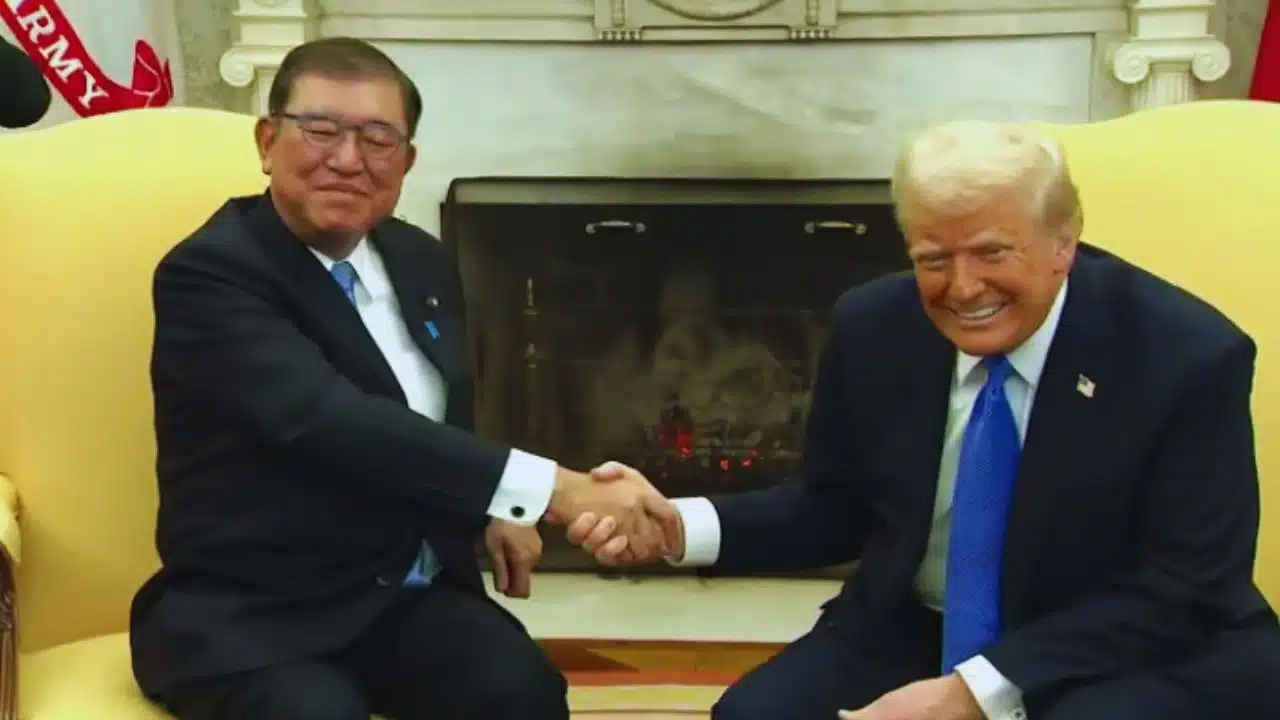
The United States and Japan have reached a new trade agreement that imposes a 15% tariff on Japanese goods—but that’s not the headline-grabber. What has captured attention is Japan’s pledge to invest $550 billion into key American sectors. According to the White House, this money will be directed “at President Trump’s discretion,” giving him considerable power over the deployment of funds in U.S. industries.
The agreement includes a mechanism called a “Japanese/USA investment vehicle,” designed to support strategic industries like semiconductors, energy, pharmaceuticals, shipbuilding, and critical minerals. However, the details of how this massive fund will be managed or distributed remain vague.
U.S. Profits Take Priority, Japan Seeks Risk-Based Sharing
The U.S. administration has stated that 90% of profits from this investment vehicle would stay in the U.S., while Japan may earn returns based on the level of contribution and risk taken. This approach is raising questions in financial and policy circles. The Financial Times reports that Japan envisions a profit-sharing model, depending on how much risk its government or businesses take.
A Model for Other Trade Deals?
U.S. Treasury Secretary Scott Bessent described the fund as a major factor in why Japan received the lower 15% tariff, instead of the initially threatened 25% rate. He indicated this financing method could serve as a template for other countries, especially major exporters like South Korea.
Bank of America analysts agree. In a recent note, they said the Japan deal might become a blueprint for countries with strong exports to the U.S. and less open markets—characteristics shared by South Korea and others.
$550 Billion Investment: Too Good to Be True?
Despite the large headline number, many experts are skeptical about whether the $550 billion investment is real—or even achievable.
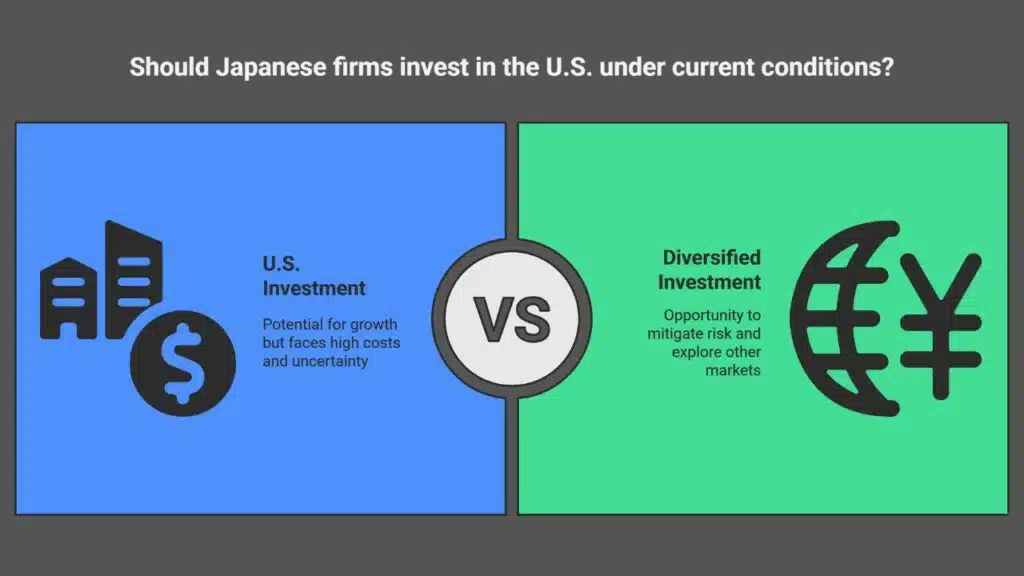
Takahide Kiuchi, former Bank of Japan policymaker and now executive economist at Nomura Research Institute, cautioned that this pledge is more of an aspirational target than a binding commitment. In his analysis, he warned that Japanese businesses may actually be deterred by the U.S. environment under Trump due to high labor costs, a strong dollar, and general economic uncertainty.
“Instead of investing in the U.S., Japanese firms may look to diversify their investments elsewhere,” Kiuchi stated.
Experts Say It Might Be ‘Vaporware’
Critics are calling the $550 billion fund potentially “vaporware,” a tech industry term for a much-hyped product that never materializes. Brad Setser, a senior fellow at the Council on Foreign Relations and former U.S. Treasury official, said there’s very little real money confirmed so far, apart from previously announced projects like Alaska LNG.
Setser pointed out that the targeted industries—semiconductors, critical minerals, shipbuilding—are already logical sectors for Japanese investment due to global supply chain concerns. “There’s a lot less here than meets the eye,” he said on X (formerly Twitter), adding that relying so heavily on foreign funds to boost U.S. industry could cause issues down the line.
What Will the Investment Look Like?
A source familiar with the deal told Fortune that while the investment would indeed be funded by the Japanese government, there are still many unknowns. The timeframe, oversight board, and safeguards against conflict of interest have not yet been finalized.
The source explained that this isn’t just a matter of Tokyo buying more U.S. commodities. Rather, the Japanese government could directly finance large-scale projects like chip plants in the U.S. and then lease the facilities to private companies. In this setup, 90% of lease revenue would go to the U.S. government.
Strategic But Risky Timing
The deal also comes at a critical moment. Trump’s reciprocal tariffs pause expires on August 1, and the U.S. is actively negotiating with the European Union and other partners. Meanwhile, a court hearing is scheduled to determine whether Trump even has the legal authority under the International Emergency Economic Powers Act to enforce these wide-ranging tariffs.
This legal uncertainty might encourage countries to make big-sounding financial promises now, in exchange for immediate tariff relief, and then delay actual investments while legal processes unfold.
Legal Experts Question Tariff Legitimacy
Investment analysts from Piper Sandler have taken a firm stance, calling Trump’s tariffs legally questionable. In their report, they noted the investment agreement with Japan lacks clear structure and specificity, adding that many foreign governments and multinational corporations are aware that these tariffs might not stand up in court.
“As long as the legal status of these tariffs is unstable, countries are unlikely to make real, large-scale investments that they wouldn’t otherwise make,” they stated.
Symbolism Over Substance?
While the $550 billion pledge from Japan certainly looks impressive on paper, analysts remain unconvinced about its real-world feasibility. With few binding details, open legal questions, and skepticism from global financial experts, the deal may be more about political optics than actual economic transformation.
If anything, it sets a new precedent in trade negotiations: foreign investment promises in exchange for favorable tariff treatment. Whether this strategy becomes a sustainable model—or backfires—will depend on the next steps, transparency, and implementation.
The Information is Collected from AOL and CNN.
























