

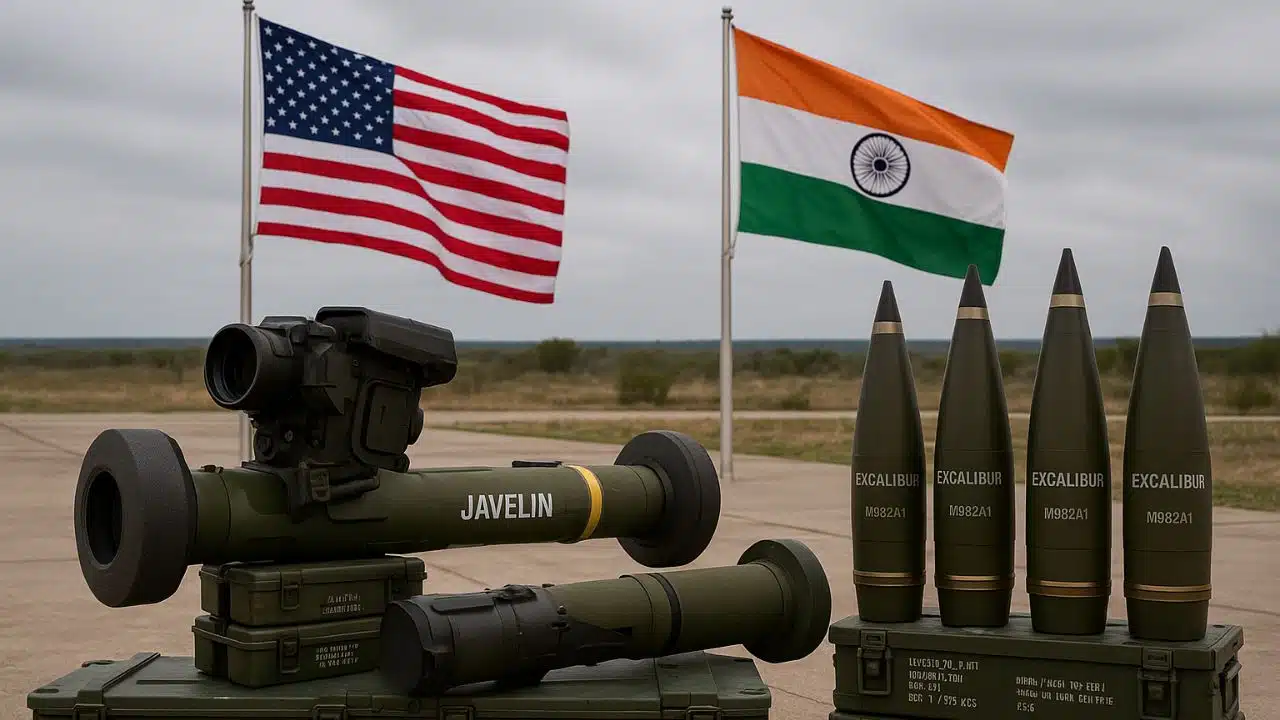
The United States has formally approved two major weapons sales to India, marking another significant step in the growing defence partnership between the two nations. According to the U.S. Defense Security Cooperation Agency (DSCA), the combined value of the approved packages is estimated at around $93 million, and includes advanced precision-guided Excalibur artillery projectiles as well as the battle-proven FGM-148 Javelin anti-tank missile system.
This approval strengthens India’s military modernization goals and reinforces Washington’s commitment to supporting New Delhi as a central strategic partner in the Indo-Pacific. The clearance also reflects the increasingly aligned security interests of both countries, especially amid rising geopolitical tensions in Asia and the continued focus on deterrence and regional stability.
Under this newly approved deal, India will receive two critical capabilities:
- M982A1 Excalibur tactical projectiles, valued at approximately $47.1 million
- Javelin missiles and related equipment, valued at approximately $45.7 million
The Excalibur artillery projectile is a GPS-guided, extended-range munition known for its accuracy and effectiveness in precision strikes. The Indian government requested the purchase of up to 216 M982A1 rounds, which will significantly boost the Indian Army’s long-range artillery precision. This weapon has been used extensively in modern conflicts and is known for its ability to strike high-value targets while minimizing collateral damage — a critical factor for operations in sensitive or populated areas.
The Javelin Missile System approval covers a comprehensive package that includes 100 Javelin rounds, one fly-to-buy missile, and 25 advanced launch units, either the Lightweight Command Launch Unit (LwCLU) or the Block 1 CLU. The Javelin is one of the world’s most reliable shoulder-fired anti-tank systems, famous for its “fire-and-forget” guidance and top-attack capability, which allows it to strike armoured vehicles from above where armour is weakest. Its deployment is especially relevant for India’s border security and mountain warfare operations, where mobility and rapid deployment are crucial.
Beyond major equipment, the approval also includes several non-major defence items and services to support the systems. These include Portable Electronic Fire Control Systems (PEFCS) integrated with Improved Platform Integration Kits (iPIK), primers, propellant charges, technical data, U.S. government assistance, and maintenance-related services. This comprehensive support package ensures that India can fully integrate, operate, and sustain the systems within its existing defence infrastructure.
The DSCA noted that no offset agreement is currently associated with the sale. Any such arrangement — typically involving industrial participation or technology transfer — would be finalized in subsequent negotiations between India and the contractor. The primary contractor identified for both systems is RTX Corporation, one of the major U.S. defence and aerospace companies.
In its statement, the DSCA emphasized that the sale aligns with the United States’ broader foreign policy and national security objectives. Washington views India as a “major defence partner” and a crucial force for political stability, peace, and economic progress in South Asia and the Indo-Pacific. Strengthening India’s capabilities is seen as essential for bolstering regional security, countering emerging threats, and maintaining a stable balance of power in an increasingly contested strategic environment.
The U.S. agency added that the sale will enhance India’s ability to counter current and future threats while simultaneously improving its deterrence posture. The advanced technologies offered through this deal are expected to integrate smoothly into India’s armed forces, which already operate various American systems procured in recent years, including P-8I maritime surveillance aircraft, Apache attack helicopters, Chinook heavy-lift helicopters, and M777 howitzers.
Importantly, DSCA clarified that the implementation of this sale will not require any additional U.S. government or contractor personnel to be stationed in India. This ensures a low operational footprint while allowing India to maintain operational independence over the supplied systems. The agency also noted that the sale does not negatively affect U.S. defence readiness, indicating that the assets being exported do not compromise American stockpiles or capabilities.
Overall, the approval represents yet another milestone in the evolving U.S.–India defence relationship. In recent years, both nations have deepened cooperation through joint exercises, logistics agreements, co-development discussions, and increasing interoperability between their armed forces. The latest sale further boosts India’s tactical and strategic strengths, contributing to its preparedness against both conventional and emerging security challenges across its borders and maritime regions.
With this clearance, India stands to enhance its battlefield precision, increase its anti-armour effectiveness, and maintain a strong defensive posture at a time when global and regional security dynamics are rapidly changing. The deal underscores the growing trust between Washington and New Delhi and signals a sustained commitment to jointly advancing stability and security across one of the world’s most strategically critical regions.






















