

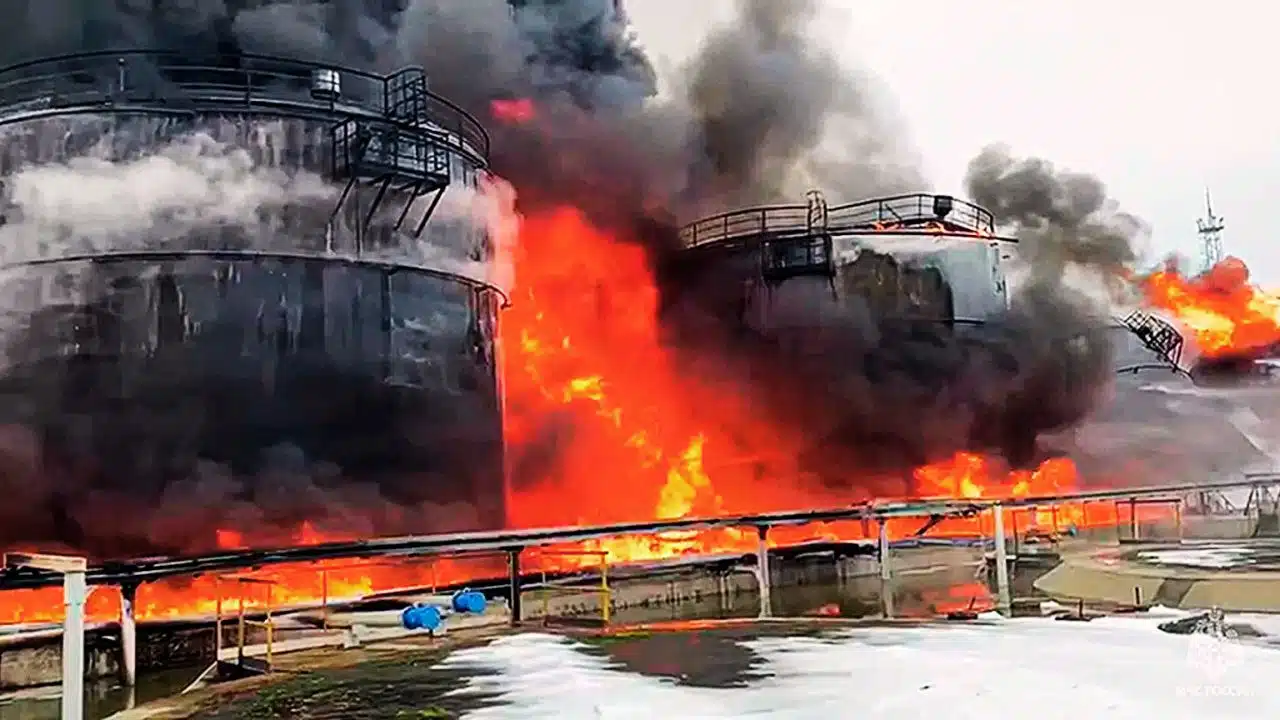
Ukraine’s expanding campaign of long-range drone strikes has knocked out roughly 10% of Russia’s oil refining capacity, according to industry and Western estimates, disrupting fuel supplies and squeezing a key pillar of the Kremlin’s war economy. The damage is forcing Moscow to juggle between protecting its domestic fuel market and preserving vital export revenues from crude and refined products.
Refineries hit, capacity lost
Since early 2024, Ukraine has steadily shifted its deep‑strike efforts toward Russia’s oil and gas infrastructure, using long‑range drones to hit refineries, depots and associated logistics hubs far beyond the front line. Open-source tallies suggest that by early 2025 at least 20 major refineries or associated facilities had been struck, including sites in Volgograd, Ryazan, Samara, Saratov and Bashkortostan.
Analysts drawing on trading data and refinery throughput figures estimate that about one‑tenth of Russia’s total refining capacity has been effectively taken offline by drone damage at any given time this year, even if plants often resume partial operations after repairs. Earlier NATO assessments had already concluded that Ukrainian strikes removed at least 10% of capacity in 2024, and a further intensification of attacks in 2025 has extended that pressure.
Fuel shortages and export squeeze
The loss of refining capacity has translated into tighter supplies of gasoline and diesel inside Russia, with several regions reporting shortages or rationing as plants cut runs or halt units for repairs following strikes. In response, Moscow has periodically restricted gasoline exports and leaned on remaining refineries to prioritize the domestic market, while still trying to safeguard foreign currency earnings from oil sales.
Analysts say the combination of Ukraine’s drone campaign and stepped‑up Western sanctions on Russia’s oil logistics has pushed down overall oil and gas revenues by around a fifth compared with a year earlier, even as fossil fuels remain the backbone of the federal budget. The resulting tension inside Russia’s oil sector is visible in reports of strained fuel balances, emergency measures on exports, and growing concern among regional officials over energy security ahead of winter.
Kyiv’s strategy and Moscow’s response
Ukrainian officials have made clear that energy infrastructure is now a deliberate strategic target, arguing that oil and gas revenues fund Russia’s invasion and that refineries also support the military through fuel supplies. Long‑range drones developed over the past two years now reach deep into Russia, striking complexes such as Gazprom’s Salavat petrochemical site in Bashkortostan and refineries in the Volgograd and Ufa areas, hundreds of kilometers from Ukraine.
Russia brands the strikes as “terrorism” and has continued its own heavy attacks on Ukraine’s power grid and energy system, seeking to undermine Kyiv’s economy and public morale. Military analysts describe this as an escalating duel over critical infrastructure, with both sides using stand‑off weapons to inflict long‑term economic costs while avoiding direct confrontation beyond the battlefield.
Global oil market implications
While refining capacity has fallen, Russia has in many cases kept crude production high, diverting barrels from damaged plants to export terminals on the Black Sea and Baltic coasts. Shipping data show increased seaborne crude flows after clusters of refinery attacks, even as some ports and pipelines have themselves been harassed by Ukrainian drones and tighter enforcement against Russia’s “shadow fleet.”
The net effect has been a paradoxical mix of stronger prices for refined products, due to reduced Russian output, and volatile discounts on Russian crude as Moscow searches for buyers and shipping capacity under sanctions. Energy specialists caution that a 10% cut in refining will not collapse Russia’s oil sector in the short term, but say the campaign is already eroding capacity, raising repair costs and slowly constraining the resources available to sustain the war.
























