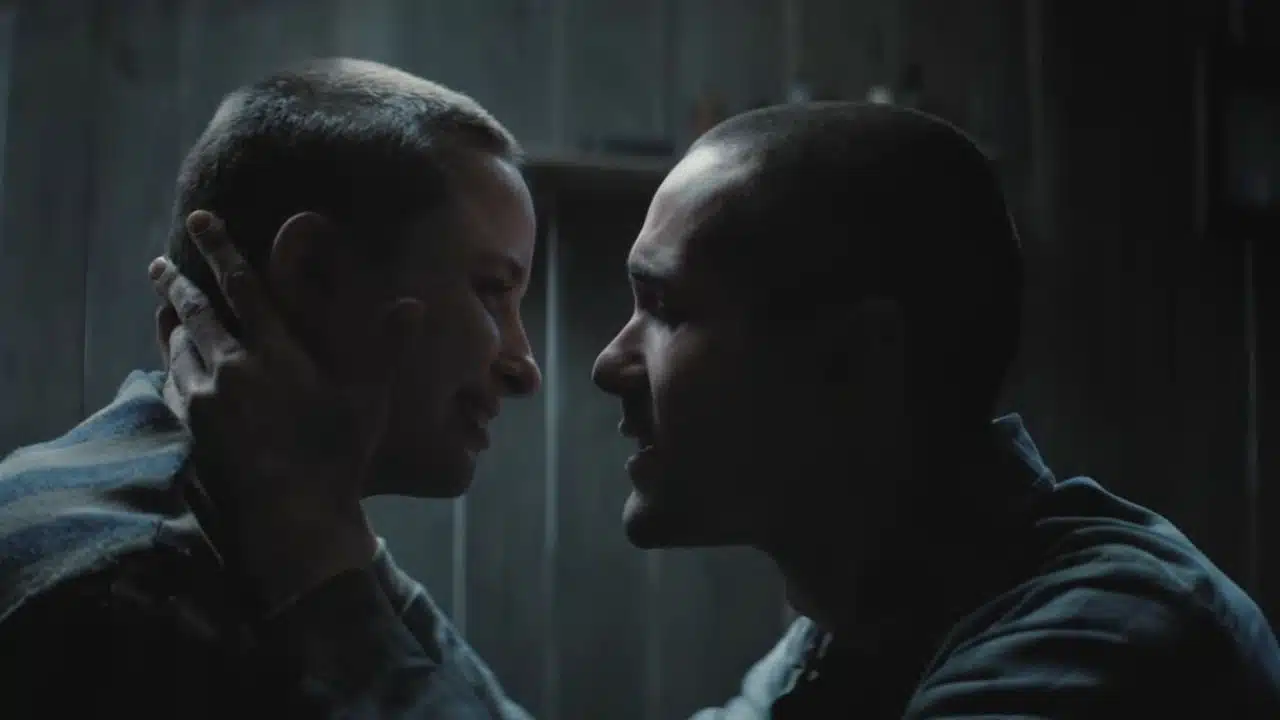
The highly anticipated TV adaptation of the bestselling book “The Tattooist of Auschwitz” has finally been released.
The six-part series, featuring a stellar cast including Harvey Keitel, Melanie Lynskey, Jonah Hauer-King, and Anna Próchniak, brings to life the love story between two individuals during the Holocaust, set in the Auschwitz-Birkenau death camp during World War II.
Since its release in 2018, the book by New Zealand author Heather Morris has sold over three million copies worldwide and topped the New York Times bestseller lists.
Morris has stated that she met Ludwig Sokolov (born Eisenberg), also known as Lali or Lale, in Australia in 2003, shortly after the death of his wife, Gita. Lali shared with Morris the story of their romance and survival in Auschwitz.
The Story in the Book
The book chronicles Lali’s journey to Auschwitz, where a fellow Jewish prisoner named Pepan forces him to train as a tattoo artist. Lali’s job is to brand unique numbers on the prisoners’ bodies. During this process, he falls in love with Gita, a Slovakian woman, while tattooing her arm.
The couple begins a secret relationship within the camp, but Gita refuses to reveal her surname, believing they will not survive Auschwitz.
Gita works in a camp warehouse that confiscates prisoners’ belongings upon arrival. She secretly smuggles valuable jewels and money to Lali, who then trades them with a German worker for medicine or uses them to bribe SS guards. When Gita falls ill with typhoid, Lali manages to procure penicillin for her.
As news of the advancing Russian forces spreads, the prisoners relocate. Before departing, Gita finally tells Lali her surname: Furman. They send Lali to Mauthausen and another Austrian death camp, but he manages to escape. However, Russian soldiers force him to work for them before he escapes once more. After two weeks of waiting at the train station in Bratislava, he finally spots Gita. Lali proposes to her, and she happily accepts.
The Real-life Events
Much of the book’s narrative aligns with real-life events. According to Morris, Lali was indeed a tattooist while a prisoner in Auschwitz, which helped him survive. In July 1942, Lali, prisoner number 32407, met Gisela “Gita” Fuhrmannova and fell in love while tattooing her.
However, the book has faced criticism from Wanda Witek-Malicka of the Auschwitz Memorial Research Center, who pointed out discrepancies in Gita’s identification number.
Morris initially claimed that Gita’s tattooed number was 34902, but Witek-Malicka stated that no surviving documents support this claim, and that a prisoner arriving at Auschwitz at the time Gita did could not have received such a high number. According to Gita’s own testimony, her identification number was 4562. Subsequent copies of Morris’ book reflected this correction.
Within the camp, Lali and Gita’s forbidden romance led them to smuggle letters between their dormitories. Lali also managed to smuggle contraband items to obtain medicine and favors for other prisoners. Eight days before Auschwitz’s liberation, while in the Mauthausen camp, Czech prisoners helped Lali by swapping the Jewish star on his uniform for a red triangle, designating him as a less vulnerable political prisoner. He later escaped and returned to Bratislava to find Gita.
Critics have pointed out other historical inconsistencies between the book and reality, such as the availability of antibiotics during the war. However, Morris has clarified that her novel is a work of fiction based on one man’s memory and not an academic or historical account of the Holocaust. Many survivors have expressed gratitude to Morris for sharing Lali and Gita’s story, which they see as their own.
What Happened to Lali and Gita after the War?
Lali and Gita married in 1945, changing their surname to the more Russian-sounding Sokolov, and migrated to Melbourne in 1948, where they established a textile business. In 1961, they had a son named Gary.
However, they never spoke publicly about how they had met. It wasn’t until Lali shared his story with Heather Morris in 2003 that their son learned the full extent of his mother’s past. Morris revealed that Gita never spoke about her time in Auschwitz, not even to her own son.
Sadly, Lali passed away in 2006, before the publication of his and Gita’s story in the book. However, their son Gary shared with Sky what he hopes people will take away from the series: the belief that bad times do end and the importance of staying positive. He hopes that the show will give viewers a sense of hope for the future, regardless of the challenges they may be facing. This, he believes, is an amazing legacy for his parents to leave behind—the message that there is always hope.
“The Tattooist of Auschwitz” is now available on Sky Atlantic and NOW TV, offering viewers a powerful and emotional glimpse into a remarkable true story of love, resilience, and survival amidst one of the darkest chapters in human history.
The Information is Taken from Esquire and Time Out