
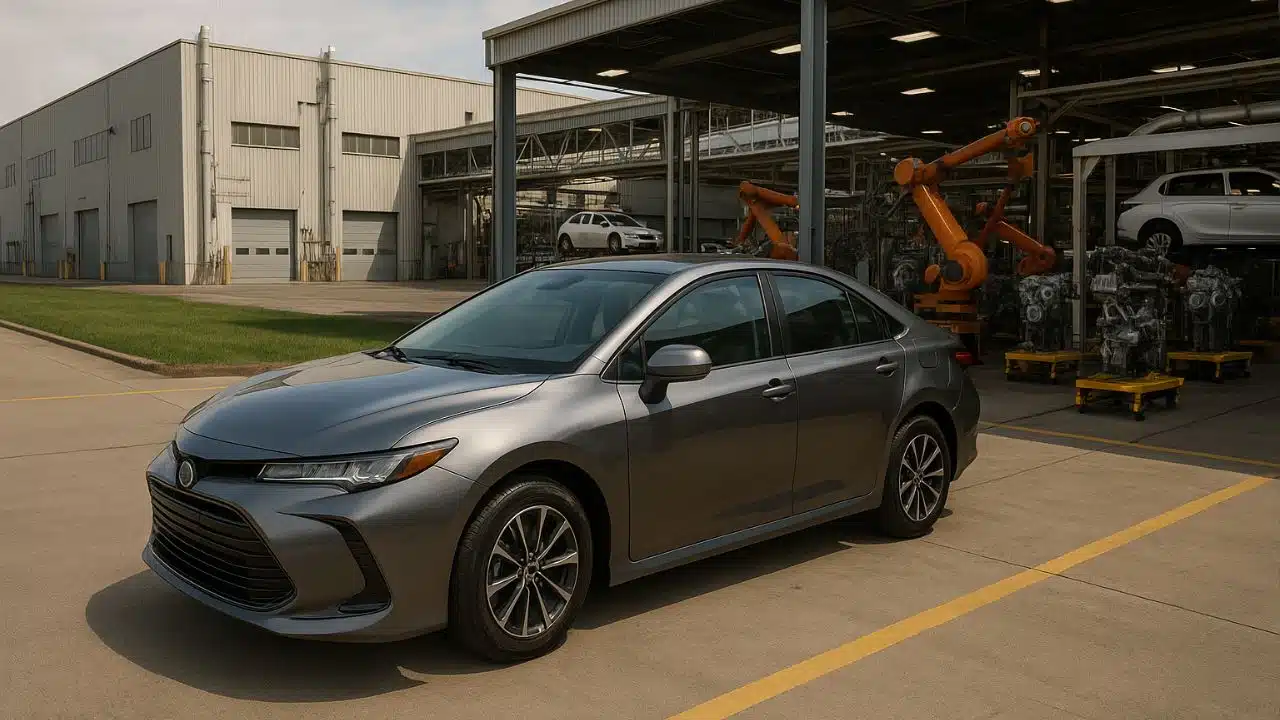
Toyota Motor has announced a sweeping $912 million investment across several U.S. manufacturing plants, underscoring the company’s growing commitment to hybrid vehicles and its long-standing philosophy of building vehicles close to the markets where they are sold. The investment spans five Southern states and represents a major phase within Toyota’s broader plan to invest up to $10 billion in the United States by 2030. This move comes at a moment when hybrid vehicles continue to outpace full electric vehicles (EVs) in U.S. demand, and the automotive industry is rapidly adjusting to shifting regulations, tariffs, and consumer preferences.
Toyota currently holds over a 51% share of the U.S. hybrid market through the third quarter of the year, reflecting both strong consumer demand and the company’s early leadership in hybrid technology. By expanding hybrid-compatible engine production and adding hybrid models to existing assembly lines, Toyota is positioning itself to maintain — and potentially grow — that lead as American drivers gravitate toward fuel-efficient options that balance traditional internal combustion with electric power.
The largest portion of Toyota’s newly announced investment — $453 million — will go to its Buffalo, West Virginia plant. This facility will expand its assembly capacity for four-cylinder hybrid-compatible engines, a critical component used across many of Toyota’s most popular hybrid models. The company plans to increase local production volume to meet demand without relying heavily on imported engine components, reducing supply chain vulnerabilities and keeping manufacturing closer to end users.
The company’s Georgetown, Kentucky plant is set to receive another $204.4 million, further supporting four-cylinder hybrid-engine production. Georgetown remains one of Toyota’s most significant facilities in North America, and this investment strengthens its role at the center of Toyota’s electrified lineup. Meanwhile, Toyota will invest $125 million in its Blue Springs, Mississippi plant to expand the production line for the Toyota Corolla. With this expansion, the Mississippi factory will add hybrid versions of the Corolla to its output, ensuring that one of the brand’s most recognizable nameplates continues to evolve alongside consumer trends.
Collectively, Toyota says the investments will create 252 new jobs, adding to the company’s position as the second-largest seller of vehicles in the United States, behind General Motors. While job creation is modest relative to the scale of the investment, the company emphasizes that the improvements will modernize facilities, enhance workflow efficiency, and support long-term production capabilities that are essential for hybrid technology scaling.
Toyota leadership highlighted the purpose behind this investment during the announcement. Kevin Voelkel, Senior Vice President of Manufacturing Operations for Toyota Motor North America, said the company is “gearing up to meet growing customer demand” as buyers continue to embrace hybrid vehicles. He reinforced Toyota’s philosophy of “building where we sell,” noting that expanding American jobs and boosting U.S. manufacturing capacity keeps the company closely aligned with its customers.
The announcement also arrives during a complicated political and economic moment for the auto industry. Just a week prior, Toyota confirmed that it would invest up to $10 billion more than previously planned in its U.S. operations over the next five years. These adjustments coincide with recent tariff policies under President Donald Trump, which have targeted imported vehicles and auto parts with the intention of strengthening domestic production. Toyota’s executives have acknowledged the wide-ranging impact these tariffs could have on global automakers, including increased production costs and broader supply-chain challenges.
Adding to the public spotlight, Toyota’s chairman, Akio Toyoda, drew media attention recently when he wore a “Make America Great Again” hat and a T-shirt featuring President Trump and Vice President JD Vance while hosting a racing event at Fuji Speedway. During the event, Toyoda met with U.S. Ambassador George Glass and commented on automotive tariffs. He stated that he was not interested in debating whether tariffs are inherently good or bad, but emphasized that every national leader seeks to protect their domestic auto industry. He expressed Toyota’s desire to find ways to make tariff policies beneficial to all stakeholders — with a particular emphasis on customers.
These comments reflect the broader tension automakers are navigating as they plan production strategies in an uncertain regulatory environment. While some manufacturers have aggressively pushed toward full electric vehicles, Toyota remains committed to a multi-pathway strategy that includes hybrids, plug-in hybrids, hydrogen fuel-cell vehicles, and battery-electric options. The company continues to argue that hybrids remain a practical and scalable solution for many markets, especially where charging infrastructure is still developing or where customers prefer a balance between efficiency and familiarity.
This latest round of investment underscores Toyota’s confidence in hybrids as a long-term pillar of the U.S. automotive market. It also highlights the company’s intention to respond quickly to regulatory changes, supply-chain disruptions, and trade policies that influence manufacturing decisions. By localizing more engine and hybrid-component production, Toyota minimizes exposure to tariff risks and ensures that hybrid models remain competitively priced.
As automakers worldwide reevaluate electric-vehicle strategies and adjust forecasts based on cooling EV sales growth, Toyota’s approach has been repeatedly validated by strong hybrid demand. The company’s ability to adapt its U.S. manufacturing footprint — including adding hybrid Corolla production and expanding engine assembly capacity — positions it well for continued steady performance even as the industry undergoes rapid change.
In the coming years, Toyota’s $912 million investment will likely play an important role in shaping both regional economies and national automotive trends. The upgrades across West Virginia, Kentucky, Mississippi, and other Southern states will reinforce the Southeast’s growing reputation as a manufacturing hub for electrified vehicles and advanced automotive engineering. For Toyota, the message is clear: hybrid vehicles remain a central part of its American strategy, and the company is committed to expanding that presence as consumer demand evolves.