
Juggling a mountain of lectures, slides, homework assignments, and upcoming exams gets overwhelming fast. That is exactly where AI study companions come in; they flip that daily digital clutter into structured, interactive review sessions. Instead of forcing learners to rely on passive reading, these platforms push for active engagement through automated quizzes, smart flashcards, and clear, step-by-step guidance.
While both India and China boast massive, fast-growing edtech scenes, the United States currently holds the largest concentration of verifiable small and medium enterprises (SMEs) building these specialized AI tools. This list focuses specifically on top U.S. innovators tailored for K-12, high school, and higher education environments.
Our Selection Criteria
We set a strict bar to separate the true innovators from generic wrappers. Every featured company on this list was chosen based on the following foundational standards:
-
U.S. Operations: Must be an active, United States-based startup or small-to-medium enterprise.
-
Core AI Integration: Must provide dedicated AI-powered tutoring, flashcards, practice questions, or personalized study assistance.
-
Proven Adoption: Platforms must demonstrate clear, measurable student value and active adoption by students, educators, or academic institutions.
-
Specialist Focus: Large, generalized legacy education platforms were excluded to highlight agile, specialized innovators.
-
Verifiable Metrics: Every entry requires public verification via live websites, app marketplace listings, or official corporate profiles.
Why the United States Leads in AI Study Companions
The United States was chosen as the leading country for AI Study Companions SMEs due to several key factors. First, it has the highest concentration of verifiable startups specifically focused on AI-powered study assistants, tutoring platforms, flashcard systems, and adaptive learning tools. This density of specialist SMEs makes the U.S. market more transparent and reliable for research.
Second, the U.S. has a strong existing edtech ecosystem, including funding opportunities, institutional adoption, and startup support infrastructure, which allows these companies to scale and refine their products effectively. Third, the size and diversity of the student market across K-12, higher education, and test-prep programs create demand for innovative AI study solutions, giving SMEs the environment to grow and succeed. Finally, the United States provides global visibility, making it easier to verify company operations, product offerings, and usage compared to other markets.
In the research, the top three countries considered were:
- United States – Leading in verified AI study companion SMEs, market infrastructure, and student adoption.
- India – Rapidly growing edtech market with strong exam-prep demand, but fewer SMEs focused solely on AI study companions.
- China – Strong AI investment and a large edtech sector, but SME verification and global visibility are limited, with large platforms dominating the market.
This combination of market concentration, infrastructure, and verifiable startups is why the United States forms the focus for the SME list in this article.
Top 10 SMEs Specializing in AI Study Companions
The following selection highlights the top small-to-medium enterprises leading the charge in personalized, AI-driven learning tools across the country.
1. StudyFetch
-
Headquarters: Beverly Hills, California, United States
-
Website: www.studyfetch.com
-
Email: support@studyfetch.com
StudyFetch takes the friction out of note-taking by instantly turning lecture slides and dense PDFs into active study kits. Drop your course material into the platform, and it builds custom practice questions and tailored flashcards on the spot. It hits the sweet spot for anyone who needs immediate structure without spending hours manually formatting review decks. The platform bridges the gap between solo cram sessions and classroom settings seamlessly.
-
Why We Chose It: Converts notes into structured learning, offers multiple study formats, and is practical for independent learners and classroom integration.
-
Things to consider: Generated materials need verification; works best with clear source notes.
2. Mindgrasp
-
Headquarters: Columbia, Maryland, United States
-
Website: www.mindgrasp.ai
-
Email: support@mindgrasp.ai
Mindgrasp tackles the heavy lifting of multi-format studying. Whether you are dealing with dense textbook chapters, recorded video lectures, or academic podcasts, it condenses them into clear summaries and flashcards. Imagine converting a complex, hour-long audio recording into a quick five-minute review sheet. It is an excellent fit if your coursework relies heavily on video or audio content rather than flat text.
-
Why We Chose It: Supports multiple content formats, encourages active engagement, and is verified.
-
Things to consider: Summaries may omit nuanced details; best used alongside core reading.
3. Knowt
-
Headquarters: New York City, New York, United States
-
Website: www.knowt.com
-
Email: team@knowt.com
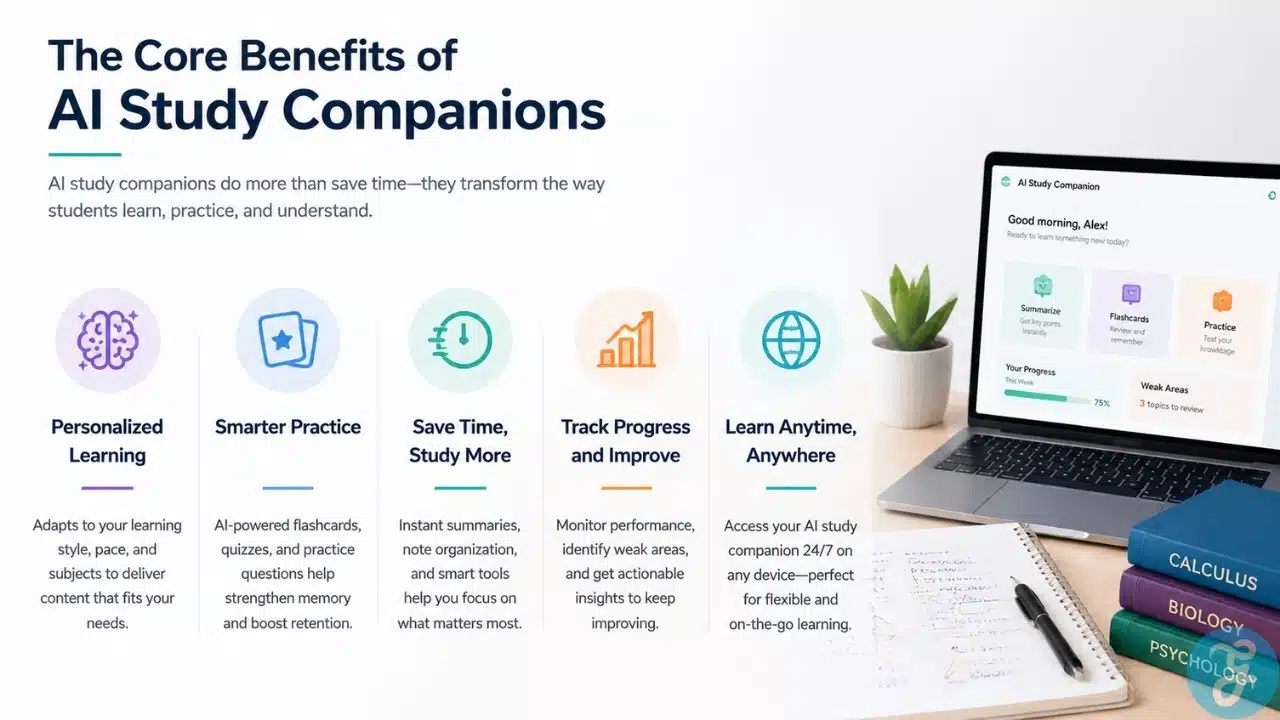
Knowt is built for heavy-duty retrieval practice. By plugging your daily class notes straight into the algorithm, you get instant, randomized flashcard decks and mock exams. It takes the manual labor out of building study guides, letting you focus entirely on active recall before exam day. If your primary study strategy relies on constant self-testing, this app streamlines the process perfectly.
-
Why We Chose It: Encourages active recall, integrates notes with practice, and balances memorization with understanding.
-
Things to consider: Flashcards require consistent review; content should be checked for accuracy.
4. Sizzle AI
-
Headquarters: New York, New York, United States
-
Website: web.szl.ai
-
Email: help@szl.ai
Sizzle AI focuses on showing the work rather than just handing over a final answer. By analyzing your uploaded assignments or specific topic notes, it builds interactive, guided exercises that coach you through tough problems one line at a time. This step-by-step scaffolding is great for mastering complex logical processes. It builds genuine problem-solving intuition instead of providing a simple shortcut.
-
Why We Chose It: Focuses on reasoning and guided learning, supports multiple content types, and is a verified U.S. SME.
-
Things to consider: Most effective alongside independent practice; branding may vary across institutions.
5. Studdy
-
Headquarters: San Francisco, California, United States
-
Website: www.studdyai.com
-
Email: team@studdy.ai
Studdy brings a visual, human touch to AI tutoring through its digital whiteboard interface. Snap a photo of a complicated equation, and the AI lays out a visual, conversational breakdown that feels like sitting next to a human tutor. It is highly optimized for technical fields where spatial layout and sequential logic are crucial to finding exactly where a calculation went wrong.
-
Why We Chose It: Emphasizes reasoning, supports complex STEM learning, and has an interactive format.
-
Things to consider: Limited to STEM subjects; students should also practice independently.
6. Mathos AI
-
Headquarters: Santa Clara, California, United States
-
Website: www.mathgptpro.com
-
Email: support@mathos.ai
Mathos AI (formerly known as MathGPTPro) cuts through the confusion of high-level mathematics. Feed it an intricate calculus or algebra problem, and it maps out a comprehensive conceptual walkthrough explaining the underlying rules behind every single operational step. If you regularly hit a wall with pure numbers and quantitative proofs, this platform acts as a reliable, round-the-clock safety net.
-
Why We Chose It: STEM-focused, supports homework and exams, and encourages conceptual understanding.
-
Things to consider: Limited to quantitative subjects; should be paired with independent practice.
7. Numerade
-
Headquarters: Pasadena, California, United States
-
Website: www.numerade.com
-
Email: tech-support@numerade.com
Numerade stands out by pairing its interactive AI engine with a massive library of human-led video explanations. Instead of forcing you to read through static lines of text, it links AI problem-solving directly with synchronized video walkthroughs. This dual approach works wonders for visual learners who need to see a scientific experiment or mathematical proof drawn out in real time.
-
Why We Chose It: Combines video explanations with AI guidance, effective for guided STEM learning, verified SME.
-
Things to consider: STEM-focused only; best paired with curriculum materials.
8. Flint
-
Headquarters: New York, New York, United States
-
Website: www.flintk12.com
-
Email: support@flintk12.com
Flint shifts the focus from solo studying to safe, teacher-guided classroom environments. Built specifically for K-12 schools, it allows educators to deploy personalized AI learning exercises while tracking student interactions from a central dashboard. It provides all the benefits of adaptive learning without the security or data privacy risks often tied to open-ended AI models.
-
Why We Chose It: Classroom-safe, supports teacher-managed personalized learning, and verified SME.
-
Things to consider: More effective in school settings; teacher setup required.
9. SchoolAI
-
Headquarters: Lehi, Utah, United States
-
Website: www.schoolai.com
-
Email: support@schoolai.com
SchoolAI gives teachers full creative control over how their students interact with artificial intelligence. Educators can build secure, sandboxed digital workspaces pre-loaded with specific guardrails and curricular goals. Students stay fully engaged within a structured environment, while the system generates real-time feedback on progress and comprehension directly for the teacher.
-
Why We Chose It: Classroom-focused AI companion, verified SME, structured AI guidance.
-
Things to consider: Less suitable for independent learners; effectiveness depends on teacher involvement.
10. Kira Learning
-
Headquarters: Palo Alto, California, United States
-
Website: www.kira-learning.com
-
Email: support@kira-learning.com
Kira Learning scales up technical education by baking adaptive AI support straight into comprehensive computer science tracks. It provides automated, high-fidelity feedback as students code or solve technical problems, giving districts a powerful way to manage large-scale STEM programs. It acts less like a casual study helper and more like a structured, curriculum-aligned co-teacher.
-
Why We Chose It: SME U.S.-based, combines tutoring and tracking, supports structured learning, and is classroom-focused.
-
Things to consider: May be overkill for individual learners; requires educator supervision.
Overview Of AI Study Companions
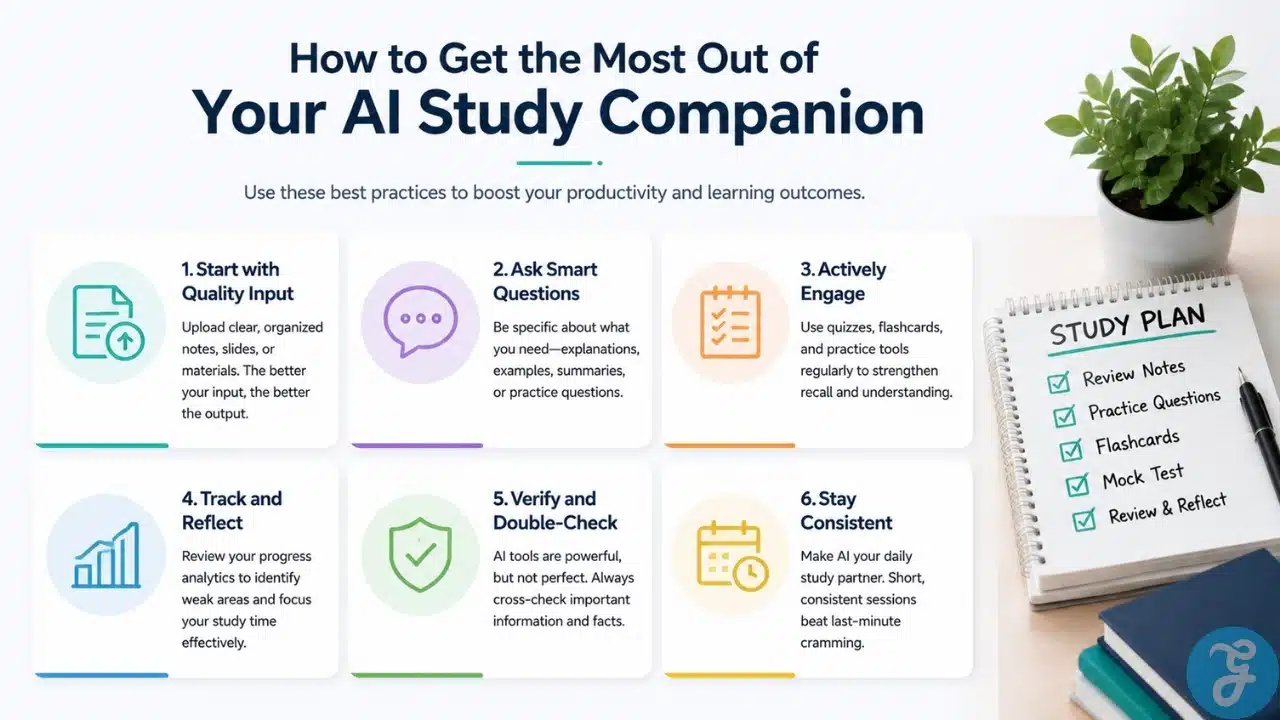
Finding the right AI tool comes down to identifying your biggest academic bottleneck. Flashcards, deep STEM tutoring, and multi-format summarization solve entirely different problems. While independent college students usually find their groove with tools like StudyFetch or Knowt, K-12 classrooms thrive on secure, managed options like Flint or SchoolAI. Each provider serves a distinct operational niche.
Comparison Summary
To help navigate these choices, here is a quick look at how each platform functions across the educational landscape:
-
StudyFetch organizes notes into active study tools.
-
Mindgrasp converts multimedia into summaries and flashcards.
-
Knowt produces flashcards and practice tests from notes.
-
Sizzle AI generates guided exercises for topic mastery.
-
Studdy offers interactive STEM tutoring on a whiteboard.
-
Mathos AI provides stepwise explanations for quantitative problems.
-
Numerade integrates video explanations with AI support.
-
Flint enables teacher-supervised K-12 AI tutoring.
-
SchoolAI provides AI-guided study spaces managed by educators.
-
Kira Learning offers adaptive, curriculum-aligned AI support for schools.
Our Top 3 Picks
-
StudyFetch – Best all-rounder for turning flat text into dynamic, active study kits.
-
Mindgrasp – Leading choice for digesting video, audio, and mixed multimedia files.
-
Flint – Standout option for safe, teacher-controlled classroom integration.
Why AI Study Companions Are Booming In The United States
American students are facing heavier, more complex workloads than ever, creating an immediate need for smart efficiency tools. AI companions alleviate that academic stress by instantly organizing chaotic study files and offering guidance when a teacher or tutor isn’t available. The massive growth we are seeing in schools and universities highlights a clear shift toward interactive, on-demand learning that integrates safely with teacher supervision and structured study plans.
Secret to Their Effectiveness
-
They flip passive reading into active, self-testing exercises.
-
They build custom quizzes and practice sets completely automatically.
-
They map out clear, sequential paths through intimidating STEM formulas.
-
They establish safe, managed environments for early education.
-
They push for deep comprehension rather than lazy copy-pasting.
Choosing Wisely
The most powerful tool isn’t the one with the longest feature list. It is the one that fits your daily study habits. Whether you need rapid flashcard repetition, deep calculus explanations, or a secure classroom sandbox, picking a platform built for your specific challenge makes all the difference. True academic impact stems from deliberate, thoughtful adoption, not chasing tech trends.
Frequently Asked Questions (FAQs) on SMEs Specializing in AI Study Companions
What Are AI Study Companions?
Tools that assist students in reviewing, organizing, and synthesizing academic material using adaptive AI tutors, automatic flashcard creators, and interactive problem sets.
Why Focus on the United States?
While global edtech hubs are expanding rapidly, the U.S. currently has the tightest concentration of specialized startups dedicating their entire core product to AI study support.
Are They Safe for Students?
Yes, especially when built with school-first guardrails. School-centered options give teachers complete visibility and data control to keep environments secure.
Which Tools Are Best for Flashcards?
StudyFetch, Knowt, and Mindgrasp are the clear frontrunners for turning notes or media into quick retrieval cards.
Which Tools Are Best for STEM?
Studdy, Mathos AI, and Numerade are heavily specialized to handle complex math, visual whiteboards, and formula breakdowns.