From my perspective as a lifestyle strategist, the conversation around home energy has shifted. It used to be about how much power you used, but in 2026, the critical factor is when you use it. I have seen clients lower their overhead simply by syncing their habits with the grid’s rhythm, turning a monthly expense into a managed asset.
Utility companies across the US are moving away from flat rates. They are adopting models that charge more during busy hours and less when the grid is quiet. If you ignore this change, you might pay a premium for running your dryer at 6 PM. But if you adapt, the savings are real.
This guide breaks down exactly how Time-of-Use (TOU) tariffs work and the specific tools you can use to optimize your bill.
Let’s look at the pricing structures, the smart technology that does the heavy lifting for you, and whether this switch aligns with your household’s routine.
What Are Time-of-Use (TOU) Tariffs?
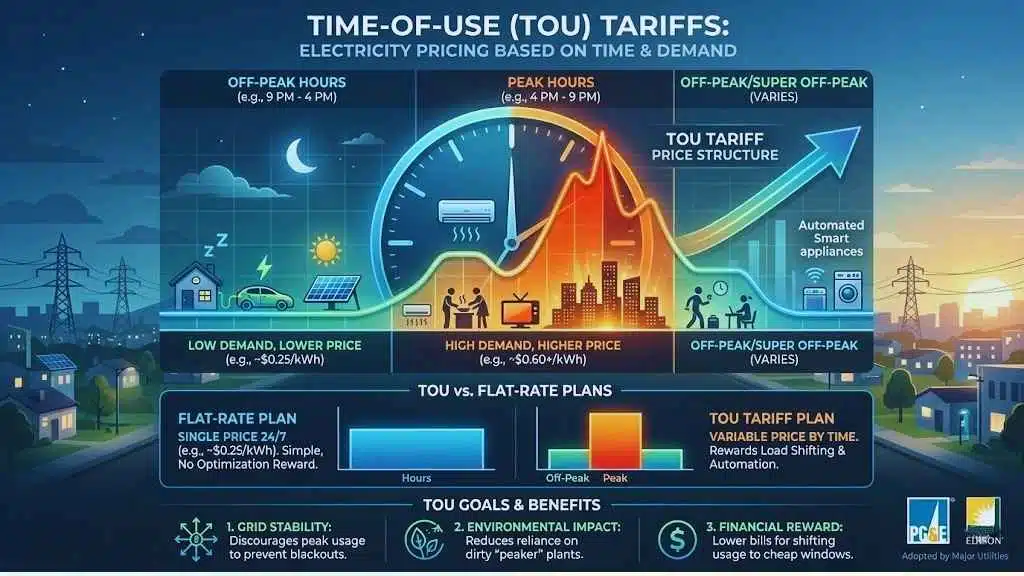
Time-of-Use tariffs are electricity plans where the price per kilowatt-hour (kWh) changes based on the time of day. Instead of paying a single flat rate around the clock, you pay different rates that reflect the real-time demand on the power grid.
Definition of TOU tariffs
Under a TOU plan, electricity is treated like a commodity with fluctuating value. When demand is high—typically on hot summer evenings when everyone runs their air conditioning—the price spikes. When demand drops late at night or mid-morning, the price falls.
Major utility providers like Pacific Gas and Electric (PG&E) and Southern California Edison (SCE) have transitioned millions of customers to these plans. The goal is to discourage energy use during “peak” windows to prevent blackouts and reduce the need for dirty “peaker” power plants.
How TOU tariffs differ from flat-rate plans
The difference lies in predictability versus opportunity. A standard flat-rate plan charges you the same amount, perhaps 25 cents per kWh, whether you use power at 2 AM or 5 PM. It is simple, but it offers no financial reward for being efficient.
In contrast, a TOU plan creates a price gap. For example, in parts of California, the rate might soar to $0.60 or more during peak hours but drop to $0.25 or less during off-peak times. This structure penalizes carelessness but rewards optimization. If you can automate your heavy energy usage to occur during cheap windows, you effectively pay wholesale prices for your power.
How Do Time-of-Use Tariffs Work?
Your bill is determined by the clock. Understanding the specific time windows in your region is the first step to controlling costs.
Peak, Off-Peak, and Super Off-Peak
Utilities divide the day into specific “buckets” of time. While these vary by provider, they generally follow this pattern:
- Peak Hours (The “Danger Zone”): This is usually 4:00 PM to 9:00 PM. Families return home, cook dinner, and turn on the TV, putting massive strain on the grid. Rates here are the highest.
- Off-Peak Hours: These typically run from late evening until the next morning (e.g., 9:00 PM to 4:00 PM). Prices are significantly lower.
- Super Off-Peak: Some plans offer a third, cheapest tier. This often happens during the day (e.g., 10:00 AM to 2:00 PM) in regions with high solar adoption, where there is actually a surplus of solar energy on the grid.
Pricing Structure Based on Demand
The price difference is not minor. It is designed to be a strong financial signal.
- Summer vs. Winter: The gap is widest in the summer. During a July heatwave, peak prices can be 200% to 300% higher than off-peak rates.
- Weekend Discounts: Many utilities, such as Con Edison in New York, classify weekends entirely as off-peak, allowing you to catch up on laundry or charge your EV cheaply on Saturdays and Sundays.
- The “Shadow” Peak: Be aware of “shoulder” periods. These are buffer times just before or after peak hours where rates are moderate—not as high as peak, but not as cheap as true off-peak.
Benefits of Time-of-Use Tariffs
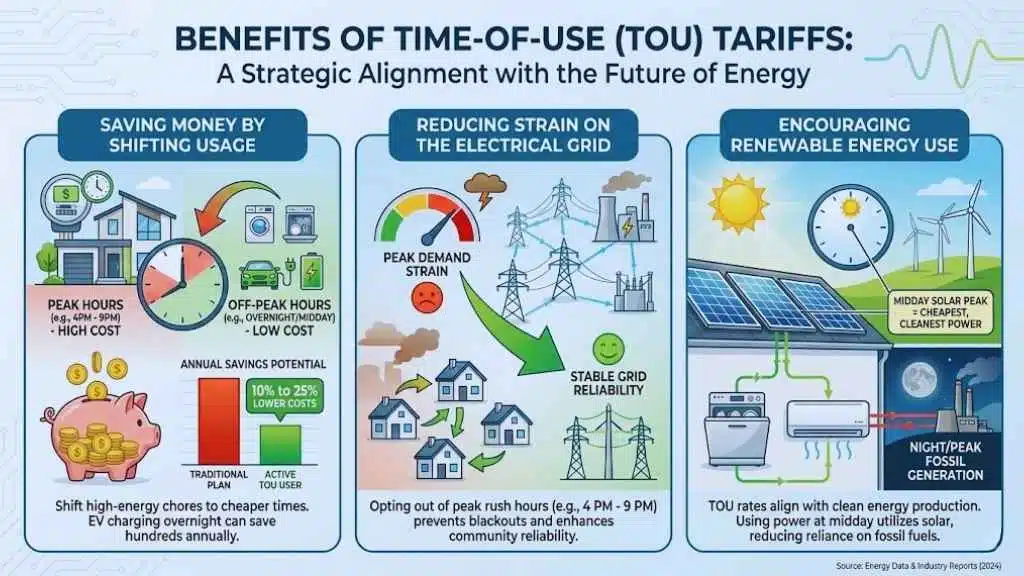
Shifting your usage is not just about pinching pennies. It is a strategic move that aligns your home with the future of energy infrastructure.
Saving money by shifting energy usage
The financial upside is immediate. Data from 2024 suggests that active TOU users can shave 10% to 25% off their annual electricity costs simply by moving high-energy chores. For a household with an electric vehicle, the savings are even more dramatic. Charging an EV overnight versus at 6 PM can save hundreds of dollars a year, essentially paying for the fuel switch.
Reducing strain on the electrical grid
By opting out of the 4 PM to 9 PM rush, you help the grid stay stable. Brownouts often happen when demand exceeds supply during these critical hours. Your shift contributes to community reliability, reducing the risk of outages for everyone.
Encouraging the use of renewable energy
TOU rates often align with clean energy production. In sunny states, electricity is cheapest at midday when solar panels are producing maximum power. By running your dishwasher at noon, you are likely using clean, solar-generated electricity rather than fossil-fuel power generated at night.
Comparing TOU Tariffs to Standard Electricity Plans
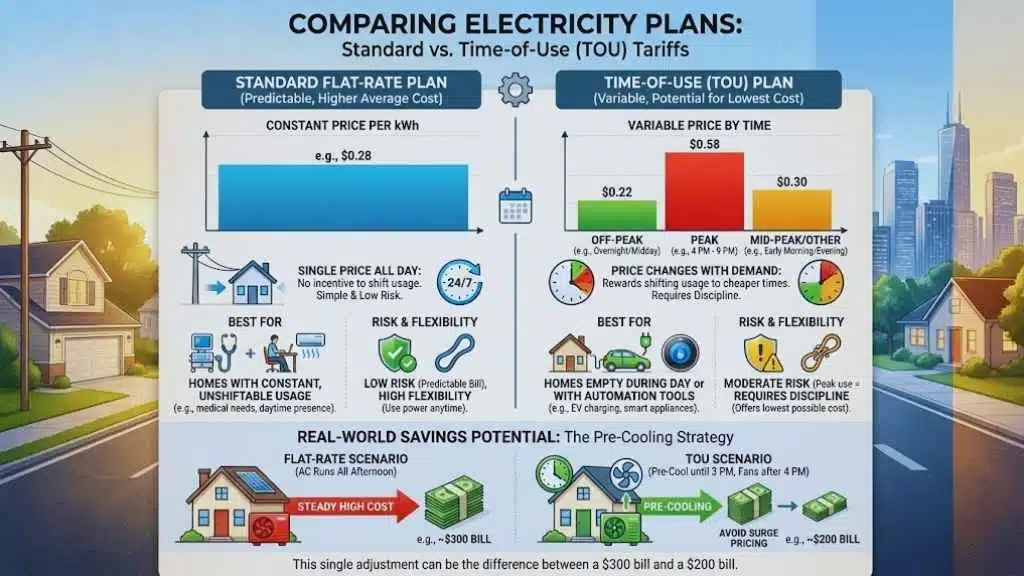
To make the right choice, you need to see the numbers side-by-side. Here is how a typical scenario plays out for a modern home.
| Feature | Standard Flat-Rate Plan | Time-of-Use (TOU) Plan |
|---|---|---|
| Pricing Model | Single price all day (e.g., $0.28/kWh). | Variable price (e.g., $0.22 Off-Peak vs. $0.58 Peak). |
| Best For | Homes with constant, unshiftable usage (e.g., medical equipment, WFH with AC). | Homes that are empty during the day or have automation tools. |
| Risk Factor | Low. Your bill is predictable. | Moderate. Using AC during peak hours can cause bill shock. |
| Flexibility | High flexibility, but higher average cost. | Requires discipline, but offers lowest possible cost. |
Real-world savings potential
Consider a family in a hot climate. On a flat rate, running the AC all afternoon costs a steady, high premium. On a TOU plan, if they “pre-cool” the house until 3 PM and then rely on fans during the 4 PM to 9 PM peak, they avoid the surge pricing entirely. This single adjustment is often the difference between a $300 bill and a $200 bill.
How to Maximize Savings with Time-of-Use Tariffs
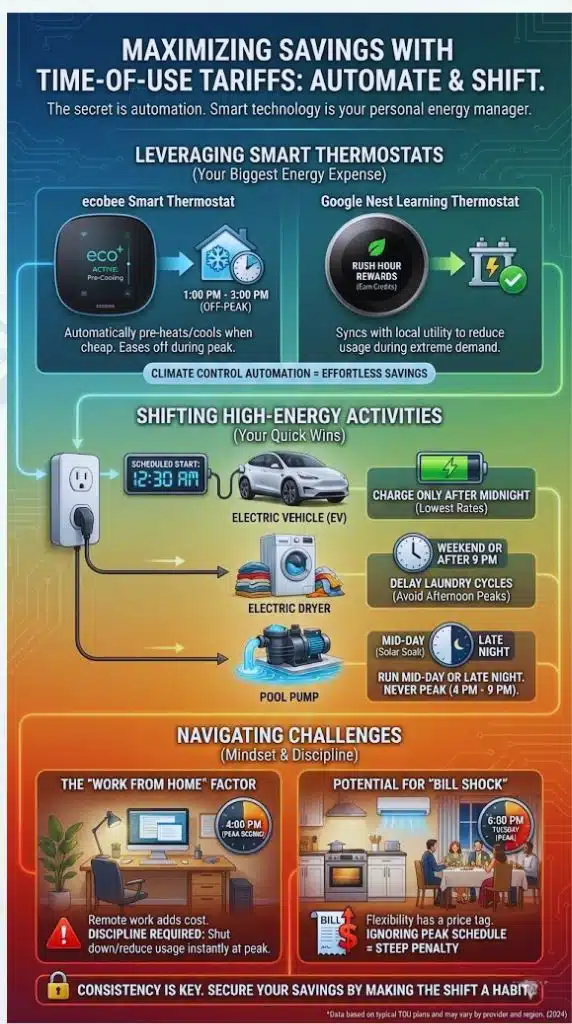
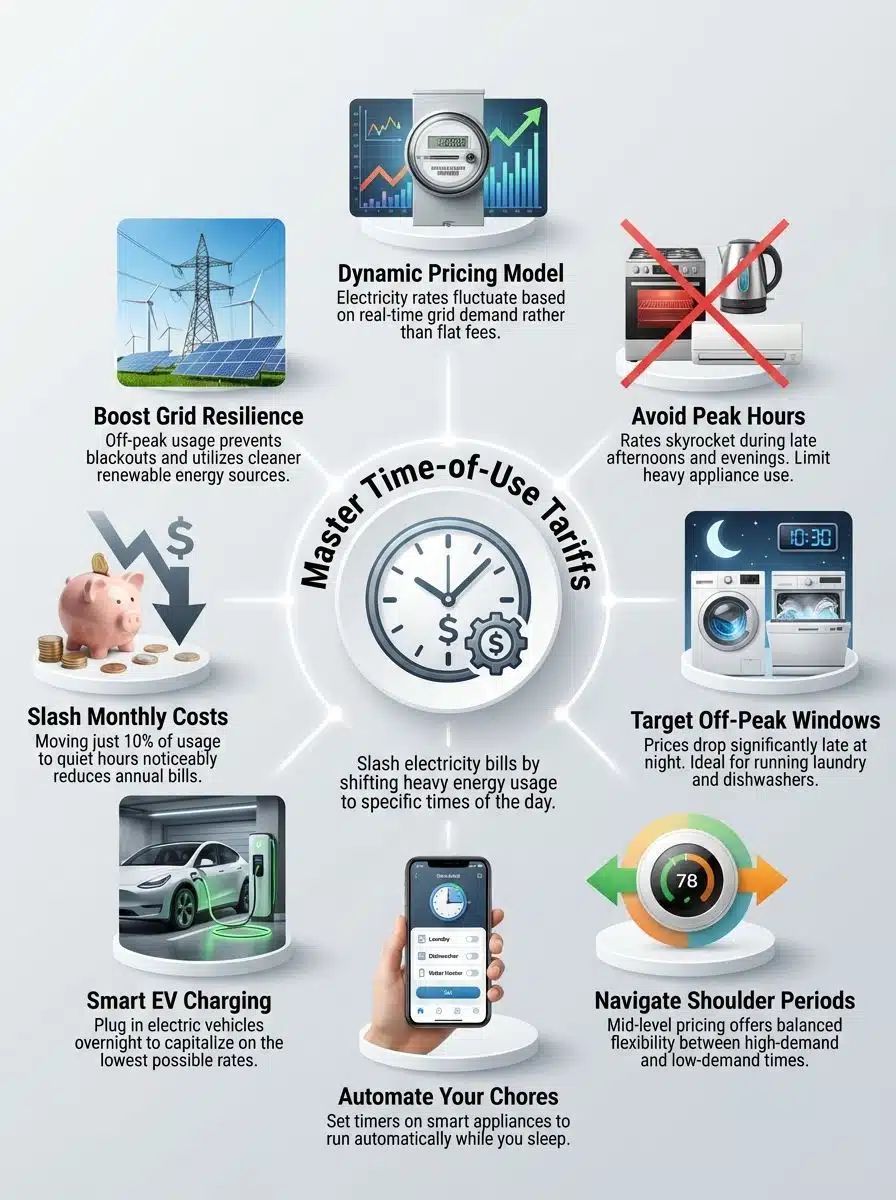
You do not need to watch the clock constantly to win at this game. The secret is automation. Smart technology acts as your personal energy manager.
Leveraging Smart Thermostats
Your heating and cooling system is likely your biggest energy expense. Smart thermostats are essential tools for TOU plans.
- Ecobee Smart Thermostat: This device includes a feature called “eco+”. It automatically pre-heats or pre-cools your home when electricity is cheap and eases off the HVAC during expensive peak hours, often without you noticing the temperature difference.
- Google Nest Learning Thermostat: Nest offers a program called “Rush Hour Rewards” (enrollment required). It syncs with your local utility to earn you credits for reducing usage during extreme demand events.
Shifting High-Energy Activities
Beyond climate control, three specific appliances consume the most power. Managing these is your quick win.
- Electric Vehicles (EVs): This is the biggest opportunity. Use the scheduling feature in your car or charger (like those from ChargePoint) to start charging only after midnight.
- Electric Dryers: These use massive amounts of heat. Delay your laundry cycle until the weekend or after 9 PM.
- Pool Pumps: If you have a pool, ensure the pump runs mid-day (to soak up solar capacity) or late at night. Never run it during the evening peak.
Challenges of Time-of-Use Tariffs
While the savings are attractive, the transition requires a change in mindset. It is not seamless for everyone.
The “Work From Home” Factor
Remote work has complicated the equation. If you work from home, you are using lights, computers, and AC all day. While mid-day rates are often reasonable, the crossover into the 4 PM peak can be costly if you are still working. Recent data suggests remote work adds roughly $40 to $50 per month to utility bills. If you are on a TOU plan, you must be disciplined about shutting down or reducing usage the moment the peak window begins.
Potential for “Bill Shock”
The penalty for ignoring the schedule is steep. Hosting a dinner party at 6 PM on a Tuesday in July? Your oven and AC running simultaneously during peak hours will be expensive. You need to be aware that flexibility has a price tag during those specific windows.
Should You Switch to a Time-of-Use Tariff?
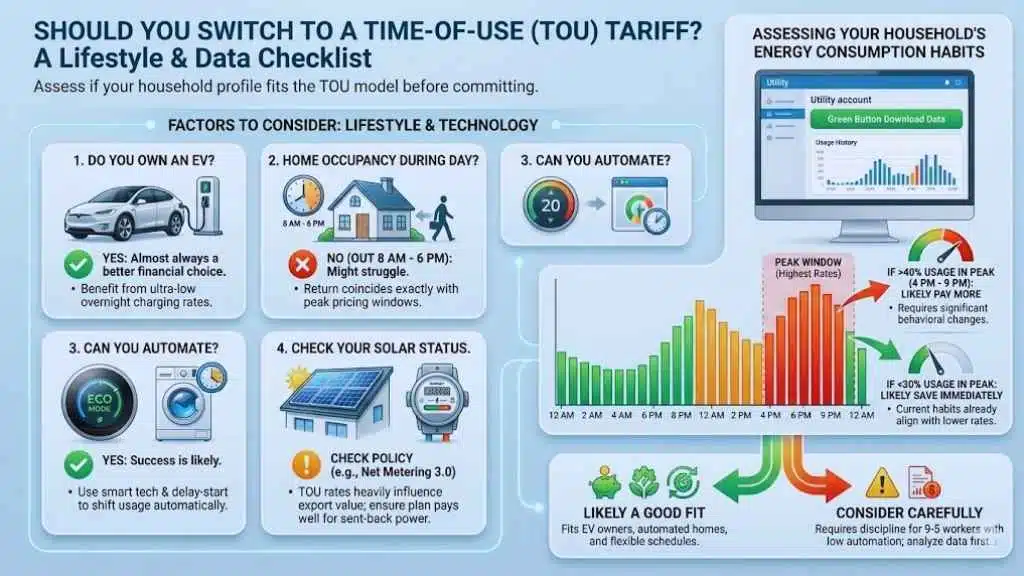
This model isn’t for everyone. Before you commit, run through this checklist to see if your lifestyle fits the profile.
Factors to Consider
- Do you own an EV? If yes, TOU is almost always the better financial choice due to overnight charging rates.
- is your home empty during the day? If you are out of the house from 8 AM to 6 PM, you might struggle, as your return home coincides exactly with peak pricing.
- Can you automate? If you have a smart thermostat and delay-start appliances, you will succeed. If you rely on manual memory, you may forget and lose the savings.
- Check your solar status. If you have solar panels, TOU rates (often under policies like Net Metering 3.0 in California) heavily influence the value of the energy you export. You need a plan that pays you well for the power you send back to the grid.
Assessing your household’s energy consumption habits
Log into your utility account and download your “Green Button” data or usage history. Look at your hourly breakdown. If more than 40% of your usage happens between 4 PM and 9 PM, you will likely pay more on a TOU plan unless you make significant changes. If that number is below 30%, you are likely to save money immediately.
Final Thoughts
Time-of-Use tariffs represent a smarter, more modern way to interact with the grid. They reward you for being efficient and penalize strain on the system. For the organized homeowner, particularly those with electric vehicles or smart home tech, they offer a clear path to lower bills.
The key is not to disrupt your life, but to automate it. By using tools like smart thermostats and simply delaying the dishwasher run until bedtime, you turn energy usage into a background task that saves you money. Check your local utility’s website today—compare your current rate against their TOU options and see if a simple switch could keep more cash in your pocket.