Decentralized finance (DeFi) is rapidly reshaping the financial landscape, offering an alternative to the traditional banking system. Powered by blockchain technology, DeFi allows users to access financial services without relying on intermediaries like banks or financial institutions.
These services include everything from lending and borrowing to trading, insurance, and yield farming. While DeFi has made significant strides, it’s still a relatively new concept, and many people remain unaware of its transformative potential.
In this article, we will explore 7 things you didn’t know about decentralized finance (DeFi), unveiling the complexities and breakthroughs that make DeFi one of the most exciting innovations of the 21st century.
What is Decentralized Finance (DeFi)?
Decentralized finance (DeFi) refers to a set of financial services and products that are built on top of decentralized networks such as blockchain technology. Unlike traditional finance, which relies on centralized institutions such as banks to control the flow of money, DeFi platforms enable peer-to-peer financial transactions.
Blockchain serves as the foundation for DeFi, offering transparency, immutability, and decentralization. DeFi services utilize smart contracts—automated contracts executed by blockchain networks like Ethereum—to facilitate financial transactions without the need for intermediaries.
Whether it’s lending, borrowing, or trading, DeFi empowers individuals to take control of their own financial dealings in a decentralized, borderless environment.
The Rise of DeFi
The rise of DeFi has been meteoric, especially since 2020. At the beginning of 2020, the total value locked (TVL) in DeFi protocols was around $1 billion. Fast forward to 2025, and the TVL in DeFi has surpassed $200 billion, with millions of active users globally.
This surge in interest can be attributed to several factors: the allure of higher returns on investments, the quest for financial inclusion, and the desire for greater transparency and autonomy in managing financial assets.
Many early adopters of DeFi are attracted by its potential to disrupt traditional finance, allowing for faster, cheaper, and more efficient transactions. With platforms like Aave, Uniswap, and Compound leading the way, DeFi is now seen as a legitimate alternative to traditional banking services, and its adoption is continuing to grow exponentially.
7 Surprising Facts About DeFi You Probably Didn’t Know
Decentralized finance (DeFi) has grown into one of the most groundbreaking financial innovations of the past decade. By enabling the use of blockchain technology to power financial services without intermediaries, DeFi is revolutionizing how financial transactions and services are performed.
While most people are familiar with the buzz surrounding cryptocurrencies like Bitcoin or Ethereum, the full potential of DeFi often remains underappreciated. The following 7 surprising facts about DeFi will reveal how it is reshaping finance, empowering individuals globally, and why it’s considered by many to be the future of money and financial freedom.
Fact #1: DeFi Operates Without Centralized Authorities
How Blockchain Technology Powers DeFi
One of the most revolutionary aspects of DeFi is its ability to function without any centralized authority or middleman. In traditional finance, banks and other financial institutions play a central role in facilitating transactions, holding deposits, and offering loans. These institutions charge fees and interest rates, often providing limited access to services based on credit scores or location.
In contrast, DeFi platforms are built on decentralized networks powered by blockchain technology. This means that financial services like lending, borrowing, and trading are conducted directly between users without needing intermediaries. Blockchain ensures that every transaction is transparent and immutable, providing a higher level of trust and security for participants.
By removing intermediaries, DeFi also significantly reduces costs associated with traditional financial systems. For example, instead of paying a bank for a loan or a foreign exchange service, DeFi users can engage directly with peers or liquidity pools, avoiding unnecessary fees.
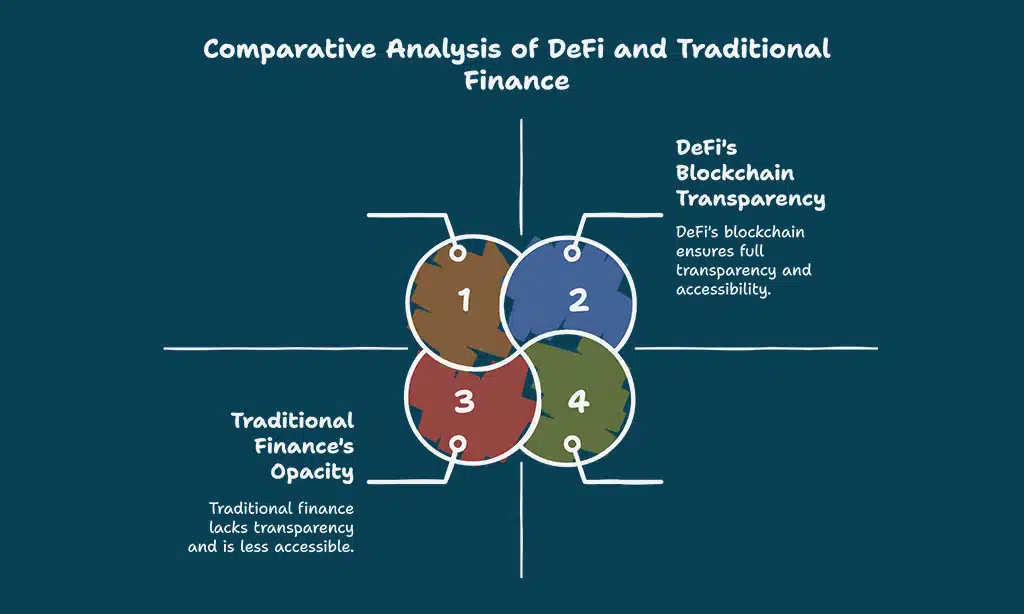
Comparison of DeFi vs. Traditional Finance
| Feature | DeFi | Traditional Finance |
| Intermediaries | None | Banks, payment processors, brokers |
| Transactions Speed | Instant, 24/7 | Can take hours or days |
| Accessibility | Open to anyone with internet access | Limited to those with bank accounts or credit history |
| Transparency | Fully transparent on the blockchain | Limited transparency |
| Cost | Low fees | Higher transaction fees |
Fact #2: DeFi is Accessible to Anyone, Anywhere
Borderless Finance and Financial Inclusion
Unlike traditional financial services, which may be inaccessible to many people due to geographical, economic, or regulatory barriers, DeFi platforms are inherently borderless. This opens up financial services to anyone with an internet connection, regardless of their location or financial status.
In many developing countries, individuals are unable to access traditional banking services because of a lack of infrastructure or credit history. DeFi has the potential to change this by offering financial products such as lending, borrowing, and insurance to individuals who would otherwise be excluded from the global financial system.
For instance, in countries like Kenya, where mobile money platforms like M-Pesa have already gained significant traction, DeFi could offer an additional layer of financial services, enhancing economic inclusion and empowering users to take charge of their finances.
Case Study: Financial Inclusion in Africa
In Africa, where millions remain unbanked, DeFi platforms are already making strides. Platforms like MakerDAO and Aave allow African users to access loans and earn interest on their crypto holdings without needing to go through traditional banks. With smartphones and mobile internet, many users can now access DeFi services, which were once the exclusive domain of those with access to banks.
Fact #3: DeFi Makes Use of Smart Contracts
What Are Smart Contracts and How Do They Work?
Smart contracts are one of the cornerstones of DeFi, enabling automation and self-execution of financial agreements without the need for intermediaries. A smart contract is a program that automatically executes the terms of an agreement when predefined conditions are met.
In the context of DeFi, smart contracts are used for various purposes, such as:
- Lending: Automatically executing the terms of a loan agreement between a borrower and a lender, including interest rates and collateral requirements.
- Trading: Facilitating the exchange of assets between users in decentralized exchanges (DEXs) without the need for a central clearinghouse.
- Insurance: Automatically triggering a payout based on certain conditions, such as flight delays or natural disasters.
Smart contracts reduce the risk of human error and fraud because they are executed automatically according to pre-set conditions. Additionally, because these contracts are stored on a blockchain, they are transparent and immutable, ensuring that all parties involved can verify the terms.
Example: Smart Contracts in Lending and Borrowing
On platforms like Compound and Aave, users can lend their cryptocurrency and earn interest through smart contracts. These smart contracts automatically execute the terms, such as determining the loan interest rate and repayment schedule, without needing a bank to process the loan.
Fact #4: DeFi Can Provide Higher Returns on Investment

Yield Farming and Staking in DeFi
One of the key attractions of DeFi is its ability to offer higher returns on investment compared to traditional financial products. Yield farming and staking are two primary ways in which DeFi platforms provide these lucrative returns.
- Yield Farming: Involves providing liquidity to decentralized exchanges (DEXs) or lending platforms in exchange for rewards. The rewards are typically paid out in the form of additional cryptocurrency, and the more liquidity you provide, the higher the potential return.
- Staking: Staking involves locking up a certain amount of cryptocurrency to participate in the network’s operations, such as validating transactions. In return for staking their tokens, users receive rewards in the form of new tokens.
However, while the potential rewards are high, these methods come with significant risks. Users must be aware of impermanent loss (a phenomenon that occurs when the value of staked assets fluctuates) and the possibility of smart contract vulnerabilities.
Yield Farming vs. Staking
| Feature | Yield Farming | Staking |
| Returns | High, but fluctuates based on liquidity | Fixed, usually lower than yield farming |
| Risk | High risk due to market volatility | Lower risk, but exposure to staking risks |
| Complexity | High, requires monitoring liquidity pools | Moderate, but less management needed |
Fact #5: DeFi is Revolutionizing Lending and Borrowing
Decentralized Lending Platforms Explained
DeFi is revolutionizing lending and borrowing by removing the need for traditional banks and credit institutions. In the traditional system, banks typically require credit checks, collateral, and a lengthy approval process to provide loans. In DeFi, loans are granted based on collateral, and the terms are governed by smart contracts, with no need for a third party.
Platforms like Compound and Aave allow users to deposit digital assets into liquidity pools, which can then be borrowed by others in exchange for collateral. This opens up new possibilities for borrowers who might not have access to traditional loans due to poor credit scores or lack of collateral.
Additionally, DeFi platforms often offer lower interest rates than banks, providing an opportunity for users to borrow at more affordable rates.
Benefits and Challenges of DeFi
Benefits of DeFi
- Increased Accessibility: Anyone with an internet connection can access DeFi services, regardless of location or financial status.
- Higher Returns: DeFi platforms offer users the opportunity to earn much higher returns on investments than traditional savings accounts or investments.
- Transparency: Transactions and smart contracts on DeFi platforms are public and immutable, providing greater trust and accountability.
- Financial Autonomy: DeFi allows users to have full control over their financial activities, without depending on intermediaries.
Challenges of DeFi
- Security Risks: As with any new technology, DeFi platforms are susceptible to bugs in smart contracts and hacking, which can result in financial loss.
- Regulatory Uncertainty: Governments and financial regulators are still trying to figure out how to manage and regulate DeFi. This could lead to legal issues for users and developers alike.
- Scalability Issues: Many DeFi platforms currently run on the Ethereum blockchain, which can become congested and lead to higher transaction fees during periods of high activity.
The Future of Decentralized Finance (DeFi)
As DeFi continues to evolve and mature, it is poised to have an even more significant impact on the global financial system. The next few years could witness the widespread adoption of DeFi, as it offers a more inclusive, transparent, and efficient alternative to traditional financial systems. Experts predict that DeFi could contribute to reshaping everything from lending and insurance to asset management and wealth creation.
Many financial institutions and investors are already beginning to recognize the potential of DeFi. Large-scale enterprises, venture capital firms, and traditional banks are looking into integrating decentralized systems into their operations, either by creating their own DeFi solutions or by partnering with existing platforms. This trend is likely to accelerate as blockchain technology becomes more mainstream, and regulatory frameworks around DeFi become clearer.
In addition to transforming how financial services are provided, DeFi could also lead to new forms of innovation in the financial space. New products, such as decentralized derivatives, insurance protocols, and prediction markets, are emerging at a rapid pace. As DeFi continues to expand, it could redefine how value is exchanged, stored, and secured in the global economy, creating a truly decentralized, peer-to-peer financial ecosystem that empowers individuals worldwide.
DeFi’s Role in the Future Financial System
DeFi is expected to play a crucial role in the future of finance. As technology improves and more users adopt decentralized financial services, DeFi could help to create a more inclusive and transparent financial system that is accessible to everyone. This could result in a shift away from centralized banking systems toward a more open, decentralized model.
DeFi Integration with Traditional Finance
In the coming years, we may see more traditional financial institutions integrating DeFi technology into their services.
Banks and financial firms could adopt decentralized platforms for lending, borrowing, and even insurance. Hybrid financial systems that combine the best aspects of traditional finance and DeFi could become commonplace, creating a more efficient, flexible, and inclusive global financial system.
Takeaways
DeFi is not just a passing trend—it’s a revolutionary shift in how we view and interact with money. The 7 things you didn’t know about decentralized finance (DeFi) shed light on the vast potential and transformative impact of this technology.
Whether it’s offering higher returns, increasing accessibility, or providing greater transparency, DeFi is reshaping the future of finance. However, as with any emerging technology, there are risks involved, and it’s crucial for users to approach DeFi with caution and a clear understanding of the landscape.
As the DeFi ecosystem matures, it’s poised to disrupt traditional finance in ways we are just beginning to understand. Stay informed, explore DeFi platforms, and get ready to take part in the financial revolution.