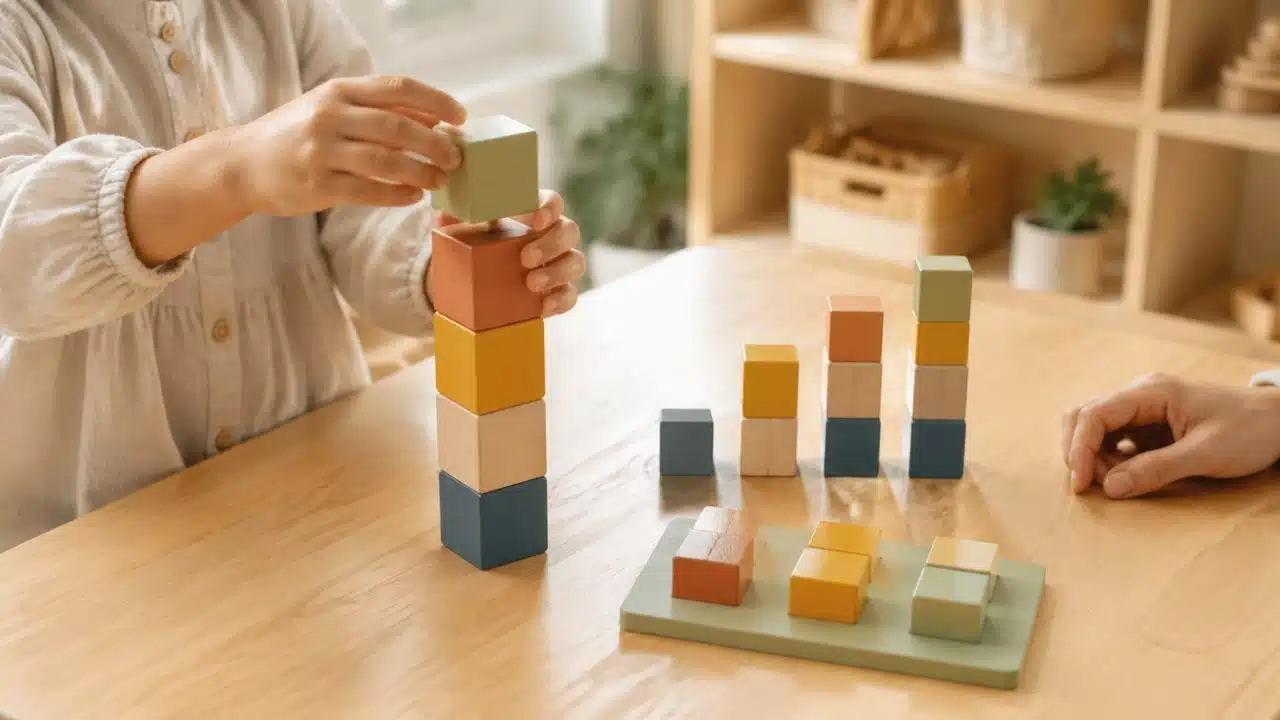
Using physical manipulatives like wooden or plastic bricks is one of the most effective strategies to introduce numerical concepts to young learners. When parents and educators teach numbers with building blocks, abstract mathematical quantities transform into tangible 3D structures, helping children connect number symbols to physical volume, spatial proportions, and set values.
| Block Activity | Core Math Skill | Sensory & Cognitive Focus | Preparation Level |
| 1. Height-Quantity Towers | Cardinality & magnitude comparison | Visual height mapping & spatial tracking | Low (blocks + numbered cards) |
| 2. Color-Coded Number Trains | Pattern recognition & classification | Color sorting & sequential alignment | Low (interlocking blocks) |
| 3. Block Array Grids | Spatial subitizing & multiplication | Grid alignment & skip counting | Low (flat baseplate + blocks) |
| 4. Subitizing Stack Sprints | Rapid set recognition | Visual perception & instant count | Low (mixed block pile) |
| 5. Missing Number Staircases | Numerical order & sequence repair | Gap analysis & structural logic | Low (wooden block set) |
| 6. Block Balance Scale | Greater than / less than comparison | Weight distribution & quantity equality | Medium (blocks + balance scale) |
| 7. Base-Ten Block Units | Place value & grouping | Ten-frame visualization & unit logic | Low (standard unit blocks) |
| 8. Number Label Search & Build | Symbol-to-quantity association | Visual scanning & motor execution | Low (sticky notes + blocks) |
8 Ways to Teach Numbers With Building Blocks
1. Vertical Height-Quantity Towers
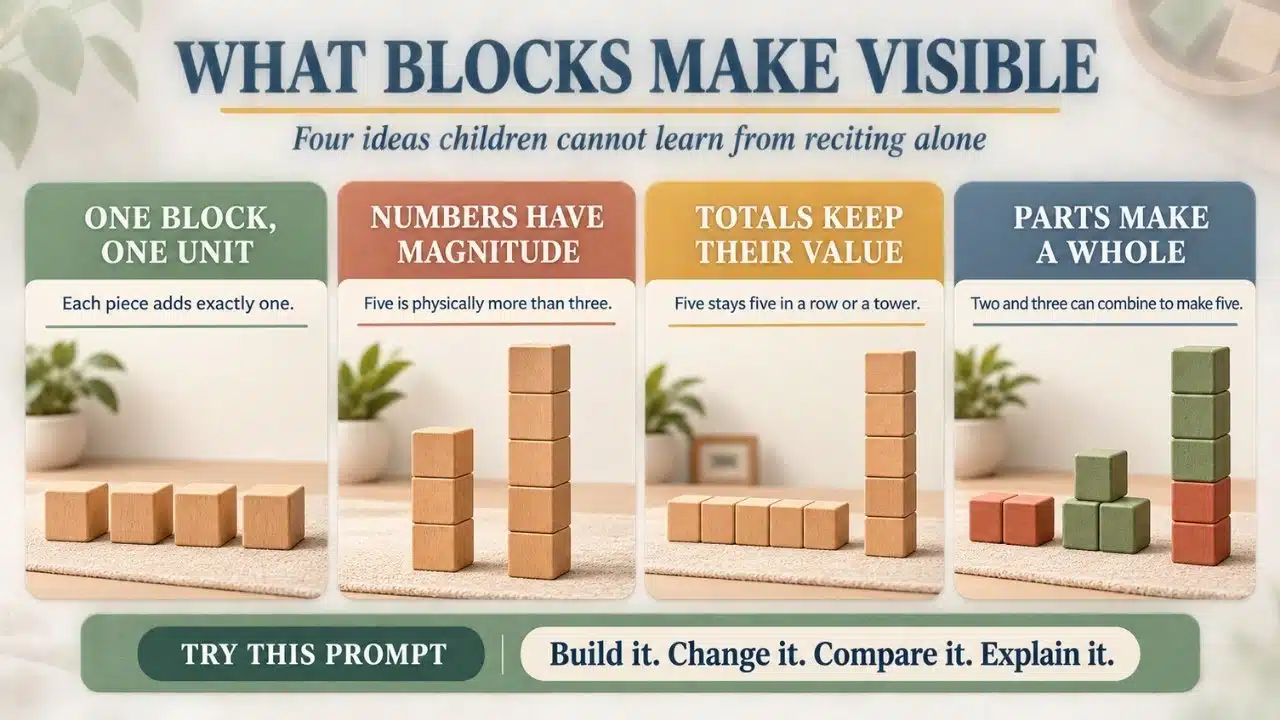
Write numbers 1 through 10 on index cards and place them in a row across the floor. Instruct your child to build a vertical tower next to each card matching the exact number written on it. A tower of 3 blocks will sit next to the number 3 card, while a tower of 10 blocks will stand tall next to the number 10 card. This visual representation allows children to immediately see that larger numbers physically occupy more space, reinforcing magnitude comparison and cardinality in a concrete visual format.
2. Color-Coded Number Pattern Trains
Connect interlocking blocks into horizontal “trains” that follow specific numerical and color patterns. For example, snap together two red blocks followed by two blue blocks, then ask your child to predict and build the next segment. This exercise links numerical counting directly with pattern identification and classification. Sorting by color while maintaining numerical constraints helps children practice dual-rule cognitive processing, an essential skill for early algebraic thinking.
3. Block Array Grids for Early Spatial Math
Place a flat baseplate on a table and create rectangular arrays using square blocks. Arrange blocks into 2 rows of 3 blocks to form a total set of 6. Guide your child to count the total units by scanning rows and columns rather than counting single scattered items. According to early childhood math development frameworks, working with visual arrays helps young learners transition from single-unit counting to skip counting and foundational multiplication structures.
4. Subitizing Stack Sprints
Subitizing is the ability to instantly recognize the quantity of a small group of objects without counting each item individually. Prepare small stacks of 2, 3, and 4 blocks beforehand and lay them out. Hold up a stack for two seconds, hide it behind your back, and ask your child to state how many blocks were in the stack. This rapid visual recognition exercise strengthens mental image processing and builds confidence in spatial number perception.
5. Missing Number Block Staircases
Build a set of block towers in ascending order from 1 to 5 blocks high to create a staircase effect. While your child closes their eyes, remove one of the central towers (such as the tower of 3 blocks) and slide the remaining towers together. Ask your child to identify which number is missing to repair the staircase structure. This problem-solving game challenges children to analyze numerical sequence integrity and understand structural number order.
6. Greater Than and Less Than Block Balance Scale
Place a simple balance scale on the table and provide a bucket of uniform building blocks. Place 4 blocks on the left side of the scale and 7 blocks on the right side. Ask your child to observe which side drops lower and explain why. Using interactive early learning strategies shows that physical weight comparison helps children visualize inequality symbols (greater than and less than) by attaching real physical weight to numerical values.
7. Base-Ten Block Units and Ten-Frames
Draw two large ten-frame grids (two rows of five squares) on a piece of paper. Provide a collection of small square blocks. Have your child fill one full ten-frame with 10 individual blocks, then add 3 extra blocks to the second frame to represent the number 13. Visualizing numbers as “one group of ten and three extra units” lays the structural foundation for place value, mental addition, and base-ten understanding long before formal worksheets are introduced.
8. Number Label Search and Build Challenge
Attach small sticky notes with written numbers onto various building blocks scattered across a rug. Call out a target number, such as 5, and have your child find the block with the number 5 label. Once found, they must instantly stack 5 unlabelled blocks on top of it. Combining visual scanning, movement, number symbol identification, and physical construction keeps learning active while reinforcing symbol-to-quantity associations.
Deconstructing Spatial Math: Why Physical Manipulation Outperforms Abstract Rote Recitation
A common pitfall in early childhood math education is assuming that if a child can count aloud to twenty from memory, they understand mathematical concepts. Rote recitation is primarily an auditory memory skill, similar to memorizing the words to a song. It does not guarantee that a child understands that the word “eight” represents a specific volume of physical items.
Building blocks solve this disconnect by bridging the gap between abstract symbols and physical reality. When a child holds a stack of five blocks in one hand and a stack of two blocks in the other, their nervous system receives immediate tactile feedback regarding weight, height, and density. They do not just hear the difference between quantities; they feel it and see it. As digital media continues to increase passive screen consumption, tactile construction play remains a non-negotiable tool for building true spatial reasoning and structural number sense.
Frequently Asked Questions (FAQs) About Teaching Numbers With Building Blocks
What type of building blocks work best for teaching early math?
Uniform wooden unit blocks or classic interlocking plastic bricks (like LEGO or Duplo) work best. Interlocking bricks are ideal for building stable vertical towers, while uniform wooden unit blocks provide accurate weight and spatial proportion feedback.
At what age should I start using building blocks for math concepts?
Basic stacking, height comparisons, and simple counting can begin around 18 months to 2 years old. Structured math games like missing number staircases, ten-frames, and array grids are ideal for preschoolers and kindergarteners aged 3 to 6.
How do building blocks help children understand place value?
By snapping ten individual unit blocks together to create a single “ten-stick,” children physically experience how ten single units merge to create one larger place-value unit. This concrete manipulation makes two-digit numbers easy to comprehend.
Can building blocks help children who struggle with traditional writing?
Yes. Children who experience fine motor delays often struggle to write numbers with pencils, which can create frustration during math practice. Using building blocks allows children to demonstrate complex mathematical thinking without fine motor writing barriers.
How long should a building block math session last?
Keep guided math play sessions short and engaging, lasting between 10 and 15 minutes. Allow the session to transition naturally into free creative play once the structured challenge is complete to maintain positive associations with math.