When toddlers and preschoolers make errors while learning to count, adults often view those missteps as incorrect answers. However, recognizing specific counting mistakes that show progress reveals that young minds are actively testing mathematical rules, shifting from mechanical recitation to genuine cognitive understanding.
| Counting Mistake | Underlying Cognitive Shift | Why It Represents Progress | Recommended Support |
| 1. Skipping the same number repeatedly | Understanding the stable-order principle | Grasps that numbers must follow a fixed, repeatable sequence | Model the full sequence naturally without corrective pressure |
| 2. Inventing pattern words (“tenteen”) | Applying linguistic rules to numbers | Recognizes structural patterns in math language | Validate the pattern logic, then supply the standard word |
| 3. Tagging objects twice during a count | Coordinating motor pacing with speech | Attempts to pair physical actions with numerical labels | Guide their hand to slow down movement to match speech |
| 4. Reciting numbers without naming the total | Separating one-to-one tagging from cardinality | Distinguishes individual item tags from set summary | Ask “How many in total?” while sweeping a hand over the set |
| 5. Counting items out of spatial order | Tracking items in unstructured arrangements | Focuses on complete inclusion rather than simple linear paths | Help arrange objects into a straight line or clean grid |
| 6. Rhythmic chanting without touching items | Absorbing verbal number strings | Builds phonological memory for mathematical vocabulary | Add physical claps or taps to link words to physical beats |
| 7. Double-counting items in a messy pile | Prioritizing total inclusion over spatial layout | Understands that every physical object must be counted | Demonstrate moving counted items from a “to-count” pile to a “done” pile |
| 8. Restarting the count when interrupted | Recognizing sequence integrity | Understands that sequence disruption invalidates the final count | Encourage their self-correction and let them complete the count |
| 9. Equating larger physical size with higher count | Transitioning from perception to abstract quantity | Connects physical dimensions to numerical magnitude concepts | Compare a set of five small buttons to two large blocks |
| 10. Inventing names for huge quantities (“zillion”) | Conceptualizing scale beyond counting limits | Realizes numbers extend infinitely past their current vocabulary | Validate their grasp of vast quantities and discuss infinity |
10 Counting Mistakes That Show Progress in Early Childhood Math
1. Skipping the Exact Same Number Repeatedly (e.g., “1, 2, 3, 5, 6”)
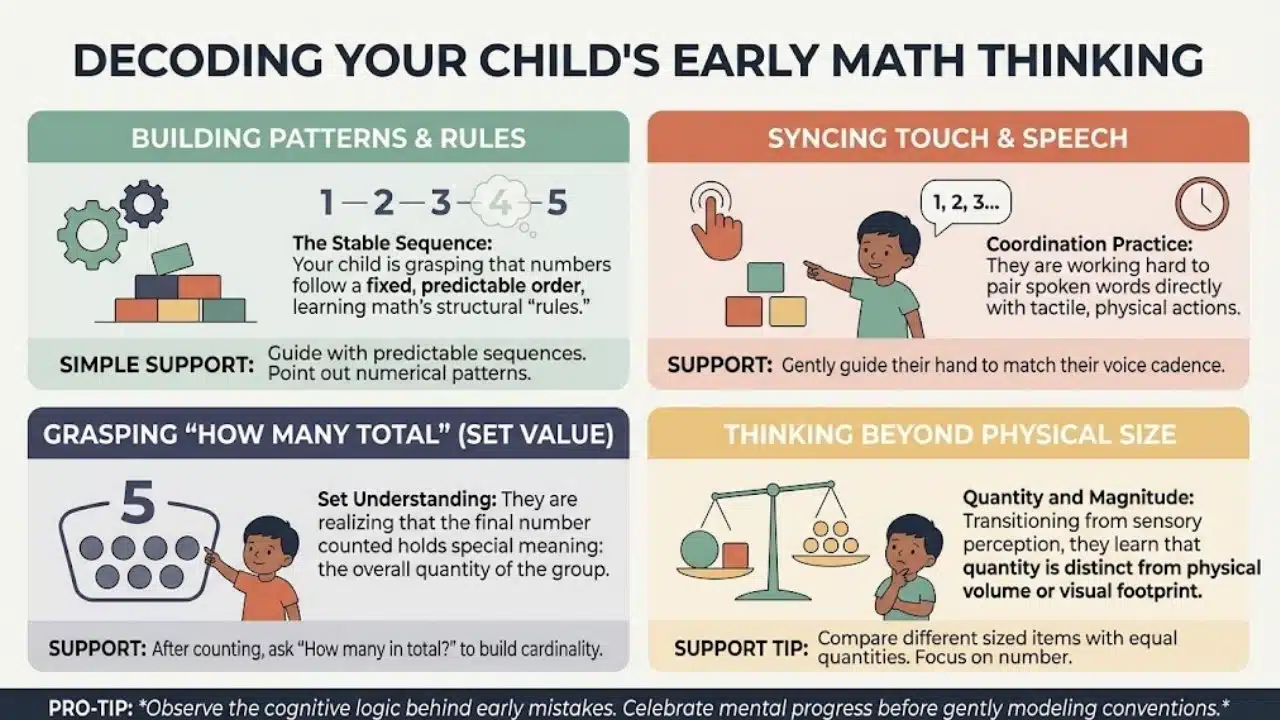
When a child skips “4” every single time they count, it appears to be a basic error. However, this demonstrates mastery of Gelman and Gallistel’s stable-order principle. The child understands that number words must be spoken in a fixed, predictable order every time, even if their current internal list is missing a digit.
2. Inventing Logical Pattern Words (e.g., “Eighteen, Nineteen, Tenteen”)
Saying “tenteen” or “twenty-one-teen” is a sign of sophisticated rule application. Instead of relying purely on memory, the child has recognized the recurring linguistic rules of numerical naming conventions. Following early childhood math development standards shows that over-generalizing patterns indicates higher-level abstract thinking than simple rote memorization.
3. Tagging a Single Object Twice While Counting
A child who points to one block and says “one, two” is struggling with physical synchronization, not math logic. This mistake shows they understand that objects require verbal number tags, but their oral speech rate is currently moving faster than their fine motor control.
4. Counting Correctly But Failing to State the Total (Lack of Cardinality)
If a child counts five cars as “1, 2, 3, 4, 5” but answers “three!” when asked how many there are total, they have mastered one-to-one correspondence while still developing cardinality. They understand how to assign labels sequentially, and are on the verge of understanding that the final number represents the total set value.
5. Counting Items in a Random Visual Order
Watching a child hop around a group of toys out of order might look chaotic, but if they touch every item once without repetition, they are demonstrating abstraction. Incorporating foundational math cognitive principles proves that children who successfully track items in random layouts possess strong spatial memory and object-tracking capabilities.
6. Chanting the Number Sequence Like a Nursery Rhyme
Chanting numbers rapidly without touching physical objects is often dismissed as meaningless singing. In reality, this phase builds the essential auditory and phonological framework required for future math. Children must master the verbal string fluently before they can pair those sounds with physical objects.
7. Double-Counting Items Left in a Cluttered Pile
When items sit in a jumbled heap, a child might count some twice. This error reveals an active struggle with spatial management, not numerical logic. The child recognizes that every item must be included, but needs organizational strategies—such as moving items across a line, to keep track of counted vs. uncounted objects.
8. Demanding to Restart the Count After an Interruption
If an interruption occurs at number seven and the child insists on starting over from number one, celebrate it. This behavior proves the child realizes that skipping around or picking up mid-sequence destroys the validity of the final count. They respect the structural integrity of the number line.
9. Assuming Larger Objects Represent Higher Numbers
A child might claim that three giant beach balls are “more” than eight tiny marbles. This mistake marks the transition from visual-spatial perception to abstract quantitative logic. The child is actively learning to decouple physical volume and visual footprint from discrete numerical quantity.
10. Creating Made-Up Words for Massive Numbers (“Zillion”, “Gazillion”)
Using invented words for large quantities shows an intuitive understanding of numerical scale. The child realizes that numbers do not end at one hundred, grasping the concept that quantities can grow infinitely beyond their current spoken vocabulary.
Deconstructing Early Math Errors in an Accelerated Learning Culture
The uncomfortable truth in early childhood education is that adults often rush children toward flawless rote recitation, treating early math as a performance metric rather than a developmental process. Flashcards and automated math apps frequently reward instant correct answers while punishing structural mistakes. This approach risks short-circuiting the genuine cognitive friction required to build deep numerical intuition.
Looking ahead, as digital platforms increasingly gamify early learning, it is vital to remember that real cognitive growth is messy. A child who misapplies a logical rule is engaging in deeper mental processing than one who simply repeats memorized sequences. The future of early math instruction relies on creating environments where errors are analyzed as windows into a child’s thinking, rather than simple mistakes to be corrected immediately.
Frequently Asked Questions (FAQs) About Counting Mistakes That Show Progress
Why should parents view early counting mistakes as a positive sign?
Counting mistakes often indicate that a child is actively applying logical rules, spatial tracking, and pattern recognition. These errors show the child is moving beyond simple rote memorization toward a deeper cognitive understanding of mathematical principles.
What is the difference between rote counting and true counting comprehension?
Rote counting is reciting number words in order from memory, similar to singing an alphabet song. True counting comprehension involves understanding that each number represents a specific physical quantity, set size, and spatial sequence.
How should adults correct a child who makes a logical counting mistake?
Avoid direct criticism or immediate correction. Instead, model the correct behavior naturally by recounting the items together, or validate their internal logic before demonstrating the standard convention.
What is one-to-one correspondence in early math development?
One-to-one correspondence is the ability to pair exactly one spoken number word with one physical object being counted. It requires coordinating visual focus, physical touch, and speech simultaneously.
At what age do children usually master cardinality?
Most children begin developing cardinality—understanding that the last number counted equals the total quantity—between the ages of 3.5 and 5. It naturally follows the mastery of one-to-one correspondence and stable-order counting.