

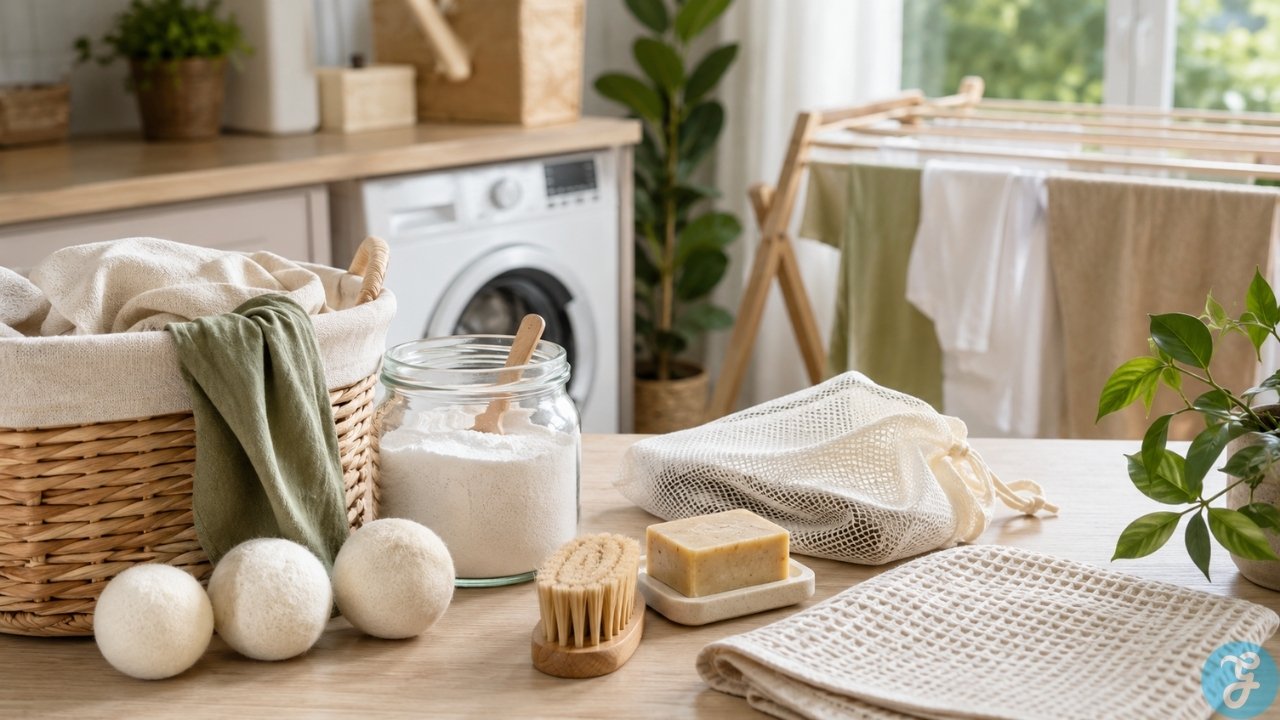
Most eco-friendly laundry advice reads like a lecture on carbon footprints, but it completely ignores whether your clothes actually come out clean. If a green alternative leaves your shirts smelling musty or fails to lift a basic coffee stain, it isn’t sustainable, it’s just a waste of water and time.
Transitioning to sustainable laundry swaps shouldn’t mean sacrificing cleanliness or turning laundry day into an exhausting manual chore. The goal is to identify which changes significantly cut down on energy usage, microplastics, and plastic waste, while filtering out the heavily marketed greenwashing that clutters the cleaning aisle.
Here is an editor-vetted breakdown of practical adjustments you can make to your routine, along with the realistic friction you can expect from each.
13 Practical Sustainable Laundry Swaps for Everyday Routines
Making the switch doesn’t require overhauling your entire routine overnight. By focusing on targeted adjustments to your washing habits and product choices, you can systematically lower your environmental impact without compromising on cleanliness. The following alternatives represent the most effective entry points for establishing a greener laundry room.
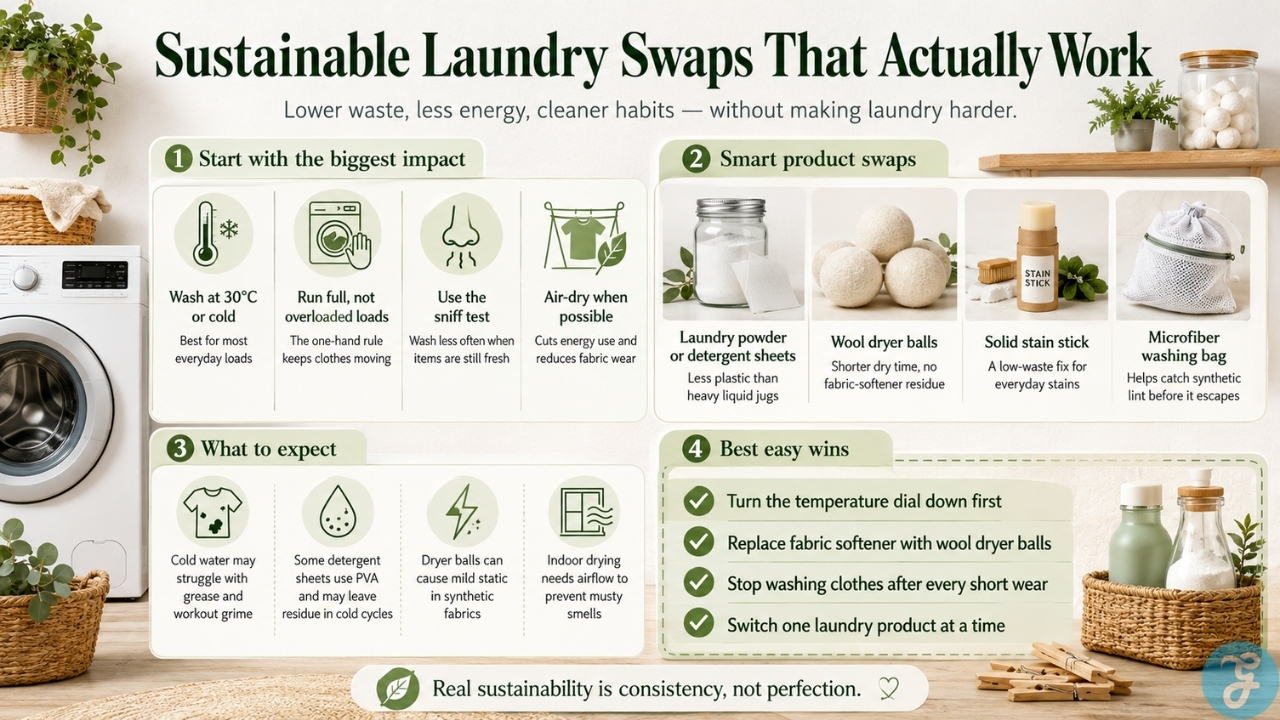
1. Drop the Dial to 30°C (or Cold Water)
Roughly 75% to 90% of the energy your washing machine uses goes entirely toward heating the water. Dropping your standard cycle down to 30°C or lower drastically reduces your household energy footprint. Modern machines and contemporary formulas are specifically engineered to axioms of cold water, meaning you don’t need heat to lift ordinary daily grime.
The practical limitation here comes down to oil and grease. Cold water cannot efficiently break down heavy lipids or body oils embedded in synthetic fabrics. For workout gear or heavily soiled work clothes, you will still need an occasional warm cycle, but for 80% of your wardrobe, cold water gets the job done perfectly while preventing your clothes from shrinking or fading.
2. Swap Liquid Detergent Jugs for Concentrated Sheets
Traditional liquid laundry detergents are up to 90% water. Shipping massive plastic jugs filled mostly with water across the country creates immense, unnecessary shipping emissions. Switching to dehydrated laundry sheets completely removes the water weight and eliminates heavy plastic packaging.
When exploring these sustainable laundry swaps, look closely at the ingredients. Many sheets rely on Polyvinyl Alcohol (PVA or PVOH) to hold their structure. While technically water-soluble, recent environmental studies highlight that PVA requires highly specific conditions to break down entirely in wastewater treatment plants, meaning some micro-polymers still slip through into aquatic environments. Furthermore, if you wash strictly in cold water, cheaper sheets can leave a gummy, un-dissolved residue on your clothes. To avoid this, dissolve the sheet in a small cup of warm water before pouring it into your drum.
3. Replace Liquid Fabric Softener with Wool Dryer Balls
Liquid fabric softeners do not actually make your clothes cleaner. Instead, they deposit a thin, chemical film of silicone polymers or tallow derivatives over the fabric fibers to give them a slippery feel. This coating ruins the absorbency of your bath towels, degrades the moisture-wicking capabilities of athletic wear, and builds up a sticky residue inside your washing machine’s pipes.
Throwing three or four pure wool dryer balls into your tumble dryer achieves a superior result mechanically. They physically bounce between layers of wet clothing, separating the fabric, allowing hot air to circulate faster, and reducing total drying time by up to 25%.
4. Switch from Chemical Stain Sprays to Solid Soap Sticks
Conventional spray-on stain removers rely on aggressive solvents and synthetic fragrances to eat away at blemishes. A solid stain stick made from vegetable oils or traditional Marseilles soap is an incredibly effective alternative for non-toxic laundry care.
The method matters here: you must catch the stain early, dampen the fabric, rub the bar directly into the fibers to create a thick paste, and let it sit before washing. It requires slightly more physical effort than a quick spray, but a single solid bar can easily last a year, replacing multiple plastic spray bottles.
5. Catch Synthetic Microfibers in a Washing Bag
Every time you wash synthetic fabrics like polyester, nylon, or acrylic, thousands of tiny plastic shards break away and head down the drain. Because municipal water filters cannot catch particles this small, they end up in oceans and marine food chains.
Using a specialized microplastic filter bag acts as a mechanical barrier. You place your synthetic garments inside the zippered mesh bag, run the wash normally, and then manually scoop the accumulated lint out of the bag’s interior corners to throw it into the trash. It adds an extra step to your sorting routine, but it is the most accessible way to halt microplastic pollution at the source until external machine filters become standard.
6. Practice the “Sniff Test” to Reduce Total Loads
The absolute most sustainable swap you can make costs nothing: stop washing clothes that aren’t actually dirty. The cultural habit of tossing a garment into the hamper after wearing it for just a few hours wears out fabric fibers prematurely and inflates your utility bills.
Jeans: Can routinely go 5 to 10 wears before needing a wash unless visibly stained.
Sweaters and Hoodies: Often only require a quick airing out on a hanger unless worn directly against the skin.
Shirts and Undergarments: Should still be washed after every wear due to direct body contact.
7. Trade Chlorine Bleach for Sodium Percarbonate (Oxygen Bleach)
Chlorine bleach is highly corrosive, irritating to the respiratory tract, and tough on aquatic life when it enters the water system. It also weakens cotton fibers over time, causing your white sheets and t-shirts to rip and yellow prematurely.
Sodium percarbonate, commonly sold as powdered oxygen bleach, breaks down into hydrogen peroxide, water, and soda ash when mixed with water. It lifts organic stains and brightens whites safely without toxic fumes. It does require warm water to fully activate, so dissolve your powder in a small pitcher of warm water before adding it to a cold cycle.
8. Use a Sturdy Folding Drying Rack Instead of the Tumble Dryer
Tumble dryers are notorious energy hogs. Line drying or utilizing an indoor drying rack completely eliminates that energy draw and prevents the friction damage that thins your clothes over time (that lint tray filter is literally made of shredded pieces of your wardrobe).
If you live in a damp climate or a poorly ventilated apartment, drying clothes indoors can cause a sudden spike in humidity, leading to mold or a lingering, sour mildew smell on your clothes. Always place your drying rack near an open window, a radiator, or run a compact dehumidifier nearby to pull the moisture out of the air quickly.
9. Swap Synthetic Scent Boosters for Pure Essential Oils
The heavily marketed scent crystals that promise to keep your laundry smelling like a chemical meadow for weeks are packed with synthetic fragrances and fixatives designed to resist rinsing out. These chemicals frequently trigger contact dermatitis and eczema on sensitive skin.
If you genuinely miss a strong fragrance, add four to five drops of pure lavender, eucalyptus, or tea tree essential oil directly onto your wool dryer balls. The scent is subtle, clean, and leaves zero chemical residue behind.
10. Trade Plastic Laundry Hampers for Canvas or Wicker Bags
Inexpensive plastic laundry baskets are notorious for cracking at the handles under heavy loads, inevitably ending up in a landfill. Investing in a heavy-duty canvas bag with reinforced straps or a traditional woven wicker hamper ensures your gear lasts for decades rather than seasons.
11. Seek Out Professional Wet Cleaning Over Dry Cleaning
Traditional dry cleaning isn’t actually dry; it involves soaking clothes in a liquid chemical solvent called perchloroethylene (“perc”). Perc is classified as a known health hazard and environmental pollutant.
For items labeled “dry clean only,” look for a local cleaner that explicitly offers professional wet cleaning. This process uses specialized, computer-controlled washers and biodegradable soaps to safely clean delicate wools and silks without toxic chemical solvents. If no wet cleaner is available nearby, many silk and wool items can actually be carefully hand-washed at home in a basin with cold water and a drop of gentle shampoo.
12. Run Only Optimized, Properly Filled Loads
Running a machine that is only one-third full wastes water, detergent, and energy. Conversely, cramming your machine to the absolute brim prevents clothes from moving freely, meaning the dirt simply gets redistributed rather than rinsed away.
The sweet spot for an efficient load is the “one-hand rule.” You should be able to comfortably fit your arm into the top of the drum above the clothes. This allows enough space for the water and eco laundry products to circulate thoroughly through the fabric.
13. Clean Your Machine with White Vinegar and Baking Soda
Over time, undissolved detergents and hard water minerals accumulate behind the drum of your machine, creating a slimy environment where bacteria thrive. Using commercial washing machine cleaner tablets introduces unnecessary synthetic chemicals into the waste stream.
Instead, run a empty, hot maintenance cycle (60°C or higher) with two cups of white distilled vinegar poured into the detergent drawer, followed by a second quick cycle with half a cup of baking soda sprinkled directly into the drum. This strips away scale build-up and neutralizes odors naturally.
The Boring Check That Matters
Before overhauling your entire laundry room with new purchases, it helps to understand exactly what you are trying to solve. Not all green alternatives are built equal.
| Product Category | Traditional Impact | Green Alternative | The Practical Catch |
| Detergent Packaging | Rigid plastic jugs that rarely get recycled | Dehydrated sheets or powders | Cheaper sheets may use PVA binders that persist in water systems. |
| Fabric Softening | Chemical films that ruin towel absorbency | Pure wool dryer balls | Can cause minor static buildup in fully synthetic loads. |
| Brighteners | Corrosive chlorine bleach that weakens fabric | Sodium percarbonate | Requires warm water activation to lift stubborn stains. |
Before You Choose
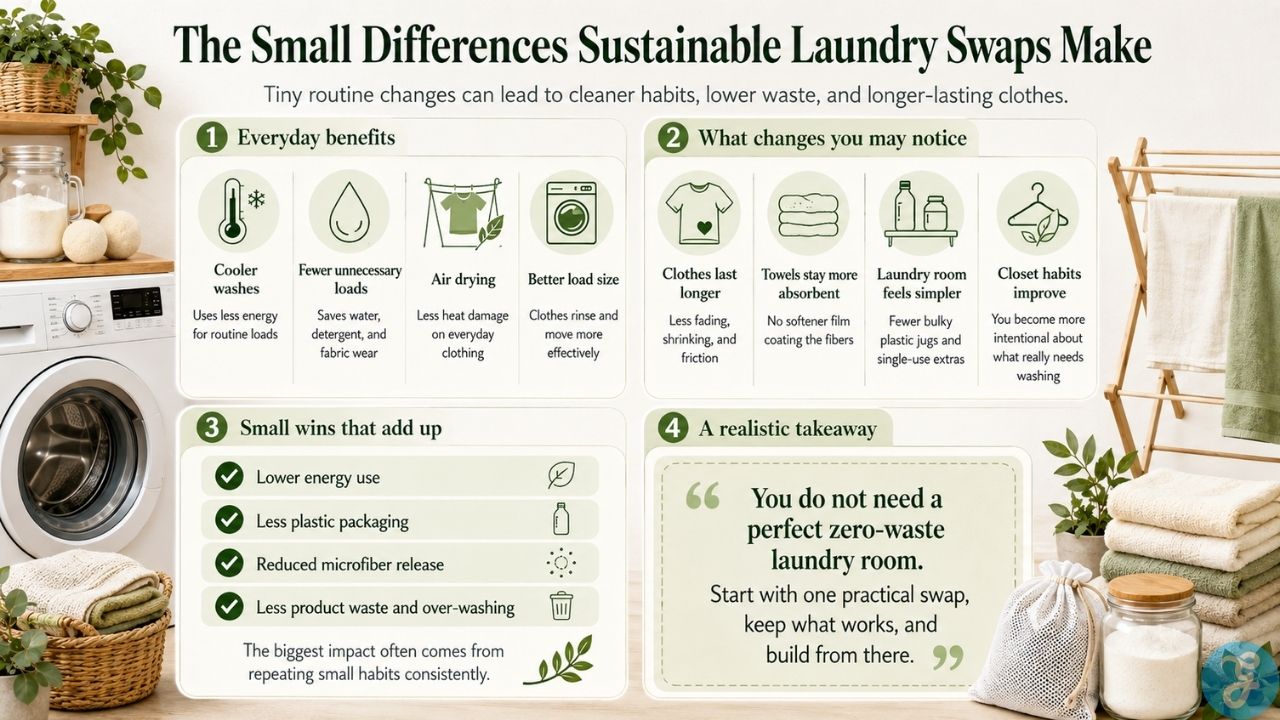
Diving headfirst into an entirely new laundry routine all at once usually results in frustration. The easiest way to start executing sustainable laundry swaps successfully is to change one variable at a time. Turn your temperature dial down to 30°C today; that change alone requires zero financial investment and instantly slashes your carbon footprint.
When your current bottle of liquid detergent runs out, replace it with a low-waste powder or a vetted plastic-free alternative. Run your clothes through the sniff test before tossing them into the wash. By treating your wardrobe with a bit more structural care and using less heat, your clothes will last significantly longer, which is the ultimate definition of sustainable living.





















