

Sri Lanka has entered a new chapter in its digital transformation as Elon Musk’s satellite internet venture, Starlink, is now officially available across the country. The announcement was made on July 2, 2025, via Musk’s verified X (formerly Twitter) account, drawing widespread attention both locally and globally.
This marks a significant milestone in Sri Lanka’s pursuit of modern, reliable, and high-speed internet infrastructure—especially for underserved regions where traditional broadband options are either limited or completely absent.
Starlink in Sri Lanka: From Approval to Activation
The journey to bringing Starlink to Sri Lanka began with critical reforms in the country’s outdated telecommunications regulations. For nearly three decades, the legal framework governing internet and telecom services in Sri Lanka had remained unchanged. Recognizing the growing need for global-standard internet accessibility, the government initiated amendments in mid-2024 to allow satellite-based broadband providers to operate legally.
In August 2024, after several evaluations and policy updates, the Telecommunications Regulatory Commission of Sri Lanka (TRCSL) officially approved Starlink’s application. This made Sri Lanka one of the first South Asian countries to formally authorize the operation of Elon Musk’s satellite internet service.
To ensure service quality and national security, a pilot project was launched in early 2025. This trial included the deployment of 10 Starlink terminals in selected remote and rural areas. Conducted in collaboration with the Ministry of Defence, the pilot program aimed to assess the feasibility, latency, and speed consistency of Starlink’s offering in different terrains and weather conditions.
The pilot’s success set the foundation for full-scale commercial deployment.
Pricing: How Much Does Starlink Cost in Sri Lanka?
With the full launch now underway, Starlink’s pricing details for residential users in Sri Lanka have been made public. According to Starlink’s official website and media reports:
| Plan Type | Hardware Cost | Monthly Subscription | Data Cap | Notes |
|---|---|---|---|---|
| Residential | Rs. 118,000 | Rs. 15,000 | Unlimited | Taxes and fees not yet clarified |
-
Hardware Cost: The one-time cost for the Starlink hardware kit (which includes the satellite dish, modem, and mounting gear) is set at Rs. 118,000, which is equivalent to approximately USD 351.
-
Monthly Charges: The recurring monthly subscription is Rs. 15,000 (around USD 45), which grants users unlimited access to satellite-powered high-speed internet.
At present, it’s unclear whether these prices include value-added tax (VAT) or any other government-imposed surcharges. Further clarification is expected as local retailers and government agencies work together to roll out billing infrastructure.
What Is Starlink, and Why Is It a Game-Changer?
Starlink is a satellite internet constellation project developed and operated by SpaceX, the aerospace company founded by Elon Musk. Unlike conventional fiber or mobile networks that rely heavily on ground infrastructure, Starlink provides internet access through a network of low Earth orbit (LEO) satellites—currently numbering over 6,700.
This design offers several benefits:
-
High-speed internet with download speeds of 100–250 Mbps
-
Low latency, making video calls and online gaming smoother
-
Reliable service even in remote and hard-to-reach regions
-
Quick deployment without the need for underground cables or towers
These advantages make Starlink particularly effective for island nations like Sri Lanka, where remote villages, mountainous terrains, and disaster-prone areas often lack stable internet connectivity.
Who Will Benefit Most from Starlink in Sri Lanka?
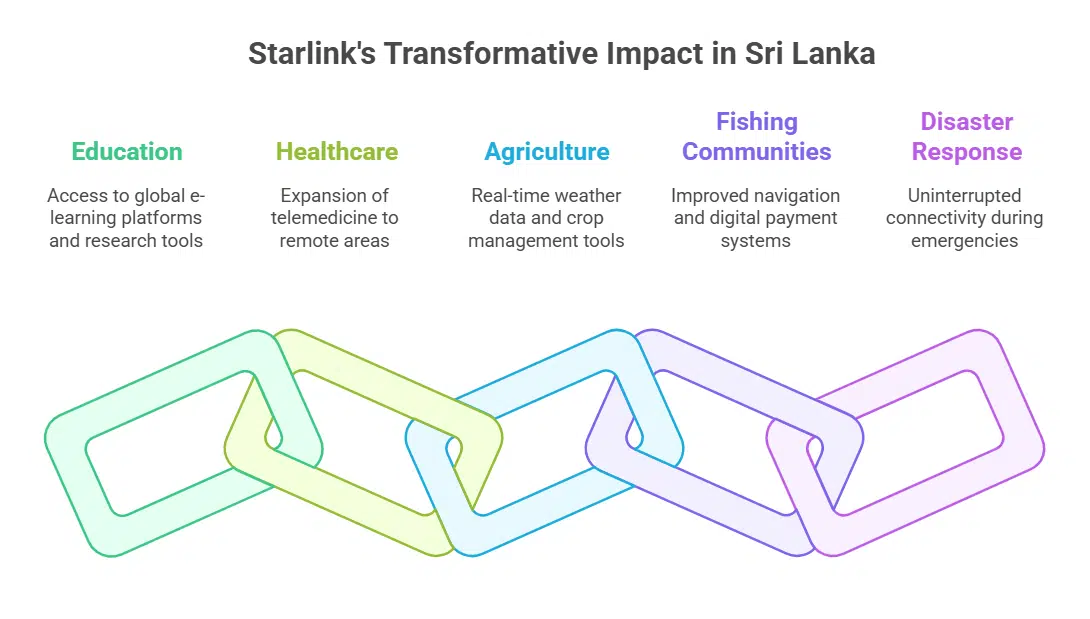
The government and telecom experts agree that Starlink’s real potential lies in empowering rural and underserved communities. Populations in areas like the Uva, Northern, Eastern, and North Central provinces, where fiber and 4G coverage remain patchy, are expected to benefit significantly.
Key sectors that could be transformed by Starlink include:
-
Education: Students and teachers in rural schools will gain access to global e-learning platforms, video conferencing, and research tools.
-
Healthcare: Telemedicine can be expanded to villages lacking hospitals and specialists.
-
Agriculture: Farmers will be able to access real-time weather data, crop management tools, and market prices.
-
Fishing Communities: Real-time navigation, weather alerts, and digital payment systems could improve safety and income.
-
Disaster Response: During floods, landslides, or cyclones, traditional communications often fail. Starlink can ensure uninterrupted connectivity in emergencies.
Starlink’s Global Expansion and South Asia Focus
With this launch, Sri Lanka joins over 140 countries that now have access to Starlink services. According to SpaceX, there are more than 6 million active users globally as of June 2025.
Starlink has been making swift inroads into the South Asian market:
-
Bangladesh officially launched Starlink in May 2025, becoming the first country in the region to go live.
-
Pakistan has approved the service in principle, pending final security and telecom audits.
-
India, a massive potential market, is expected to approve Starlink services soon. Reports indicate that SpaceX is in talks with telecom giants Reliance Jio and Bharti Airtel to collaborate on local deployments.
Implementation Challenges and Next Steps
While the announcement is monumental, there are still some practical issues to be addressed before Starlink can achieve mass adoption in Sri Lanka:
-
Affordability: The hardware cost of Rs. 118,000 remains relatively high for the average Sri Lankan household. Subsidies or financing plans may be required to boost uptake in low-income communities.
-
Import and Retail Logistics: A local supply chain must be established to deliver hardware, handle installations, and provide after-sales support.
-
Data Security and Policy Oversight: Since Starlink bypasses traditional telecom infrastructure, government agencies are still developing frameworks for monitoring data flow and ensuring national cybersecurity.
-
Awareness and Digital Literacy: The government and NGOs will need to educate rural users on the benefits of satellite internet and how to use the new technology effectively.
Despite these challenges, authorities are optimistic. The Telecommunications Regulatory Commission, in coordination with the Ministry of Digital Economy and the Ministry of Defence, will continue overseeing Starlink’s deployment to ensure safety, reliability, and accessibility for all.
A New Digital Horizon for Sri Lanka
The launch of Starlink in Sri Lanka is not just about faster internet—it represents a bold step toward bridging the digital divide. With global-standard connectivity now within reach for even the most remote communities, the possibilities for education, healthcare, entrepreneurship, and disaster management are vast.
As Sri Lanka embraces this technology-driven future, the focus must now shift to ensuring equitable access, affordable pricing, and sustainable integration of satellite internet into national infrastructure. Elon Musk’s Starlink has opened the door—what happens next depends on how Sri Lanka walks through it.

























