Are you worried AI will take your job, or leave you guessing what to learn next? Many people feel that way; they see headlines, they hear jargon, and they get stuck. You want clear steps and a real view of new roles, not hype.
This year, employers created at least six new jobs in AI prompt architect field and related roles, jobs that ask humans to write and test prompts and to guide AI. This post will name those jobs, list the key skills, show pay trends, and give you a simple plan to start. Read on.
The Role of the Prompt Architect in AI
Prompt architects craft the instructions that guide AI models. They test prompts, tune language, and map context for tasks. Good prompts cut wrong answers, save time, and lift product value, like a sharp tool in a busy shop.
Companies now hire prompt architects for product teams, research groups, and legal units. The role links AI jobs and domain experts, such as doctors, lawyers, and data scientists. You need clear writing, basic coding, and strong domain knowledge to do this job well.
Key Skills for Prompt Architect Roles
Key skills for a prompt architect role are varied. Technical expertise in LLM API and Python is essential. Strong analytical skills assist with evaluating and enhancing prompts. Additionally, soft skills like context design are important as well!
Technical Skills: LLM API and Python
Prompt architects need strong coding skills. LLM APIs and Python form the core toolset for many AI jobs.
- Learn LLM API basics, call models, handle responses, and read docs so you can use large language models in real projects.
- Master Python, write clean scripts, and use libraries like requests and asyncio to run prompts at scale.
- Build prompt templates, test variants, and log outputs to find which prompts give the best results.
- Track costs, set rate limits, and parse billing reports to keep projects profitable for clients and teams.
- Implement retries, error handling, and timeouts to keep services stable during heavy use.
- Use vector stores, embeddings, and retrieval calls to add memory and facts to prompts for domain work.
- Secure keys, follow privacy rules, and redact sensitive data to meet legal and ethical AI standards.
- Automate pipelines, run unit tests for prompts, and version code so team members can reproduce results.
Analytical Skills: Prompt Evaluation and Optimization
Good prompt architects run tests, read results, and rate answers. They use simple metrics, like accuracy, time, and cost, to compare versions. This work helps AI jobs, prompt engineering, and the prompt architect role stay practical and clear.
They tweak wording, add guardrails, and cut down bad outputs. Teams track changes with logs, charts, and short notes, so they can show gains fast. This skill keeps artificial intelligence useful, safe, and fair.
Soft Skills: Context Design and Domain Expertise
Context design helps prompt architects create improved AI prompts. It involves understanding how context influences responses from AI. A strong grasp of the specific area they work in, like healthcare or finance, is key.
They must know what users need and expect.
Domain expertise adds depth to their designs. Someone with experience in medicine will write different prompts than someone in law. This knowledge ensures the prompts are useful and relevant.
Soft skills help connect technology with human needs, making them more effective in their roles as prompt architects.
6 New Jobs in AI Prompt Architect Field
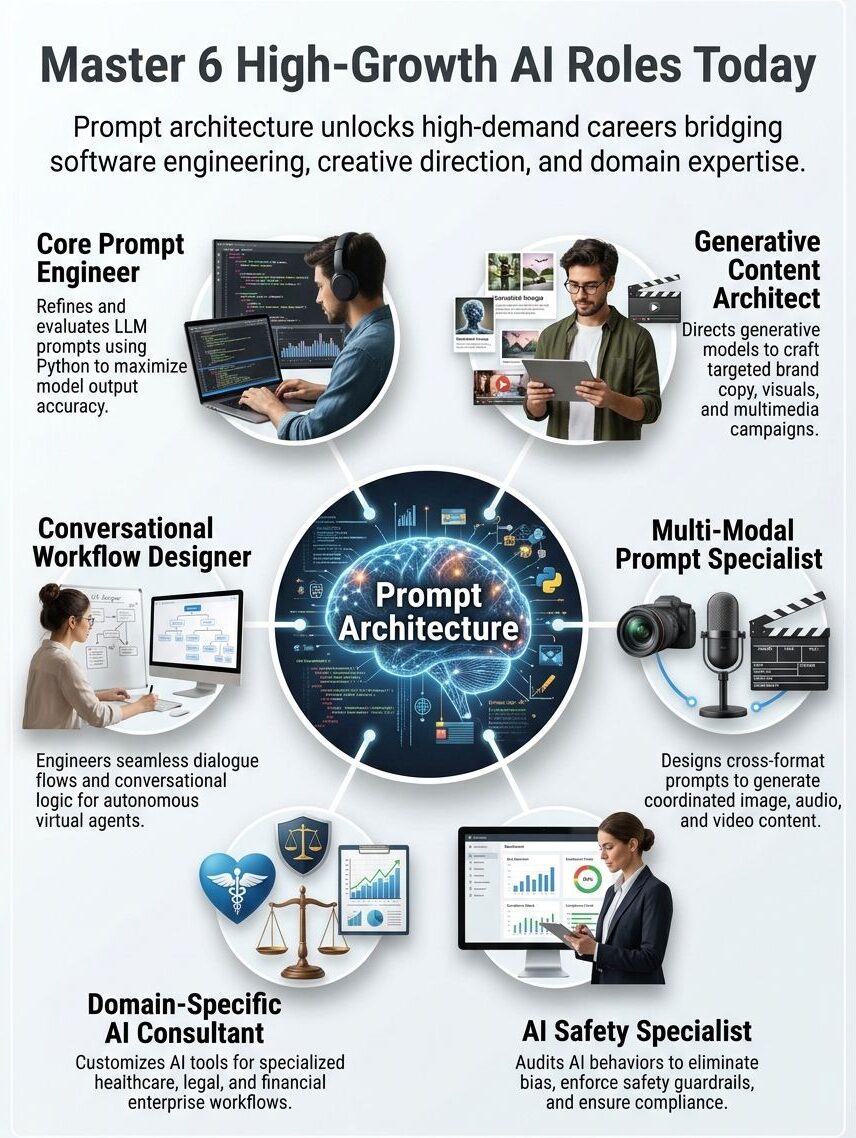
The AI prompt architect field is buzzing with fresh job opportunities this year. From engineers to specialists, there’s a role for many talents. Curious about what these new jobs entail? Keep reading!
1. Core AI Prompt Engineer Role
The Core AI Prompt Engineer role is essential in today’s job market. These engineers create prompts for AI models, aiding them in understanding and responding better. They work with large language models (LLMs) to enhance AI responses.
A strong background in coding, especially Python, is important for this job. Engineers also need analytical skills to assess and refine prompts. Good communication skills are crucial too; they assist in designing effective context for different projects.
This role requires creativity and technical expertise, making it distinctive in the expanding field of artificial intelligence careers.
2. Generative AI Content Architect Job
A Generative AI Content Architect creates content using AI tools. They design text, images, and videos that tell a story or share ideas. This role needs strong skills in prompt engineering.
It also requires knowledge of how to enhance AI outputs.
Content architects collaborate with teams to build effective messages for brands and businesses. They work closely with developers and designers as well. Their job is significant as it helps companies connect better with their audience through engaging content.
3. Multi-Modal Prompt Specialist Role: Image, Audio, and Video
Multi-Modal Prompt Specialists work with images, audio, and video. They create prompts that help AI understand and generate content across different formats. This role blends art with technology.
People in this job need to know how to work with various media types. They must grasp tools for image editing and audio mixing. Familiarity with video production is also key. Strong communication skills are important too, as they explain ideas clearly to both teams and clients.
4. AI Safety and Alignment Specialist Job
An AI Safety and Alignment Specialist focuses on making sure AI systems work as intended. This means they check if the AI behaves safely and ethically. They look for ways to prevent problems, like bias or misuse of technology.
Their work helps keep users safe from harm.
These specialists need strong skills in both technology and ethics. Knowledge of machine learning is key, plus an understanding of ethical concerns in AI use. They must communicate well, too; explaining complex ideas simply is important.
With more companies using AI, these roles are growing quickly in today’s job market.
5. Domain-Specific AI Consultant Role: Healthcare, Legal, Finance
Domain-specific AI consultants work in fields like healthcare, legal, and finance. They understand the unique needs of these industries. In healthcare, they assist in improving patient outcomes with better data management.
For legal firms, they simplify document reviews using AI tools. In finance, they enhance risk assessment models.
These consultants apply their expertise to guide companies. Their goal is to ensure that AI aligns with each domain’s rules and processes. By doing this, they increase efficiency and accuracy in critical tasks.
The role combines technical skills with industry knowledge for effective solutions.
6. Conversational AI Workflow Designer Job
The Conversational AI Workflow Designer creates smooth interactions for users and AI. They build chatbots and voice assistants, making sure these tools understand and respond well.
This job requires a strong grasp of user expectations. Designers need to keep conversations clear and natural.
They also work closely with other teams like developers and data scientists. Together, they enhance the user experience. A good workflow designer pays attention to details in dialogue design.
Their goal is to make communication easy for everyone involved.
Salary Trends for AI Prompt Architect Jobs
Salaries for AI Prompt Architect jobs vary by experience. Entry-level roles start low, but senior positions can bring in high pay. Freelance work is also rising with good rates.
Entry-Level and Senior-Level AI Prompt Architect Pay
Readers, here are typical pay ranges for entry and senior prompt architects.
| Role | Experience | Typical US Salary Range | Common Compensation Mix |
|---|---|---|---|
| Entry-Level Prompt Architect | 0–2 years | $70,000 – $110,000 per year | Base pay, small bonus, equity for startups |
| Mid-Level Prompt Architect | 2–5 years | $110,000 – $160,000 per year | Higher bonus, occasional equity, project pay |
| Senior Prompt Architect | 5+ years | $150,000 – $300,000 per year | Large bonus, equity, leadership premium |
| Lead / Principal | 8+ years | $220,000 – $400,000 per year | Significant equity, profit share, exec perks |
| Freelance / Contract | Varies | $50 – $200 per hour | Higher hourly pay for short gigs, no benefits |
– Job pay varies by city, company size, and industry.
– Remote roles often trim base pay, but add flexibility.
– Startups trade lower salary for larger equity slices.
– Big tech firms pay top cash and add large bonuses.
– Healthcare and finance roles pay more, due to domain risk.
– Contractors charge higher hourly rates to cover lack of benefits.
Freelance and Contract Prompt Architect Work
Freelance prompt architects sell skills, not hours.
| Freelance and Contract Prompt Architect Work, for Readers | |
|---|---|
| What they do |
|
| Typical rate |
|
| Where to find work |
|
| Core skills |
|
| Common contract types |
|
| Tools and stack |
|
| How to win gigs |
|
| Benefits |
|
| Drawbacks |
|
| Quick example |
|
How to Start a Career in AI Prompt Engineering
To start a career in AI prompt engineering, first build a strong portfolio. Show off your skills by creating different prompts and projects that highlight your understanding of AI tools.
Keep an eye on trends in the field too!
Build a Prompt Portfolio
Creating a prompt portfolio is key for a career in AI. This collection shows your skills and ideas.
- Start with sample prompts that you wrote yourself. Show different styles and uses.
- Include results from your prompts. Share how they improved AI responses or outcomes.
- Keep it organized. Use categories like creative writing, technical tasks, or conversational design.
- Add projects you worked on with others. Teamwork showcases your ability to collaborate.
- Update your portfolio regularly. Include new projects and trends in the AI field.
- Make it visually appealing. Use clear headings, bullet points, and visuals to enhance understanding.
- Share your portfolio online. Platforms like LinkedIn can help you reach more people in the tech industry.
Building a strong prompt portfolio opens doors in the growing world of AI jobs. It shows employers what you can do in areas like prompt engineering and AI specialization.
Track AI Trends and Tools
Keep an eye on new AI trends. They change fast, and knowing them can help your career.
- Follow AI news sites. Big websites report on the latest in artificial intelligence. This helps you stay updated.
- Join online forums or groups. Places like Reddit and Discord have communities talking about AI jobs and tools.
- Use social media wisely. Platforms like Twitter let you follow AI experts and thought leaders for quick updates.
- Sign up for newsletters. These often showcase new tools, job openings, and industry insights right in your inbox.
- Attend webinars or virtual events. Many companies host these to share information about their work with AI.
- Experiment with new tools yourself. Playing around with different software helps you understand what’s out there in the field of prompt engineering.
- Check out online courses or tutorials. Learning from skilled professionals can boost your skills quickly.
Staying aware of these trends will position you well in this growing field of AI jobs!
The Future of Prompt Architect Jobs
The future of Prompt Architect jobs is exciting and full of new chances. As technology grows, these roles will shift into new areas, like Context Engineers and AI Agent Orchestration.
Move to Context Engineer Role
Context engineers focus on how AI understands and uses information. They design ways to give context to prompts for better responses. This role helps make sure that AI gives more accurate and relevant answers.
A context engineer needs strong communication skills. They work with teams, explaining ideas simply. This job also requires knowledge of different subjects, like healthcare or legal matters.
Understanding a specific area can really improve AI performance in that field.
Rise of AI Agent Orchestration
AI agent orchestration is growing fast. It helps different AI systems work together smoothly. This makes tasks easier and faster. For example, one AI can handle voice commands while another processes data in the background.
Many companies are using this method to improve efficiency. With AI working together, businesses save time and resources. As a result, more jobs in this area are appearing each year.
People skilled in managing these agents will be in high demand soon.
The Bottom Line about Jobs in AI Prompt Architect Field
The rise of the prompt architect shows that new jobs are here. We explored roles like AI prompt engineer and generative AI content architect. Each role needs special skills in technology, analysis, and communication.
These jobs can bring great pay too! Think about how you might fit into this new landscape; now is the time to start a career in AI. Stay curious and keep learning to catch these exciting opportunities ahead!