
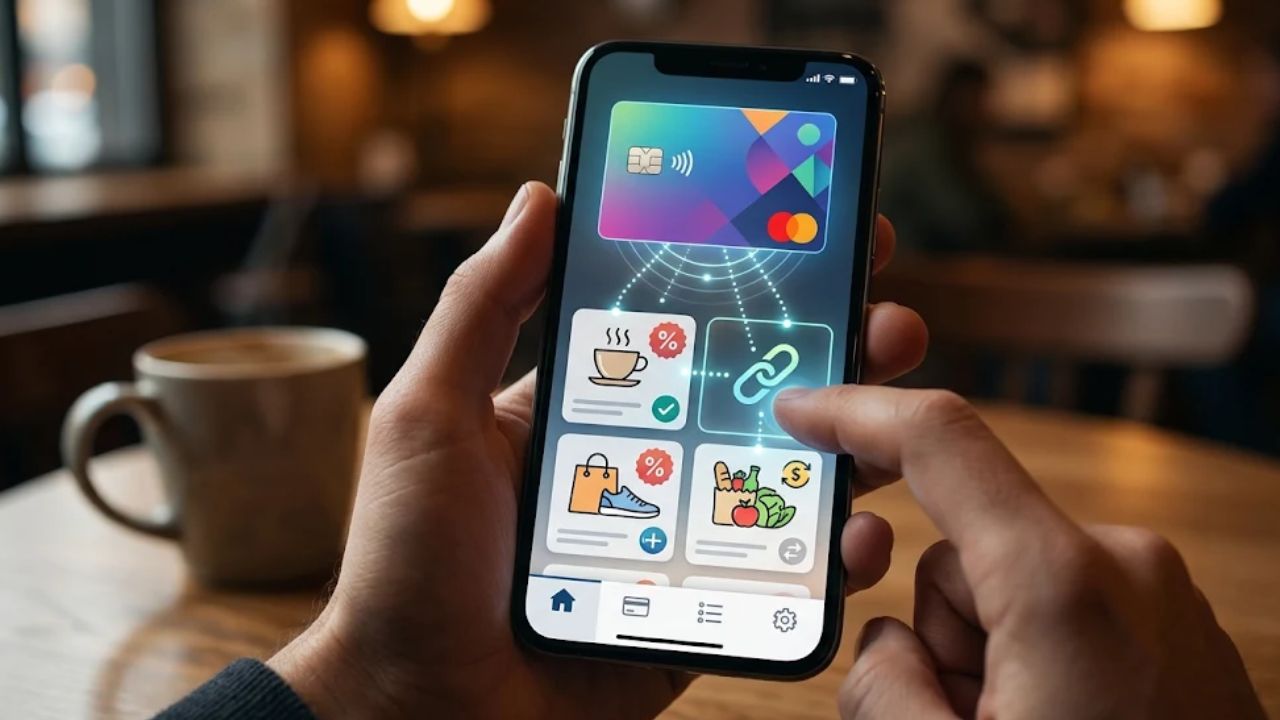
You’ve seen an “Offers” tab in your bank’s app. Maybe you wonder if it’s a real deal or just a way to track what you buy. Here is the plain answer: a card-linked offer is a deal paid for by a store. It shows up in your bank’s app and is tied to your debit or credit card.
You tap to activate it, then pay with that card. The bank matches your purchase to the offer and later adds cash back or a credit to your account. You don’t need a coupon or a code.
This guide follows one purchase from the first tap to the credit on your statement. You’ll see who pays for the reward, how your bank makes money from it, where your data goes, how much you can save, and the mistakes that cost people their rewards.
What Are Card-Linked Offers?
Card-linked offers, or CLOs, are digital deals from brands and stores. They are linked straight to a payment card, like a debit or credit card. The deal lives inside your banking app or wallet app. It is tied to one card, and your purchase is matched to the offer on its own.
The key point is who pays. The store pays for the reward, not your bank.
Why there’s no coupon or code
Card-linked offers cut out the extra steps at checkout. You don’t show anything to the cashier or type a code online. You just pay with the card you linked. The reward comes later. Depending on your bank, it may come as cash back, points, or a statement credit.
Who offers them
Big card issuers like Chase, American Express, Citi, Capital One, and Bank of America have run offers inside their apps. Credit unions, regional banks, and fintech apps can offer them too.
Some of these programs run on technology from outside companies. One of them, Cardlytics, says its ad technology reaches about 70% of U.S. households. Another, Kard, supplies merchant-funded offers to banking and wallet apps.
What kinds of stores take part
Offers often cover places you already shop. A 2016 report listed restaurants, apparel, sporting goods, and travel as popular offer types. The same report named fuel and phone service as growing types.
How Do Card-Linked Offers Work Inside Your Banking App?
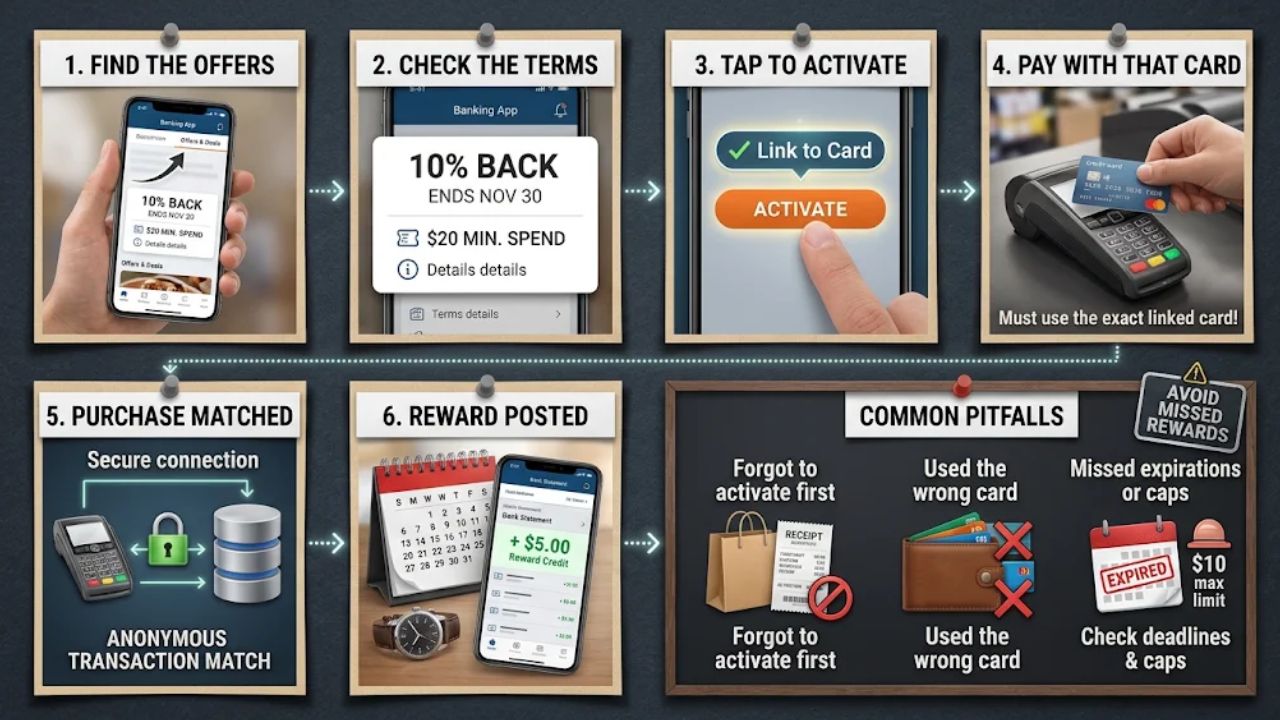
The process is short, but the order matters. If you skip a step, you can miss the reward. Here is how one purchase moves from your first tap to the credit on your statement.
Follow one purchase, step by step
- Find the offers tab. Offer programs sit inside your bank’s online and mobile banking. Look for a tab or section with a name like “Offers” or “Deals.” It is often on your card’s main screen.
- Read the offer terms. Check the end date, the percent or amount back, any cap on what you can earn, and any minimum you must spend. See if the deal works in stores, online, or both.
- Tap to activate. Most bank offers need you to turn them on before you buy. Tapping “Add” or “Activate” links that deal to your card.
- Pay with the linked card. Use the exact card the offer is tied to. A different card from the same bank may not count.
- The bank matches your purchase. Your purchase is checked against the offers you turned on. In Cardlytics’ setup, the purchase data is made anonymous and linked to a user number instead of your name.
- Wait for the credit. The reward does not land at checkout. It often takes a few days, and sometimes longer. Your offer terms may say how long.
- Check that it posted. Look at your statement or your offers page for the credit. If it’s missing after the waiting period, contact your bank.
A simple example
Say your app shows an offer of 10% back at a clothing store. You tap “Activate” on Monday. You shop there that weekend and pay with that same card.
The store charges you full price. A few days later, a credit for 10% of what you spent shows up on your account. If the offer had a cap, you’d get no more than the cap, even if 10% of your total was higher.
The catches that cost people rewards
Card-linked offers are simple, but they are not automatic in every way. These are the most common ways people lose a reward.
- Forgetting to activate. If you buy first and activate later, the purchase may not count.
- Paying with the wrong card. The deal is tied to one card. Paying with another card, even from the same bank, can miss it.
- Using a phone wallet set up with a different card. If you tap your phone to pay, make sure the wallet is using the linked card.
- Going over the cap. Many offers limit how much you can earn. Spend past the cap and you won’t get more back.
- Missing the end date. Offers expire. A purchase after the end date won’t count.
- Expecting the money right away. Credits take time to post. Don’t count on the savings until you see them.
A good habit is to activate the offers you might use, then check the terms once more before a big purchase.
Who Pays for the Reward, and What Happens to Your Data?
These are the two questions most people have when they first see the offers tab. The short answer: the store pays, your bank gets a share, and your data is supposed to stay inside the bank.
Where the money comes from
The store funds your cash back. It treats the offer as advertising. The store pays only when someone actually makes a purchase, so every dollar it spends ties to a sale.
Your bank does not pay for your reward. Instead, it earns money from the program. In Cardlytics’ model, a share of the store’s ad spend is split between Cardlytics and the bank.
Cardlytics calls these payments to banks “Partner Share.” Its top three bank partners get over 80% of those payments. That tells you a few big banks make most of the money in this part of the market.
A myth worth clearing up
You may read that banks earn from these deals through the fees stores pay on each card swipe. Those fees exist on every card purchase, offer or not. The money tied to the offer itself comes from the store’s ad budget, shared with the bank through a revenue split.
Where your data goes
To match a purchase to an offer, the system has to look at what you bought. Card-linked offers use real purchase data and purchase history, not web cookies. They don’t depend on clicks or tracking links, and they sit inside secure platforms like banking apps.
Cardlytics says its software runs “behind the bank’s or brands’ firewall, ensuring that no personally identifiable information leaves the bank’s or non-bank’s premises.” It also says transaction data is “anonymized and attributed to unique user numbers, ensuring privacy and security.”
In plain terms, the store should see results, like how many people bought. It should not see your name or account number. Keep in mind that these promises come from the company that runs the system.
What regulators are watching
The Consumer Financial Protection Bureau has raised a wider concern about payments. It said payment tools may collect and use data in excess of what is needed to initiate and complete a transaction.
The agency also said the standard privacy form banks send “may not accurately represent the increased and varied ways financial institutions share information.” A government study it cited found that “the consumer opt-out rate is generally low.” So the privacy notice in your mailbox may not tell the whole story. And most people never use the opt-out choices they have.
Is the trade worth it?
Not tapping “Activate” means you won’t earn the reward. It may not stop your bank from using your purchase history to choose which offers you see. If that matters to you, ask your bank how its offer program uses your data and what choices you have.
For many people, the trade is fair. You get money back on things you’d buy anyway, and the data stays inside the bank. If you’re still uneasy, read your bank’s privacy notice and offer terms before you start.
What Do Shoppers, Banks, and Merchants Get From Card-Linked Offers?
Each side gets something different. Here is a quick look at who gains what.
| Who | What They Get | What They Give |
| Shoppers | Cash back or credits with no coupons or codes, often 5-15% at restaurants and 5-10% at stores | A tap to activate, use of the linked card, and purchase data the bank uses to pick offers |
| Banks | A share of the store’s ad spend and a reason for you to open the app | Space in the app and a duty to protect your data |
| Merchants | New and repeat shoppers, plus clear proof of which sales the offer drove | The cost of the reward, paid only when a sale happens |
How much you can save by category
The amount back depends on the type of store. Kard lists these typical ranges:
- Restaurants and fast food: 5-15% back
- Retail and clothing: 5-10% back
- Travel: up to 20% back on larger purchases
These are ranges, not promises. Your own offers depend on your bank, your card, and the stores in your feed. Caps also limit how much you can earn on one deal.
What banks gain
Banks have pushed these programs for years. A 2016 report said banks’ offer redemption rates had risen an average of 20% to 50% over the prior few years. The same report said Bank of America customers redeemed 30% more in cash-back rewards in 2015 than the year before. Those numbers are old, but they show why banks kept building offers into their apps. Shoppers who earn rewards tend to come back to the app.
Why banks are pushing offers now
Kard points to three trends coming together. Banking apps became daily-use apps where people sign in and pay attention. Ad budgets got tighter. And older ways to track shoppers broke down as cookies faded and phone tracking rules changed.
That last point matters to marketers. One estimate says about 80% of advertisers depend on third-party cookies. Card-linked offers use real purchases instead.
The bigger field around this, called commerce media, is the fastest-growing type of advertising. Kard says it may reach nearly a fifth of all ad revenue by 2030.
How merchants prove offers bring new sales
Stores want to know if an offer brought in new sales or just paid people who would have bought anyway. To test this, Kard splits shoppers into three groups.
- Test group (80%): sees the offer.
- Control group (10%): does not see it, so the store can compare.
- Reserve group (10%): held back.
If the test group spends more than the control group, the offer likely drove new sales. That gap is what marketers call lift. Kard shares a case study from the restaurant chain Fazoli’s. The campaign drove over $530K in sales and about 6,000 offer redemptions a week. Of those redemptions, 81% came from new customers.
Card-Linked Offers vs Traditional Coupons: What’s Different?
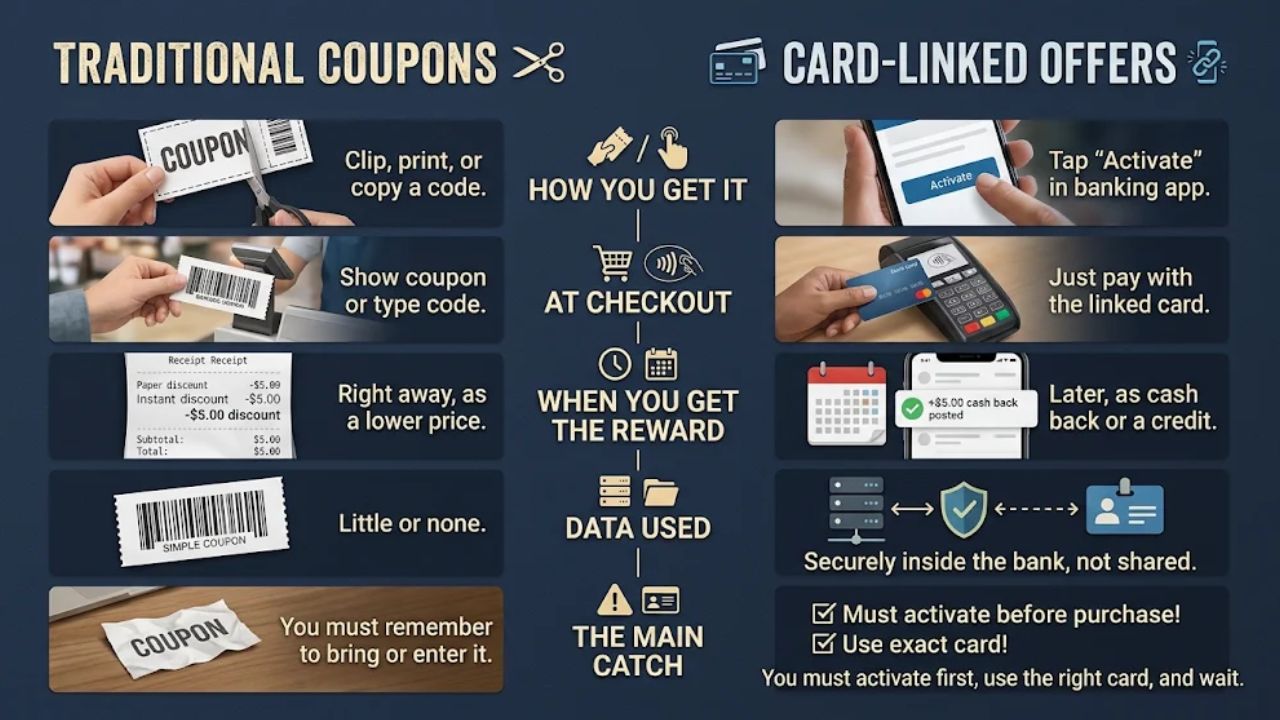
Coupons have been around for a long time. Card-linked offers work in a different way, and the key differences are about effort, timing, and data.
| Aspect | Traditional Coupons | Card-Linked Offers |
| How You Get It | Clip, print, or copy a code | Tap “Activate” in your banking app |
| At Checkout | Show the coupon or type the code | Just pay with the linked card, no extra steps |
| Who Pays | The store or brand | The store, and only when a sale happens |
| When You Get the Reward | Right away, as a lower price | Later, as cash back or a credit that can take days to post |
| Data Used | Little or none | Your card purchases, used inside the bank, not cookies |
| How the Store Measures Results | Hard to tell which coupons drove sales | Each reward ties to a real purchase |
| Main Catch | You must remember to bring or enter it | You must activate first, use the right card, and wait for the credit |
The big trade is timing. A coupon cuts the price now. A card-linked offer gives money back later, but with less work at checkout.
Where Can You Find Card-Linked Offers? Bank and App Examples
Most big banks and many smaller ones have some kind of offers section. Here is where to look and what’s known about each.
| Bank or App | Where to Look | What to Know |
| Chase | Chase Offers in the Chase app | Listed as a Cardlytics bank partner |
| American Express | Amex Offers in the Amex app | Listed as a Cardlytics bank partner |
| Wells Fargo | Offers section in the Wells Fargo app | Listed as a Cardlytics bank partner |
| Bank of America | Offers or deals area in the app | Its Cardlytics relationship ended by February 16, 2026 |
| Capital One and Citi | Offers area in each bank’s app | Both run their own card-linked offer programs |
| Credit unions and fintech apps | Rewards or offers tab, if offered | Some use providers like Kard to show offers in banking and wallet apps |
Names and menus change often. If you can’t find the tab, search your app for “offers” or “deals,” or ask your bank.
The landscape is shifting
The companies behind these offers are changing. That can change what you see in your app. Bank of America gave Cardlytics notice in April 2025 that it would not renew their deal. The relationship ended by February 16, 2026. If you bank there, your offers feed may look different than it did before.
Cardlytics’ own numbers show a mixed picture. Its revenue fell 16.2% to $233.3 million in 2025, down from $278.3 million in 2024. Its billings fell 13.3% to $385.0 million.
Yet its user count grew. Monthly qualified users, which the company calls MQUs, rose 17.7% to 224.2 million in 2025, up from 190.5 million in 2024. More people saw offers, even as the money from them dropped.
Meanwhile, newer providers like Kard sell offer programs to banking and wallet apps. For you, this means more banks and apps may add an offers tab, and the deals inside may come from different sources over time.
How to Start Saving With Card-Linked Offers Today
You don’t need to sign up for anything new to try this. Your bank’s app may already have offers waiting. Here is a simple plan.
- Open your banking app and find the offers tab. Look on your card’s main screen or search the app.
- Activate only the deals you’ll use. Pick stores you already shop at. Don’t spend more just to chase a reward.
- Read the fine print. Note the end date, cap, minimum spend, and whether it works online or in stores.
- Pay with the linked card. If you use a phone wallet, check that it’s set to that card.
- Watch for the credit. Give it a few days. If it’s still missing after the time the terms allow, contact your bank.
- Check your privacy settings. Read your bank’s privacy notice and ask what choices you have about how your data is used.
Stick to restaurants, retail, and travel, where the ranges above are highest, and the savings can add up over a year.
A quick note for marketers
If you’re a brand looking at this channel, Kard flags three common mistakes. They are skipping lift testing, picking a platform whose cardholders don’t match your buyers, and forgetting to set spend caps.
Start with a test and control split, set a firm budget cap, and choose banks or apps whose users look like your customers.
For cardholders, the bottom line is simple. Activate first, pay with the right card, and wait for the credit. The store pays for your reward, and you keep the savings.
Frequently Asked Questions About Card-Linked Offers
1. What are card-linked offers (CLOs) in a banking app?
Card-linked offers are deals tied to your debit or credit card. Major banks like Chase and Bank of America now offer them directly in their mobile apps, where you tap “add,” shop as usual, and get cash back automatically.
2. How does the bank know I used the offer?
The bank sees your card transaction, matches it to the activated deal using the merchant’s identification code, and adds the reward to your account. You don’t need a coupon or code.
3. What does Brian Riley say about card-linked offers?
Brian Riley, Director of Credit Advisory Service at Javelin Strategy & Research, has said that banks hold rich spending data. That data helps them pick offers that fit each customer. Better-fitting offers get used more often, which gives stores more sales and banks more loyal users.
4. Are card-linked offers safe for my data?
Yes, most banks keep your name and card number private from merchants. The store only sees an anonymous transaction identifier, not your personal details.