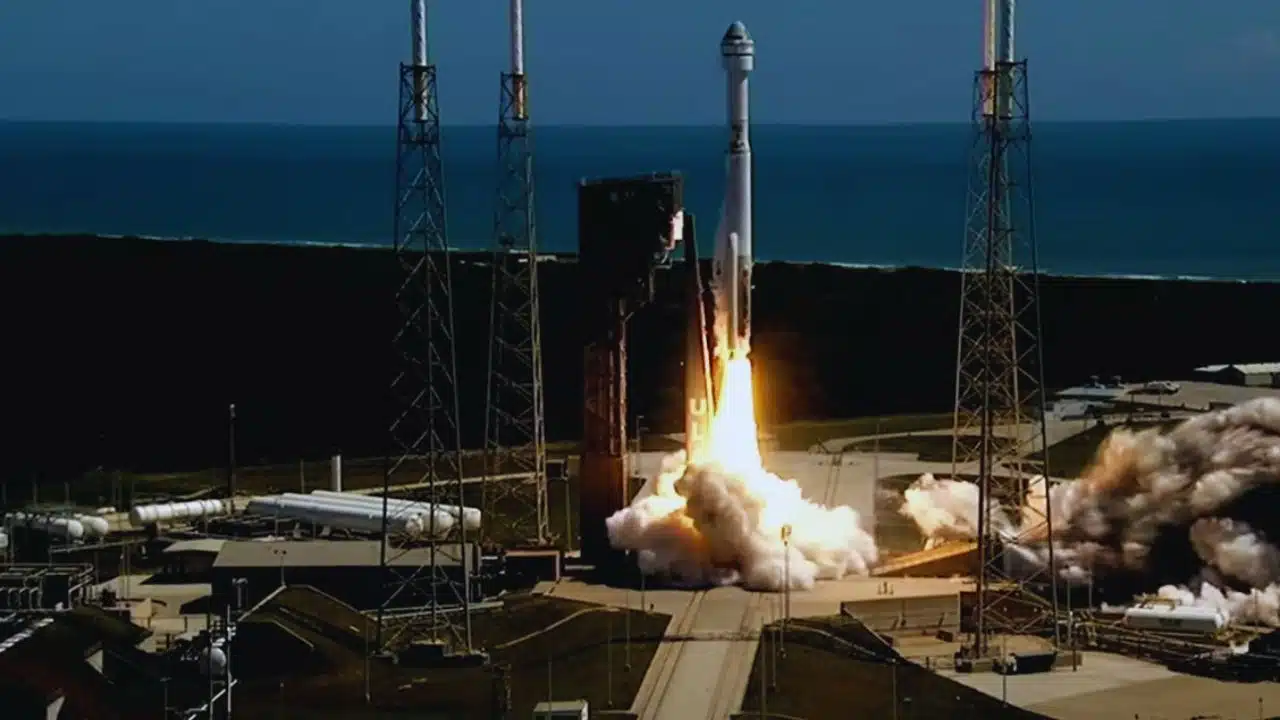
Boeing’s Starliner space capsule, after years of delays and technical issues, finally lifted off from the Cape Canaveral Space Force Station. The capsule, carrying two NASA astronauts, reached orbit approximately twelve minutes after launch.
This mission marks the first time the commercially-built Starliner is carrying humans, with a scheduled docking at the International Space Station (ISS) around 12:15 p.m. ET on Thursday.
Crew Members and Mission Details
Astronauts Barry “Butch” Wilmore and Sunita Williams “Suni” Williams are the crew members on this historic flight. Wilmore serves as the mission commander, while Williams is the mission pilot.
The astronauts will spend the next 25 hours catching up to the ISS and testing critical systems of the Starliner, including life support and communication. They will also test the manual controls of the vehicle, although the spacecraft is designed to fly itself.
Challenges Leading Up to the Launch
This successful launch comes after multiple attempts and numerous technical challenges. On Saturday, the countdown was halted with less than four minutes remaining due to an issue with the flight computers controlling the launch.
United Launch Alliance (ULA), the launch provider, replaced a faulty power supply and cleared the system for Wednesday’s launch. The previous month, a misbehaving valve on the Atlas V rocket’s upper stage, Centaur, caused another delay.
While addressing that issue, Boeing discovered a helium leak in Starliner’s propulsion system. After thorough reviews, NASA confirmed that Boeing could proceed with the mission.
Past Setbacks and Determination
Boeing’s journey to this point has been fraught with setbacks. An uncrewed Starliner mission in 2019 failed to reach the ISS due to faulty flight computer code.
NASA and Boeing declared a subsequent re-flight in 2022 to be successful, but problems with the capsule’s parachute systems and the flammable tape used to manage internal cabling later emerged. These problems were rectified, and NASA gave the green light for the crewed mission.
NASA’s Dual Partnerships
Since the retirement of the Space Shuttle in 2011, NASA has partnered with commercial companies Boeing and SpaceX to ferry astronauts to and from the ISS.
While SpaceX has already completed nine missions for NASA and four private flights, Boeing has faced significant delays.
The success of this Starliner mission is crucial for Boeing to catch up with SpaceX and provide NASA with a second option for routine astronaut flights.
The Launch Day Events
The United Launch Alliance Atlas V rocket roared to life at 10:52 a.m. EDT, successfully boosting the Starliner into space. However, flight controllers had to troubleshoot unexpected helium leaks in the ship’s propulsion system.
Despite this, the mission continued smoothly, with the Atlas V rocket generating a combined 1.6 million pounds of thrust to lift the 197-foot rocket skyward, matching the orbital path of the ISS.
Astronauts’ Reactions and Mission Objectives
Before the launch, Wilmore expressed gratitude and excitement, saying, “We all know that when the going gets tough, and it often does, the tough get going.” The astronauts will spend about a week aboard the ISS, testing the Starliner’s systems and ensuring it is ready for operational missions. They will also take a moment to congratulate Boeing, ULA, and NASA for the problem-free climb to space.
Next Steps and Future Missions
Upon returning to Earth, Wilmore and Williams will land under a canopy of parachutes in the southwest U.S. NASA and Boeing will analyze the data from this flight before certifying the Starliner for future operational missions.
NASA plans to alternate astronaut flights between Boeing and SpaceX, with trips to the ISS occurring approximately every six months.
Significance of the Starliner Mission
This mission marks a significant milestone for Boeing and the Commercial Crew Program. The Starliner is now poised to join SpaceX’s Crew Dragon in providing NASA with reliable access to the ISS.
This dual partnership ensures that NASA has consistent and dependable options for transporting astronauts to low-Earth orbit, furthering human space exploration.
The successful launch and anticipated docking of the Starliner capsule represent a triumph of perseverance and innovation, demonstrating Boeing’s capability to overcome challenges and contribute to the future of space travel. As Wilmore and Williams embark on their mission, the world watches with anticipation and hope for a new era in commercial spaceflight.
The information is taken from VBS News and BBC