


Choosing between a social media agency and an in-house team is about more than comparing monthly costs. You also need to know who can respond quickly, understand your business well enough to speak for it, and give you the level of control you want over the work.
An agency can bring skills and capacity you may not need to hire for full time. An in-house team can stay closer to your customers, products, and daily decisions. Neither is automatically the better choice. This guide compares cost, speed, context, and control so you can choose a setup that fits how your business actually works.
What’s the Difference Between a Social Media Agency and an In-House Team?
A social media agency is an outside company you pay to plan, create, and manage your social content, while an in-house team is made up of employees who work only for your business. The core difference is ownership: agencies serve multiple clients and bring ready-made systems, while in-house staff work exclusively on your brand and build knowledge over time.
Agencies typically offer:
- A full team of specialists (strategist, designer, copywriter, analyst) for one retainer fee
- Established tools, templates, and reporting systems
- Experience across many industries and platforms
In-house teams typically offer:
- Full-time attention to one brand
- Direct access to product, sales, and customer service teams
- Slower ramp-up but potentially stronger long-term brand fluency
Decision rule: Choose an agency if you need a full skill set fast without hiring multiple people. Choose in-house if your brand has complex, fast-moving internal information that outside partners would struggle to track daily.
Social Media Agency vs In-House Team: How Much Does Each Cost?
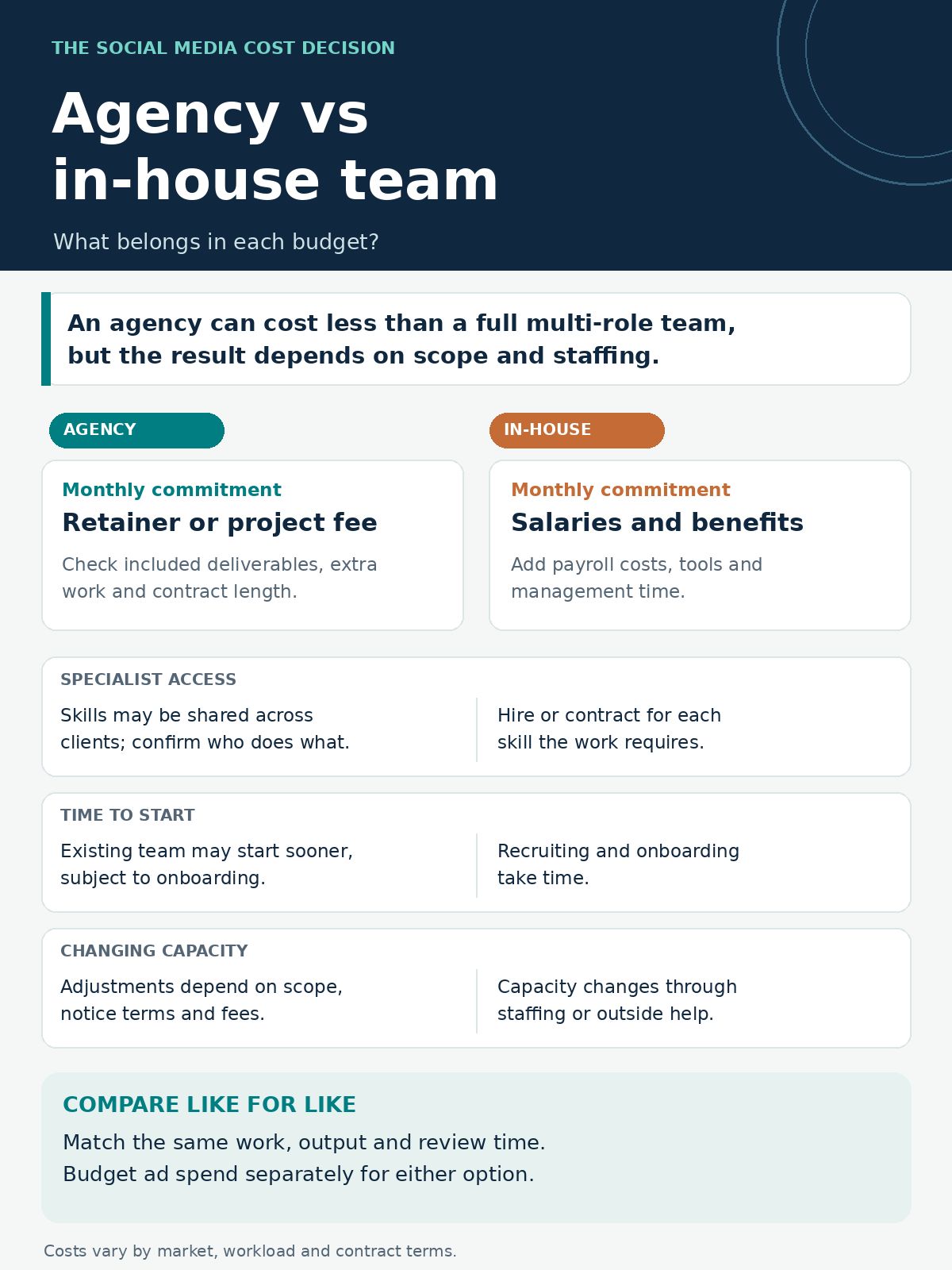
Agency retainers generally cost less than building an equivalent in-house department, because you are sharing the cost of specialists across multiple clients instead of paying full salaries for each role. In-house departments carry higher fixed costs but give you full control over how that budget is spent.
| Cost Factor | Agency | In-House Team |
|---|---|---|
| Monthly cost structure | Flat retainer covering strategy, content, and reporting | Salaries plus benefits, tools, and overhead |
| Team access | Multiple specialists included in one fee | Must hire separately for each skill (design, copy, ads) |
| Ramp-up time | Faster, existing systems in place | Slower, requires hiring and onboarding |
| Flexibility | Easy to scale up or down contractually | Harder to scale quickly without layoffs or new hires |
Common mistake: Comparing only the agency retainer number to one employee’s salary without factoring in benefits, software, and management time on the in-house side. That comparison almost always makes the agency look more expensive than it really is.
Is It Cheaper to Hire One In-House Manager or Use an Agency?
Hiring one in-house social media manager is often cheaper on paper than an agency retainer, but that person cannot cover every skill an agency team provides, such as paid ads, video editing, and analytics. A single hire works well for basic posting and community management, but complex campaigns usually require outside support anyway.
Consider this comparison:
- One in-house manager: Lower monthly cost, but limited bandwidth and skill range. Good for simple, steady posting schedules.
- Agency: Higher monthly cost, but includes strategy, design, copywriting, and reporting as a package. Better for brands running multi-platform campaigns or paid promotions.
Example: A local retail shop posting three times a week might do fine with one in-house manager. A growing e-commerce brand running ads on three platforms with regular video content usually needs an agency’s broader skill set, or a manager plus outside support.
Can a Social Media Agency Work Faster Than an In-House Team?
Yes, agencies typically move faster in the first few months because they already have proven workflows, content calendars, and platform know-how ready to deploy. In-house teams need time to build those same systems from scratch, even with talented hires.
Reasons agencies ramp up quickly:
- Pre-built content approval processes
- Existing relationships with ad platforms and analytics tools
- Experience launching campaigns for similar industries
Reasons in-house teams start slower:
- Hiring and training take weeks or months
- New employees need time to learn brand history and tone
- Systems and reporting dashboards often need to be built from the ground up
Decision rule: If you need visible results within 60 to 90 days, an agency is usually the faster path. If you have 6 months or more to build capability internally, an in-house team can catch up and often surpass agency speed once fully trained.
Do Agencies Really Understand Your Brand Better Than In-House Employees?
In-house employees generally understand brand voice and internal context better than agencies, simply because they work inside the business every day. However, a well-onboarded agency can still represent a brand accurately if given clear guidelines, access to key people, and regular feedback.
What in-house teams do better:
- Catch subtle tone issues instantly
- Know product details, customer complaints, and internal news without being told
- React to internal events (launches, leadership changes) without a briefing
What agencies need to succeed at brand context:
- A detailed brand voice guide
- Regular calls with internal stakeholders
- Access to customer service or sales notes, not just marketing materials
Common mistake: Handing an agency a logo and a few sample posts and expecting them to sound exactly like the brand within the first month. Context takes deliberate onboarding, not assumption.
What Are the Hidden Costs of Managing Social Media In-House?
The biggest hidden costs of an in-house social media team are software subscriptions, ongoing training, employee benefits, and turnover, which rarely show up in the initial hiring budget. These costs can quietly push in-house spending well above what businesses originally planned.
Hidden costs to budget for:
- Software: Scheduling tools, design software, analytics platforms
- Training: Courses, certifications, and time spent learning new platform features
- Benefits: Health insurance, paid time off, payroll taxes
- Turnover: Recruiting and retraining costs when an employee leaves
- Management time: Hours a manager spends supervising instead of doing other work
Edge case: A business that hires one junior social media coordinator without budgeting for tools or oversight often ends up spending more time correcting mistakes than they would have spent managing an agency relationship.
When Should a Small Business Hire an Agency Instead of Doing It In-House?
A small business should hire an agency instead of building an in-house team when it lacks the budget for multiple specialists, needs results quickly, or does not yet have consistent enough volume to justify a full-time hire. Agencies give small businesses access to a full skill set without the overhead of employment.
Good signs it’s time to hire an agency:
- No one on staff has marketing or content experience
- Leadership is spending more than a few hours a week on social media with little to show for it
- The business is launching a new product or campaign with a tight deadline
- Paid advertising is part of the plan, and no one internally understands ad platforms
Example: A startup founder posting inconsistently between other duties is a strong candidate for outsourcing, since the founder’s time is usually better spent on product and sales.
What Are the Downsides of Outsourcing to an Agency, and What Control Do You Lose?
The main downside of outsourcing is losing some day-to-day control over content decisions, approval speed, and how quickly small brand nuances get corrected. Businesses also give up some flexibility, since agency contracts often include minimum terms and defined scopes of work.
Control trade-offs to expect:
- Content typically goes through an approval process instead of being posted instantly
- Agencies work across multiple clients, so your brand is not their only priority
- Strategy changes may require contract discussions rather than a quick internal decision
- Sensitive or fast-moving internal information takes longer to reach an outside team
Decision rule: If your business needs same-day content changes based on internal events (retail promotions, breaking news reactions), build in a fast-response clause with your agency or keep that specific function in-house.
How Do You Know If Your Company Is Too Small for an Agency?
A company may be too small for a full-service agency if it has no consistent marketing budget, very low posting volume, or no clear audience or offer yet to promote. In these cases, a freelancer, part-time contractor, or founder-led approach is usually more practical than a retainer-based agency.
Signs a business isn’t ready for an agency yet:
- Monthly marketing budget cannot cover even a basic retainer
- The business has not defined its target customer or core offer
- There is no product or service ready to actively promote yet
Alternative: Many small businesses start with a freelancer or part-time specialist, then move to an agency once revenue and content needs grow.
Can You Use Both an Agency and an In-House Team Together?
Yes, combining an agency and an in-house team is a common and effective model, especially for growing businesses that need both strategic support and someone who understands internal operations. This hybrid setup is becoming more common heading into 2027 as businesses look for flexibility without giving up brand control entirely.
Common hybrid arrangements:
- Agency handles strategy, paid ads, and content production; in-house staff handles community management and customer replies
- In-house team manages day-to-day posting; agency steps in for big campaigns, launches, or seasonal pushes
- Agency trains an in-house hire during onboarding, then shifts to a consulting role
Example: A mid-size company might keep one in-house community manager to respond to comments in real time while an agency produces monthly content calendars and manages paid campaigns.
Common Mistakes Companies Make When Choosing Between Agency and In-House
The most common mistake is comparing only the sticker price of an agency retainer to a single employee’s salary, without accounting for benefits, tools, training, and management time on the in-house side. This skews the decision before other factors are even considered.
Other frequent mistakes:
- Hiring an agency without a clear brand guide, then blaming the agency for “not getting it”
- Expecting in-house hires to master every skill (writing, design, ads, analytics) without support
- Switching between agency and in-house too often, which resets progress each time
- Ignoring scalability needs and locking into one model without a plan to adjust as the business grows
Common mistake spotlight: Businesses that skip a clear onboarding process for a new agency often see slow, generic content for the first month or two, then assume the agency isn’t a good fit, when the real issue was a lack of context sharing.
How Long Does It Take to See Results From a Social Media Agency?
Most businesses start seeing measurable engagement or traffic improvements from a social media agency within 60 to 90 days, though stronger conversion results often take three to six months depending on the platform and industry. Paid campaigns tend to show faster results than organic growth strategies.
Typical timeline:
- First 30 days: Agency audits current accounts, sets up systems, and begins publishing
- 60 to 90 days: Engagement trends and content performance patterns become clearer
- 3 to 6 months: Follower growth, lead generation, or sales impact becomes measurable
Edge case: Businesses in highly competitive or niche industries may need longer timelines, since audience building and trust take more time regardless of who manages the account.
How Do Agencies Handle Urgent Social Media Crises Compared to In-House Teams?
In-house teams usually respond faster to internal information during a crisis because they already have direct access to leadership and company details, while agencies bring established crisis playbooks and often broader after-hours coverage. Neither option is automatically better; it depends on how well each is prepared.
In-house crisis advantages:
- Immediate access to internal facts and leadership decisions
- No need to loop in an outside party before responding
Agency crisis advantages:
- Experience handling public backlash across multiple clients and industries
- Structured response templates and monitoring tools already in place
- Often available outside normal business hours
Decision rule: If your business faces frequent public-facing risk (customer service complaints going viral, product recalls), make sure whichever option you choose has a documented crisis response plan with clear approval steps, not just good intentions.
Final Thoughts
The right setup depends on the work your business needs done each week. If social media calls for constant input from your product, sales, or customer teams, build that knowledge into your workflow. If you need specialist skills or more capacity, decide which work an agency can own and who will approve it.
Before committing, map out the full cost, expected turnaround time, and decision process for each option. A social media agency vs in-house team comparison is most useful when it reflects your actual workload and the control your business needs.
FAQ about Social Media Agency vs In-House Team
Is an agency always cheaper than an in-house team?
Not always, but agencies are usually cheaper than building an equivalent in-house department with multiple specialists, since the retainer covers a shared team instead of full individual salaries.
How fast can an agency start producing content?
Most agencies can begin publishing within 2 to 4 weeks of onboarding, since they already have systems and templates ready to adapt to a new brand.
Can an in-house team ever be faster than an agency?
Yes, once fully trained and equipped with the right tools, an experienced in-house team can respond to internal events and approve content faster than an outside agency.
What size business typically needs a full in-house team?
Businesses with consistent, high-volume content needs and enough revenue to support multiple full-time marketing salaries usually benefit most from a full in-house team .
Do agencies handle customer service messages too?
Some agencies offer community management as part of their retainer, but this should be clearly defined in the contract since not all packages include real-time customer replies.






















