
Dark social is traffic created when someone shares a link through a private channel that does not provide usable source information to the destination website. The visit itself remains visible, but the recommendation behind it often does not. Analytics may classify the visitor as Direct or credit the session to an earlier known source.
The name sounds more mysterious than the behavior actually is. Dark social has nothing to do with the dark web or suspicious online activity. It is simply the part of person-to-person sharing that conventional analytics cannot reliably identify.
What Dark Social Really Means
Journalist Alexis C. Madrigal introduced the term “dark social” in 2012. His central point remains relevant: people shared links through email, instant messaging, chat rooms, and private conversations long before public social networks made sharing visible and measurable.
The platforms have changed, but the behavior has not. Today, people privately exchange links through:
- WhatsApp, Signal, Telegram, Messenger, and iMessage
- SMS and other text messages
- Personal email
- Slack and Microsoft Teams
- Direct messages on social platforms
- Discord servers and closed communities
- Links copied and pasted into group conversations
- Private documents, notes, and discussion spaces
A private channel is not automatically dark, however. If an email newsletter uses properly tagged links, its visits can usually be identified as email traffic. A messaging share button can also attach campaign information to the URL.
What makes a visit dark is not the privacy of the conversation by itself. It is the absence of usable information showing where the visitor came from.
Imagine that someone finds a helpful article through Google. After reading it, they copy the URL and send it to a colleague through WhatsApp. The colleague opens the link and visits the article.
The human journey is easy to understand. Google helped the first reader discover the content, and a personal recommendation brought in the second reader.
The analytics journey is less complete. The second visitor lands directly on the article, but the website may receive no referring page, campaign parameter, or platform identifier. It cannot see the private conversation or identify the person who shared the link.
Analytics platforms normally depend on signals such as:
- Referrer information supplied by the browser
- UTM campaign parameters
- Advertising click identifiers
- Platform integrations
- Previously recorded visits
- Permitted first-party identifiers
When those signals are missing, the platform has little evidence to work with.
Encryption is often blamed for this problem, but that explanation is too simple. The immediate issue is that the destination website receives no usable source information. Privacy-focused apps can contribute to that outcome, but so can copied URLs, missing campaign tags, redirects, browser settings, ad blockers, and technical configuration errors.
Dark Social Is Not the Same as Direct Traffic
This is where many explanations go wrong. Dark social describes a likely behavior: one person privately shared a link with another.
Direct traffic is an analytics classification. In Google Analytics, (direct) / (none) generally means there is no clear source information available for the visit.
Some Direct traffic may come from dark social, but the Direct category can also include people who:
- Typed the website address into their browser
- Used a bookmark or browser history
- Opened an untagged link in a document
- Followed a link that lost its campaign parameters
- Passed through an incorrectly configured redirect
- Used an ad blocker or privacy tool
- Arrived from an untagged marketing campaign
- Moved between domains without correct cross-domain tracking
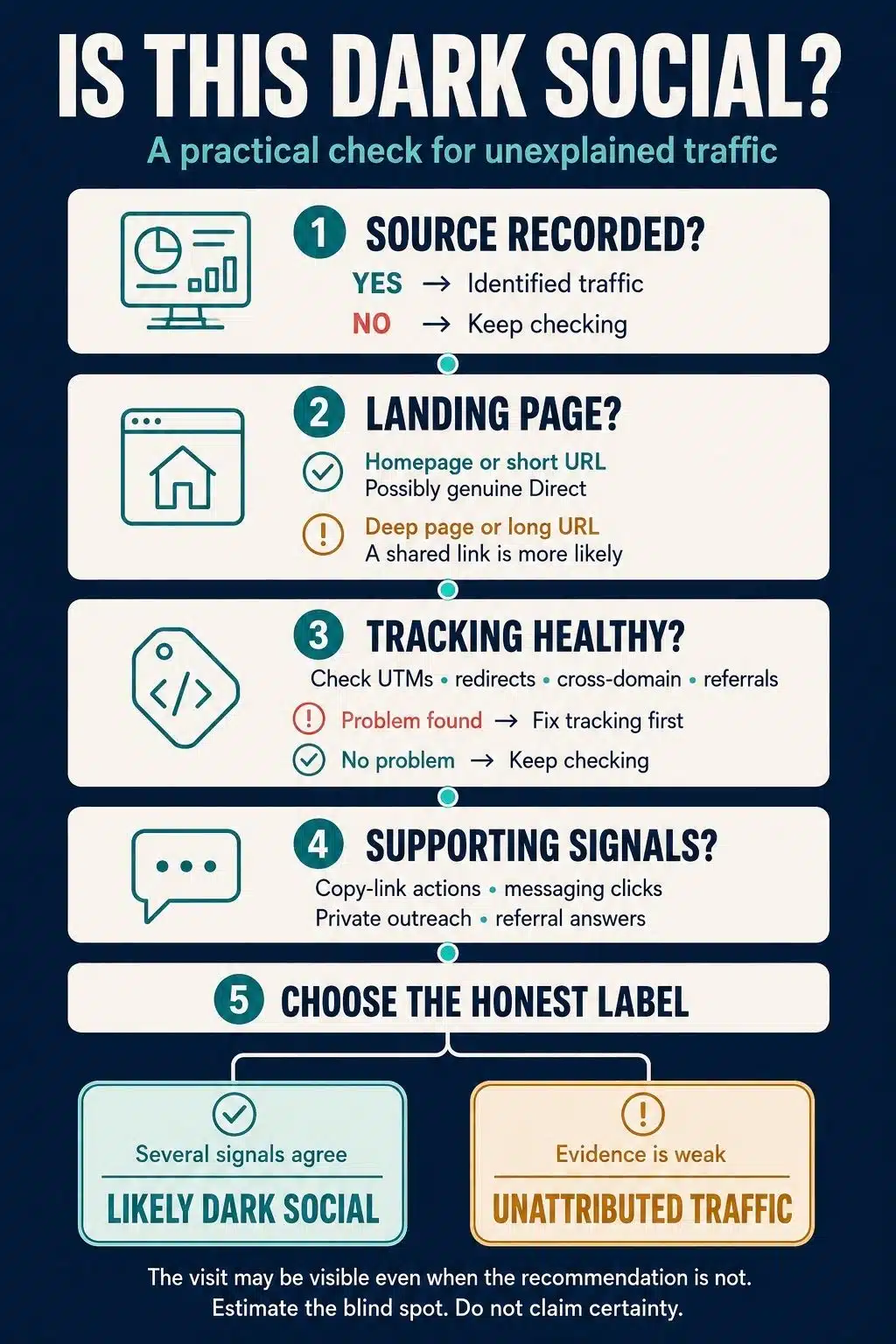
When I see Direct traffic landing on a homepage, genuine direct navigation is a reasonable explanation. When it lands on a long and highly specific article URL, private sharing becomes more plausible. It still is not proven. A bookmark, document, browser history, or technical problem could produce the same pattern.
GA4 adds another layer of complexity. Its session-scoped acquisition reporting uses non-direct attribution rules. If a returning visitor previously arrived through a known source and later comes back without identifiable source information, that later session may be credited to the earlier source within the applicable lookback period.
Event and key-event attribution can behave differently depending on the selected report and attribution settings. Direct interactions often receive little or no conversion credit when a known non-direct touchpoint exists.
As a result, dark-social visits do not always appear neatly inside Direct traffic. They can also be hidden behind search, email, social, or another previously recorded channel.
Why This Missing Traffic Matters
Dark social is not just a technical reporting issue. It can affect how a business evaluates content, marketing performance, customer acquisition, and brand demand.
Useful content may have more reach than public numbers suggest
An article can attract few visible social shares while circulating actively in private conversations. Practical guides, research, product recommendations, professional resources, and sensitive subjects are natural candidates for this kind of sharing.
Someone looking for medical, financial, workplace, or personal advice may prefer sending a link privately instead of posting it publicly. A professional may share a useful report with a team through Slack rather than announce it on LinkedIn.
If a publisher considers only public reactions and identified social referrals, some of its most useful content may appear less influential than it really is.
Direct traffic can appear stronger than it is
A website may interpret rising Direct traffic as proof that more people remember the brand and deliberately visit it. That may be partly true. It may also include private recommendations, untagged campaigns, lost tracking information, and other unattributed visits.
Without that context, a team can mistake an unknown-source bucket for a pure measure of brand loyalty.
Word of mouth receives too little credit
Private sharing is often more selective than public posting. Someone sends a particular resource to a particular person because it seems relevant to that person’s question, problem, or decision.
That does not guarantee a conversion, and I would avoid claiming that dark-social visitors are always more valuable. Their intent depends on the content, audience, product, and reason for sharing.
Still, a personal recommendation can influence trust in a way that last-click analytics does not show.
Easily measured channels can look more effective
Analytics naturally gives more visibility to channels that supply clean attribution signals. Search ads, tagged emails, and public referral sources are easier to place in a report than a recommendation made in a private group.
This can encourage teams to overvalue the final measurable click while undervaluing editorial quality, customer advocacy, community discussion, and word of mouth.
Attribution should inform a decision, not end the discussion.
How to Measure Dark Social Without Pretending It Is Exact
No tool can reveal every private share, and private conversations should remain private. The practical goal is to reduce preventable attribution loss and estimate the remaining blind spot responsibly.
Fix known tracking problems first
Before attributing unexplained traffic to dark social, audit the measurement setup.
Check whether:
- Campaign links use consistent UTM parameters
- Redirects preserve query parameters
- Cross-domain measurement works correctly
- Payment gateways create unwanted referrals
- Newsletter and social links have been tested
- Internal employee traffic is excluded
- Shortened links preserve campaign information
- UTM names follow one consistent format
These problems can turn measurable traffic into unattributed traffic. Counting the resulting visits as dark social would hide the technical issue rather than solve it.
Tag every distribution link you control
UTM parameters are useful for links placed in newsletters, SMS campaigns, partner promotions, customer communities, downloadable resources, referral programs, QR codes, and share buttons.
A simple and consistent system for source, medium, and campaign is more valuable than an elaborate system nobody follows. Capitalization and naming should remain consistent because analytics platforms can treat small variations as separate values.
UTMs reduce uncertainty, but they do not reveal every sharing step.
For example, a reader may open a link from an email newsletter and then forward the same tagged URL through WhatsApp. The second visit can still be credited to the newsletter because its campaign parameters remain attached.
The visit is measurable, but the final private recommendation is not. Analytics understands the tag carried by the URL, not the conversation surrounding it.
Record sharing signals
A website can track interactions with copy-link buttons, messaging buttons, email-share options, referral invitations, and native share menus.
These events help identify pages that inspire sharing and the methods readers attempt to use. They do not confirm that someone completed the share or that a recipient opened the link.
For that reason, these metrics should be labelled as share actions or sharing intent rather than completed shares.
Study unattributed deep-page entrances
Direct or unattributed visits that begin on specific articles, reports, tools, or product pages can provide a useful clue.
A person may reasonably type a short domain name. They are much less likely to type a long article address character by character. A visit to that article probably followed a link, although the source could still be a bookmark, document, browser history, or untagged campaign.
I would create a segment for this traffic and call it “likely dark social” or “unattributed deep-link traffic.” The wording matters because it keeps an informed estimate from being presented as a confirmed fact.
Ask visitors what influenced them
A short “How did you hear about us?” question can reveal influences that click-based attribution misses.
Possible answers might include:
- A friend or colleague
- A private group or community
- Search
- Social media
- An event, video, or podcast
- Other
Adding an optional text field can uncover sources the team did not anticipate.
People do not always remember their full journey, so self-reported attribution is imperfect. Someone may mention the source they remember most clearly rather than the one that first created awareness. Even with that limitation, these responses can reveal recommendations that analytics would never find on its own.
Unique referral links or codes can also help measure structured recommendations from partners, customers, community members, and sales teams. They will not capture every organic share, but they can improve visibility into formal referral activity.
Focus on Patterns Instead of One Dark-Social Number
There is no credible universal percentage showing how much traffic comes from dark social. The proportion varies with the audience, content, industry, devices, tracking setup, and definition being used.
Claims that most online sharing happens through dark social often rely on old studies, vendor data, publisher-specific samples, or changing definitions. They should not be applied to every website.
A more useful approach is to compare several signals:
- Unattributed visits to deep pages
- Copy-link and share-button activity
- Traffic spikes without an identifiable campaign
- Referral-link or code usage
- Self-reported recommendations
- Content that repeatedly attracts private-share actions
- Changes following community or customer outreach
- Signups and conversions associated with unattributed landing pages
No single signal proves that a visit came from a private message. When several patterns point in the same direction, however, they can support a reasonable estimate.
What Better Measurement Still Cannot Tell You
Even a careful tracking system usually cannot identify:
- Who privately shared an untagged link
- Which conversation produced a visit
- How many people saw a link but did not open it
- Whether a copied URL was ever sent
- Why the sender chose to share it
- Whether a campaign link was later forwarded through another channel
Server-side tracking does not automatically recover this information. If the browser or app never transmits the original source, processing the data on a different server cannot recreate it.
Aggressive fingerprinting is not a responsible answer either. It introduces privacy and reliability problems without providing a trustworthy picture of the private conversation.
Good measurement should reduce uncertainty while respecting the reason private communication is private in the first place.
Treat the Blind Spot Honestly
Analytics is a record of the signals a system received. It is not a complete history of how someone discovered a brand, discussed a piece of content, or decided to visit a page.
A dashboard cannot fully capture the article shared in a family group, the report sent between colleagues, or the recommendation quietly circulating inside a private professional community. That limitation does not make analytics useless. It simply means the numbers need context.
The sensible response to dark social is not to invent precision. Fix the tracking you control, compare multiple signals, ask visitors what influenced them, and resist giving absolute credit to whichever channel happens to be easiest to measure.
Frequently Asked Questions on Dark Social
It is called dark social because the sharing source is hidden from standard analytics. “Dark” refers to missing visibility, not illegal activity or the dark web.
Some dark-social visits may appear as Direct, but Direct also contains typed URLs, bookmarks, untagged documents, technical tracking failures, and other unknown sources. The two should never be treated as identical.
3. Can GA4 identify traffic from private messaging apps?
GA4 can identify a visit when the link carries usable campaign or referral information. Without those signals, the visit may appear as Direct or receive credit from an earlier known source, depending on the report scope and attribution rules.
UTMs improve attribution for links you control, but they cannot capture every organic copy-and-paste share. A tagged URL can also be forwarded through another channel while retaining its original campaign label.
Yes. A smaller site may receive fewer visits, but private recommendations can still influence content discovery, leads, subscriptions, and sales. The goal is not to calculate a perfect dark-social percentage. It is to avoid making decisions as though unattributed traffic has no human source.