The global gaming industry often looks to the giants of Tokyo and Osaka for spectacle, but the technical soul of Japanese play often resides within its fiercely independent mid-sized studios. In 2026, the landscape for SMEs for Game Design & Mechanics in Japan is characterized by a “mechanics-first” philosophy that prioritizes tactile feedback and systemic depth over sheer graphical fidelity. These studios operate as specialized ateliers, where a small headcount allows for a purity of vision that often gets diluted in massive AAA pipelines.
From the mathematical choreography of bullet-hell shooters to the rhythmic precision of high-speed action, these developers represent the artisanal side of software engineering. Identifying the specific studios that excel in these niche disciplines requires an understanding of how they balance tradition with technical innovation.
Our Selection Criteria
Our selection for the 2026 cycle focused on studios that maintain operational independence while exerting a massive influence on global design trends. We prioritized entities that have pioneered specific mechanical “feel” or systemic architectures.
-
Mechanical Signature. The studio must have a “design fingerprints”—a tactile or systemic style that is immediately recognizable to players.
-
Operational Independence. Prioritizing studios that are either fully independent, publicly listed without a parent, or maintain total creative autonomy despite minority investments.
-
Systemic Longevity. A track record of developing mechanics that are studied and emulated by other developers globally.
-
Headcount Agility. Focusing on SMEs (typically under 250 employees) where the core design philosophy is driven by a small, consistent creative leadership.
These benchmarks allow us to distinguish between studios that merely produce content and those that actively advance the science of play.
Evaluating the Top 15 SMEs for Game Design & Mechanics in Japan
The following organizations represent the pinnacle of technical and creative design within the Japanese archipelago. Here is our breakdown of the developers currently defining the mechanical standards of 2026.
Osaka remains a vital hub for studios that treat 2D animation not just as an aesthetic choice, but as a framework for complex mechanical depth.
1. Vanillaware
Based in Osaka and led by the legendary George Kamitani, Vanillaware is a micro-studio that has pioneered a unique philosophy: jointed, hand-scripted 2D character animation. In titles like 13 Sentinels: Aegis Rim and the more recent legacy of Unicorn Overlord, they demonstrate that 2D layering can provide mechanical depth—such as unit positioning and collision logic—that rivals complex 3D environments.
Best for: Developers looking to blend high-fidelity 2D artistry with deep, systemic strategy and real-time combat.
Why We Chose It: They are the world leaders in proving that 2D aesthetics can support “Triple-A” level mechanical complexity.
Things to consider: Their development cycles are notoriously long due to the artisanal nature of their hand-drawn assets.
Maintaining a public listing while staying independent allows legacy studios to refine a single genre for decades.
2. Nihon Falcom
With a headcount of approximately 80 employees, Nihon Falcom is a master of the Action-RPG hybrid. Their Ys series is a case study in “dodge-timing” combat, while the Trails series has pioneered relationship-layered world-state systems that track thousands of player choices across multiple games. In 2026, they remain the gold standard for efficient, high-impact JRPG design.
Best for: Narrative-heavy RPGs that require a perfect balance between high-speed action and complex state-tracking.
Why We Chose It: They achieve a level of world-building and mechanical consistency that often eludes studios five times their size.
Things to consider: Their visual technology often trails behind the industry curve, as they prioritize mechanical refinement over graphical fidelity.
Action design in Japan is often defined by “hit-stop” and “expressiveness,” disciplines mastered by certain Osaka-based powerhouses.
3. PlatinumGames
While Tencent holds a minority investment, PlatinumGames remains a fiercely independent creative entity. They are the global benchmark for “action feel.” Their mastery of hit-stop (the momentary pause when an attack connects), combo expressiveness, and “Witch Time” style dodging has influenced every major action game of the last decade.
Best for: High-octane action titles where the “feel” of movement and combat is the primary selling point.
Why We Chose It: They are arguably the best in the world at translating player intent into fluid, satisfying on-screen kinetic energy.
Things to consider: Their focus is almost exclusively on high-skill action, which can make their systems daunting for casual players.
Some legendary independents have stayed small specifically to preserve their influence on kinetic screen management.
4. Treasure Co., Ltd.
Founded by ex-Konami veterans, Treasure is a titan of “kinetic screen management.” Their work on Ikaruga and Radiant Silvergun introduced the world to polarity mechanics—where players must switch their “charge” to absorb or repel bullets. They treat the game screen as a mathematical space where every projectile has a specific, readable purpose.
Best for: Puzzle-action hybrids and shooters that require innovative, non-traditional gameplay loops.
Why We Chose It: Their outsized influence on “bullet choreography” and enemy pattern design remains unmatched in the indie space.
Things to consider: The studio is extremely selective and has a very low output frequency, often operating on a “quality over quantity” basis.
The mathematical design of projectile choreography is a discipline that borders on digital art.
5. Cave Interactive
Cave Interactive holds the Guinness World Record for being the most prolific danmaku (bullet hell) developer. Their contribution to game design is the “expressive grammar” of projectile density. Rather than just increasing difficulty, their patterns are designed to guide the player through a specific rhythmic “dance” across the screen.
Best for: High-precision arcade shooters and mobile games that require complex, readable projectile patterns.
Why We Chose It: They transformed a niche sub-genre into a sophisticated design discipline based on spatial awareness and hitbox precision.
Things to consider: Their expertise is highly specialized in the shooter genre, which may not translate directly to 3D exploration games.
Fighting games in 2026 have been revolutionized by studios that can make 3D models feel like hand-drawn art.
6. Arc System Works
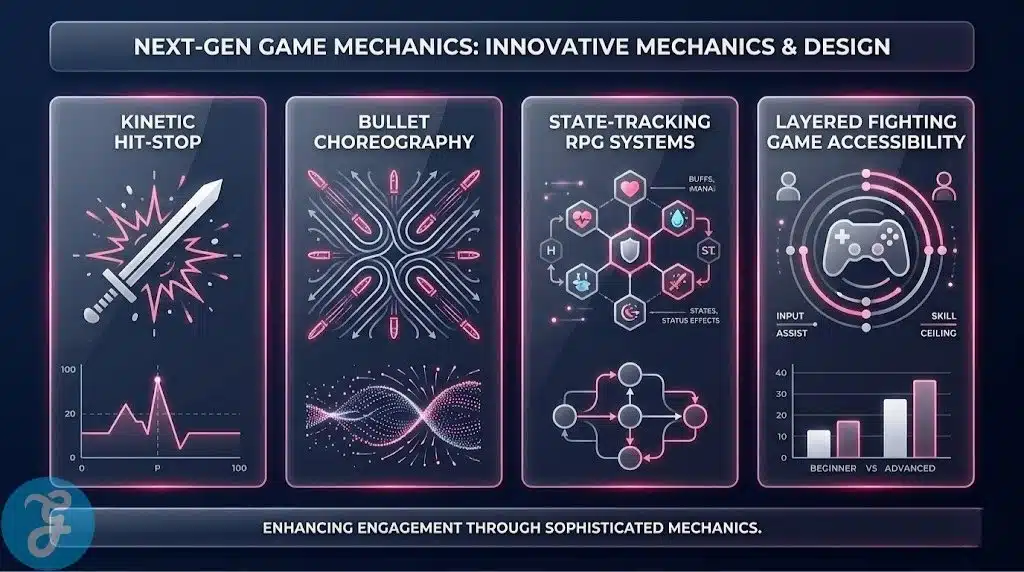
Arc System Works is the independent leader in fighting game design. With Guilty Gear Strive, they mastered the art of “layering accessibility.” They provide deep, high-level mechanical systems for pros while ensuring that beginners can still perform impressive, satisfying maneuvers. Their technical “shading” of 3D models to look like 2D anime is a benchmark for the industry.
Best for: Competitive fighting games and titles requiring a “2.5D” visual style with frame-perfect input precision.
Why We Chose It: They have successfully solved the “fighting game barrier” by making complex systems intuitive without sacrificing competitive integrity.
Things to consider: Their systems are heavily input-dependent, which requires robust netcode and high-performance hardware.
Side-scrolling action requires a specific approach where traversal and combat are treated as a single, unified system.
7. Inti Creates
Founded by ex-Capcom staff, Inti Creates are the undisputed specialists in side-scrolling “movement-as-expression.” In the Azure Striker Gunvolt series, the act of moving through a level is the same as the act of fighting. They specialize in high-speed, 2D platforming where the player’s momentum is the primary mechanical resource.
Best for: 2D action platformers and “Metroidvania” style games that prioritize fluid traversal and boss-fight choreography.
Why We Chose It: They have kept the “Mega Man” style of precision action alive while evolving it with modern tagging and combo mechanics.
Things to consider: Their games are unashamedly “retro-plus,” which may not appeal to those seeking full 3D cinematic experiences.
Systemic curiosity can often be more rewarding than narrative completion, a design philosophy pioneered in Gifu Prefecture.
8. Nippon Ichi Software (NIS)
Nippon Ichi Software created a sub-genre of Strategy-RPGs (SRPGs) built around “systemic stacking.” Their Disgaea series allows players to level up to 9,999, lift and throw units, and enter “Item Worlds” to fight inside their own equipment. They design mechanics that reward the player for “breaking” the game through clever systemic interactions.
Best for: Tactical RPGs and systems-heavy games that encourage experimentation and “theory-crafting.”
Why We Chose It: They are the masters of the “grind-as-gameplay,” making the act of increasing numbers feel like a rewarding mechanical puzzle.
Things to consider: Their games can be visually cluttered and mechanically overwhelming for those who prefer simple, streamlined experiences.
Competitive systems within puzzle-action hybrids require a very specific “visible ceiling” of mastery.
9. Arika
Founded by the creator of Street Fighter II, Arika is a Tokyo-based SME known for designing competitive systems within non-traditional genres. Their work on Tetris 99 redefined how “Battle Royale” mechanics could be applied to a puzzle game. They excel at taking a known mechanic and adding a layer of high-level competitive pressure that feels fair and readable.
Best for: Competitive puzzle games, high-speed Tetris variants, and technical fighting game co-development.
Why We Chose It: They have an uncanny ability to find the “competitive heart” of any genre, regardless of how simple the initial premise seems.
Things to consider: Their focus is often on high-level play, which can result in a steep learning curve for the average user.
Real-time battle systems that prioritize positioning and interruption were a niche specialty that has since become industry standard.
10. Tri-Ace
Tri-Ace is the technical architect behind some of the most complex real-time RPG systems ever designed. Known for Star Ocean and Valkyrie Profile, their design philosophy centers on “interruption mechanics”—where player timing and positioning can cancel an enemy’s attack. In 2026, they remain independent experts in tactical, real-time combat.
Best for: Real-time RPG combat systems that require deep tactical planning and “frame-perfect” execution.
Why We Chose It: They were among the first to successfully blend the menu-based strategy of JRPGs with the kinetic urgency of fighting games.
Things to consider: Their systems are notoriously complex, often requiring several hours for players to fully grasp the underlying logic.
Merging narrative weight with systemic innovation requires a focus on how “story” can be told through mechanics.
11. Mistwalker
Founded by the “father of Final Fantasy,” Hironobu Sakaguchi, Mistwalker is a tiny SME that focuses on narrative-systemic fusion. In 2026, they are recognized for the “Dimengeon” system in Fantasian, which allows players to “store” random encounters and fight them all at once later. This mechanic respects the player’s time while creating a unique, high-stakes combat encounter.
Best for: Narrative RPGs that want to innovate on traditional “quality of life” features through creative mechanics.
Why We Chose It: They consistently find ways to fix the “annoyances” of the RPG genre by turning them into fun, engaging systems.
Things to consider: As a very small studio, they often focus on mobile or specific console platforms, limiting their reach.
The choreography of “bullet patterns” can be used as a storytelling tool in the right hands.
12. G.rev
G.rev (Green Revolution) is a Tokyo-based studio founded by Treasure and Taito veterans. They specialize in “spatial choreography” in shooters. In 2026, they are known for Senko no Ronde, which blends the “bullet hell” genre with the mechanics of a 3D fighting game. They treat 3D space as a canvas for complex, competitive projectile logic.
Best for: 3D shooters and competitive hybrids that require unique, spatial-oriented gameplay mechanics.
Why We Chose It: They are experts at taking the 2D “bullet hell” philosophy and successfully translating it into a 3D, competitive arena format.
Things to consider: Their niche is extremely specific, making them most suitable for players who are already fans of high-skill arcade games.
Tactile, physical mechanics that prioritize the “sensation” of play are essential for family-friendly experiences.
13. Good-Feel
Operating out of Kobe and Tokyo, Good-Feel was founded by ex-Konami staff. They are masters of “tactile mechanics.” In games like Yoshi’s Woolly World and Princess Peach: Showtime!, they use physics and texture-based design to make the player feel the weight and “material” of the world. They turn physical metaphors into engaging gameplay.
Best for: Highly visual, tactile platformers and family-friendly games that prioritize “feel” and charm.
Why We Chose It: They excel at making digital worlds feel “hand-made,” using physics-based mechanics to reinforce that physical sensation.
Things to consider: Their focus is primarily on polished, accessible experiences, which may lack the “hardcore” edge of other studios on this list.
The “Igavania” loop of exploration and combat remains one of the most resilient design architectures in the industry.
14. ArtPlay
Founded by Koji Igarashi (the creator of the “Metroidvania” sub-genre), ArtPlay is a Tokyo-based SME that specializes in the “Exploration-Combat-Collection” loop. Their design philosophy centers on the “shard” or “soul” system, where every enemy defeated provides a new mechanic, ensuring that the player’s mechanical kit is constantly evolving as they explore.
Best for: 2D and 2.5D exploration games (Metroidvanias) that require deep RPG systems and satisfying combat loops.
Why We Chose It: They are the primary architects of a genre that has seen a massive resurgence in the 2020s, and they still lead in its mechanical execution.
Things to consider: Their design is heavily rooted in a specific tradition, which can feel repetitive to those seeking entirely new genres.
Ludonarrative harmony—where the mechanics and the story are one and the same—is the final frontier of design.
15. White Owls Inc.
Led by the eccentric SWERY65, White Owls Inc. is a small Osaka-based studio that focuses on “experimental narrative-mechanical ludonarrative.” They design mechanics that are often “uncomfortable” or “weird” to match the psychological state of their characters. They prove that mechanics can be used to elicit emotions beyond just “fun,” such as tension, confusion, or empathy.
Best for: Experimental indie titles and narrative-driven games that want to use mechanics as a tool for emotional storytelling.
Why We Chose It: They are one of the few studios in Japan pushing the boundaries of what a “mechanic” can be used for in a narrative context.
Things to consider: Their games are often “janky” by design, which can be off-putting for players used to the polished perfection of PlatinumGames or Arc System Works.
Reviewing these varied design houses side-by-side helps clarify the systemic landscape of the Japanese industry.
An Overview of the Japanese Mechanical Landscape
Examining these distinct providers collectively provides a clear perspective on the mechanical infrastructure available in Japan. The following data points highlight the primary functional differences between these regional powerhouses.
Overview Comparison Table
Comparing these specific metrics highlights the structural differences between “tactile” studios and “systemic” studios.
| Studio / SME | Location | Mechanical Signature | Primary Genre Focus |
| Vanillaware | Osaka | Jointed 2D Animation | Strategy / 2D Action |
| Nihon Falcom | Tokyo | Dodge-Timing / State-Tracking | Action-RPG / JRPG |
| PlatinumGames | Osaka | Hit-Stop / Expressive Combat | Character Action |
| Treasure | Tokyo | Kinetic Screen Management | Puzzle-Action / Shooter |
| Cave Interactive | Tokyo | Bullet Choreography | Danmaku (Bullet Hell) |
| Arc System Works | Yokohama | Layered Accessibility | Fighting Games |
| Inti Creates | Chiba | Movement-as-Expression | 2D Action Platformers |
| Nippon Ichi | Gifu | Systemic Stacking | Strategy-RPG (SRPG) |
| Arika | Tokyo | Competitive Mastery | Puzzle-Action / Combat |
| Tri-Ace | Tokyo | Interruption Mechanics | Real-Time RPG Combat |
| Mistwalker | Tokyo | Narrative-Systemic Fusion | Narrative RPG |
| G.rev | Tokyo | Spatial Choreography | 3D Shooter Hybrid |
| Good-Feel | Kobe | Tactile/Physical Mechanics | Platformer / Action |
| ArtPlay | Tokyo | Exploration-Combat Loop | Metroidvania (Igavania) |
| White Owls Inc. | Osaka | Experimental Ludonarrative | Narrative / Experimental |
Evaluating these diverse creative houses naturally leads to our primary recommendations for specific design needs.
Our Top 3 Picks and Why
Narrowing down the field highlights three developers making exceptional contributions to the Japanese ecosystem in 2026. PlatinumGames remains the undisputed king of “action feel,” providing the mechanical DNA that defines the modern character action genre. Arc System Works stands out for its incredible technical feat of making 3D models act as hand-drawn 2D art, while successfully bridging the gap between casual and pro play. Finally, Vanillaware is our pick for artistic-mechanical fusion; they have proven that 2D layering can support a level of systemic depth that was previously thought only possible in 3D environments.
Selecting the right design partner requires a deep understanding of their specific mechanical “language.”
Choosing the Right Japanese Design Partner
Navigating the landscape of Japanese development requires identifying which studio aligns with your mechanical requirements or creative vision.
-
Determine the “Feel” Priority. Do you need high-speed, frame-perfect reaction (PlatinumGames, Arc System Works) or deep, methodical systemic planning (Nippon Ichi, Nihon Falcom)?
-
Assess Asset Integration. Decide if your design requires a focus on 2D hand-drawn mastery (Vanillaware, Inti Creates) or high-fidelity 3D physics (Good-Feel, Tri-Ace).
-
Identify Genre Specialization. Match your project to the studio’s “signature move” (e.g., Cave for projectiles, ArtPlay for exploration loops).
-
Evaluate Operational Scale. SMEs like Treasure and White Owls are extremely small and selective; ensure your project aligns with their specific artistic interests before pursuing a partnership.
Applying this framework directly to your specific needs ensures you are engaging with the right tier of the Japanese design industry.
Decision Matrix
Matching your specific creative or technical priorities with the right developer ensures a successful partnership.
| Choose This Studio… | If You Prioritize… |
| PlatinumGames or Arc System Works | Unmatched kinetic energy and high-level competitive mechanics. |
| Vanillaware or Inti Creates | Pioneering 2D animation and movement-as-expression frameworks. |
| Nihon Falcom or Tri-Ace | Refined, high-performance JRPG battle systems and world-state tracking. |
| Cave or Treasure | Mathematical projectile choreography and kinetic screen management. |
Before finalizing a collaboration or study of these studios, running through a final verification process is vital.
The Final Checklist
Running through this quick verification process guarantees you are aligning with a stable, high-performance entity.
-
Confirm “Mechanical Ownership.” Verify that the studio’s lead designers are still the ones who pioneered their signature systems.
-
Verify Platform Expertise. Some Japanese SMEs are masters of specific hardware (e.g., Nintendo Switch vs. PC) due to their arcade-first history.
-
Check Co-Development Availability. Many of these studios (like Arika and Tri-Ace) often act as the “mechanics arm” for larger publishers; verify their current project bandwidth.
-
Ensure Design-Art Synergy. Japanese SMEs often have a “lead artist” who is also a “lead designer”; ensure their visual style matches your mechanical needs.
-
Review Recent “Feeling” Updates. Play the studio’s most recent 2025/2026 release to see how their core mechanics have evolved for modern hardware.
Implementing these systems successfully requires a deep understanding of what makes Japanese design so unique.
The Philosophy of the Japanese “Feeling”
As we move through 2026, it is clear that the landscape for SMEs for Game Design & Mechanics in Japan is defined by a relentless pursuit of the “feeling” of play. Reflecting on the artisanal nature of studios like Vanillaware or the mathematical precision of Cave, it becomes evident that Japanese design is not just about writing code; it is about crafting a tactile experience. In the West, we often prioritize “content volume” and “narrative fidelity,” but in the ateliers of Osaka and Tokyo, the focus remains on the singular moment an attack connects or a character jumps. This “mechanics-first” approach is what has allowed these independent SMEs to remain relevant for decades, even as larger corporations struggle with astronomical production costs.
The spirit of the Japanese SME is the spirit of the craftsman—polishing a single movement loop until it feels like an extension of the player’s own body. Supporting this ecosystem means recognizing that the most profound innovations in gaming don’t always happen in a thousand-person boardroom; they happen in a small room in Yokohama where a designer is obsessing over the exact number of frames a character should pause after a hit.
To further clarify the state of Japanese game design, addressing common logistical questions is essential.
Frequently Asked Questions (FAQs) About SMEs for Game Design & Mechanics
Why are Japanese mechanics considered so “tactile”?
Japanese game design has deep roots in the arcade industry, where a player’s decision to spend another coin was directly tied to how “good” the controls felt. This legacy of “arcade feel” (immediate response, clear hitboxes, and kinetic feedback) remains a core pillar of Japanese design philosophy today.
Are these independent studios easy to collaborate with?
While many are open to co-development, Japanese SMEs often have very specific internal cultures and prioritize creative autonomy. Successful partnerships usually involve a “hands-off” approach to their signature mechanics while providing support for localizing content and managing global marketing.
How do Japanese SMEs manage such deep systems with small teams?
They often utilize highly specialized, proprietary tools developed over decades. For example, Arc System Works has a custom Unreal Engine pipeline for their shading, and Vanillaware has a proprietary animation engine. This technical “head start” allows them to focus on design rather than rebuilding foundations.
Is 2D design still relevant in the Japanese AAA space in 2026?
Absolutely. Thanks to the success of studios like Vanillaware and Inti Creates, 2D and “2.5D” design are seen as high-end aesthetic and mechanical choices rather than budget constraints. In 2026, 2D titles often command the same prestige and price points as 3D blockbusters.
What is the significance of the “Ex-Capcom” or “Ex-Konami” label?
The “golden age” of 90s Japanese arcade and console development was driven by Capcom and Konami. When those large structures shifted, many of their best designers formed the SMEs we see today (PlatinumGames, Treasure, Inti Creates). This ensures a direct lineage of design excellence from the 16-bit era to modern hardware.