
Many professionals build early career habits around saying yes to every incoming request. We take on late-night deliverables, volunteer for extra project committees, and absorb tasks outside our job descriptions to prove our commitment.
Over time, this strategy backfires. Constantly agreeing to extra work leads directly to missed deadlines, compromised work quality, and severe professional exhaustion.
Learning effective methods for setting boundaries at work allows you to manage your time, protect your mental bandwidth, and deliver high-impact results. When handled thoughtfully, establishing firm limits actually increases the respect peers and managers have for your professional judgment.
Why Setting Boundaries at Work Is Essential for Career Growth
Every time you accept an incoming request, you implicitly deprioritize something already sitting on your schedule. Time and energy are strictly finite. When your daily calendar fills up with low-priority tasks or favors for colleagues, your focus fractures, leaving less capacity for high-impact projects.
People usually hesitate to set workplace limits due to two common concerns:
-
Fear of professional penalty: Worrying that declining a task makes you look unmotivated or uncollaborative during performance reviews.
-
Fear of damaging relationships: Believing that saying no will offend peers, alienate clients, or create tension in daily team interactions.
Understanding the realities of setting boundaries at work reveals why chronic overcommitment harms team relationships far more than firm limits ever could. Taking on more than you can handle leads to sliding deadlines, faltering communication, and building resentment. Most colleagues prefer a clear, timely refusal over a hesitant commitment that ends in a rushed product or a late delivery.
Practical Approaches to Setting Boundaries at Work
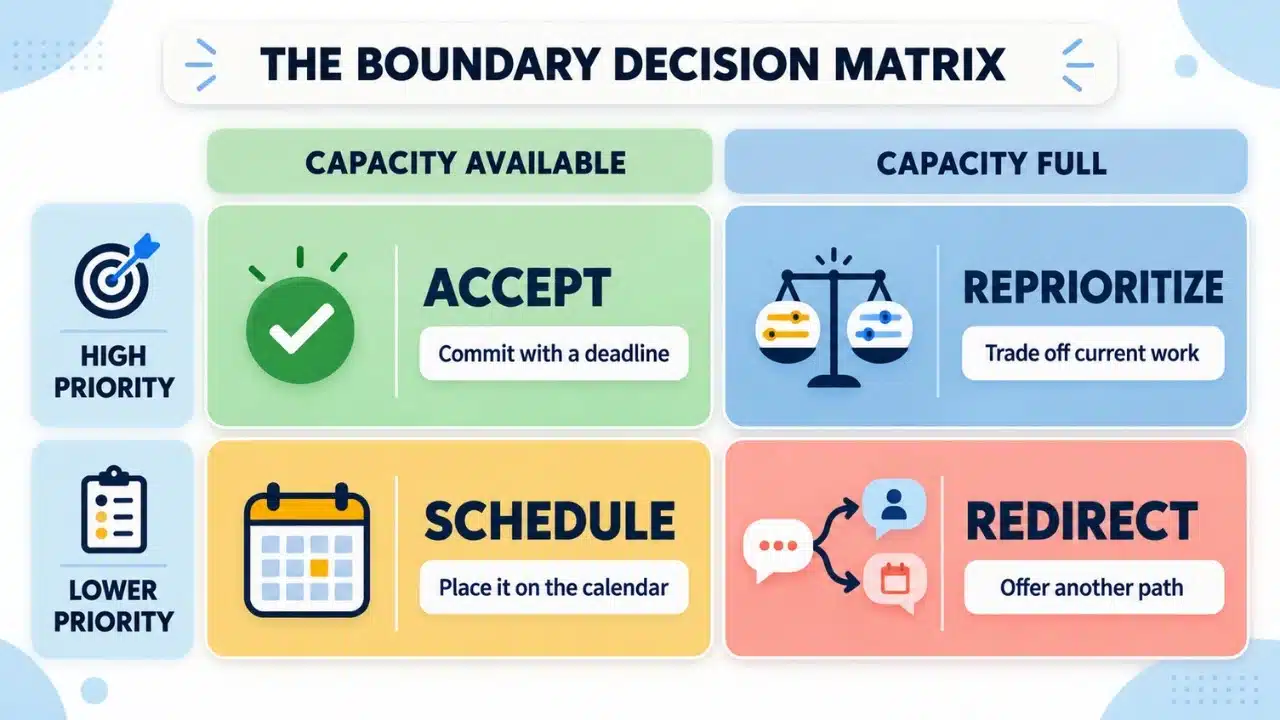
Refusals become far easier to deliver when you ground them in workload realities rather than personal willingness. Mastering setting boundaries at work comes down to framing every response around true capacity, you are declining an assignment because your current schedule leaves no room to execute it properly, not because you lack interest in the work.
When a supervisor asks you to take on an additional assignment, avoid shutting them down directly. Instead, invite them to help you re-prioritize your existing queue.
You might say: “I can certainly take on this project. Right now, my primary focus is finishing the quarterly analysis by Thursday and prepping the client deck for Friday. If this new assignment takes priority, which of those two deliverables should I pause or push back?”
This approach shifts the conversation away from personal effort and onto operational tradeoffs. It highlights your current workload while keeping your manager in control of team priorities.
Handling Requests From Peers
Colleagues often stop by with quick favors that disrupt deep-work hours. When dealing with peers, pair a firm boundary with a constructive alternative.
If a coworker asks you to build a visual template for their upcoming presentation, offer clear parameters: “I can’t design the slides for you this week because my schedule is fully booked with the software rollout. However, I can send you the slide master template I used last month so you can pull the formatting directly.”
This acknowledges their need and offers immediate value without taking on the burden of execution yourself.
Four Daily Habits for Setting Boundaries at Work
Establishing limits does not require dramatic confrontations. Integrating straightforward routines for setting boundaries at work keeps your schedule manageable and predictable.
1. Buy Time Before Committing
Reflexive “yes” responses happen when you feel put on the spot. When a colleague or manager asks for immediate help, pause before answering. Use a standard holding phrase like: “Let me review my project calendar and deliverable commitments for the week, and I’ll follow up with you by 2:00 PM.” This gives you space to evaluate your real capacity without feeling pressured to agree immediately.
2. Brevity Works Best
Over-explaining your refusal weakens your position. Long justifications sound like excuses and invite the requester to problem-solve your schedule for you. Stating “I don’t have the capacity to take this on before Friday” is clear and professional. Adding a lengthy story about your personal calendar gives the impression that your boundary is open for negotiation.
3. Drop the Unnecessary Apologies
Excessive apologizing implies that you are making a mistake by protecting your time. Replace phrases like “I’m so sorry, but I just can’t” with straightforward statements such as “Thanks for thinking of me for this project, but my current commitments won’t allow me to give it the attention it needs.”
If your workplace relies on shared digital calendars, block off dedicated slots for deep work and mark them as busy. Treat these timeboxes with the same respect you give to external client meetings. When team members see protected blocks on your schedule, they are far less likely to drop unexpected tasks onto your plate.
Managing Scope Creep with Clients and External Partners
External projects bring unique hurdles when setting boundaries at work, particularly when clients routinely request small adjustments, extra meetings, or additional revisions that stretch beyond the original contract scope.
When scope creep begins, rely on agreed-upon project frameworks rather than making the refusal feel personal.
You might explain: “That additional feature sounds like a great enhancement for Phase Two. To ensure we stay on budget and hit our target launch date for Phase One, we’ll keep our current focus tight and add this item to our post-launch roadmap.”
This frames your boundary as a safeguard for the client’s budget and launch schedule rather than an unwillingness to deliver value.
How Setting Boundaries at Work Builds Long-Term Respect
Consistently setting boundaries at work requires ongoing practice rather than a single conversation. Reliability serves as the anchor for maintaining strong professional relationships while enforcing limits. When you commit to a project, deliver exceptional work on schedule.
Seeing that your limits lead to consistent focus and dependable results changes how colleagues perceive your availability. Over time, your team stops seeing a refusal as an obstacle and recognizes it as the mark of a professional who manages their time with precision.
Frequently Asked Questions (FAQs) About Setting Boundaries at Work
How do I start setting boundaries at work if I have always said yes to everything?
Start small by establishing low-stakes limits, such as pausing briefly before answering non-urgent requests or logging off on time. Communicate your core priorities during regular one-on-ones so colleagues understand your current workload before making extra requests.
Will setting boundaries at work hurt my chances of getting a promotion?
Professional boundary-setting actually enhances your promotion prospects by protecting your ability to deliver high-quality work on core projects. Overcommitting leads to burnout and missed deadlines, which damages your reputation far more than declining low-priority tasks.
What should I do if my manager pushes back when I try setting boundaries at work?
Shift the conversation from personal availability to objective capacity by presenting your active project list. Ask your manager directly which deliverables should be paused or deprioritized to make room for new demands, keeping them in control of trade-offs.
How does setting boundaries at work differ in remote or hybrid environments?
Remote setups require clear digital boundaries to replace physical workplace cues. Set explicit calendar availability, update your chat status during focus blocks, and avoid responding to routine messages outside business hours.
How can I decline a request without sounding unhelpful?
Offer a constructive counteroffer instead of giving a flat refusal. Share a relevant template, offer a brief review of an outline, or suggest a future date when your schedule opens up to demonstrate a collaborative attitude while keeping your calendar protected.